

4 Steps to Write an Incident Report for Car Accident

Once you are hit by a car and start writing the incident report, it can overwhelm you. From including the details to thinking about the legal and insurance implications, a car accident report can be tricky. The accident report would significantly influence your claim. But don’t worry, we will break down the steps to write a perfect car accident report so you can follow it.
As an experienced personal injury law firm, we understand that people often miss crucial details or feel unsure about their narrative. Since many people face similar challenges, we will guide you through the steps to write an accurate, impactful, and detailed car accident report. From identifying the information to documenting the accident scene, you will learn everything.
Identify Essential Information for Your Report
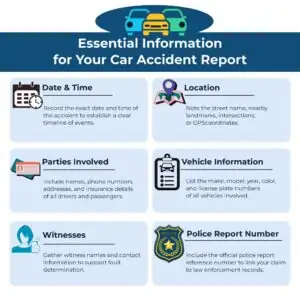
When you first start drafting the car accident report, stay patient. Begin with the dates, location, party details, and vehicle information. So, focus on including:
- Date and Time: Accurately record the date and time of the incident. The date and time will establish a clear timeline of events, suggesting when it happened.
- Location: Next, record the place of the accident. It should include street names, landmarks, or GPS coordinates. The right location is critical for insurance claims, as they will visit it.
- Parties Involved: You should include the names, contact details, and insurance details of all drivers and passengers involved. It will help you contact the at-fault party and the insurer for the legal process.
- Vehicle Information: Your accident report must include the make, model, year, and license plate numbers of the involved vehicles. It will help police identify the parties and assess damages.
- Witnesses: If there were any eyewitnesses, gather their names and contact details. The witness can provide further insights into the accident. It is crucial in determining fault and liability.
- Police Documentation Number: You should include the reference number if the accident involved law enforcement authority. The reference number will link to official records of the incident.
Need Help After a Car Accident?
In 2022, California reported 4,428 vehicle collision deaths. At the same time, Texas and Washington had 4,408 and 733 fatalities, respectively. The high-volume of car crashes and fatalities is a concerning matter. It also shows why an appropriate car accident documentation is necessary.
When you organize all the information properly, it becomes easy for the future legal process and insurance claims. A comprehensive car accident report will significantly impact the outcome of your claims.
However, after a car accident, you deal with physical pain, medical pressure, and emotional issues. So, it becomes stressful to write the report appropriately. That’s where Ledger Law Firm comes in really helpful. We will not only prepare the report but also ensure you get your deserved compensation soon. We also provide the support you need to navigate this post-accident challenging time.
Document Accident Details Accurately
Once you have drafted the report and included the initial points, it’s time to document the accident details. It starts with the accident sequence and includes road condition, injuries, vehicle or property damages, etc.
- Describe the Sequence of Events: Always record every possible detail of the event, how the actions took place one after another. It should describe the actions of the drivers that caused the collision. Our personal injury attorneys suggest a well-structured document. More accident and event details mean your insurance claim outcomes will be higher. It’s because vivid details provide better context and clarity.
- Weather and Road Conditions: Also, document the weather conditions during the accident time. Was it raining or foggy? Was the visibility appropriate? Next, include the road condition properly. Was there any pothole in the road? Was it wet, icy, or otherwise dangerous? Bad weather and roads are a major cause of car accidents. So, don’t forget to include the details. It’s also crucial because, for inappropriately maintained roads, you can sue the authority.
- Injuries and Damages: Assess and record the injury details of everyone. Include the injury location and its nature. For damaged vehicles and property, assess and write them clearly with maximum details. If there was a dent, a broken windshield, etc., record every details properly. The injury and vehicle damage will be the main factor of your insurance claim. So, take your time and record them with as much detail as possible.
- Photo and Video Evidence: If possible, take pictures and videos of the event. Include accident scene, vehicle damages, and road signs or signals. Visual evidence will support your report. Also, appropriate photographic evidence will reinforce your claims. The jury will assess the photos and videos as impactful legal evidence. It also speeds up your claim process.
- Sketch the Scene: You can create a simple diagram of the incident scene. Even if you are not good at sketching, you can take expert help with it. The sketch will show the vehicle positions and other details. It will clarify the circumstances surrounding the accident, so that others can easily understand the accident details.
- Collect More Evidence Quickly: You must try to collect medical records and videos as soon as possible. Ideally, collect the evidence within 24 to 72 hours after the crash. It’s crucial because otherwise the evidence can be tampered with and lost. If you are unable to collect the evidence personally, contact our expert car accident attorneys. We will collect and preserve the evidence to fight for you.
Precise documentation ensures two things:
- Assists you in case file submission before the jury
- Strengthens your legal position for insurance claims
Also, we are always with you during the recovery period and legal process after a car accident. From collecting the medical details, the doctor’s opinion to vehicle damage assessment, we will do everything for you.
Structure Your Report for Clarity
The key to crafting an effective and organized structure is to maintain a clear and detailed structure. For this, follow these structured guidelines:
- Give a precise title with the accident date and your name. It could be ‘Incident Report for Car Accident on [Date] – [Your Name].’ So, anyone will easily understand the purpose of the report soon.
- Introduction: Briefly overview the report’s purpose. Also, shortly narrate the event. It will quickly establish the actual message you want to convey.
- Body: Now, it’s time to write the main body of the car accident report. It should include three parts: accident details, evidence information, and witness.
- Essential Information: It should contain the date, time, and location of the car accident.
- Accident Details: Share the accident details one by one. It must include the actions leading up to the accident. Also, include the medical records and police report.
- Witness Statements: Record the witness statement and include their summary in your car accident report.
- Conclusion: In the conclusion, summarize the car accident scene to strengthen your argument. Also, record the post-accident details.
- Appendices: Attach supplementary documents in the appendices. It could be photos or law enforcement records. These will be powerful references supporting your case.
An organized car accident report ensures. It makes the legal proceeding easy and fast. When you can present the information properly, the well-structured accounts can lead to more favorable legal outcomes. Also, a well-crafted document helps the legal professionals. With it, they can establish the facts better.
Review and Finalize Your Incident Report
Don’t submit your car accident report with the draft. Before submitting, review it for overlooked errors, missing points, and proper formatting. Here’s how you can make your report the best it can be:
- Proofread for Errors: Review the report for the car crash for any spelling, grammar, or factual inaccuracies. Ensure that all names, dates, and details are correct. Any minor errors can reduce the credibility of the accident report.
- Verify Completeness: Check for all essential details in each section of your document. Is anything missing, like the date, accident sequence, etc.? It’s crucial because better details ensure effective legal and insurance processes.
- Use a Structured Format: You can follow a structured format or template. It will ensure more clarity. Thus, the reader can easily follow the information. So, the jury can quickly review the car accident case details.
- Seek Feedback: You can ask a trusted colleague or legal advisor to review your document. They can bring new viewpoints and reveal errors that you might have missed. It will improve your car accident report and its accuracy.
- Make Necessary Revisions: Once you receive the feedback, adjust your document. We suggest that you review and make adjustments two to three times before submitting the car accident report. It ensures your final report will be 100% accurate.
- Maintain Confidentiality: Appropriately handle all the sensitive information. You should comply with the privacy regulations. Also, it helps in securing witnesses’ trust.
- Complete and Send: Now, save it in a Word or PDF file. Then, you can send it to the relevant parties. It could be your insurance company or legal representative.
An appropriate car accident report review process makes it more professional and accurate. It will strengthen your claims to recover it fast.
Conclusion
A professional, accurate, and well-organized car accident report will be crucial for your insurance claims. From including the accident date and location to documenting your medical reports and vehicle damages, the report must include everything.
You should first draft the car accident report, then check it for missing points, add them, and finalize the submission copy. Ledger Law Firm is ready to help you with the drafting, writing, and submission of the accident report. We ensure it includes every detail to help you get better and faster compensation claims.
FAQs About 4 Steps to Write an Incident Report for Car Accident
What essential information should be included in an incident report for a car accident?
An effective car accident incident report should include the date, time, and location of the incident. Location. Next, it includes the names, contact details, and insurance details of the involved parties. Also, write down the make, model, year, and license plate numbers of the vehicle. You should also record witness details and the police documentation number.
Why is it important to record the date and time of the accident?
The accurate date and time of the car accident establishes a clear timeline of events. Thus, the jury can easily understand the event details and also check the government record for it.
How should the location of the accident be documented?
You should include the exact location of the accident. It could be street names, landmarks, or GPS coordinates. The more details you include in the report, the clearer and stronger your document will be.
What information about the parties involved in the accident should be collected?
You should collect the names, contact details, and insurance specifics of all drivers and passengers involved in the accident, which is essential for claims processing and any potential legal actions.
What vehicle information is necessary to document?
For the car accident report, always include the make, model, year, and license plate numbers of all vehicles involved. These details will identify the parties and assess vehicle damage better.
Why is it important to gather witness information?
Gathering the names and contact details of any witnesses is important because their statements can be pivotal in determining fault and liability in the incident.
What is the significance of the police documentation number?
The police documentation number links to official records of the incident. So, the police documentation number is a reference point for future legal proceedings. Also, the insurer will ask for it before negotiation.
What do the vehicle collision statistics from 2022 indicate?
The statistics indicate a high number of vehicle collision deaths, emphasizing the importance of thorough documentation in the aftermath of a crash to support the resolution of cases.
How can legal assistance help after a car accident?
A professional legal assistant will navigate the challenging aftermath of an accident. The Ledger Law Firm consists of 80+ team members with an expert car accident attorney. So, we deal with your car accident claim fast and ensure cordial communication for your peace.

Emery Brett Ledger brings more than 27 years of experience to personal injury law. He founded & led The Ledger Law Firm in securing over $100 million in compensation for clients with life-altering injuries & complex claims. Licensed in California, Texas, & Washington, Emery earned his law degree from Pepperdine University School of Law. His practice areas include car & truck accidents, wrongful death, catastrophic injuries, maritime claims, & mass tort litigation. He has been recognized by The National Trial Lawyers’ Top 100, Mass Tort Trial Lawyers Top 25, and America’s Top 100 Personal Injury Attorneys. Emery also received the 2025 Elite Lawyer Award & holds a perfect 10.0 Avvo rating with Platinum Client Champion status. His legal work has been featured on CNN, Forbes, NBC, & ABC.
Free Case Evaluation
Recent Posts
- How to Win a Left Turn Accident Case: Fault, Right of Way, Evidence & Compensation
- What to Do After a Pedestrian Accident: 10 Essential Steps to Protect Your Health and Claim
- Who Is at Fault in a Self-Driving Car Accident? Liability, Insurance, and Self-Driving Car Crash Injury Claims
- Car Accident Out of State: Insurance, Jurisdiction, and What Happens If You Get in an Accident in Another State
- Car Accident Caused by Flooding: Who Is Liable, Insurance Coverage, and Your Legal Rights After a Flooding Car Accident
Emery Brett Ledger brings more than 27 years of experience to personal injury law. He founded & led The Ledger Law Firm in securing over $100 million in compensation for clients with life-altering injuries & complex claims. Licensed in California, Texas, & Washington, Emery earned his law degree from Pepperdine University School of Law. His practice areas include car & truck accidents, wrongful death, catastrophic injuries, maritime claims, & mass tort litigation. He has been recognized by The National Trial Lawyers’ Top 100, Mass Tort Trial Lawyers Top 25, and America’s Top 100 Personal Injury Attorneys. Emery also received the 2025 Elite Lawyer Award & holds a perfect 10.0 Avvo rating with Platinum Client Champion status. His legal work has been featured on CNN, Forbes, NBC, & ABC.
