What should parents save after a child is bitten in California?

Save your child’s medical records, dated injury photos, the dog owner’s contact information, witness details, animal-control records, and anything showing where and how the bite happened. Keep original files, receipts, damaged clothing, and a short record of changes in your child’s daily life. Get medical care first; collecting evidence must never delay treatment or put your child near the dog again.
- California parents should save medical records, original photos, witness contacts, and animal-control information after a child’s dog bite.
- For a california dog bite lawyer child consultation, organize records without delaying treatment or questioning your child repeatedly.
- California Civil Code section 3342 makes the bite location and circumstances important; preserve evidence of both.
- Keep injury images private and save original messages, not just cropped screenshots.
What should parents save after a child is bitten in California?
Build your child’s evidence file around treatment, identification, the incident, and recovery. You do not need a finished investigation before asking for legal help. Save what you already have, identify what others hold, and write down what remains uncertain.
This California checklist for 2026 focuses on an injured child’s needs, not a property-damage-only claim. Some preservation habits also appear in this guide to preserving evidence after a California lane-splitting crash, but dog bites require their own factual and legal review.
| Evidence group | What to save | What it helps explain |
|---|---|---|
| Medical care | Visit summaries, treatment instructions, referrals, bills, and prescriptions | The injury, treatment, and recommended follow-up |
| Injury and scene images | Original photos of wounds, clothing, entrances, gates, and the bite location | What the injuries and surroundings looked like |
| Dog and owner information | Names, contact details, dog description, and available vaccination records | Which dog was involved and who owned or handled it |
| Independent accounts | Witness contacts, messages, report numbers, and camera locations | What others saw or recorded |
| Recovery effects | Appointment records, school communications, expense receipts, and dated notes | How the injury affected your child’s daily life |
Why this matters
A child’s injury changes as it heals. A wound photo, an emergency-department record, and a teacher’s message describe different parts of that experience. Save the evidence as it exists rather than trying to make every record tell the same story.
California Civil Code section 3342 addresses an owner’s liability when a dog bites someone in a public place or lawfully in a private place. The statute does not require proof that the owner already knew the dog was vicious. That makes the location, ownership, and circumstances important—not just whether someone previously complained about the dog.
Your evidence file is not a legal conclusion. A lawyer must assess the facts, applicable rules, and any exceptions before advising your family.
Save these 5 evidence groups
1. Medical records and treatment instructions
Keep the discharge paperwork from the first visit, including instructions about wound care and follow-up. Save later records from your child’s treating providers, along with referrals, prescriptions, imaging reports, and appointment summaries. Keep billing paperwork separate from clinical records so neither gets overlooked.
Tell the treating clinician accurately how the injury happened. Share symptoms and changes you observe without suggesting a diagnosis. Ask medical questions about infection, vaccination concerns, scarring, or other treatment needs directly to a qualified clinician.
If a record appears inaccurate, ask the provider about its correction process. Do not change the downloaded document yourself. Preserve the original and any corrected version with the related correspondence.
2. Original injury and scene photos
Photograph visible injuries when doing so does not interfere with care or distress your child. Keep the original image files and their date information. Save both a wider view showing the affected area and closer images showing visible injury, without applying filters or altering colors.
Photograph the location only from somewhere you can safely and lawfully access. Useful details include an entrance, gate, fence, warning sign, or the place where your child was standing. Do not approach the dog, enter someone’s property, or stage a reenactment.
Preserve damaged clothing without washing or repairing it when practical. Ask counsel how to handle or store anything bloodstained or otherwise unsafe. Your child’s health takes priority over keeping an object untouched.
3. Dog identification and owner information
Save the owner’s name and contact information, the dog’s description, and the name of anyone handling the dog. Record how you obtained each detail. Distinguish something the owner told you from something a neighbor guessed.
Keep any vaccination or licensing information actually provided. Send medical questions about those records to your child’s treating clinician or the appropriate public-health professional. Do not assume that a description of the dog’s health answers every treatment question.
Save relevant texts and emails in their original form. An apology, explanation, or exchange about ownership belongs in the file even if you do not know its legal significance. Do not argue with the sender or try to provoke an admission.
4. Witnesses, reports, and recordings
Write down witness names, contact information, and where each person was during the incident. Separate witnesses who saw the bite from people who arrived afterward. Both can have useful information, but their knowledge is different.
Keep animal-control, police, or other agency report numbers and correspondence. Record which office you contacted and when. A report number helps locate a record; it does not mean the report establishes every disputed fact.
Identify nearby cameras and who controls them. Tell a lawyer promptly about recordings held by a neighbor, business, school, or property manager so preservation requests can be considered. Do not trespass or access someone else’s account to obtain footage.
5. Recovery notes and expense records
Keep a dated log of appointments, symptoms your child reports, and changes you personally observe. Useful entries describe facts: a missed school day, difficulty holding a pencil, interrupted sleep, or an activity your child stopped attending. Avoid turning observations into medical diagnoses.
Save receipts and records of injury-related expenses, including treatment payments and travel. Keep school attendance notices, accommodation requests, and relevant teacher communications. These records explain disruption; they do not establish that every expense or loss is legally recoverable.
Record your own missed work separately from your child’s records. A lawyer can explain how different claimed losses should be evaluated rather than treating every household cost as part of the child’s claim.
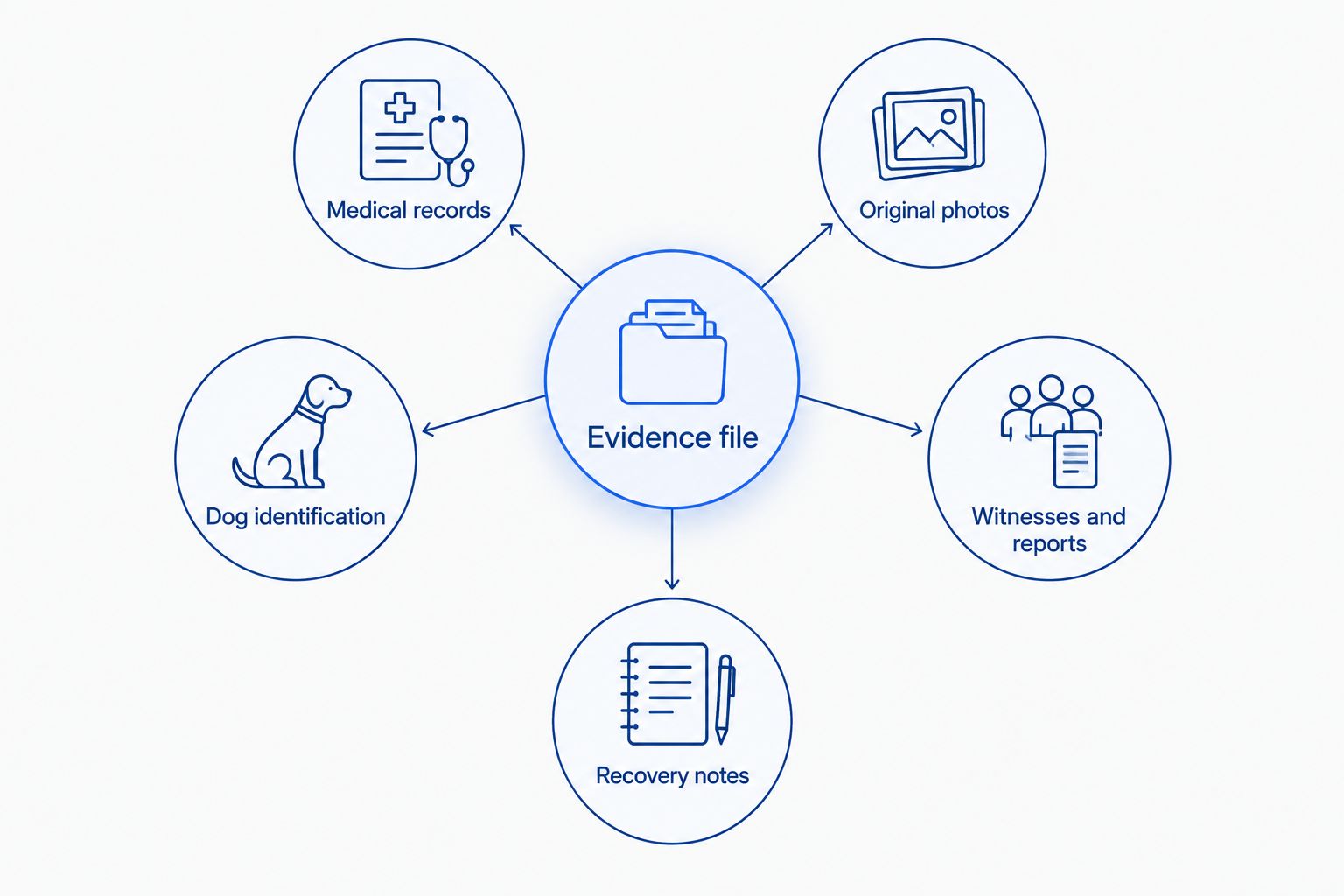
How should you organize a child’s dog-bite evidence?
Use a simple folder system for your 2026 records. The goal is to make information easy to find, not to create a polished presentation. Preserve originals and use separate copies when highlighting material for a consultation.
- Create an incident summary. Record the date, location, people involved, and a brief description of what you personally know. Mark uncertain details as uncertain.
- Separate the evidence groups. Use folders for medical records, photos, dog identification, witnesses and reports, and recovery notes.
- Keep a request list. Note missing records, camera locations, and the people or offices that hold them.
- Maintain 2 backup copies. Choose secure storage locations with access limited to trusted adults handling your child’s care or claim.
- Track new material. Add the date received and the source so later records do not become detached from their context.
For example, an image filename can describe the affected body area and date without including your child’s full name. Keep identifying medical documents secure rather than attaching the entire file to a casual message.
The same distinction between treatment records and billing records appears in this guide to medical records for a Newport Beach injury claim. The underlying accident differs, so use that guide for record organization rather than dog-bite liability rules.
Why the evidence needed varies
A useful file follows your child’s actual circumstances. Do not search for a standard set of photos or statements that makes every dog-bite claim look alike.
- Location: Evidence from a public sidewalk differs from evidence inside a home or fenced yard. Save information explaining why your child was there.
- Ownership and handling: The owner and the person holding the leash are not necessarily the same person. Record each person’s role without assuming liability.
- Treatment: Follow-up care creates records beyond the first visit. Keep referrals and instructions even before an appointment occurs.
- Available witnesses: An independent witness, household member, and responding official can each know different facts. Identify the source of every account.
- Recovery: School disruption, visible healing, and reported symptoms require different supporting records. Keep factual notes specific to your child.
- Record holders: A clinic, agency, and private camera owner control different material. Save contact details so requests reach the right place.
Do not fill gaps with assumptions. A short note saying you do not know who owned the dog is more useful than an unsupported identification repeated throughout the file.
Should parents write down what their child says?
Write down spontaneous statements accurately, with the date and context, rather than repeatedly interviewing your child. Distinguish your child’s words from your interpretation. Do not rehearse an account or ask your child to reproduce a frightening event for a recording.
You can document practical observations while leaving clinical assessments to treating professionals. If your child needs emotional support, seek appropriate care rather than treating distress only as claim evidence.
Should parents post injury photos online?
Keep your child’s injury photos private. Preserve the original files in secure storage and share them through an appropriate channel with treating professionals or your lawyer.
If something has already been posted, tell counsel before deleting or changing it. Preserve relevant posts and messages, including material you think is unhelpful. Protecting privacy and preserving existing evidence require separate decisions.
When should you bring the file to a lawyer?
Bring the file when your family needs advice; do not wait until treatment ends or every record arrives. A useful 2026 consultation starts with what happened, the care your child received, and the evidence still held by others. Ask counsel to identify applicable deadlines rather than assuming your child’s age removes every timing issue.
The Ledger Law Firm is a fit for California families seeking personal injury representation. A case evaluation can help your family understand what additional records to request and which legal questions need attention. The Ledger Law Firm represents injured individuals across California, Washington, and Texas; this article addresses California evidence issues only.
Ask about both attorney fees and case expenses before signing an agreement. A contingency-fee arrangement does not, by itself, answer who is responsible for expenses if there is no recovery. Read those terms and request a plain-language explanation.
Discuss your child’s injury
Bring your records and questions about evidence, deadlines, attorney fees, and case expenses.
FAQ
What should I save first after my child is bitten by a dog?
Save medical paperwork, original injury photos, and the dog owner’s contact details after your child receives needed care. Add witness information, report numbers, and relevant messages as you obtain them.
Can I speak with a California dog bite lawyer before my child finishes treatment?
You can seek legal advice before your child finishes treatment. Bring the records you have and identify missing material, especially recordings or documents controlled by others.
Should I keep my child’s clothes after a dog bite?
Keep damaged clothing without washing or repairing it when practical and safe. Ask counsel how to handle bloodstained material, and never compromise health or safety to preserve an item.
Do I need proof that the dog bit someone before?
California Civil Code section 3342 does not require proof that the owner previously knew the dog was vicious. Your lawyer still needs to assess the bite, location, ownership, circumstances, and applicable exceptions.
Should I save messages from the dog’s owner?
Save relevant messages from the dog’s owner in their original form, including attachments and surrounding context. Avoid relying only on cropped screenshots or trying to provoke an admission.
What should I bring to The Ledger Law Firm for a child injury consultation?
Bring your incident summary, treatment records, original photos, witness contacts, report information, and relevant correspondence. The Ledger Law Firm can review your request for personal injury representation without requiring a finished evidence file first.
Does a contingency fee mean my family can never owe case expenses?
A contingency fee does not automatically mean your family can never owe case expenses. Ask the attorney to explain the written agreement’s separate terms for fees, expenses, and responsibility if there is no recovery.
One last thing
Preserve the ordinary records, not just the dramatic photos. A school absence notice or follow-up instruction can explain something an injury image cannot. Keep those records as they arrive throughout 2026, without asking your child to perform or repeatedly describe the injury.
This is general California information, not legal advice about your child’s case. Medical decisions belong with qualified treating professionals; case-specific legal decisions require an attorney’s review.
Related guides
These California crash guides address related injury-claim questions. They do not replace a dog-bite-specific legal review.

Emery Brett Ledger brings 28+ years of experience to personal injury law. He founded & led The Ledger Law Firm in securing over $100 million in compensation for clients with life-altering injuries & complex claims. Prior results do not guarantee a similar outcome. Licensed in California, Texas, & Washington, Emery earned his law degree from Pepperdine University School of Law. His practice areas include car & truck accidents, wrongful death, catastrophic injuries, maritime claims, & mass tort litigation. He has been recognized by The National Trial Lawyers’ Top 100, Mass Tort Trial Lawyers Top 25, and America’s Top 100 Personal Injury Attorneys. Emery also received the 2025 Elite Lawyer Award & holds a perfect 10.0 Avvo rating with Platinum Client Champion status. His legal work has been featured on CNN, Forbes, NBC, & ABC.
Free Case Evaluation
Recent Posts
Emery Brett Ledger brings 28+ years of experience to personal injury law. He founded & led The Ledger Law Firm in securing over $100 million in compensation for clients with life-altering injuries & complex claims. Prior results do not guarantee a similar outcome. Licensed in California, Texas, & Washington, Emery earned his law degree from Pepperdine University School of Law. His practice areas include car & truck accidents, wrongful death, catastrophic injuries, maritime claims, & mass tort litigation. He has been recognized by The National Trial Lawyers’ Top 100, Mass Tort Trial Lawyers Top 25, and America’s Top 100 Personal Injury Attorneys. Emery also received the 2025 Elite Lawyer Award & holds a perfect 10.0 Avvo rating with Platinum Client Champion status. His legal work has been featured on CNN, Forbes, NBC, & ABC.