How do you preserve evidence after a California lane-splitting crash?

After a California lane-splitting crash in 2026, get medical help, photograph the scene only when safe, collect witness details, and preserve original recordings, riding gear, and motorcycle damage. Ask promptly for nearby camera footage, and do not repair, discard, edit, or overwrite evidence before you understand what needs inspection.
- California law recognizes lane splitting; evidence must show how the crash happened, not simply that you rode between vehicles.
- For a California motorcycle accident lawyer, lane splitting footage helps establish vehicle movements and road conditions.
- Preserve original files, damaged gear, medical records, and witness contacts; photographs alone do not replace physical evidence.
- Ledger Law represents injured riders; a case evaluation helps identify evidence to preserve and questions about responsibility.
Why this matters
Lane splitting alone does not establish who caused your crash. The useful evidence shows where vehicles traveled, whether a driver changed lanes, what each person could see, and how the collision caused your injuries.
California law defines lane splitting. The California Highway Patrol's Lane Splitting Safety Tips also address riding between vehicles and warn drivers against intentionally blocking riders. These authorities provide context; they do not decide fault in an individual collision.
For immediate safety and reporting tasks, start with these steps after a car accident in California. The guidance below focuses on preserving evidence for an injured motorcyclist's California claim in 2026, not Washington or Texas law.
How do you preserve evidence after a California lane-splitting crash?
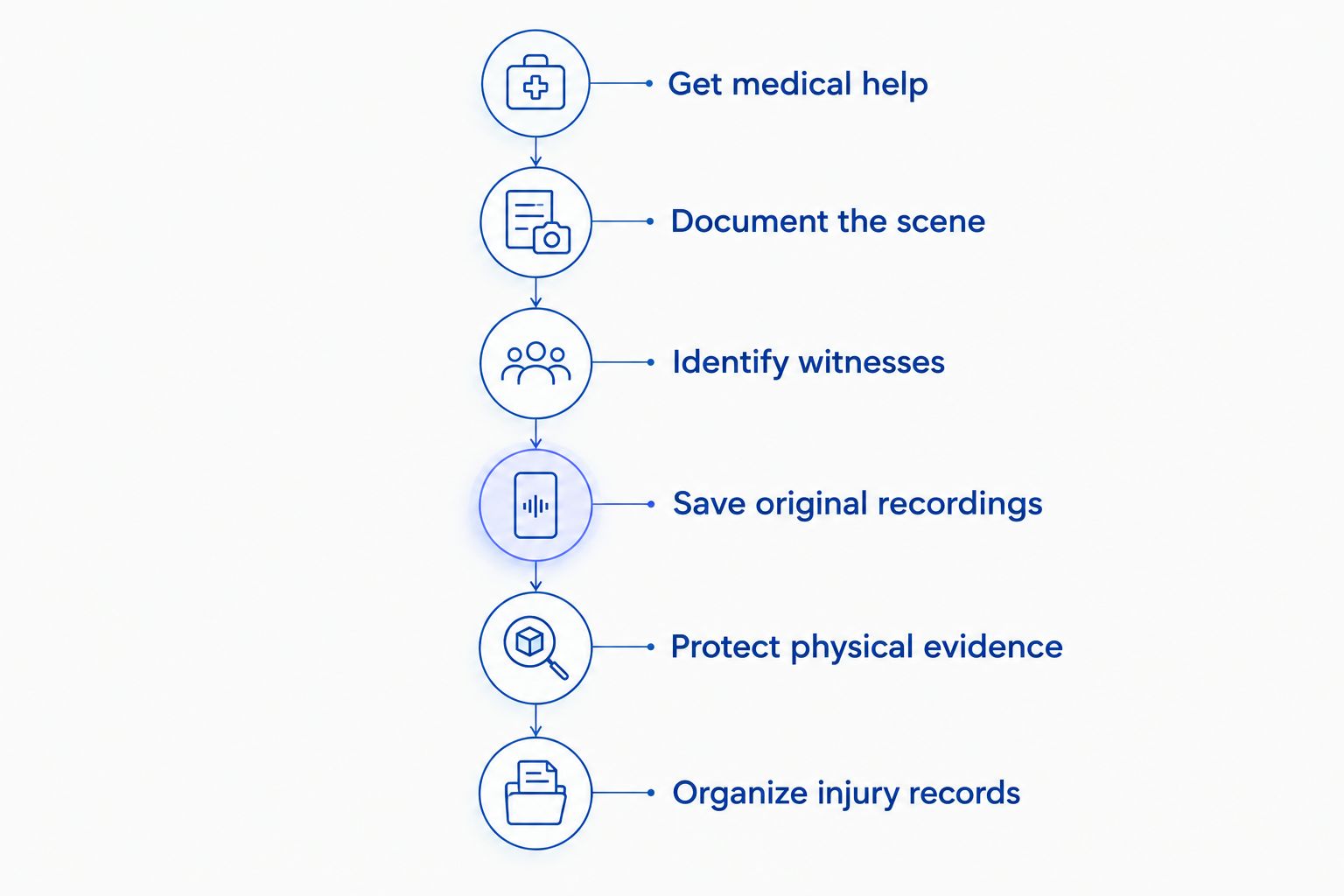
Use this sequence without delaying treatment or entering moving traffic. If you cannot safely collect evidence, ask a trusted person to help and record what remains available later.
- Get medical help. Call 911 for an emergency. Tell medical personnel about your symptoms and how the impact occurred; do not minimize pain or guess at a diagnosis.
- Document the scene. From a safe position, photograph vehicle positions, lane markings, debris, damage, traffic controls, and nearby cameras. Do not stand between active traffic lanes to get a better angle.
- Identify witnesses. Ask for names, contact information, and what each person actually saw. Keep independent witness accounts separate from your own recollection.
- Save original recordings. Preserve helmet-camera, motorcycle-camera, dashcam, and phone files. Keep footage from before and after the impact, not just the collision itself.
- Protect physical evidence. Keep the motorcycle, helmet, clothing, and other damaged equipment. Tell the tow yard or repair shop that inspection and preservation need attention before alterations occur.
- Organize injury records. Save treatment instructions, appointment records, work restrictions, receipts, and communications about the crash. Keep a factual account of symptoms and daily limitations.
Treatment comes first; evidence collection must not create another injury. If an ambulance takes you away, document that fact rather than trying to reconstruct photographs you never took.
Which evidence helps explain a lane-splitting collision?
Different evidence answers different questions. A close-up of a damaged fairing helps document contact, but it does not show the traffic pattern before impact. A witness account adds context, but its value depends on what the witness could actually see.
| Evidence | Best for | Limitation to account for |
|---|---|---|
| Original camera footage | Showing movement before and during impact | A narrow camera angle can leave nearby vehicles outside the frame |
| Scene photographs | Recording lane layout, debris, and visible damage | Still images do not establish an entire movement sequence |
| Independent witness accounts | Describing lane changes, signals, and traffic behavior | A witness might have seen only part of the event |
| Motorcycle and riding gear | Preserving contact marks and damage for inspection | Repairs, cleaning, and disposal can change the evidence |
| Medical records | Documenting symptoms, treatment, and functional limits | Medical records do not independently establish the driving sequence |
| Police report | Identifying parties, witnesses, and recorded observations | A report does not replace the underlying evidence |
Preserve evidence that seems unfavorable, too. A recording showing your speed, positioning, or an earlier maneuver still belongs in the original record; deleting part of it prevents a complete review.
Photograph the layout, not just the impact damage
Use 3 photo views when safe: wide views of the roadway, medium views connecting the vehicles to lane markings, and close-ups of damage. Include signs, intersection features, visibility obstructions, and the direction each vehicle was traveling.
Photograph your motorcycle before someone moves it if that is safely possible. If emergency responders or traffic conditions require movement, record where it was moved and why, without interfering with their work.
Preserve what witnesses actually observed
Ask an open question such as what the witness saw before the collision. Note where the person stood or drove and whether anything blocked the view.
Do not ask witnesses to agree with your explanation. Save their contact details and original messages, and distinguish their words from your summary.
How should you preserve camera footage in 2026?
Keep the original recording and make a separate copy for viewing or sharing. Do not trim the only version, add captions to it, or replace it with a screen recording.
Keep 2 copies in separate locations, such as a secure storage account and an external drive. Retain the source device or memory card when practical, and record the filename, device, date, and time displayed. If the device clock was wrong, note the discrepancy rather than changing the original file.
Look for possible recordings from:
- Your helmet camera or motorcycle camera.
- Other vehicles, including witnesses' dashcams.
- Nearby businesses, parking areas, and building entrances.
- Transit vehicles or other identifiable vehicles near the collision.
Write down camera locations even when you cannot obtain footage yourself. A visible camera does not guarantee that it recorded the roadway or retained the relevant period.
When requesting footage, identify the crash location, travel direction, approximate time, and a reasonable period before and after impact. Ask the recipient to preserve the original recording and associated information. A preservation request is not a guarantee of access or retention. An attorney can assess whether additional legal steps are needed.
What should you do with the motorcycle and riding gear?
Tell whoever holds the motorcycle that you need to address evidence preservation before repairs, dismantling, salvage, or disposal. Ask for the storage location, condition photographs, and written notice of any proposed transfer or alteration.
Do not ignore notices from a tow yard or insurer. Discuss storage arrangements and inspection promptly so preserving the motorcycle does not become an unmanaged problem.
Keep the helmet, jacket, gloves, boots, and other damaged items in their post-crash condition when practical. Photograph them before handling, avoid cleaning away contact marks, and label containers with a description of their contents.
Do not keep using a crash-involved helmet as protective equipment. Preserve it as evidence and follow the manufacturer's replacement guidance. Evidence preservation and safe riding are separate decisions.
A mechanic's repair estimate serves a different purpose from an inspection addressing how the crash occurred. Before authorizing work, ask whether relevant components need documentation or examination first.
Why evidence-preservation priorities vary
The same checklist does not resolve every California motorcycle collision. Your first preservation requests should follow the evidence that actually exists and the questions people dispute.
- Disputed vehicle movement: If the driver denies changing lanes, footage and witness sightlines deserve particular attention.
- Available cameras: A business camera, helmet camera, and dashcam can show different parts of the same event.
- Motorcycle custody: A bike held by a tow yard requires different arrangements from one stored securely at home.
- Serious injuries: Hospital treatment can prevent you from gathering scene evidence; another person can help preserve records without guessing what happened.
- Changed conditions: Cleared debris, moved vehicles, and completed repairs make existing photographs and original recordings more important.
- Unclear timestamps: Incorrect device clocks require an explanation connecting the recording to the crash, not edits that conceal the discrepancy.
For a 2026 case evaluation, separate what you know from what you infer. Write that you felt an impact from the left if that is what you remember; do not turn it into a claim about an unseen driver's actions.
What medical and work records should you keep?
Keep discharge instructions, referrals, imaging reports, prescriptions, treatment schedules, and written work restrictions. Tell your treating provider about new symptoms and relevant prior conditions so the medical history stays accurate.
A short recovery log can record sleep disruption, missed work, difficulty walking, and activities you cannot perform as usual. Use dated observations rather than repeated conclusions about how serious the claim should be.
Save employer communications and records showing missed shifts or changed duties. Keep receipts associated with treatment and recovery, but do not assume every expense automatically qualifies for reimbursement.
The guide to medical records for a Newport Beach accident claim explains which treatment documents help organize an injury claim. Bring the records you have; do not delay a case evaluation because the file is incomplete.
What should you bring to a California motorcycle injury consultation?
Bring a brief timeline, the police report number if available, insurance correspondence, photographs, witness contacts, and the location of the motorcycle. Explain where original recordings are stored and identify any pending repair, disposal, or document-signing decision.
This guide is for injured riders considering personal injury representation, rather than property-damage-only help. A Ledger Law motorcycle injury case evaluation can address preservation priorities and the evidence needed to assess responsibility.
A consultation does not replace medical treatment or guarantee a result. Ask about the scope of representation, attorney fees, responsibility for case expenses, and what happens to those expenses if there is no recovery. Do not assume that no recovery necessarily means no costs.
Discuss your motorcycle injury claim
Explain the crash, your injuries, and any footage or motorcycle evidence that needs preservation.
Can you preserve evidence if you already left the scene?
Yes. Save your existing files, write down your recollection, identify witnesses, and record the motorcycle's current location. Photograph injuries and equipment as they are now, without presenting later photographs as scene photographs.
Explain any gaps honestly. Evidence collected after the crash can still help, but its timing and source need to remain clear.
Does legal lane splitting mean the driver is automatically responsible?
No. California law recognizes lane splitting, but the circumstances of the collision still matter. Preserve evidence of both vehicles' movements, visibility, signals, and traffic conditions rather than relying on the label alone.
Should you give an insurer your only recording?
No. Preserve the original and retain a secure copy before providing a requested recording. Get advice about the request's scope, and do not alter or selectively delete relevant footage.
FAQ
Is lane splitting legal in California in 2026?
California law recognizes lane splitting. That does not establish fault in a particular crash; the evidence must show how the collision happened.
What if I was too injured to take pictures?
You can still preserve medical records, witness contacts, existing recordings, and the motorcycle. Ask someone you trust to help identify evidence without recreating or guessing at the original scene.
How do I find video of my lane-splitting accident?
Identify nearby businesses, buildings, vehicles, and witnesses that might have recorded the crash. Request preservation promptly, but do not assume a camera recorded the event or that its owner must release footage directly to you.
Can I repair my motorcycle before the claim is finished?
Address inspection and evidence preservation before authorizing repairs that change relevant damage. Coordinate with the insurer, repair facility, and your attorney rather than assuming photographs replace a physical inspection.
Should I keep a damaged motorcycle helmet?
Keep the damaged helmet as evidence when practical, but do not continue using it for protection. Photograph its condition and follow the manufacturer’s replacement guidance.
What if the police report describes the crash incorrectly?
Preserve the evidence supporting your account and ask the reporting agency about its correction or supplemental-information process. Keep the original report and any later version; do not assume a requested change will be accepted.
What should I ask a California motorcycle accident lawyer about lane splitting?
Ask which evidence needs immediate preservation, how responsibility will be assessed, and who will coordinate inspection or footage requests. Also ask for a clear explanation of attorney fees and case expenses.
One last thing
A phone message explaining where a video came from can matter alongside the video itself. Keep the sender's details, the original attachment, and the surrounding conversation so the recording's source stays traceable.
Preserve the context, not just the most dramatic image. A complete record gives everyone evaluating your injury claim a clearer account of what happened.
Related guides
Sources
The agency page named in this guide is linked to its official text.

Emery Brett Ledger brings 28+ years of experience to personal injury law. He founded & led The Ledger Law Firm in securing over $100 million in compensation for clients with life-altering injuries & complex claims. Prior results do not guarantee a similar outcome. Licensed in California, Texas, & Washington, Emery earned his law degree from Pepperdine University School of Law. His practice areas include car & truck accidents, wrongful death, catastrophic injuries, maritime claims, & mass tort litigation. He has been recognized by The National Trial Lawyers’ Top 100, Mass Tort Trial Lawyers Top 25, and America’s Top 100 Personal Injury Attorneys. Emery also received the 2025 Elite Lawyer Award & holds a perfect 10.0 Avvo rating with Platinum Client Champion status. His legal work has been featured on CNN, Forbes, NBC, & ABC.
Free Case Evaluation
Recent Posts
- What Is a Legal Tort After a Car Accident? Understanding Claims, Negligence, and Next Steps
- Tort Law and Slip-and-Fall Injuries: How to Decide Whether to Seek a Case Evaluation
- Tort Lawyer for a Slip and Fall: How to Decide Whether to Seek Help and Prepare for a Case Evaluation
- Suing After a Car Accident: How to Compare Your Options, Evidence, Timing, and Costs
- How to Settle a Car Accident Claim Without a Lawyer
Emery Brett Ledger brings 28+ years of experience to personal injury law. He founded & led The Ledger Law Firm in securing over $100 million in compensation for clients with life-altering injuries & complex claims. Prior results do not guarantee a similar outcome. Licensed in California, Texas, & Washington, Emery earned his law degree from Pepperdine University School of Law. His practice areas include car & truck accidents, wrongful death, catastrophic injuries, maritime claims, & mass tort litigation. He has been recognized by The National Trial Lawyers’ Top 100, Mass Tort Trial Lawyers Top 25, and America’s Top 100 Personal Injury Attorneys. Emery also received the 2025 Elite Lawyer Award & holds a perfect 10.0 Avvo rating with Platinum Client Champion status. His legal work has been featured on CNN, Forbes, NBC, & ABC.