Should you accept an early Newport Beach crash settlement offer?

Do not accept an early Newport Beach crash settlement offer until you understand your injuries, the losses the payment covers, and the rights the release gives up. An early offer is not automatically unfair, but accepting a final bodily injury settlement before your medical outlook is clear puts unresolved expenses on you. For a California crash in 2026, review the written offer and release together before agreeing.
- For a Newport Beach car accident attorney insurance offer review, start with medical evidence and the proposed release.
- An early settlement is not automatically unfair; unresolved treatment and broad release language require closer review.
- Ledger Law represents injured people; a case evaluation can help identify questions about settlement terms.
- California injury deadlines keep running during negotiations. Do not confuse an adjuster’s response date with a legal deadline.
Should you accept an early Newport Beach crash settlement offer?
Accept only when you can make an informed decision about both the payment and the release. The date an offer arrives does not establish whether it adequately addresses your injuries. The supporting records and settlement terms matter more.
Start by comparing your treatment history with the medical records that help a Newport Beach car accident claim. Then identify anything the offer leaves unresolved, including recommended care, missed work, or reimbursement claims.
| Your situation | Best next step | Benefit | Limitation |
|---|---|---|---|
| Your medical outlook is documented and the settlement terms are clear | Consider acceptance after reviewing the full agreement | Resolves the covered claim without further negotiation | The release gives up the rights it describes |
| Treatment or work restrictions remain unresolved | Request time and supporting information | Lets you document losses before deciding | Waiting does not suspend legal deadlines |
| The offer’s scope, fault position, or release is unclear | Obtain a legal review before accepting | Identifies disputed issues and contract terms | Legal review cannot guarantee a larger recovery |
Do not use this table as a settlement calculator. A claim requires an individual review of responsibility, injuries, documentation, insurance, and the proposed agreement.
Why this matters
An early payment can arrive while you are still trying to arrange care or manage time away from work. That makes the decision practical, not just legal: you need to know what the payment resolves and which obligations remain yours.
A bodily injury settlement is different from a payment limited to vehicle repairs. Read the scope of the release rather than relying on the payment’s label. If your injuries remain unresolved, ask whether signing affects those claims, even when the conversation began with your damaged car.
What should you check before accepting in 2026?
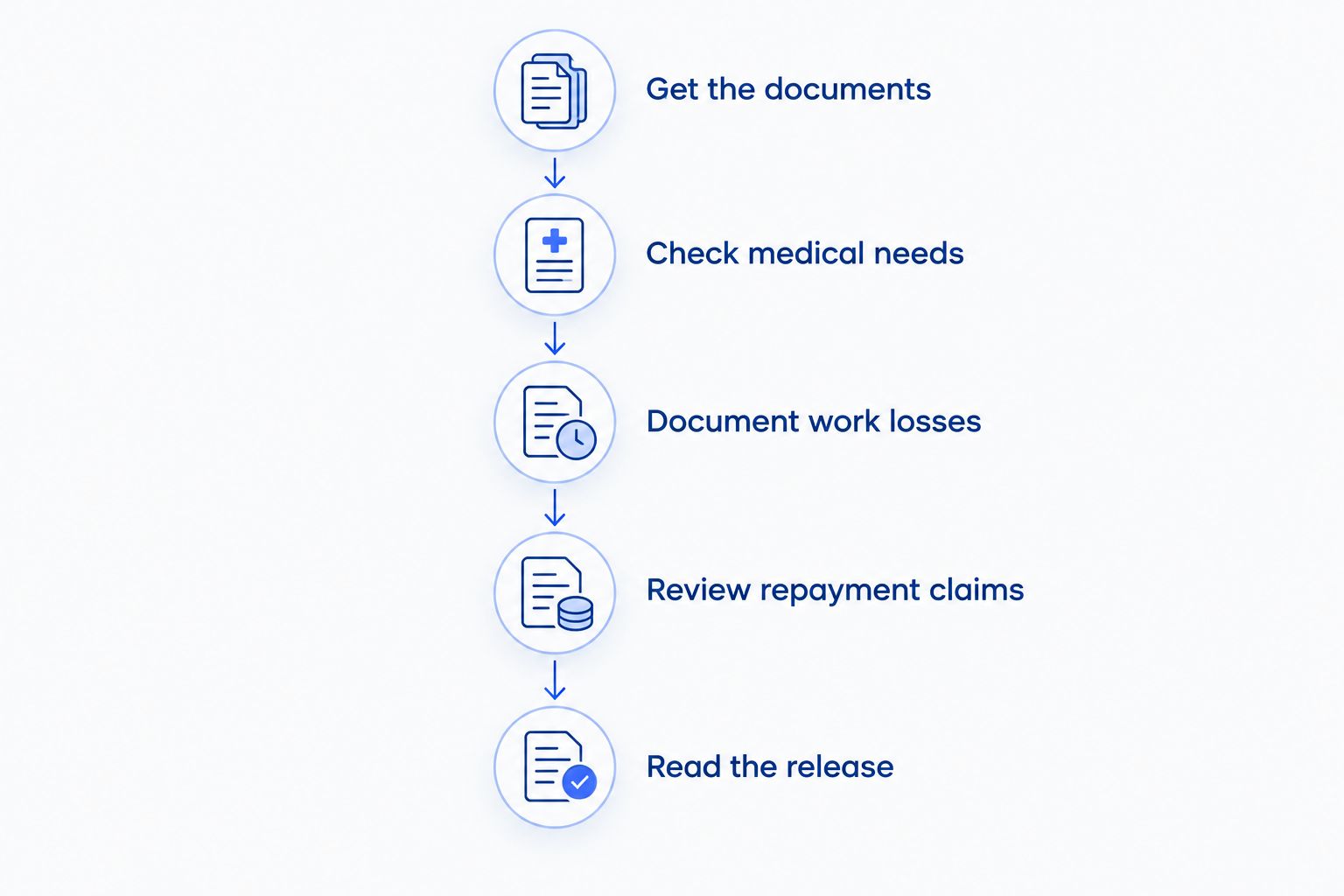
Use this sequence to turn an offer into a decision you can explain. Keep the documents together so you can compare the insurer’s proposal with your actual records.
Get the documents
Ask for the written offer, proposed release, and any explanation of the losses included. Save the accompanying emails and letters. If the adjuster gives a response date, ask what that date means and whether the insurer will extend it.
Identify who will be released and which claims the agreement covers. Do not assume a conversation about one part of the crash limits the written agreement to that issue.
Check medical needs
Ask your treating clinician about your diagnosis, recommended treatment, restrictions, and medical outlook. You do not need to diagnose yourself or predict a recovery date. You need an accurate record of what your clinician knows and what remains uncertain.
Keep referrals and recommended follow-up care with your treatment records. If you have not received recommended care because of an access or scheduling problem, document that explanation rather than leaving an unexplained gap.
Document work losses
Collect records showing missed work, reduced hours, or medically supported restrictions. Pay records and employer communications help connect the claimed loss to a specific period. Self-employed people should organize records that explain the work and income affected.
Separate money already lost from future limitations that still need medical support. A personal estimate is not a substitute for documentation.
Review repayment claims
Identify unpaid providers and any health insurer or benefit program asserting reimbursement rights. Ask whether the proposed settlement accounts for those obligations and who will resolve them. A settlement payment is not necessarily the amount you keep.
Do not assume every medical bill becomes a lien or that every reimbursement demand is correct. The applicable agreement, benefit program, and law determine the obligation.
Read the release
Check the claims released, the people or businesses protected, and any language addressing unknown injuries. Look for repayment, indemnity, confidentiality, or other obligations that continue after signing. Ask for a plain-language explanation of anything you do not understand.
Why an early settlement offer varies
Different offers reflect different evidence and disputes. For a Newport Beach injury claim in 2026, focus on the reasons behind the amount rather than comparing it with an unrelated person’s settlement.
- Medical evidence: Diagnoses, treatment records, and supported future care help establish the injury-related losses.
- Responsibility for the crash: Disputed fault changes the issues that must be resolved before payment.
- Work and daily-life effects: Documented restrictions and lost income provide context beyond medical bills.
- Insurance coverage: Available coverage and policy terms affect the insurance claim; they do not independently measure your injuries.
- Repayment obligations: Medical balances and valid reimbursement claims affect the amount remaining after settlement.
- Release terms: The rights surrendered and obligations accepted matter alongside the payment.
There is no reliable settlement estimate based only on a diagnosis, an emergency-room visit, or a short description of the collision. Avoid treating an online average as a valuation of your claim.
Does an early offer mean the insurer is underpaying you?
An early offer does not, by itself, prove underpayment or bad faith. It does mean you should check whether the insurer evaluated the evidence needed to understand your injuries. Ask which records the adjuster reviewed and which losses the proposal includes.
Compare that explanation with your own file. If recommended treatment, supported wage loss, or another documented issue is missing, identify it in writing. Keep the discussion factual rather than supplying an unsupported counteroffer.
A documented disagreement is more useful than a guess about what the insurer will pay. An attorney can assess disputed issues, but no review establishes a guaranteed settlement outcome.
Can you reopen a claim after signing a settlement release?
Do not assume you can reopen a settled injury claim because symptoms worsen or additional bills arrive. The release’s wording and applicable law control, and challenging a completed agreement is different from continuing an open negotiation.
California Civil Code section 1542 addresses general releases and unknown claims. Settlement agreements can contain a waiver of that protection. That makes the unknown-claims language a substantive issue, not routine paperwork to skip.
If a proposed release includes a section 1542 waiver, ask what it means for injuries or losses you do not yet know about. Do not sign on the assumption that an adjuster can simply add money later.
How long can you wait before deciding?
California generally allows 2 years to file a personal injury lawsuit under Code of Civil Procedure section 335.1. Exceptions and different rules apply, so do not calculate your deadline from this general rule alone. Settlement discussions do not automatically pause it.
Claims involving a public entity require separate attention. California Government Code section 911.2 generally requires presentation of a personal injury claim within 6 months after the claim accrues. That claim-presentation requirement is different from filing a lawsuit, and additional deadlines follow.
For a crash in 2026, get the applicable dates checked promptly if a public vehicle, public employee, or road-condition claim is involved. An insurer’s requested response date is also different from either legal deadline.
Do not wait for treatment to finish before checking deadlines. You can continue documenting injuries while obtaining advice about the steps needed to preserve a claim.
What should you ask a Newport Beach car accident attorney?
Bring the offer, release, crash information, medical records, and insurance correspondence to a case evaluation. Explain your current symptoms, treatment recommendations, work restrictions, and any deadline mentioned in writing. Include documents that seem unfavorable rather than leaving the attorney to discover them later.
Ask these questions before deciding:
- What injuries and losses does this offer appear to address?
- Which unresolved issues need more evidence?
- Does the release extend beyond the claim I intend to settle?
- Are reimbursement claims or unpaid medical bills outstanding?
- Which legal deadlines apply to my circumstances?
- What would representation involve, including fees and expenses?
Ledger Law’s personal injury representation is relevant to injured people seeking help with a crash claim, not just vehicle repairs. A case evaluation should help you understand the decision without requiring a promise about the result.
You can review Ledger Law when considering representation. Ask whether the firm can assess your offer and what information it needs before giving advice.
Discuss your crash settlement offer
Ask about the release, unresolved injuries, legal deadlines, and the terms of representation.
What do attorney fees and case expenses change?
A contingency fee and case expenses are different. The attorney fee is governed by the representation agreement; expenses concern the costs of handling the case. Ask how each is calculated, paid, and deducted before signing an agreement.
Do not assume that no recovery necessarily means no responsibility for expenses. Ask what happens to costs if the claim does not produce a recovery or if representation ends. Get the answer in the written terms.
When evaluating a proposed settlement, request an explanation of the expected distribution rather than looking only at the total payment. Attorney fees, applicable expenses, and valid repayment obligations all belong in that discussion. The calculation must use your actual agreement and obligations, not a generic online example.
FAQ
Should I accept the first insurance offer after a Newport Beach car accident?
Do not accept solely because it is the first offer or because you need a quick answer. Review your injuries, documented losses, repayment obligations, and the proposed release before deciding.
Can I ask for more time to review a crash settlement offer?
You can request more time and ask for the response in writing. An extension to review an offer does not automatically extend a California legal deadline.
Should I settle while I am still receiving medical treatment?
Unfinished treatment requires careful review before a final injury settlement. Ask your clinician about recommended care and have the release assessed before accepting responsibility for unresolved losses.
Does accepting money for my car settle my injury claim too?
The payment documents and release determine which claims are resolved. Confirm that a property-damage payment does not release an injury claim you intend to keep open.
How long do I have to file a California car accident injury lawsuit?
California generally provides 2 years under Code of Civil Procedure section 335.1, but exceptions apply. Public-entity injury claims generally require claim presentation within 6 months under Government Code section 911.2.
What does a California section 1542 waiver mean in a release?
A section 1542 waiver addresses California protection concerning unknown claims in a general release. Ask how the proposed wording affects injuries or losses you have not yet discovered.
Can Ledger Law review my Newport Beach crash settlement concerns?
Ledger Law represents people injured in car accidents. Ask about a case evaluation and bring the written offer, release, medical information, and insurance correspondence so the relevant issues can be identified.
One last thing
Before signing, compare the final release with the version you previously reviewed. Check that the parties, covered claims, payment terms, and continuing obligations match your understanding. If the document changes, review the changes before agreeing.
For a Newport Beach crash settlement decision in 2026, the practical goal is not to delay automatically or accept quickly. Make sure the agreement resolves the claim you intend to settle, with the consequences you understand.
This article provides general California information, not legal advice for your individual circumstances. An attorney must assess your facts, documents, and applicable deadlines.
Related guides
- Steps to take after a car accident in California
- What to bring to a Seattle car accident consultation
- What to bring to a Dallas car accident lawyer consultation
The Seattle and Dallas guides concern consultations in Washington and Texas. Do not apply California’s deadlines or release rules to those states.

Emery Brett Ledger brings 28+ years of experience to personal injury law. He founded & led The Ledger Law Firm in securing over $100 million in compensation for clients with life-altering injuries & complex claims. Prior results do not guarantee a similar outcome. Licensed in California, Texas, & Washington, Emery earned his law degree from Pepperdine University School of Law. His practice areas include car & truck accidents, wrongful death, catastrophic injuries, maritime claims, & mass tort litigation. He has been recognized by The National Trial Lawyers’ Top 100, Mass Tort Trial Lawyers Top 25, and America’s Top 100 Personal Injury Attorneys. Emery also received the 2025 Elite Lawyer Award & holds a perfect 10.0 Avvo rating with Platinum Client Champion status. His legal work has been featured on CNN, Forbes, NBC, & ABC.
Free Case Evaluation
Recent Posts
- Should you accept an early Newport Beach crash settlement offer?
- Can a Dallas car accident lawyer help after an uninsured crash?
- What can an injured passenger claim after a Seattle car crash?
- 7 steps to take after a car accident in California
- What should you bring to a Seattle car accident consultation?
Emery Brett Ledger brings 28+ years of experience to personal injury law. He founded & led The Ledger Law Firm in securing over $100 million in compensation for clients with life-altering injuries & complex claims. Prior results do not guarantee a similar outcome. Licensed in California, Texas, & Washington, Emery earned his law degree from Pepperdine University School of Law. His practice areas include car & truck accidents, wrongful death, catastrophic injuries, maritime claims, & mass tort litigation. He has been recognized by The National Trial Lawyers’ Top 100, Mass Tort Trial Lawyers Top 25, and America’s Top 100 Personal Injury Attorneys. Emery also received the 2025 Elite Lawyer Award & holds a perfect 10.0 Avvo rating with Platinum Client Champion status. His legal work has been featured on CNN, Forbes, NBC, & ABC.