Can helmet use affect a California motorcycle injury claim?
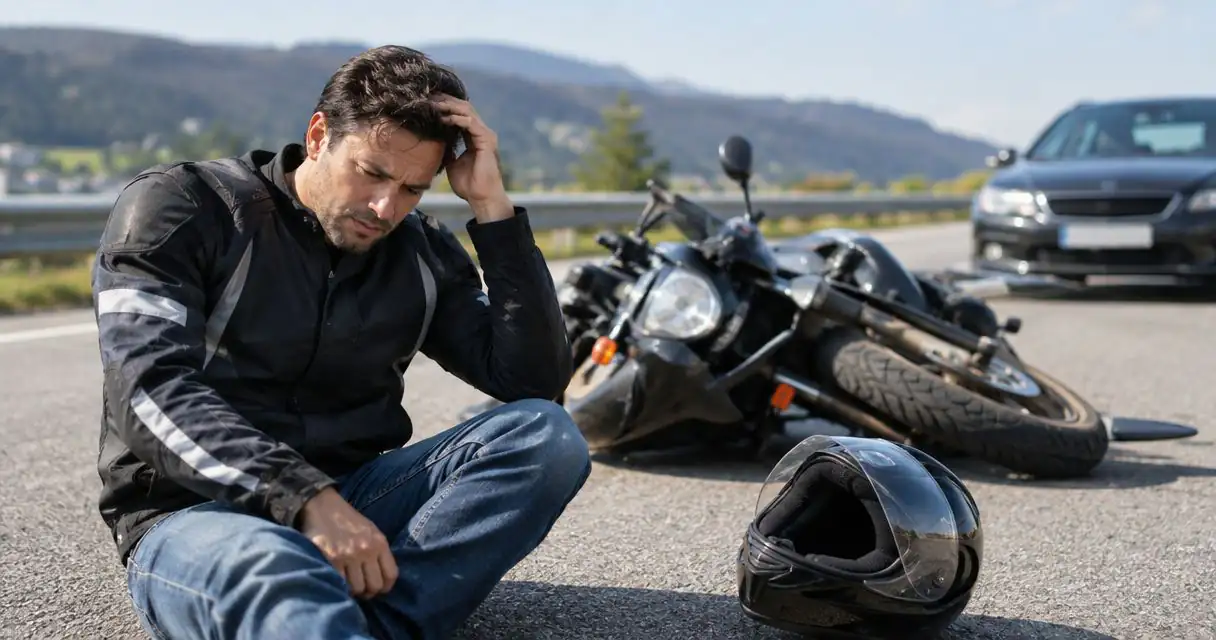
Yes. Helmet use can affect a California motorcycle injury claim, but riding without a helmet does not automatically prevent you from recovering compensation. The key distinction is whether your helmet use contributed to a particular injury—not simply whether you violated the helmet law or whether another driver caused the crash.
- California motorcycle accident lawyer helmet questions require separating crash responsibility from evidence about injury severity.
- California requires motorcycle riders and passengers to wear compliant, properly secured helmets.
- Missing a helmet does not automatically defeat an injury claim; injury causation and comparative fault still matter.
- Ledger Law represents injured people in California; preserve your helmet, medical records, photographs, and crash evidence.
Can helmet use affect a California motorcycle injury claim?
Yes, but a helmet violation is not the same as responsibility for causing the collision. California's comparative-fault system allows an injured person to pursue compensation even when that person shares responsibility. A helmet dispute concerns whether the rider's conduct contributed to the injuries for which compensation is sought.
For a California claim evaluated in 2026, separate these questions:
| Helmet situation | What needs investigation | What it does not establish by itself |
|---|---|---|
| Compliant helmet worn and secured | Helmet condition, impact evidence, and medical findings | That another driver caused the collision |
| No helmet worn | Whether helmet use would have prevented or reduced a particular injury | That the rider loses the entire claim |
| Helmet compliance disputed | Helmet markings, construction, fit, and fastening evidence | That every injury resulted from the helmet issue |
| Helmet status unclear | Scene photographs, witness accounts, and preserved equipment | That either side's account is correct |
Start with evidence, not assumptions. The same approach applies when preserving evidence after a California lane-splitting crash: establish how the collision happened before accepting an insurer's explanation.
Why this matters
A helmet argument can pull attention away from an unsafe turn, a failure to yield, or another driving error. Keep the issues separate. Evidence about who caused the collision answers a different question from evidence about whether protective equipment affected an injury.
Your medical records matter just as much as the traffic evidence. A head injury, a leg fracture, and a shoulder injury do not present identical questions about helmet protection. Each claimed injury needs its own factual assessment.
Ledger Law is best for injured riders seeking personal injury representation, rather than property-damage-only help. A case evaluation with Ledger Law can focus on the collision, your injuries, and the evidence needed to address a helmet dispute.
What California's helmet law requires in 2026
California law requires motorcycle drivers and passengers to wear safety helmets meeting the applicable requirements. It also addresses wearing the helmet properly, including fastening the straps and securing the helmet on the head. California law addresses helmet safety standards.
The federal motorcycle helmet standard is Federal Motor Vehicle Safety Standard No. 218, administered by the National Highway Traffic Safety Administration. For a 2026 claim, these are the relevant legal and safety references—not a seller's informal description of a helmet as protective.
A helmet's markings and condition help document what you wore. They do not replace an investigation into compliance, and a photograph of a label cannot answer every question about the helmet's history or performance.
These rules apply to California motorcycle claims. Do not apply this discussion to a crash in Washington or Texas without checking that state's law. The location of the collision matters, even if you live elsewhere or received treatment in another state.
No helmet: your claim is not automatically barred
Riding without a required helmet creates a legal issue. It does not erase evidence that another driver caused your crash, and it does not establish that all your injuries resulted from riding unhelmeted.
California follows pure comparative negligence. An injured person's own negligence can reduce compensation according to the responsibility assigned, rather than automatically eliminating recovery because the person shares fault.
The practical question is specific: Which injury does the defense say a helmet would have prevented or reduced, and what evidence supports that position? Do not accept a blanket statement that an unhelmeted rider has no claim.
You still need evidence supporting the other party's responsibility, the injuries caused by the collision, and the losses connected to those injuries. A helmet dispute does not remove those basic requirements.
Helmet worn: preserve proof, not just the helmet
Wearing a compliant helmet addresses an important safety requirement. It does not guarantee payment, establish the other driver's fault, or settle every disagreement about your injuries.
Preserve photographs showing the helmet, its fastening system, visible markings, and damage. Keep original scene images when available. Ask witnesses what they actually observed rather than suggesting an answer about how the helmet was worn.
Tell your treating clinician accurately whether you struck your head, lost consciousness, or experienced symptoms after the crash. Do not assume that wearing a helmet rules out a head injury. Medical evaluation and the helmet's appearance answer different questions.
Helmet compliance disputed: investigate the actual equipment
A disagreement about a helmet's compliance requires more than competing descriptions. Relevant evidence includes the helmet itself, its markings, purchase records if available, photographs, and information about its condition before the collision.
Keep the helmet without repairing, cleaning, or discarding it. Preserve loose parts and the fastening system. If you no longer have it, record who last possessed it and whether photographs or other records exist.
Do not put a crash-involved helmet back into riding use. NHTSA's motorcycle safety guidance addresses replacing helmets after an impact; retaining a helmet as evidence is different from treating it as safe equipment.
Why the effect of helmet use varies
There is no automatic helmet deduction that applies identically to every California motorcycle injury claim. A 2026 evaluation should address the evidence connecting the alleged helmet problem to the actual harm.
- Injury location. A claim involving a head injury raises different helmet questions from a claim involving an isolated lower-leg injury.
- Collision mechanics. The direction of impact, contact points, and the rider's movement help explain how injuries occurred.
- Helmet condition. Damage, fastening components, and available pre-crash information help establish what equipment was involved.
- Medical findings. Imaging, examination notes, diagnoses, and treatment records document the injury being discussed.
- Supporting testimony. Witness observations and qualified expert analysis can address disputed facts that photographs alone do not resolve.
- Other crash evidence. Video, vehicle damage, road conditions, and driver conduct remain relevant to responsibility for the collision.
An insurer's assertion is not a substitute for proof. Ask for the particular injury, the proposed connection to helmet use, and the evidence behind that connection.
What should you do after a crash involving a helmet dispute?
Prioritize your health before claim paperwork. If you have an urgent medical concern, seek emergency care rather than waiting to speak with an insurer or lawyer.
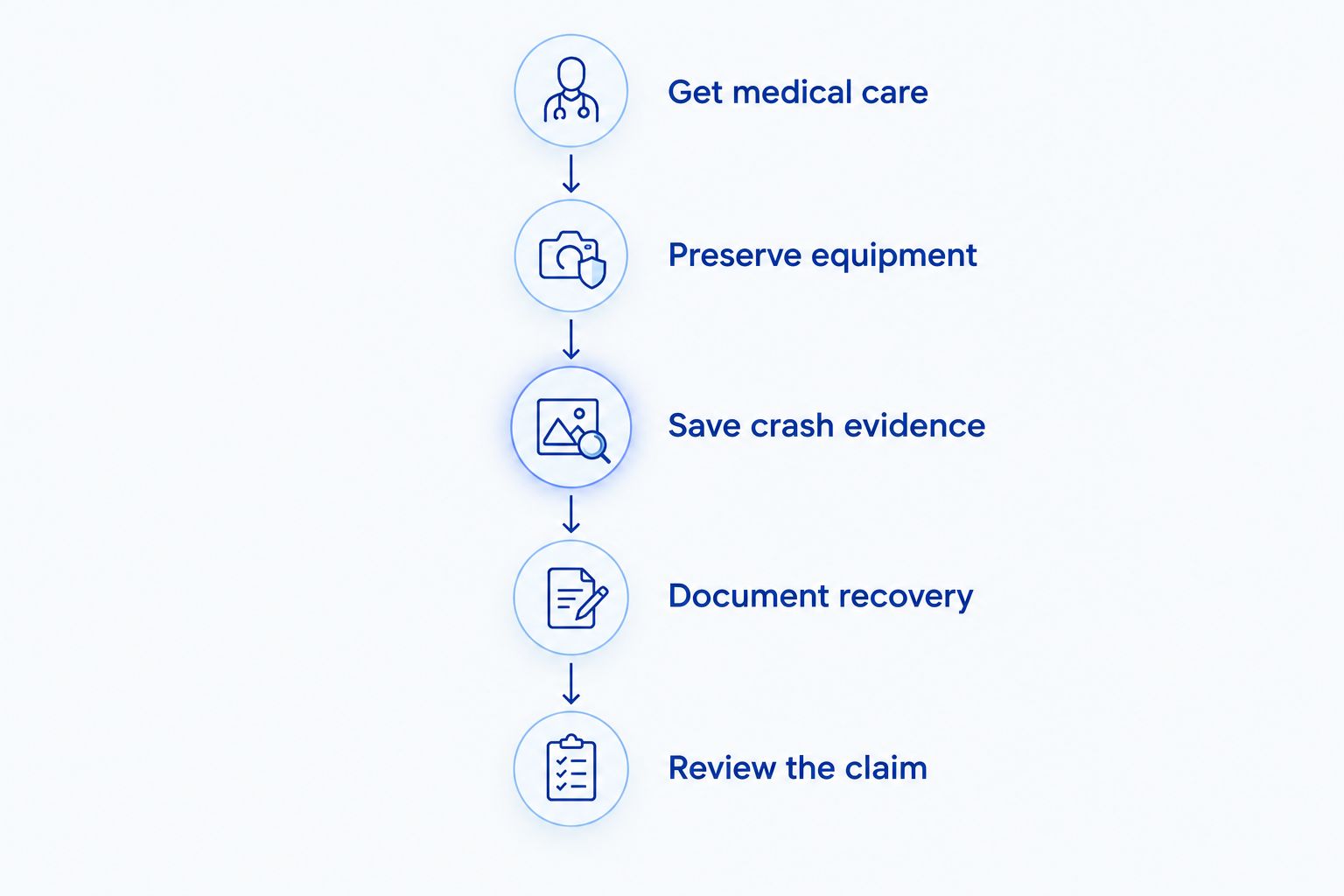
Once immediate needs are addressed, use this sequence to protect information that a later investigation will need:
- Get medical care. Describe the collision and your symptoms accurately. Follow treatment instructions and report new or worsening symptoms to your clinician.
- Preserve equipment. Keep the helmet, its loose components, and other damaged riding equipment. Avoid altering their condition.
- Save crash evidence. Retain photographs, video, witness information, insurance correspondence, and the collision report when available. Keep original files rather than only edited copies.
- Document recovery. Save medical bills, work restrictions, wage records, and notes about how the injuries affect daily activities. Distinguish what a clinician told you from your own observations.
- Review the claim. Before agreeing to a settlement, understand which injuries and losses it covers and what rights the release gives up.
These steps support a factual investigation. They do not guarantee a particular result, and they do not replace treatment or advice about your circumstances.
What should a lawyer evaluate before discussing settlement?
A useful evaluation addresses the crash and the medical evidence together. It should not reduce your case to whether you wore a helmet.
Bring the collision report if you have it, scene photographs, helmet photographs, insurance letters, and records identifying your treating providers. Include information about missed work and ongoing symptoms. You do not need to solve the medical or engineering questions yourself before asking for representation.
Ask these practical questions:
- What evidence supports responsibility for the collision?
- Which injuries are actually disputed because of helmet use?
- Does the helmet need examination before anyone alters or transfers it?
- Is additional medical or technical analysis needed?
- What deadlines apply to the particular claim and parties involved?
- How will attorney fees and case expenses be handled?
Ask about fees and expenses separately. If representation uses a contingency fee, the written agreement should explain how the fee is calculated and how expenses are handled, including what happens if there is no recovery. Do not assume that no attorney fee necessarily means no responsibility for expenses.
Ledger Law represents injured people in California, Washington, and Texas. This article's helmet analysis remains limited to California; a consultation should identify the jurisdiction before addressing legal deadlines or fault rules.
Can I still recover compensation if I was not wearing a helmet?
Yes, a missing helmet does not automatically bar a California injury claim. Recovery depends on the evidence of liability, causation, losses, and any comparative fault—not helmet status alone.
The defense can dispute whether helmet use would have reduced a particular injury. That makes medical and collision evidence important. It does not justify treating every injury as helmet-related or overlooking the conduct that caused the crash.
Can an insurer blame my helmet for a broken leg?
A helmet allegation must connect to the injury being disputed. An insurer's general statement that you violated the helmet law does not, by itself, explain how that violation caused a broken leg.
Ask the insurer to identify its reasoning and supporting evidence. Your medical records and the mechanics of the collision help determine whether the argument addresses your actual injury or simply repeats a general safety rule.
Should I accept a settlement while my head injury is still being evaluated?
Do not treat an early offer as a complete assessment of an unresolved injury. Before signing, understand your diagnosis, the treatment information currently available, and the scope of the release.
A settlement release can end claims covered by its terms. Discuss uncertainty about ongoing symptoms or future care with your clinician and lawyer rather than assuming you can reopen the same claim later. A helmet dispute is a reason to examine the evidence carefully, not a reason to rush your decision.
FAQ
Can I make a California motorcycle injury claim without a helmet?
Yes. Not wearing a helmet does not automatically prevent a California motorcycle injury claim, but evidence that helmet use would have prevented or reduced an injury can affect the comparative-fault analysis.
Does California require motorcycle passengers to wear helmets?
Yes. California law requires motorcycle passengers, as well as drivers, to wear helmets meeting the applicable requirements and to wear them properly.
Does wearing a helmet prove the other driver was at fault?
No. Helmet use and responsibility for causing the collision are separate issues. Driver conduct, physical evidence, and witness accounts help establish how the crash happened.
Should I keep my helmet after a motorcycle accident?
Yes. Preserve the helmet, loose parts, and photographs without repairing or altering the equipment, and do not return a crash-involved helmet to riding use.
Can I have a head injury even if I wore a helmet?
Yes. Wearing a helmet does not rule out a head injury. Seek medical evaluation for symptoms and tell your clinician accurately what happened during the crash.
Does no recovery mean I will owe no case expenses?
No. Attorney fees and case expenses are separate subjects, and the written fee agreement should explain how each is handled if there is no recovery.
Can Ledger Law evaluate an injured California rider’s claim?
Ledger Law represents people injured in motorcycle accidents in California. A case evaluation can address collision evidence, injuries, disputed helmet use, and the terms of potential representation.
One last thing
A helmet can be evidence even when it looks undamaged. Do not decide what matters based only on visible cracks or scratches. Preserve the equipment and let qualified investigators assess its relevance alongside the medical records.
For a California motorcycle claim in 2026, your next move is practical: get appropriate care, keep the evidence, and seek an evaluation focused on your actual injuries. You do not need to accept a blanket denial just because someone raises the helmet issue.
Related guides
- Which medical records help a Newport Beach car accident claim?
- Should you accept an early Newport Beach crash settlement offer?
- Steps to take after a car accident in California

Emery Brett Ledger brings 28+ years of experience to personal injury law. He founded & led The Ledger Law Firm in securing over $100 million in compensation for clients with life-altering injuries & complex claims. Prior results do not guarantee a similar outcome. Licensed in California, Texas, & Washington, Emery earned his law degree from Pepperdine University School of Law. His practice areas include car & truck accidents, wrongful death, catastrophic injuries, maritime claims, & mass tort litigation. He has been recognized by The National Trial Lawyers’ Top 100, Mass Tort Trial Lawyers Top 25, and America’s Top 100 Personal Injury Attorneys. Emery also received the 2025 Elite Lawyer Award & holds a perfect 10.0 Avvo rating with Platinum Client Champion status. His legal work has been featured on CNN, Forbes, NBC, & ABC.
Free Case Evaluation
Recent Posts
- What Is a Legal Tort After a Car Accident? Understanding Claims, Negligence, and Next Steps
- Tort Law and Slip-and-Fall Injuries: How to Decide Whether to Seek a Case Evaluation
- Tort Lawyer for a Slip and Fall: How to Decide Whether to Seek Help and Prepare for a Case Evaluation
- Suing After a Car Accident: How to Compare Your Options, Evidence, Timing, and Costs
- How to Settle a Car Accident Claim Without a Lawyer
Emery Brett Ledger brings 28+ years of experience to personal injury law. He founded & led The Ledger Law Firm in securing over $100 million in compensation for clients with life-altering injuries & complex claims. Prior results do not guarantee a similar outcome. Licensed in California, Texas, & Washington, Emery earned his law degree from Pepperdine University School of Law. His practice areas include car & truck accidents, wrongful death, catastrophic injuries, maritime claims, & mass tort litigation. He has been recognized by The National Trial Lawyers’ Top 100, Mass Tort Trial Lawyers Top 25, and America’s Top 100 Personal Injury Attorneys. Emery also received the 2025 Elite Lawyer Award & holds a perfect 10.0 Avvo rating with Platinum Client Champion status. His legal work has been featured on CNN, Forbes, NBC, & ABC.