Do I Need a Lawyer for a Car Accident Settlement in California?
Track the California claim-handling timeline in the settlement file
Assess a California settlement file by following the insurer’s actions in sequence. Start with the settlement file: identify what the insurer has accepted or questioned, what records support each loss, and what the proposed resolution would settle and leave open.
A focused review follows the claim communications, requests for proof, responses, claim decision, and any settlement offer or release. Compare each claimed loss with the record supporting it, note questions the insurer has not answered, and separate resolved issues from issues that remain open.
The decision should follow those California settlement checkpoints rather than a general rule that every crash requires representation.
We advise contacting a lawyer for a car accident case if you have experienced serious injuries, significant damages, or need compensation decided in court. We also advise contacting a car accident lawyer if a driver is blamed after a crash, if there are injuries, or if the car is expensive and damaged.
Use those points as a screening test rather than as a rule that every crash requires representation. Ask yourself:
- Is the account of responsibility accepted, or is someone blaming you or another driver?
- Do you understand the full extent of your injuries and losses?
- Can you connect each claimed loss to a record you can produce?
- Is the insurer responding clearly and addressing the issues you raised?
- Would you know what question to ask before accepting the proposed resolution?
If the answers are clear and the remaining work is routine, independent handling may remain reasonable. If the answers are uncertain, an evaluation can help you identify what requires closer review.
To answer the lawyer question, review the settlement offer and the insurer’s file in sequence: identify the claim milestones and unanswered communications, match each asserted loss to a supporting record, and examine what the proposed resolution or release would leave unresolved. If that review exposes disputed responsibility, serious or continuing injuries, contested losses, or multiple parties, the offer warrants closer review.
Understand what a settlement decision involves
A California car accident settlement decision involves more than comparing an insurer’s offer with a number you had in mind. You need a clear account of what happened, what was damaged, and which losses are documented.
That gives you four questions to organize before you decide whether to proceed alone:
- What facts support your account of how the collision happened?
- What injuries and property damage followed the collision?
- What expenses and other documented losses can you connect to it?
- What future or continuing effects remain uncertain?
A settlement discussion can feel simple because the insurer may ask for a limited set of information or present a single offer. The underlying decision may still require you to separate what is known from what is unresolved.
Economic losses are one part of that review. We state that economic damages have an easily ascertainable quantitative value, including medical bills, lost wages, and vehicle damage. We also state that economic damages can include hospital bills, examination costs, personal-property repair expenses, and other out-of-pocket expenses resulting from the accident.
Gather each category separately instead of placing all losses into one total. A useful working list is:
- Medical bills, hospital bills, and examination costs
- Lost wages and the records that show the loss
- Vehicle damage and repair estimates
- Damage to other personal property
- Other out-of-pocket expenses tied to the accident
The list is an organizing tool, not a valuation formula. It helps you see whether the proposed resolution addresses the losses you have identified and whether any claimed amount still lacks supporting documentation.
The practical question is not whether you can complete a form or send an email. It is whether you can make an informed choice about the claim after considering responsibility, documented losses, unresolved injuries, insurer communications, and the proposed resolution together.
A claim may look straightforward when viewed only through vehicle repair. It may require more review if medical treatment continues, wage loss is still developing, responsibility is contested, or the insurer’s position does not address the records you provided. Do not reduce the decision to the size of the first offer or the apparent simplicity of the collision. Test the whole record.
Read the insurer’s file as a decision signal
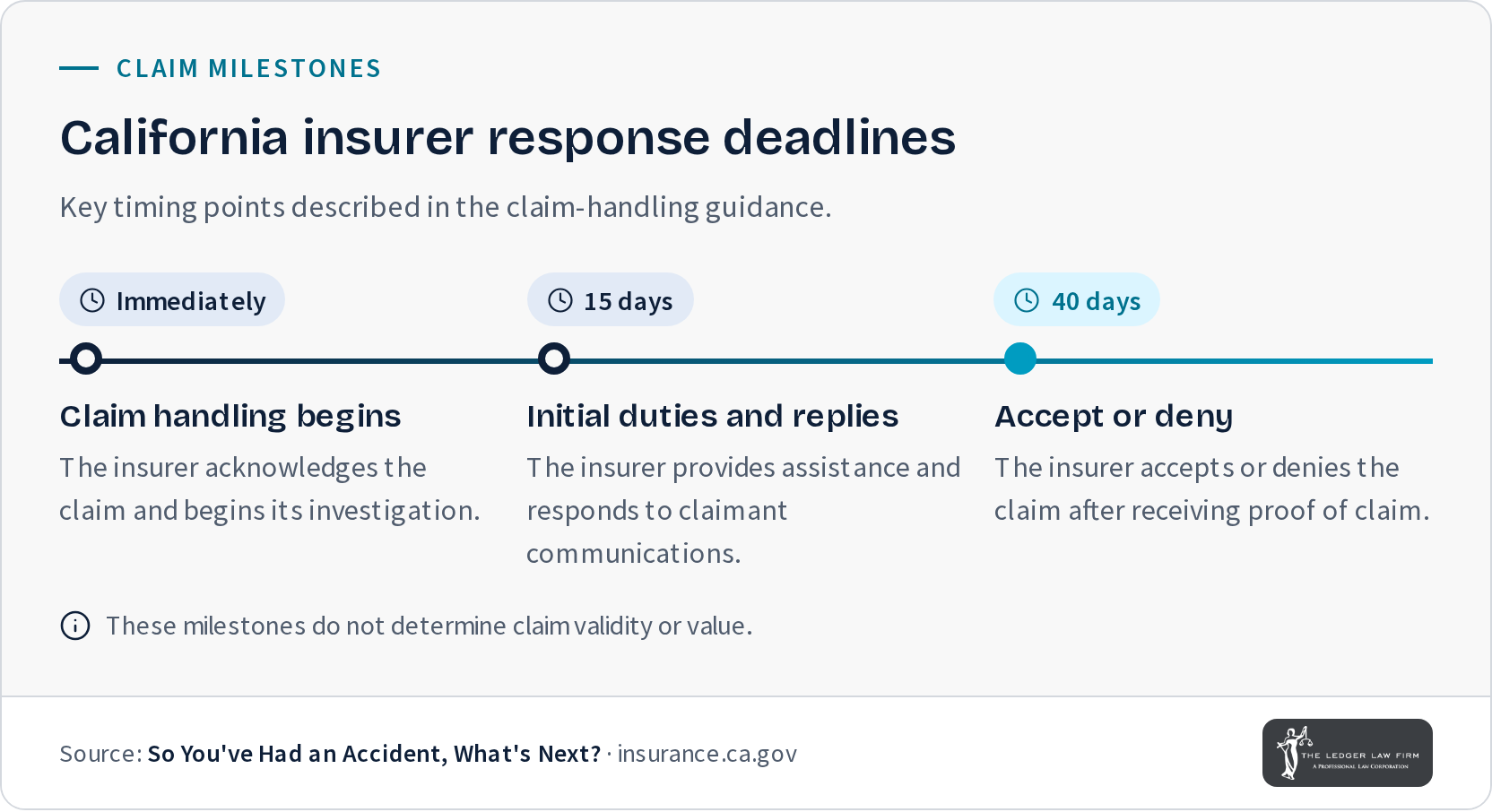
The insurer’s claim file can show whether the process is moving through ordinary steps or whether important questions remain open. California insurance guidance says insurance companies must advise policyholders of benefits, coverage, time limits, and other provisions of the policy. Keep that information with the rest of your claim records rather than relying on a general description of coverage.
The same guidance describes several process milestones:
- An insurer must acknowledge a claim, begin an investigation, provide forms and instructions, and provide reasonable assistance immediately but no later than 15 days after receiving notice of the claim.
- An insurer must respond to communications from a claimant immediately but no later than 15 days after receiving them.
The 15-day periods measure the insurer’s response or initial claim-handling duties. A separate 40-day milestone follows the insurer’s receipt of proof of claim. Those milestones do not, by themselves, determine whether your claim is valid or what it is worth.
California insurance guidance describes proof of claim as documentation in your possession that provides evidence of the claim and supports the magnitude or amount of the loss. The guidance gives repair estimates and a police report indicating vehicle theft as examples. For a collision claim, use that concept to ask whether the insurer has received the records that support the losses you are presenting.
Mark the dates and details of each step:
- When you gave notice of the claim
- What forms, instructions, or requests the insurer sent
- What records you supplied and when you supplied them
- When the insurer responded to your communications
- Whether the insurer accepted, denied, or continued to investigate the claim
- What explanation accompanied any proposed resolution
A missing response, an unanswered question, or a request you do not understand is a reason to pause before treating the process as complete. It does not automatically prove misconduct or determine the outcome. It does show that you have an issue to resolve or obtain advice about.
California insurance companies are required to offer a fair settlement under the California Department of Insurance guidance. That statement gives you a standard to keep in mind, but it does not tell you whether a particular offer meets that standard on your facts.
Compare the offer with the claim record. Does it address the losses you documented? Does it account for the responsibility position the insurer has taken? Does it leave a question about an injury, expense, vehicle repair, or continuing effect unanswered? If you cannot explain the connection between the offer and the records, do not treat the offer as self-explanatory.
You can continue organizing the file while asking the insurer for clarification. If the response remains unclear, the offer appears to leave significant issues unresolved, or you are unsure what accepting it would mean, those are signals to consider legal review rather than making a rushed decision.
Check whether the facts are straightforward
A self-handled settlement is easier to assess when the important facts line up and the supporting record is complete. That does not mean the claim must be small or that the insurer must agree with every detail. It means you can identify the main questions and support your answers.
Use this practical test:
- The account of responsibility is clear enough for you to explain without relying on assumptions.
- The injuries are limited, understood, and no longer creating unanswered questions about the claim.
- The vehicle and other property losses are identifiable and supported by repair records or estimates.
- Medical bills, examination costs, lost wages, and other out-of-pocket expenses are separated and documented.
- You understand what the insurer has accepted, disputed, requested, or left unanswered.
- You can describe what the proposed resolution covers and which issues remain outside it.
The economic-loss record can include medical bills, lost wages, and vehicle damage. Those categories give you a way to organize the decision without trying to assign a value that the available facts cannot support.
Straightforward facts also require you to consider who may be responsible. We state that causation in personal injury cases can sometimes involve multiple defendants sharing liability. If you are dealing with more than one driver, owner, insurer, or other potentially responsible party, the claim may no longer fit a single, uncomplicated path.
Independent handling may remain reasonable when the records answer the central questions and the insurer’s position is understandable. It becomes less comfortable when you are filling gaps with guesses. If you cannot tell whether the record is complete, treat that uncertainty as part of the decision rather than as a reason to settle quickly.
Spot the signals that make self-representation harder
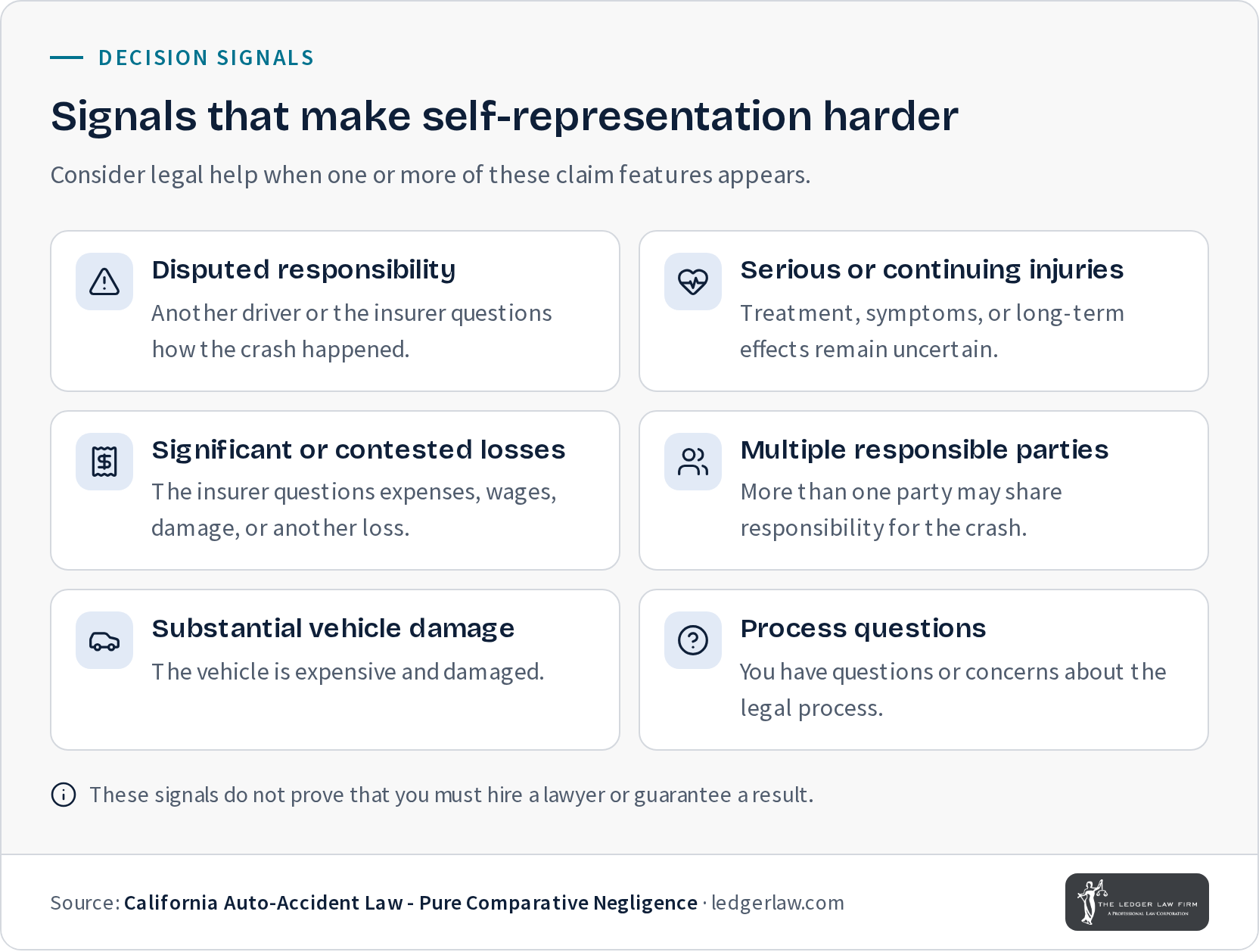
Some claim features create more work and more room for an unresolved issue to affect the settlement decision. Consider legal help when one or more of these signals appears:
- Responsibility is disputed. Another driver blames you, the insurer questions how the crash happened, or the available accounts do not match.
- The injuries are serious or continuing. You are still dealing with treatment, symptoms, or uncertainty about the crash’s longer-term impact.
- The losses are significant or contested. The insurer questions medical expenses, lost wages, vehicle damage, or another documented loss.
- More than one party may share responsibility. We state that causation can sometimes involve multiple defendants sharing liability, which can make the responsibility analysis less direct.
- The vehicle damage is substantial. We advise contacting a car accident lawyer if the car is expensive and damaged.
- The insurer is not offering a fair settlement. We advise considering a lawyer when the insurance company is not offering a fair settlement.
- You do not understand the process. We advise considering hiring an auto accident lawyer if you have questions or concerns about the legal process.
These signals do not prove that you must hire a lawyer or that representation will produce a particular result. They identify situations in which the decision requires more than routine communication with an insurer.
For example, a disputed-fault claim may require you to keep responsibility separate from the amount of your losses. A continuing-injury claim may require you to distinguish expenses already documented from effects that remain uncertain. A multiple-party claim may require you to avoid assuming that one insurer’s position resolves every responsibility question. A contested-loss claim may require you to connect each expense to a record and answer the insurer’s specific objection.
If you can identify the unresolved issue but cannot explain how to address it, an evaluation can be a sensible next step. If you cannot identify the unresolved issue because the claim file is confusing, organize the file first and then seek help with the questions it raises.
A useful rule for your own decision is to count unresolved categories, not just documents. A thick file can still leave responsibility, injury, loss, or settlement terms unclear. A short file can still support independent handling if the central facts are settled and each material loss is understandable.
When serious injuries, significant damages, blamed responsibility, expensive vehicle damage, multiple potentially liable parties, insurer resistance, or process questions appear together, we advise contacting a lawyer rather than assuming the claim is routine.
Compare the two practical paths
You generally have two practical paths: continue handling the claim yourself or seek legal help. The choice turns on the work involved, the questions that remain unresolved, and the type of support you need.
| Decision factor | Handling the claim yourself | Seeking legal help |
|---|---|---|
| Control | You communicate directly with the insurer, organize your records, and make the settlement decisions yourself. | You remain involved in the objectives and decisions for the claim. |
| Main work | You explain the collision, provide supporting records, respond to requests, and assess the proposed resolution. | |
| Issue spotting | You must identify disputed responsibility, missing records, contested losses, and unclear settlement terms on your own. | Under California’s lawyer-conduct rules, a lawyer must reasonably consult with a client about how to accomplish the client’s objectives and explain a matter as far as reasonably necessary for informed decisions. |
| Communication | You receive and answer the insurer’s communications directly. | Under California’s lawyer-conduct rules, a lawyer must keep a client reasonably informed about significant developments and promptly comply with reasonable requests for information and significant documents when necessary to do so. |
| Flexibility | You can continue independently while the record remains clear and the process is understandable. | You can seek help when the claim presents serious injuries, significant damages, disputed responsibility, contested losses, or questions about the legal process. |
| Trade-off | You retain direct control but also carry the work of interpreting the record and responding to unresolved issues. | You receive guidance and representation, but you must understand the proposed working relationship and fee arrangement before moving forward. |
The table is a decision aid, not a prediction. Legal representation does not remove your role in explaining your objectives or making important decisions. California’s lawyer-conduct rules require consultation, information about significant developments, and explanations reasonably necessary for informed decisions. Those duties describe the lawyer-client relationship; they do not promise a particular settlement, award, or recovery.
Self-handling may feel appropriate when you understand the facts and want to communicate directly. Legal help may fit better when the claim requires issue-spotting, representation, or a structured explanation of questions you cannot resolve from the file. Choose based on the problem your claim presents, not on a general belief that every accident belongs in court or that every claim should be settled without assistance.
Account for the cost and agreement before hiring
Cost is part of the decision, but it should not be treated as a single standard number. Before hiring a lawyer, understand the proposed fee arrangement, the work it covers, how later events may affect the fee, and what decisions remain yours.
A California lawyer may not make an agreement for, charge, or collect an unconscionable or illegal fee. California law also provides that whether a fee is unconscionable is determined from the facts and circumstances existing when the fee agreement is entered, unless the parties contemplate that later events will affect the fee.
Those rules give you a reason to read the proposed agreement as a decision document. Ask plain questions about:
- What work the lawyer will perform
- What part of the claim the agreement covers
- How the fee is calculated
- Which later events could affect the fee
- What communication and decision-making process you should expect
- What questions you should resolve before signing
Do not assume that legal help has one universal price or one universal scope. The written arrangement and the facts of your claim matter.
You can compare the practical cost of self-handling with the practical cost of obtaining legal help, but avoid making the comparison from a hoped-for settlement amount. You do not yet know whether the claim will remain routine, whether the insurer will change its position, or whether unresolved issues will require more work.
A sound decision asks whether the support addresses the problem that caused you to seek help. If your concern is disputed responsibility, ask how that issue would be examined. If your concern is continuing injury or contested losses, identify what records and questions would be reviewed. If your concern is communication, understand how significant developments and documents would be handled.
Build the claim record before choosing
A complete working file lets you test whether the settlement question is understandable. For each claimed loss, identify the record that supports it. Build your file around that purpose.
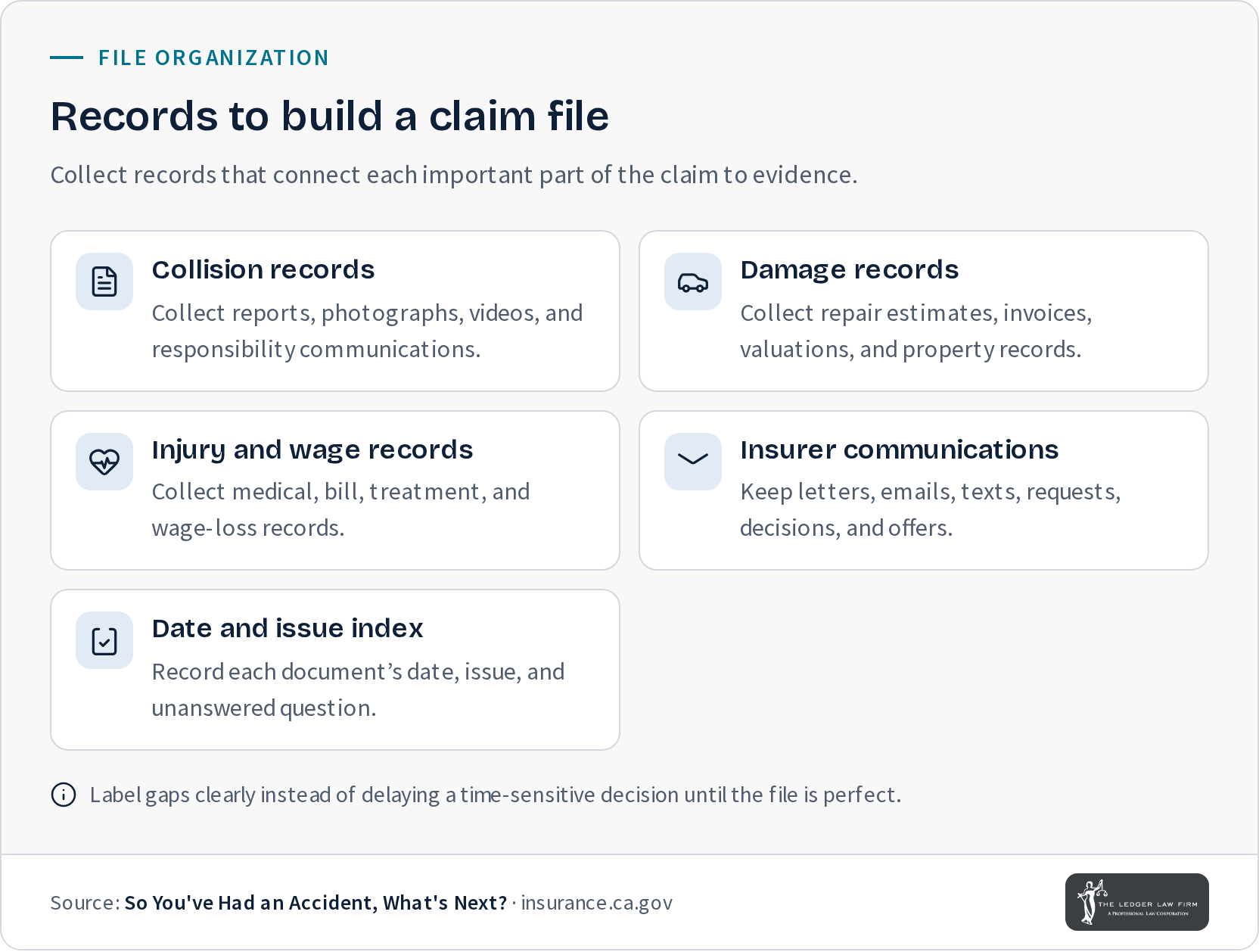
Collect and label:
- The collision or incident report
- Photographs and video of the vehicles, scene, visible injuries, and property damage
- Insurance policy information and claim numbers
- Names and contact information for the drivers, owners, insurers, and other involved parties
- Medical records, medical bills, hospital bills, and examination costs
- Wage-loss information and records supporting time away from work
- Vehicle repair estimates, invoices, valuation communications, and records of other property damage
- Every letter, email, text, and other communication with the insurer
- Requests for information, forms, instructions, claim decisions, and settlement offers
- Notes showing when you sent records and when the insurer responded
The purpose is not to collect papers without a plan. The purpose is to connect each important part of the claim with a record you can locate quickly.
Separate the file into four working sections:
- What happened: reports, photographs, videos, statements, and communications about responsibility.
- What was damaged: vehicle repair records, property damage records, and related estimates or invoices.
- What you experienced: medical records, bills, examinations, treatment information, and wage-loss records.
- What the insurer did: claim notices, requests, responses, decisions, explanations, and proposed resolutions.
Then create a short index showing the date, document type, issue addressed, and any question the document leaves open. This index is an immediate-use tool. It helps you find missing records, compare the insurer’s position with your supporting material, and explain the claim without relying on memory alone.
Organizing the file around those subjects makes it easier to see which part of the settlement decision is documented and which part still needs attention.
Do not treat a document as useful merely because it exists. Ask what question it answers. A repair estimate may support vehicle damage. A medical bill may document an expense. A communication may show what the insurer requested or decided. A record that does not connect to a claim issue may still belong in the file, but it should not obscure the records that carry the decision.
If you are requesting legal help, the same organized file can make the initial discussion more focused. Bring the records you have, identify what you cannot locate, and write down the questions you want answered. Do not delay a time-sensitive decision simply because the file is not perfect; mark the gaps clearly instead.
Use the records to test the settlement question
Once your records are organized, test the proposed resolution one issue at a time. Start with a simple comparison:
- What loss or responsibility question does the document support?
- What did you tell the insurer about that issue?
- What did the insurer acknowledge, dispute, request, or leave unanswered?
- Does the proposed resolution address the issue clearly?
- What fact or document would change your understanding of the issue?
This approach keeps you from treating an offer as a standalone number. It also helps you separate a missing record from a disagreement about what the record means. California insurance guidance describes proof of claim as documentation that provides evidence of the claim and supports the magnitude or amount of the loss, so preserve the connection between each claimed loss and its supporting material.
Write unresolved questions in plain language. Examples include:
- Why does the insurer dispute responsibility when the report and photographs appear to support my account?
- Which medical or wage-loss record is missing from the claim file?
- What loss does this part of the proposed resolution address?
- What does the insurer still need before it will make a decision?
- What part of the claim remains open after the proposed resolution?
- What should I understand before I respond?
If you consult a lawyer, these questions create a useful agenda. These questions can help focus the discussion on the issues affecting your decision. You should therefore bring the questions that affect your decision, not only a stack of documents.
Preserve the insurer’s communications in date order and keep copies of what you sent. Note unanswered requests and deadlines stated in the correspondence, but do not assume a date in a letter resolves every legal timing question. If you are represented, California’s lawyer-conduct rules require the lawyer to keep you reasonably informed about significant developments and to promptly comply with reasonable requests for information and significant documents when necessary to do so.
Before accepting a proposed resolution, identify every material question you still cannot answer. A clear record of those questions does not tell you what decision to make. It tells you where independent handling stops being comfortable and where individualized review may be useful.
Know the California dispute path that may remain available
If an automobile claim remains disputed, California provides an administrative path that may be relevant to some disputes. Before referral to California’s Automobile Claims Mediation Program, you must first go through the California Department of Insurance’s normal complaint process.
That sequence matters. The mediation program is not the first step described in the California Department of Insurance guidance. You begin with the normal complaint process, and the dispute must continue through the required stages before a referral toward mediation can occur.
After the California Department of Insurance complaint process, the insurer must be allowed 28 calendar days to resolve the dispute before the mediation process can begin. The 28-calendar-day period measures the time the insurer must be allowed after that complaint process and before mediation begins.
Keep this path separate from your private decision about whether to hire a lawyer. An administrative complaint or mediation option does not by itself answer questions about responsibility, injuries, losses, settlement terms, or the effect of accepting an offer. Use it as one possible process to understand when the claim remains unresolved, not as a substitute for reviewing the claim’s facts.
If you are considering this dispute path, record what complaint steps you have completed, what response you received, and whether the required period has passed. Keep copies of the complaint materials and insurer communications with the rest of your file. If you are uncertain whether the process applies to your dispute or how it interacts with your claim, treat that uncertainty as a question for current California guidance or individualized legal review.
Keep timing and legal significance open for review
A settlement decision can turn on timing, but a general article cannot select the controlling date for your claim. Keep separate records for the collision date, notice of claim, delivery of proof, insurer responses, medical treatment, wage loss, settlement communications, and any complaint process.
Do not merge those dates into one timeline entry. Each date may answer a different question, and the significance of a date depends on the facts, the policy, the parties involved, and the current California rules that apply to the issue. A date in an insurer communication may describe the insurer’s process without resolving every legal deadline connected to your claim.
The same caution applies to legal significance. Responsibility, coverage, fault allocation, injuries, losses, and the effect of accepting a proposed resolution are separate questions. A clear vehicle repair record does not by itself answer an injury question. A payment or claim response does not by itself tell you whether every other issue is resolved. A dispute with one insurer does not necessarily identify every potentially responsible party.
When you see language about a release, denial, limitation, deadline, coverage position, or allocation of fault, copy the exact language into your question list. Do not rely on a shortened description if the wording may affect the decision.
Use this section as a pause point: if a date or document could change whether you accept, continue, complain, mediate, or seek representation, mark it as unresolved until you understand its role. Current California requirements and the facts of your claim determine the legal significance of those details. General information can help you organize the questions, but it cannot supply the missing facts.
Choose self-handling only when the record supports it
Self-handling is more defensible when your claim record supports the decision at each important step. Before continuing alone, confirm that you can explain:
- What happened and why you believe responsibility is clear enough to discuss
- Which injuries and losses are part of the claim
- Which medical, wage, repair, and other expense records support those losses
- What the insurer has acknowledged, disputed, requested, or decided
- What the proposed resolution addresses
- Which questions remain open and how you plan to address them
California insurance companies are required to advise policyholders of benefits, coverage, time limits, and other policy provisions. Those requirements provide process points to track; they do not determine whether your individual claim record is complete or whether a particular offer answers every question.
Continue independently only if the unresolved issues are limited enough for you to understand and address. That may mean asking the insurer a focused question, supplying a missing record, or comparing a proposed resolution with the losses you have documented.
Pause and consider legal help if you cannot explain the insurer’s position, if responsibility remains disputed, if injuries or losses remain uncertain, if multiple parties may share responsibility, or if the proposed resolution leaves a material question unanswered. We advise considering a lawyer when you have questions or concerns about the legal process or when the insurance company is not offering a fair settlement.
Use a final three-part check before responding to an offer:
- Record: Can you locate the document supporting each material part of your claim?
- Response: Can you explain what the insurer has said about each material issue?
- Choice: Can you describe what you would be accepting, continuing, or leaving unresolved?
If any answer is no, do not treat the claim as simple merely because the insurer has made an offer. Identify the missing answer first. That is the point at which an evaluation may be more useful than another general search for a settlement number.
Request an evaluation when important questions remain
You do not need to decide based on the accident label alone. Decide from the unresolved questions in your record. Independent handling may remain reasonable when responsibility, injuries, losses, insurer communications, and the proposed resolution are understandable and supported. Legal help deserves consideration when serious injuries, significant damages, disputed responsibility, multiple potentially responsible parties, contested losses, or insurer resistance make the decision harder.
We advise contacting a lawyer if you have experienced serious injuries, significant damages, or need compensation decided in court.
A qualified California lawyer must review your specific circumstances before deciding what legal options, deadlines, or settlement choices may apply to you. We offer a free consultation with an auto-accident lawyer.
Common questions about California car accident settlements and legal help
Can I accept a California car accident settlement before my treatment is finished?
Be cautious when treatment is continuing or the long-term effects of an injury remain uncertain. Before accepting an offer, identify what losses and issues it resolves, whether any future effects remain open, and whether the proposed terms include a release. The significance of those terms depends on the facts and current California law, so individualized legal review may be appropriate before you agree.
What should I do if the insurer disputes fault or offers less than my documented losses?
Keep responsibility questions separate from the amount of your losses. Organize photographs, reports, medical and wage records, repair estimates, and insurer communications, then ask the insurer to explain each disputed item. If responsibility, multiple parties, significant injuries, or contested losses remain unresolved, the claim may be difficult to evaluate independently and legal review should be considered.
How do I check whether a California car accident claim is approaching a legal deadline?
Record the collision date, claim notice, proof-of-claim delivery, medical treatment, insurer responses, settlement communications, and any complaint activity separately. Do not assume that an insurer’s date or a general article identifies the controlling legal deadline. California deadlines can depend on the claim, parties, exceptions, and other facts, so verify the current rule for your circumstances before relying on a date.
What should I ask before signing a car accident lawyer’s fee agreement?
Ask what work the agreement covers, how the fee is calculated, which later events could affect it, what costs may be separate, and which decisions remain yours. Review how communication and significant documents will be handled. California lawyers may not charge an unconscionable or illegal fee, but whether a fee is permissible depends on the agreement and circumstances when it is entered.
Can I use California insurance mediation if the settlement dispute is not resolved?
For disputes that may qualify, California’s Automobile Claims Mediation Program requires you to complete the California Department of Insurance’s normal complaint process first. After that process, the insurer must be allowed 28 calendar days to resolve the dispute before mediation can begin. This administrative option does not determine fault, injury damages, settlement terms, or the effect of accepting an offer.

Emery Brett Ledger brings 28+ years of experience to personal injury law. He founded & led The Ledger Law Firm in securing over $100 million in compensation for clients with life-altering injuries & complex claims. Prior results do not guarantee a similar outcome. Licensed in California, Texas, & Washington, Emery earned his law degree from Pepperdine University School of Law. His practice areas include car & truck accidents, wrongful death, catastrophic injuries, maritime claims, & mass tort litigation. He has been recognized by The National Trial Lawyers’ Top 100, Mass Tort Trial Lawyers Top 25, and America’s Top 100 Personal Injury Attorneys. Emery also received the 2025 Elite Lawyer Award & holds a perfect 10.0 Avvo rating with Platinum Client Champion status. His legal work has been featured on CNN, Forbes, NBC, & ABC.
Free Case Evaluation
Recent Posts
- Do I Need a Lawyer for a Car Accident Settlement in California?
- How do Texas wrongful death and estate claims differ?
- Who can an injured California car passenger bring a claim against?
- Which trip records matter after a Seattle rideshare injury?
- What Is the Average Personal Injury Settlement for a Slip-and-Fall Claim?
Emery Brett Ledger brings 28+ years of experience to personal injury law. He founded & led The Ledger Law Firm in securing over $100 million in compensation for clients with life-altering injuries & complex claims. Prior results do not guarantee a similar outcome. Licensed in California, Texas, & Washington, Emery earned his law degree from Pepperdine University School of Law. His practice areas include car & truck accidents, wrongful death, catastrophic injuries, maritime claims, & mass tort litigation. He has been recognized by The National Trial Lawyers’ Top 100, Mass Tort Trial Lawyers Top 25, and America’s Top 100 Personal Injury Attorneys. Emery also received the 2025 Elite Lawyer Award & holds a perfect 10.0 Avvo rating with Platinum Client Champion status. His legal work has been featured on CNN, Forbes, NBC, & ABC.