How do Texas wrongful death and estate claims differ?

Texas wrongful death claims compensate eligible family members for their own losses, while an estate’s survival claim preserves the injury claim the person who died could have brought. Both can arise from the same fatal accident, but they have different claimants, damages, and rules about who can act.
- Texas wrongful death claims belong to a surviving spouse, children, and parents—not automatically to everyone who inherits.
- A Texas survival claim preserves the deceased person’s injury claim; estate authority matters.
- Texas wrongful death lawyer estate consultations should separate family losses from the deceased person’s injury claim.
- Ledger Law represents Texas families seeking personal injury representation after fatal accidents.
How do Texas wrongful death and estate claims differ?
A wrongful death claim addresses the family’s loss; a survival claim addresses the deceased person’s injury. In this context, an “estate claim” usually means a survival claim, not a separate lawsuit over inheritance.
Texas Civil Practice and Remedies Code Chapter 71 provides the framework for both claims. Sections 71.004 and 71.021 explain the central distinction: eligible family beneficiaries have wrongful death rights, while an injured person’s claim can survive death in favor of heirs, legal representatives, and the estate.
| Question | Texas wrongful death claim | Texas survival claim |
|---|---|---|
| Whose loss does it address? | Eligible family members’ losses from the death | The deceased person’s injury-related losses |
| Who are the beneficiaries? | Surviving spouse, children, and parents | The estate, with distribution governed by estate rules |
| What losses are evaluated? | Lost support, lost companionship, and mental anguish | Pre-death medical expenses, lost earnings, and conscious pain and suffering |
| Does inheriting establish eligibility? | No; wrongful death eligibility follows the statute | Inheritance and estate administration affect distribution and authority |
| Can both claims arise together? | Yes, when the facts support both | Yes, without recovering twice for the same loss |
Ledger Law provides personal injury representation in Texas. A case evaluation should identify both potential claims before anyone assumes that being a beneficiary also authorizes them to represent the estate.
Why this matters
A family can have a valid wrongful death claim and still need to resolve who has authority to pursue a survival claim. Signing an insurance form as the deceased person’s child does not, by itself, establish authority to sign for the estate.
For a fatal accident in Dallas or elsewhere in Texas, keep the family claim and estate claim separate from the beginning. That distinction helps your lawyer identify the correct parties, preserve the right evidence, and assess what a proposed release actually covers.
This 2026 guide addresses Texas law only. California and Washington have different rules; their beneficiary and filing requirements should not be applied to a Texas case.
Texas wrongful death claims: losses suffered by the family
Texas Civil Practice and Remedies Code Section 71.004 identifies the surviving spouse, children, and parents as wrongful death beneficiaries. One or more of those individuals can bring the action for the benefit of all eligible beneficiaries.
Being named in a will does not make someone a wrongful death beneficiary. A sibling, friend, or other relative does not qualify solely because that person inherits property or handled the funeral arrangements.
What does a wrongful death claim cover?
A Texas wrongful death claim can address financial support and services the deceased person would have provided, loss of companionship and society, mental anguish, and loss of inheritance when supported by evidence. The claim concerns the beneficiaries’ losses, not simply the deceased person’s medical bills.
Useful evidence includes employment records, household responsibilities, financial contributions, and information about the family relationship. Explain the person’s actual role in your life rather than trying to assign a settlement value yourself.
What happens if the family does not file?
Section 71.004 provides that, if eligible beneficiaries have not begun the action within 3 calendar months after the death, the executor or administrator must bring it unless all eligible beneficiaries request otherwise.
That rule does not turn wrongful death compensation into ordinary estate property. It addresses who brings the action, not whose losses the claim compensates.
Texas survival claims: losses suffered before death
Texas Civil Practice and Remedies Code Section 71.021 prevents a personal injury action from ending solely because the injured person died. The survival claim continues the deceased person’s claim rather than creating a new claim for the family’s grief.
A survival claim is not a second wrongful death claim. Its damages depend on what happened to the injured person before death and what the evidence supports.
What does a survival claim cover?
A survival claim can include accident-related medical expenses, lost earnings before death, and conscious pain and suffering. Medical records, witness observations, and the timeline between injury and death help establish these losses.
Do not assume pain-and-suffering damages exist simply because an accident was fatal. Evidence of consciousness and suffering matters, and the circumstances of the death must be evaluated individually.
Who can pursue the estate’s claim?
An estate’s personal representative generally pursues the survival claim. Texas law also recognizes circumstances in which heirs can proceed, but being an heir alone does not resolve every question about legal authority.
Bring any will, probate filings, letters testamentary, or letters of administration to the case evaluation. If no estate proceeding exists, say so; your lawyer needs to assess the appropriate route rather than assume someone already has authority.
Why the claims and required evidence vary
The distinction between wrongful death and survival claims remains the same in 2026. What changes from family to family is the evidence, the eligible parties, and the estate’s legal status.
- Family relationships: A spouse, child, or parent has a different statutory position from a sibling or an unrelated beneficiary.
- Time between injury and death: Treatment records and witness accounts help identify losses suffered before death.
- Estate administration: An existing executor or administrator affects who can act for the estate.
- Financial contributions: Employment, caregiving, and household services help explain the beneficiaries’ losses.
- Accident evidence: Crash reports, video, witness accounts, and medical evidence help establish responsibility and causation.
- Existing paperwork: Insurance releases, prior claims, and probate documents can affect how the case proceeds.
None of these factors supports a reliable settlement estimate by itself. A case evaluation should explain which facts establish liability, which support damages, and which require further investigation.
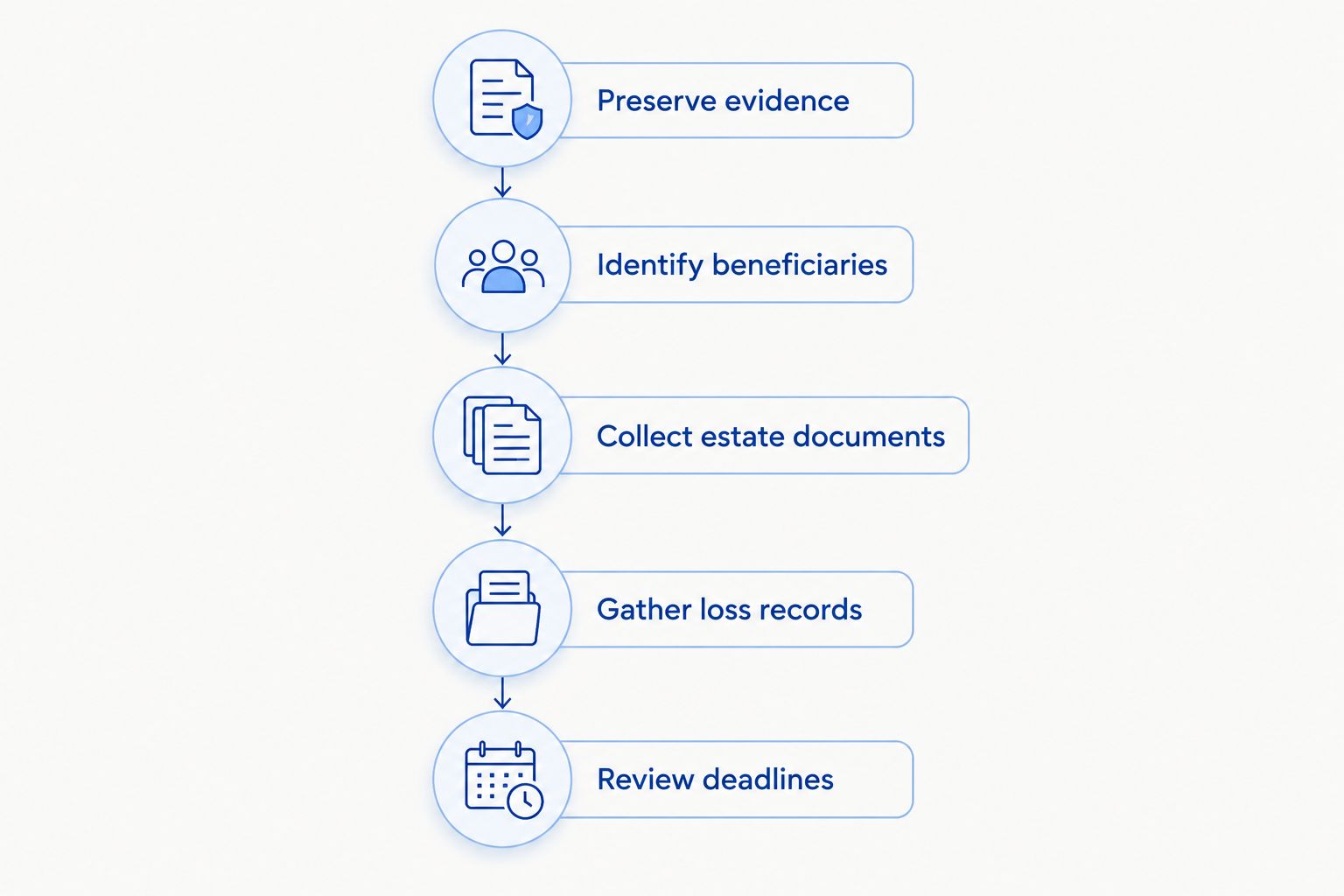
What should your family do first?
You do not need a finished investigation before speaking with a lawyer. Start with the documents you have and identify anything you cannot yet obtain.
- Preserve evidence. Save photographs, messages, witness details, crash information, and correspondence without editing the originals. Do not discard the deceased person’s relevant phone records or accident-related belongings.
- Identify beneficiaries. List the surviving spouse, children, and parents, including anyone who lives elsewhere. Explain family relationships accurately rather than assuming that the person handling arrangements is the only claimant.
- Collect estate documents. Gather the will and any probate filings or appointment documents. Tell the lawyer whether anyone has already been appointed to administer the estate.
- Gather loss records. Keep medical records, billing statements, employment information, and records of household contributions. Save funeral invoices too, so counsel can assess their treatment without counting the same expense twice.
- Review deadlines. Record the accident date and death date, and bring any government correspondence or insurance paperwork. Ask the lawyer to identify deadlines for each potential claim.
The order keeps evidence preservation separate from decisions about who can sign. Do not wait for every record before asking about deadlines.
What deadlines apply to Texas fatal accident claims in 2026?
Texas generally sets a 2-year limitations period for wrongful death claims, running from death, under Civil Practice and Remedies Code Section 16.003. Exceptions and special rules require a case-specific review.
A survival claim also requires its own deadline analysis. Do not assume that the death creates a fresh 2-year period for every injury claim; the injury timeline and applicable tolling rules matter.
Government-related claims can involve separate notice requirements. For a 2026 case evaluation, give your lawyer the accident date, death date, defendant information, and any earlier notices or filings rather than relying on a calendar reminder alone.
Can both claims proceed after the same fatal accident?
Both Texas wrongful death and survival claims can proceed when the facts support each claim. They address different losses, even when the evidence about the accident overlaps.
Your lawyer should explain which damages belong to the beneficiaries and which belong to the estate. The same medical expense or other loss cannot be recovered twice merely by listing it under both claims.
Does every fatal accident support both claims?
Every fatal accident requires an individual assessment of responsibility and damages. A survival claim’s value and available damages depend on the deceased person’s injury-related losses, while a wrongful death claim depends on eligible beneficiaries and their losses.
Does wrongful death compensation pass through the estate?
Texas wrongful death compensation belongs to the statutory beneficiaries rather than passing through the estate as an ordinary estate asset. Survival proceeds belong to the estate and are subject to estate administration and distribution rules.
That difference matters when family members have different roles. The person named executor is not automatically the only wrongful death beneficiary, and a wrongful death beneficiary is not automatically the estate’s representative.
What should a Texas case evaluation clarify?
A useful evaluation should give your family a clear explanation of the two claims, not just a request to sign documents. Ask who the firm would represent, who has signing authority, and whether separate estate administration work is needed.
Ledger Law is best for families seeking personal injury representation after a fatal accident in Texas. The firm’s personal injury focus is relevant to investigating the accident and resulting claims; a case evaluation should separately clarify any probate work your family needs.
Ask about attorney fees and case expenses before hiring counsel. If a contingency agreement is proposed, review how the fee is calculated, how expenses are deducted, and who is responsible for expenses if there is no recovery; do not assume that no recovery necessarily means no costs.
You can use the contact page to ask about an evaluation. Have the accident date, death date, family relationships, and estate status ready, even if the rest of your records are incomplete.
FAQ
Can a spouse bring both a wrongful death claim and an estate claim in Texas?
A surviving spouse is an eligible Texas wrongful death beneficiary, but pursuing the survival claim requires a separate review of estate authority. Marriage alone does not automatically establish authority to act for the estate.
Can a sibling file a Texas wrongful death lawsuit?
A sibling is not a Texas wrongful death beneficiary solely because of the sibling relationship. Texas Section 71.004 identifies the surviving spouse, children, and parents as beneficiaries.
Do we need probate before speaking with a wrongful death lawyer?
You do not need to finish probate before seeking a case evaluation. Bring any existing estate documents so the lawyer can assess representation authority and deadlines.
What if our loved one died immediately after the accident?
An immediate death does not eliminate eligible family members’ potential wrongful death claims. Survival damages require separate evidence of the deceased person’s losses; conscious pain and suffering should not be assumed.
Does the executor receive all the wrongful death money?
The executor does not receive wrongful death compensation personally just because the executor files the action. The claim is for the benefit of the eligible statutory beneficiaries.
How long do we have to file a Texas wrongful death claim in 2026?
Texas generally allows 2 years from death to file a wrongful death claim under Section 16.003. Exceptions, government notice requirements, and the survival claim’s separate timeline require individual review.
What should we bring to Ledger Law for a fatal accident case evaluation?
Bring accident information, the death certificate if available, family relationship details, medical records, insurance correspondence, and estate documents. Missing documents should not delay a discussion about filing deadlines.
One last thing
Read every release for whose claims it covers, not just the amount offered. A document can refer to family claims, estate claims, or both, and the person signing must have the appropriate authority.
Before accepting a resolution in 2026, ask counsel to identify the beneficiaries, the estate’s role, and the claims being released. That single review helps keep two legally distinct claims from being treated as interchangeable paperwork.
Related guides
- What should families bring to a Texas wrongful death consultation?
- Can a Texas truck accident claim involve several defendants?
- What evidence should a Texas truck accident attorney preserve?

Emery Brett Ledger brings 28+ years of experience to personal injury law. He founded & led The Ledger Law Firm in securing over $100 million in compensation for clients with life-altering injuries & complex claims. Prior results do not guarantee a similar outcome. Licensed in California, Texas, & Washington, Emery earned his law degree from Pepperdine University School of Law. His practice areas include car & truck accidents, wrongful death, catastrophic injuries, maritime claims, & mass tort litigation. He has been recognized by The National Trial Lawyers’ Top 100, Mass Tort Trial Lawyers Top 25, and America’s Top 100 Personal Injury Attorneys. Emery also received the 2025 Elite Lawyer Award & holds a perfect 10.0 Avvo rating with Platinum Client Champion status. His legal work has been featured on CNN, Forbes, NBC, & ABC.
Free Case Evaluation
Recent Posts
- How do Texas wrongful death and estate claims differ?
- Who can an injured California car passenger bring a claim against?
- Which trip records matter after a Seattle rideshare injury?
- What Is the Average Personal Injury Settlement for a Slip-and-Fall Claim?
- How should you organize medical bills after a Seattle car crash?
Emery Brett Ledger brings 28+ years of experience to personal injury law. He founded & led The Ledger Law Firm in securing over $100 million in compensation for clients with life-altering injuries & complex claims. Prior results do not guarantee a similar outcome. Licensed in California, Texas, & Washington, Emery earned his law degree from Pepperdine University School of Law. His practice areas include car & truck accidents, wrongful death, catastrophic injuries, maritime claims, & mass tort litigation. He has been recognized by The National Trial Lawyers’ Top 100, Mass Tort Trial Lawyers Top 25, and America’s Top 100 Personal Injury Attorneys. Emery also received the 2025 Elite Lawyer Award & holds a perfect 10.0 Avvo rating with Platinum Client Champion status. His legal work has been featured on CNN, Forbes, NBC, & ABC.