Which trip records matter after a Seattle rideshare injury?
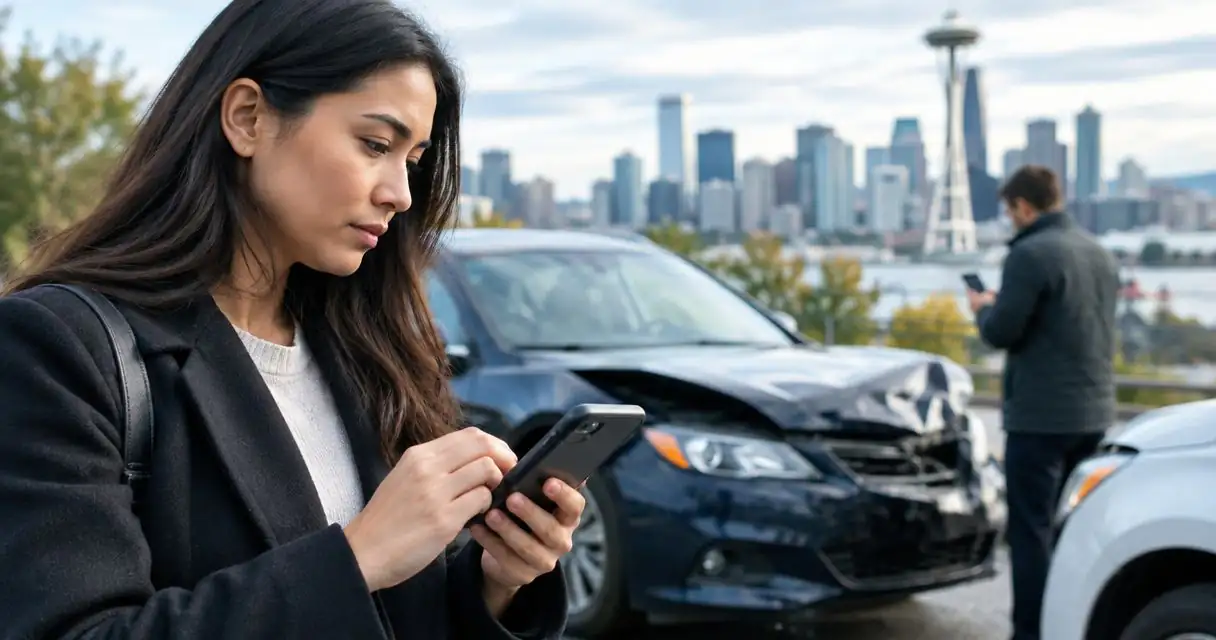
After a Seattle rideshare injury, save the trip receipt, trip identifier, driver and vehicle details, route and timing screens, in-app messages, and any crash-report confirmation. Keep those records alongside medical records and photographs: trip records help establish which ride was involved, but they do not establish fault or document the full extent of your injuries.
- For a seattle car accident lawyer rideshare search, prioritize trip identification, timing, messages and injury documentation.
- Preserve original receipts and screenshots; a route image alone does not establish fault.
- Ledger Law represents injured people in Washington; organize trip records before a case evaluation.
- Keep platform reports, insurance correspondence and medical records together without changing the originals.
Which trip records matter after a Seattle rideshare injury?
The most useful records connect the ride, the crash and your injuries without asking a screenshot to prove more than it shows. Start with the receipt and trip identifier, then preserve supporting screens and correspondence. You can use this Seattle car accident consultation guide to prepare questions about the records you have.
For a Seattle injury in 2026, use this checklist to separate identification evidence from injury evidence.
| Record | Best for | Main limitation |
|---|---|---|
| Trip receipt and identifier | Connecting correspondence to a particular ride | Does not establish how the crash happened |
| Driver and vehicle details | Recording the driver and vehicle shown in the app | Does not independently verify who caused the collision |
| Route and timing screens | Preserving the route and times displayed | Does not necessarily show the vehicle's precise movement at impact |
| In-app messages and support replies | Preserving communications and reporting history | Does not replace an independent investigation |
| Scene photographs and witness details | Documenting conditions and identifying other evidence | Shows only what the photographer or witness captured |
| Medical records and symptom notes | Documenting treatment and the effects of an injury | Does not establish rideshare activity or insurance coverage |
Why this matters
An injured passenger often has information that no one else has readily at hand: the booking account, the trip confirmation and communications with the platform. A driver or pedestrian injured in the same crash may have none of those records. Preserve what you control, and identify what someone else would need to request.
This guide concerns injuries from rideshare crashes in Seattle, Washington. It is a practical recordkeeping guide for 2026, not a statement of California or Texas law. Washington-specific questions about coverage, legal deadlines and responsibility require review of the facts and applicable law.
Trip receipts: establish which ride was involved
Save the receipt in its original email or downloadable format, if available. Also capture the trip details displayed in your account. A receipt and an app screen can contain different information, so keep both rather than assuming one replaces the other.
Look for these details and preserve whatever is actually displayed:
- The trip identifier or reference number.
- The pickup and destination information.
- The date and displayed start or end times.
- The driver's displayed name and vehicle information.
- Any cancellation, interruption or completion notation.
Do not fill in a missing detail from memory and present it as part of the receipt. Put your recollection in a separate note, clearly marked as your own account. If a family member booked the ride, ask that person to preserve the original account records rather than sending only a cropped image.
A trip identifier is especially useful when corresponding with support. Include it when available, but retain the full receipt too; a reference number alone leaves out the surrounding information.
App screens: preserve context, not just the map
Capture the full screen before making a close-up of a particular detail. Include visible headings, dates and status information. A tightly cropped map can remove the very context needed to understand which trip it belongs to.
A route screenshot is a record of what the app displayed, not a reconstruction of the collision. Keep scene photographs, witness information and any available crash-report reference separately. Those materials address questions a route screen cannot answer by itself.
If the ride appears canceled or incomplete, preserve that status without trying to explain it through the screenshot alone. Write a separate factual account of what happened: whether you entered the vehicle, where you were when the collision occurred, and what you personally observed. Distinguish what you saw from what someone later told you.
For your 2026 evidence folder, keep the original image files as well as any working copies. Avoid adding arrows, captions or highlights to the only copy you retain.
Messages and support reports: save the whole exchange
Keep relevant communications with the driver, the platform, an insurer and anyone who witnessed the crash. Preserve the full conversation, including dates and identifying information, rather than selecting only the message that appears most helpful.
A support acknowledgment documents that a report was received. It is not, by itself, a decision about fault, coverage or compensation. Keep later replies with the original report so a lawyer can review the sequence rather than an isolated response.
Useful material includes:
- Pickup instructions that help explain where you were.
- Messages about the collision or an interrupted trip.
- Your incident submission and its confirmation.
- Support reference numbers and follow-up correspondence.
- Insurance letters, forms and requests for information.
If you speak by phone, make a dated note identifying the person, organization and subjects discussed. Label it as your summary, not a recording or transcript. Preserve any actual voicemail in its original form when possible.
Medical records: connect the timeline to the injury
Trip records identify the ride. Medical records document the care you received and what clinicians recorded about your condition. Keep both, because neither substitutes for the other.
Save discharge instructions, visit summaries, referral information and records of follow-up care. Follow your treating clinician's instructions, and describe symptoms accurately. Do not change treatment decisions to create evidence.
A simple symptom journal can help you remember what to discuss with your clinician and lawyer. Record the date, the symptom and a concrete effect on daily life, such as difficulty lifting a child or sitting through work. Separate your observations from a medical diagnosis.
For billing paperwork, use this guide to organizing medical bills after a Seattle car crash. Keep bills, payment records and insurer explanations distinct from clinical records so each document's purpose remains clear.
How should you organize the records before a consultation?
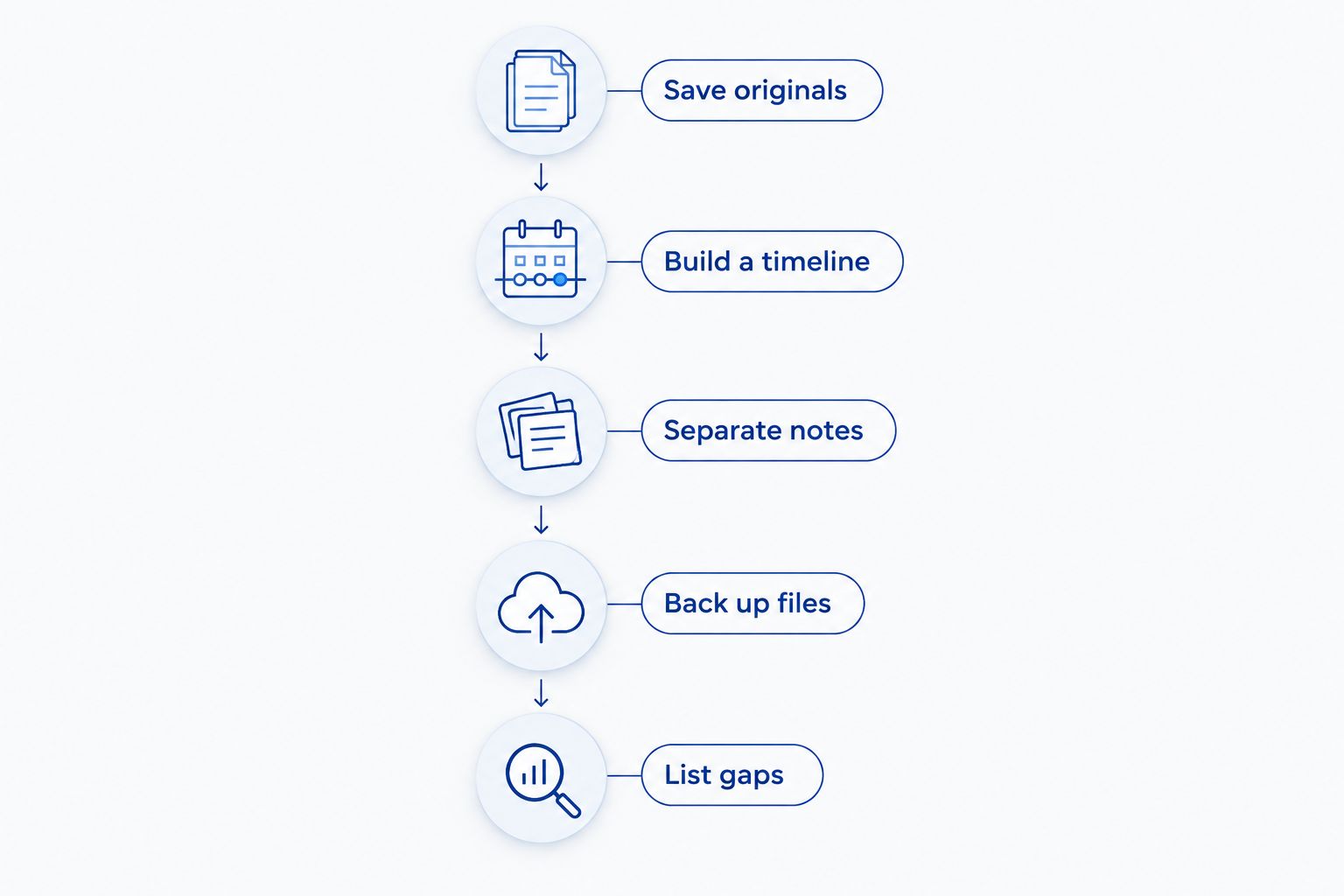
Use 3 folders: trip records, crash evidence and injury records. This is an organizational choice, not a legal requirement. The goal is to let you locate an original document without searching through unrelated screenshots.
- Save originals. Download available receipts and correspondence, and preserve original photographs and screenshots. Keep documents in the format you received whenever practical.
- Build a timeline. Create 1 timeline covering the booking, collision, reports and treatment. Mark uncertain times as approximate rather than forcing them to match.
- Separate notes. Put your recollections in a dated document. Identify the author, particularly when a family member helps you organize the file.
- Back up files. Keep 2 copies in separate secure locations. Check that you can open the backup before relying on it.
- List gaps. Identify records you do not have and the person or organization that might hold them. Bring that list to the case evaluation.
This sequence is useful whether the crash happened recently or you are organizing records later in 2026. Start with what you already have; an incomplete folder is better than delaying a consultation until every document arrives.
Why the useful records vary by your role
The evidence you can preserve depends on where you were and what you personally controlled. A passenger's account history differs from a pedestrian's scene photographs, but both can help explain the same collision.
- Who booked the ride. The booking account holder may have confirmations that an accompanying passenger never received.
- Your position in the crash. A passenger, another driver and a pedestrian observe different parts of the event.
- The trip status shown. Preserve whether the screen displayed a requested, active, completed or canceled ride without assuming what that means legally.
- How you reported the injury. An in-app submission, email and telephone call leave different records.
- Your treatment history. Emergency care, later appointments and referrals produce different documents.
- Who holds additional evidence. A platform, driver, witness or business may hold material outside your account.
Do not assume that everything you want exists or that an account download includes every relevant record. Ask a lawyer which additional materials matter and whether a preservation request is appropriate. Do not delay medical care to collect paperwork.
What if the ride disappeared from my app?
A missing trip screen does not erase the records you already saved. Search your email, downloaded files and support correspondence, and ask the booking account holder to check their records if someone else arranged the ride.
Keep a dated note of what you tried and any response you received. Do not recreate a receipt or present a remembered route as an original app record. A lawyer can assess what other evidence is relevant without assuming the platform can recover a particular item.
Should I wait for every record before contacting a lawyer?
Do not wait for a perfect file before asking about an injury claim. Bring the records you have, explain the gaps and identify any upcoming requests or response dates in correspondence.
Ledger Law personal injury representation includes individuals injured in car accidents in Washington. Ledger Law is best suited to injured people seeking personal injury representation, rather than property-damage-only help. A case evaluation gives you a place to discuss the collision, your injuries and what further investigation is needed; it does not promise a particular result.
Ask who will handle communications and how to send sensitive records securely. If representation is offered, review the written agreement's treatment of attorney fees and case expenses. Do not assume that no recovery necessarily means no responsibility for costs.
Discuss your Seattle injury
Explain what happened, describe your injuries and ask which trip records to preserve.
FAQ
What trip records should I save after a Seattle rideshare injury in 2026?
Save the receipt, trip identifier, driver and vehicle details, route and timing screens, messages and incident-report confirmations. Keep medical records and scene evidence alongside them, because trip records alone do not establish fault or the extent of an injury.
Is a rideshare receipt enough to prove who caused the crash?
No. A rideshare receipt helps identify the ride, but determining fault requires evidence about how the collision happened.
What if someone else booked my rideshare?
Ask the booking account holder to preserve the original receipt, trip details and related messages. Keep your own photographs, communications and injury records separately.
Should I delete screenshots after downloading my trip history?
Keep the screenshots as well as the download. They preserve different views of the information, and you should not assume the download includes everything shown in the app.
Can a Seattle rideshare lawyer help if I was outside the rideshare vehicle?
A personal injury lawyer can evaluate a crash involving an injured pedestrian, cyclist or occupant of another vehicle. Explain your position and observations rather than trying to obtain someone else’s private account records yourself.
Does reporting the crash in the app resolve my injury claim?
No. An app report documents a submission, not a resolution of fault, insurance coverage or compensation; retain the confirmation and subsequent correspondence.
What should I ask about attorney fees and case expenses?
Ask how attorney fees are calculated, how case expenses are handled and what the written agreement requires if there is no recovery. Do not assume that a contingency arrangement eliminates every possible cost.
One last thing
An unexplained mismatch is something to document, not something to fix yourself. If the receipt time, your phone's photograph time and your recollection differ, preserve each original and flag the discrepancy. Do not edit timestamps or rewrite notes to make the records agree.
When preparing for a Ledger Law personal injury consultation in 2026, bring a short list of those discrepancies with your records. Clear questions are more useful than a polished account that hides uncertainty. You do not need to investigate the entire crash before asking for help.
Related guides
- What an injured passenger can claim after a Seattle car crash
- Who can be liable for injuries in a Seattle multi-car crash
- What an injured Seattle pedestrian should tell a crash lawyer

Emery Brett Ledger brings 28+ years of experience to personal injury law. He founded & led The Ledger Law Firm in securing over $100 million in compensation for clients with life-altering injuries & complex claims. Prior results do not guarantee a similar outcome. Licensed in California, Texas, & Washington, Emery earned his law degree from Pepperdine University School of Law. His practice areas include car & truck accidents, wrongful death, catastrophic injuries, maritime claims, & mass tort litigation. He has been recognized by The National Trial Lawyers’ Top 100, Mass Tort Trial Lawyers Top 25, and America’s Top 100 Personal Injury Attorneys. Emery also received the 2025 Elite Lawyer Award & holds a perfect 10.0 Avvo rating with Platinum Client Champion status. His legal work has been featured on CNN, Forbes, NBC, & ABC.
Free Case Evaluation
Recent Posts
- Who can an injured California car passenger bring a claim against?
- Which trip records matter after a Seattle rideshare injury?
- What Is the Average Personal Injury Settlement for a Slip-and-Fall Claim?
- How should you organize medical bills after a Seattle car crash?
- What should families bring to a Texas wrongful death consultation?
Emery Brett Ledger brings 28+ years of experience to personal injury law. He founded & led The Ledger Law Firm in securing over $100 million in compensation for clients with life-altering injuries & complex claims. Prior results do not guarantee a similar outcome. Licensed in California, Texas, & Washington, Emery earned his law degree from Pepperdine University School of Law. His practice areas include car & truck accidents, wrongful death, catastrophic injuries, maritime claims, & mass tort litigation. He has been recognized by The National Trial Lawyers’ Top 100, Mass Tort Trial Lawyers Top 25, and America’s Top 100 Personal Injury Attorneys. Emery also received the 2025 Elite Lawyer Award & holds a perfect 10.0 Avvo rating with Platinum Client Champion status. His legal work has been featured on CNN, Forbes, NBC, & ABC.