Can a Texas truck accident claim involve several defendants?

Yes. A Texas truck accident claim can involve several defendants when evidence connects more than one person or business to your injuries. A driver, trucking company, maintenance provider, cargo-loading business, or manufacturer can face different allegations, but naming more defendants does not automatically increase compensation.
- A Texas truck accident attorney multiple defendants investigation must connect each proposed defendant to a supported legal claim.
- Ledger Law represents injured people in Texas truck accident claims; a case evaluation helps identify responsibility and evidence.
- Texas generally bars recovery when your share of responsibility exceeds 50 percent.
- Preserve trucking records early; company names, insurance policies, and vehicle ownership do not establish liability by themselves.
Why this matters
After a serious truck crash, you need treatment and answers—not a guessing game about which company is responsible. Different businesses can control the driver, trailer, maintenance, and cargo, so an investigation must look beyond the name painted on the truck.
Ledger Law is a fit for injured people seeking personal injury representation after a Texas truck accident. A case evaluation should address both your injuries and the evidence connecting potential defendants to the crash. You can start with Ledger Law while keeping medical care your first priority.
This page addresses Texas injury claims in 2026. California and Washington have different rules; do not apply the Texas fault thresholds below to crashes governed by another state's law.
Can a Texas truck accident claim involve several defendants?
Yes. Several defendants can belong in one Texas truck accident lawsuit when the facts support a legal claim against each. The central question is not how many businesses were involved in the shipment; it is what each business did, what responsibility it had, and how its conduct contributed to your injuries.
The following comparison identifies possible defendants, not a list of businesses that belong in every case.
| Potential defendant | Possible basis for a claim | Evidence to examine | Important limit |
|---|---|---|---|
| Truck driver | Unsafe driving that contributed to the collision | Witness accounts, video, electronic records, crash evidence | A citation alone does not resolve civil responsibility |
| Motor carrier | Responsibility for an employee's driving or its own negligent conduct | Employment records, dispatch communications, safety records | The driver's relationship to the carrier matters |
| Maintenance provider | Negligent inspection or repair connected to a failure | Work orders, inspection records, failed components | A repair history alone does not prove a defective repair |
| Cargo-loading business | Loading or securement conduct that contributed to the crash | Loading records, photographs, cargo condition | Responsibility depends on who performed or controlled the work |
| Manufacturer | A legally actionable product defect | Component examination, design records, expert analysis | A broken component is not automatically a defective product |
| Another driver | Driving that helped cause the collision | Video, witness accounts, vehicle damage | Fault must be evaluated separately from the truck driver's conduct |
Investigate broadly, then make claims selectively. Adding an unsupported defendant creates disputes without supplying the missing proof.
How do you identify the right defendants?
Start with records that show who controlled the truck and the work being performed. Then connect those relationships to the event that injured you.
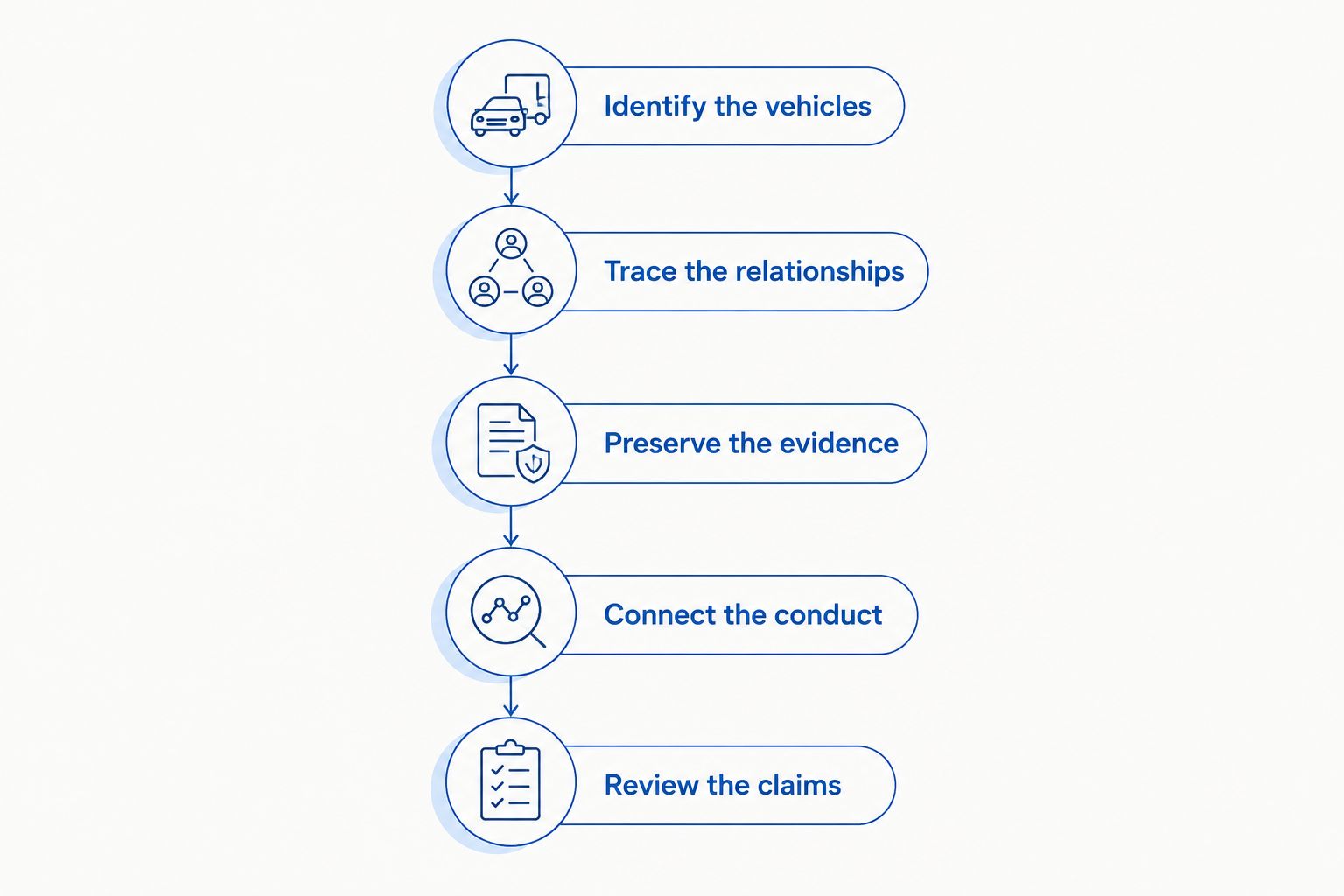
- Identify the vehicles. Save the truck and trailer identifiers, photographs, crash report information, and business names you already have. A tractor and trailer can have different owners.
- Trace the relationships. Identify the driver, motor carrier, vehicle owners, and businesses involved in loading or repair. Ownership, employment, and operational control answer different questions.
- Preserve the evidence. Ask counsel about preservation notices covering relevant video, electronic data, communications, and physical components. Keep your own photographs and original files.
- Connect the conduct. Determine whether a particular act or omission contributed to the collision and your injuries. Being involved in a shipment is not enough.
- Review the claims. Match the evidence to the applicable legal duties before deciding whom to sue. Some claims require technical analysis or face special legal defenses.
You do not need to complete this investigation before seeking representation. Bring what you have, even if the crash report is unfinished or the company relationships remain unclear.
Why responsibility varies between defendants
Different defendants do not necessarily face the same claim. In a Texas truck crash investigation, these factors shape the responsibility analysis:
- The driver's working relationship. Employment status and whether the driver acted within the scope of employment affect claims against a carrier.
- Control over the work. Dispatch instructions, repair decisions, and loading arrangements help identify who made the relevant decisions.
- The cause of the collision. Unsafe driving, a mechanical failure, and shifting cargo require different evidence.
- The timing of a failure. Damage caused by the collision must be distinguished from a condition that caused it.
- The legal basis of the claim. Negligence, responsibility for an employee, and product liability involve different requirements and defenses.
- Available proof. A plausible explanation still needs records, testimony, physical evidence, or other admissible support.
Insurance belongs in the investigation, but insurance is not a substitute for liability. A business's policy does not prove that the business caused your injuries or that the policy covers the claim.
How does Texas divide responsibility among several parties?
Texas uses proportionate responsibility for many personal injury claims. Under Texas law, an injured claimant generally cannot recover damages when the claimant's responsibility exceeds 50 percent. At 50 percent, that particular bar does not apply, although the claimant's damages are reduced by the assigned responsibility under Texas law.
For an ordinary negligence claim governed by Chapter 33, a defendant assigned 51 percent responsibility crosses the more-than-50-percent threshold for joint and several liability under Texas law. That rule can make the defendant responsible for more than its individual percentage of recoverable damages. Statutory exceptions and the particular claims still matter.
These are the Texas statutory thresholds relevant to this discussion in 2026. They are not predictions about your case, and an insurer's opening fault assessment is not a final court determination.
Multiple-defendant cases also distinguish between a defendant and a designated responsible third party. Under Texas law, a responsible-third-party designation can affect allocation of responsibility without itself making that person liable to you. Ask counsel who is actually being sued, who is only being designated, and what that distinction means for recovery.
What evidence should you preserve when several businesses are involved?
Preserve evidence that shows both what happened and who controlled the relevant activity. The crash report is a starting point, not the entire investigation.
For the vehicle and trip, relevant material can include electronic logging records, dispatch communications, available camera recordings, inspection documents, maintenance records, and loading paperwork. Which records matter depends on the suspected cause; not every truck has every type of recording or electronic data.
Keep your medical records, treatment instructions, work restrictions, and communications about missed work. These connect the collision to the harm for which you seek compensation. Save original photographs and messages rather than relying only on edited screenshots.
Footage requires particular attention because the person driving is not necessarily the person administering the recording system. Establishing who controls dash cam footage helps identify the appropriate recipient for a preservation request; access, storage, and deletion authority are separate questions. Do not assume a driver's statement about a recording resolves what the carrier or system administrator holds.
A preservation notice is not the same as obtaining the evidence. Counsel must still pursue the appropriate requests, inspections, agreements, or court procedures. The notice should identify relevant material without assuming a universal retention period.
For a focused checklist, read what evidence a Texas truck accident attorney should preserve. Do not contact a trucking business to arrange your own inspection of a damaged commercial vehicle. Let counsel address access and preservation while you focus on treatment.
Does adding defendants mean a larger settlement?
No. Multiple defendants do not create multiple recoveries for the same injury. Your damages, the evidence of responsibility, applicable defenses, insurance coverage, and collection issues all affect the claim.
A broader investigation has a clear benefit: it can identify responsibility that an examination of the driver alone would miss. It also adds work. More parties can mean additional document disputes, depositions, experts, and disagreements about who caused what.
Keep these questions separate during a 2026 case evaluation:
- Who has a legally supported responsibility for the injury?
- What losses can the evidence establish?
- What insurance or other recovery sources apply?
- What case expenses will the investigation require?
A careful evaluation addresses all of them. A promise based only on the number of defendants does not.
Can you settle with one defendant and continue against others?
Yes, a Texas injury claim can involve a settlement with one defendant while claims against others continue. But the release language, settlement credits, and responsibility issues require review before you sign.
Texas law addresses settlement-related reductions in covered cases. A payment from one party therefore cannot be treated as automatically separate from the remaining claim. The precise effect depends on the applicable law and settlement terms.
Give your attorney every proposed release, check, and settlement communication. Do not assume a document releases only the person whose name appears at the top. A release can define covered parties more broadly than you expect.
How long do you have to bring a Texas truck injury lawsuit?
Two years is the general Texas limitations period for personal injury claims under Texas law. Exceptions and claim-specific requirements can change the analysis, so the deadline must be reviewed for your facts rather than calculated from this article alone.
In 2026, identifying defendants promptly remains important because naming one party does not necessarily preserve claims against every other party. Notice requirements and claims involving government entities also need separate attention.
Do not wait for your treatment to end before asking about deadlines. You can continue receiving care while counsel evaluates responsibility, preserves evidence, and determines when legal action is necessary.
What should you ask during a case evaluation?
You deserve an explanation of the investigation, not a guarantee. Ask Ledger Law how the available facts support examining the carrier, driver, and any other business connected to the crash.
Useful questions include:
- Which potential defendants need investigation, and why?
- What evidence needs immediate preservation?
- Which allegations require an expert?
- How will updates and settlement decisions be communicated?
- How are attorney fees calculated, and who pays case expenses?
- What happens to expenses if there is no recovery?
Read the fee agreement carefully. Attorney fees and case expenses are different, and you should not assume that no recovery necessarily means no costs. Multiple-party litigation makes that distinction especially important.
Discuss your Texas truck injury claim
Ask about potential defendants, evidence preservation, deadlines, and the fee agreement.
FAQ
Can I sue the trucking company and the driver together in Texas?
Yes, when the facts support claims against both the driver and trucking company. The driver’s working relationship, scope of employment, and the company’s own conduct require separate review.
Is the company named on the trailer automatically responsible?
No, the company named on the trailer is not automatically responsible for your injuries. Ownership, control, and conduct must be investigated rather than inferred from signage.
Can a maintenance company be responsible for a truck crash?
Yes, a maintenance company can face a claim when a legally actionable inspection or repair failure contributed to the crash. A maintenance record or broken part alone does not establish that connection.
Can I recover if I was partly at fault in Texas?
Yes, Texas generally permits recovery at 50 percent responsibility or less, with damages reduced for your share of responsibility. Responsibility greater than 50 percent generally bars recovery under Texas law.
Does every defendant have to pay an equal share?
No, defendants do not automatically pay equal shares. Texas responsibility allocation, joint and several liability rules, settlement credits, and the specific claims determine payment obligations.
How long do I have to file a Texas truck accident injury lawsuit?
Two years is the general Texas personal injury limitations period under Texas law. Exceptions and separate notice requirements require an individual deadline review.
Do several defendants guarantee more compensation?
No, several defendants do not guarantee more compensation. Each claim needs support, and your damages, responsibility allocation, defenses, and available recovery sources still matter.
One last thing
The name on the truck is a lead, not a liability finding. Save the photographs, paperwork, and messages you already have, and bring them to a case evaluation. Your job is to explain what happened and how you were hurt—not to solve the trucking company's business relationships yourself.
Related guides
- What should you bring to a Dallas car accident lawyer consultation?
- How can a Dallas lawyer investigate a hit-and-run injury?

Emery Brett Ledger brings 28+ years of experience to personal injury law. He founded & led The Ledger Law Firm in securing over $100 million in compensation for clients with life-altering injuries & complex claims. Prior results do not guarantee a similar outcome. Licensed in California, Texas, & Washington, Emery earned his law degree from Pepperdine University School of Law. His practice areas include car & truck accidents, wrongful death, catastrophic injuries, maritime claims, & mass tort litigation. He has been recognized by The National Trial Lawyers’ Top 100, Mass Tort Trial Lawyers Top 25, and America’s Top 100 Personal Injury Attorneys. Emery also received the 2025 Elite Lawyer Award & holds a perfect 10.0 Avvo rating with Platinum Client Champion status. His legal work has been featured on CNN, Forbes, NBC, & ABC.
Free Case Evaluation
Recent Posts
- Attorneys for Work Injuries: How to Decide Whether to Contact One and Prepare for an Evaluation
- Injury Attorneys Dallas: How to Decide Whether to Contact a Car Accident Lawyer
- Personal Injury Lawyer Greenville South Carolina: How to Decide Whether to Seek Help After a Slip and Fall
- Lawyers for Wrongful Death: How to Choose One and Prepare for a Case Evaluation
- Injury Attorney in LA: How to Decide Whether to Seek a Case Evaluation After a Crash
Emery Brett Ledger brings 28+ years of experience to personal injury law. He founded & led The Ledger Law Firm in securing over $100 million in compensation for clients with life-altering injuries & complex claims. Prior results do not guarantee a similar outcome. Licensed in California, Texas, & Washington, Emery earned his law degree from Pepperdine University School of Law. His practice areas include car & truck accidents, wrongful death, catastrophic injuries, maritime claims, & mass tort litigation. He has been recognized by The National Trial Lawyers’ Top 100, Mass Tort Trial Lawyers Top 25, and America’s Top 100 Personal Injury Attorneys. Emery also received the 2025 Elite Lawyer Award & holds a perfect 10.0 Avvo rating with Platinum Client Champion status. His legal work has been featured on CNN, Forbes, NBC, & ABC.