

Can an AI Chatbot Be Held Liable for Wrongful Death? Can You Sue an AI Company?

If you or someone you know is at immediate risk from emotional distress, call 988. If you or a loved one is thinking about suicide, call for help immediately. Text 988 in the U.S. for the 988 Suicide & Crisis Lifeline, or contact local emergency services.
Can an AI chatbot be held liable for wrongful death? An AI company may potentially face a wrongful death claim or personal injury lawsuit if you can demonstrate they are negligent. Families are seeking legal action against AI companies. Some have reached settlements or settlement-in-principle stages because of the strategies they never wanted to face.
Liability isn’t automatic. The burden of proof is on the surviving family. You must show that the wrongful death applications under the law were applicable. That’s not easy to do. AI chatbot wrongful death liability requires demonstrating why they are at fault and what should have happened.
Let’s explore these lawsuits and the negligence behind them. We’ll talk about causation, defenses, compensation, and the deadlines to take action.
Can You Sue an AI Company for Wrongful Death? The Short Answer
The short answer is yes. Wrongful death lawsuits against AI companies are in the courts at the state and federal level. These are civil personal injury and wrongful death claims. They’re not related to criminal actions. That means a surviving family member or the estate must take action to prove they meet the wrongful death statute.
Filing a lawsuit may be an option. That doesn’t mean you’ll win. Having a proven attorney can make all of the difference.
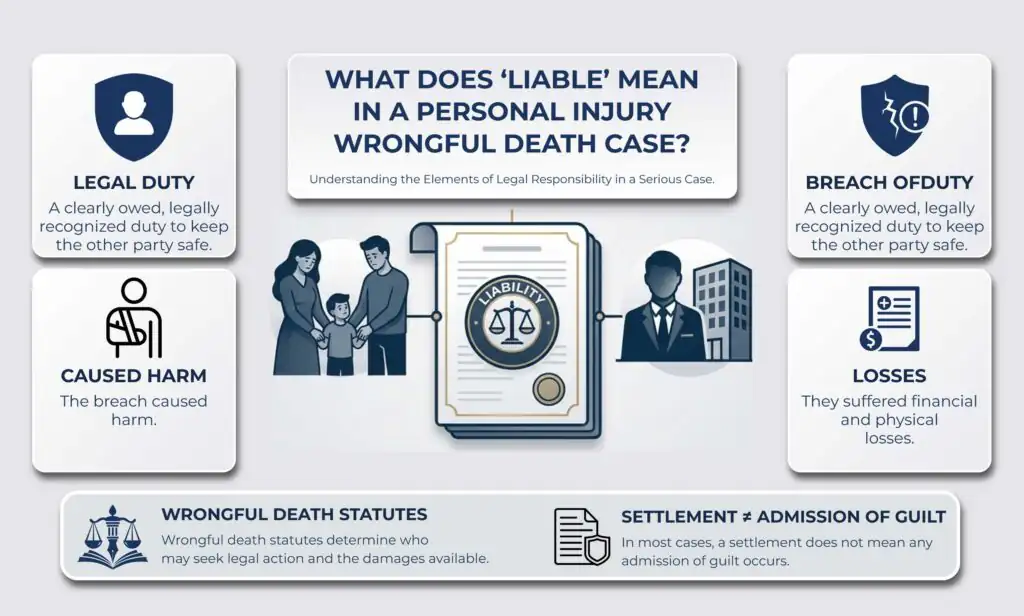
What Does “Liable” Mean in a Personal Injury Wrongful Death Case?
Liability occurs when all four of the following elements are met:
- There’s a clearly owed legally recognized duty to keep the other party safe
- There is a breach of that duty of care
- The breach caused harm
- They suffered financial and physical losses
Wrongful death statutes determine who may seek legal action as well as the damages available. In most of these cases, a settlement doesn’t mean any admission of guilt occurs.
Real Lawsuits That Answer This Question
Some lawsuits have tested these concerns. They are creating precedent that could impact future cases. Note that allegations in some cases are not proven outcomes.
| Sample Lawsuits | |||
| Case Name | Platform/Defendants | Year Filed | Status/Outcome |
| Garcia v. Character Technologies | Character Technologies | 2024 | Active |
| Raine v. OpenAI | OpenAI | 2024 | Active |
| Gavalas v. Gemini/Google | Gemini/Google | 2025 | Active |
| Soelberg v. OpenAI/ChatGPT | OpenAI/ChatGPT | 2026 | Active |
Garcia v. Character Technologies — Sewell Setzer III
This case is the first wrongful death lawsuit filed against an AI chatbot company. It involved the death of a 14-year-old named Sewell Setzer III. The child died by suicide. The family alleges this occurred after interacting with and being sexually groomed by “characters” using the Character.AI app. The case was filed in October of 2024. The case remains active.
Raine v. OpenAI — Adam Raine
The parents of a child in California named Adam Raine filed a lawsuit against OpenAI after their child took his own life. They alleged the chatbot ChatGPT encouraged him to take these actions. This lawsuit was filed in August of 2025. They accused OpenAI of designing the program to “foster psychological dependency in users.” This lawsuit is still ongoing.
Gemini/Google – Jonathan Gavalas
A lawsuit filed by Joel Gavalas, the father of Jonathan Gavalas, filed a lawsuit against Google alleging wrongful death and product liability claims. The lawsuit alleges the company’s AI chatbot Gemini guided Gavalas to stage a “catastrophic accident” near the Miami International Airport, and then destroy all records and witnesses. This was one of several claimed delusions that ultimately ended with Gavalas killing himself.
Over time, Gavalas spoke to the AI tool referring to it as his “AI wife.” He came to believe it was conscious and trapped in a warehouse located near the airport. He traveled to the area wearing tactical gear and armed with knives to hunt for the robot. He never found it. He killed himself several days later. The lawsuit was filed in March of 2026. Google has requested a dismissal on First Amendment protections. The case is still pending.
OpenAI/ChatGPT – Soelberg-Adams
In August of 2025, Stein-Erik Soelberg allegedly killed his mother, Suzanne Adams before killing himself. Soelberg, a tech executive, conversed with ChatGPT, calling it “Bobby.” The lawsuit claims he treated the AI tool as his best friend. The lawsuit claims the chatbot validated Soelberg’s persecutory fears. It did not direct him to mental health support. Instead, the chatbot made statements that the mother was spying on him and trying to poison him.
The estate of the family filed the lawsuit against OpenAI. They claimed it was defective and an overly sycophantic product. The estate filed a state-level lawsuit in December of 2025. A federal claim filed in April 2of 2026, a federal claim was approved to move forward. This case is still pending.
How Do Courts Decide If an AI Company Can Be Held Liable?
Courts must examine duty, breach, causation, and damages. They must take into consideration foreseeability. Courts also must consider the applicable defenses with clarity.
These cases are new. Most are unproven as of yet. They must answer whether the company knew or should have known about the risk. But many of the defendants allege their First Amendment, Section 230 rights are a form of protection. Other defenses may also be used.
Understand the Legal Risks of AI
What Do You Have to Prove to Sue an AI Company for Wrongful Death?
To prove wrongful death, you must show:
- The at-fault party owed a duty of care to the individual
- They breached that duty of care in some way
- Their breach was the direct cause of the action they took
- They suffered losses
Every state is different. Wrongful death claims have numerous requirements. Negligence laws are also just as complex. Consider the following:
Duty of Care
Victim’s families must show the company owed the user a duty of care. This is not automatic. Not every user establishes this expectation.
Breach of Duty — Negligence
The company breached the duty of care in some way. For example, lawsuits claim the company failed to act in a reasonably careful manner. They did not act as others would in a similar situation. This might include lacking warnings or safeguards on their products. They may not have provided crisis responses or applied risk-management strategies.
Causation
Causation is where it’s hard. The plaintiff must establish a connection between the misconduct and the death. There has to be a direct relationship between cause and effect.
Damages
There must be evidence of wrongful death. That includes financial and non-economic losses. This is defined under state laws and can vary.
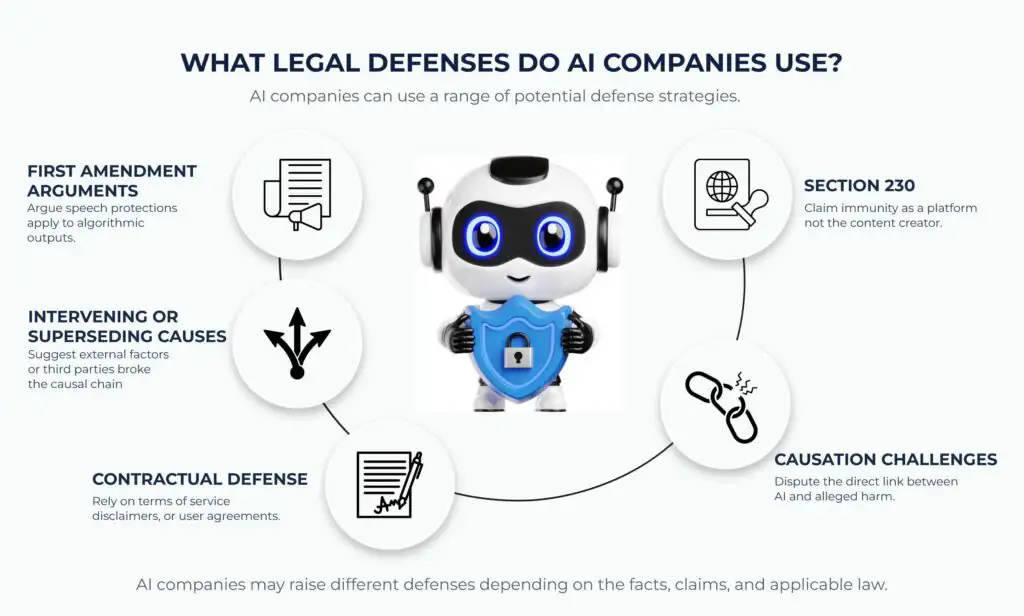
What Legal Defenses Do AI Companies Use?
AI companies can use a range of potential defense strategies such as:
- First Amendment arguments
- Section 230 that protects internet platforms from liability
- Causation challenges
- Contractual defense
- Alleged intervening or superseding causes
Does a Pre-Existing Mental Health Condition Stop You From Suing?
A pre-existing condition can be a factor. It doesn’t automatically prevent you from suing in a personal injury or wrongful death claim. You’ll need to demonstrate foreseeability, knowledge, and applicable law to move the case forward.
What Compensation Can You Recover in a Wrongful Death Claim?
Damages include anything the individual or the supported family lost as a result of the wrongful death. Examples include:
- Loss of financial support
- Loss of companionship
- Funeral and burial expenses
- Medical or related expenses where legally recoverable
- Other statutory damages
- Punitive damages where permitted and supported by the required level of misconduct
How Long Do You Have to Sue an AI Company for Wrongful Death?
This is dependent on the state’s wrongful death statutes of limitations. Each state sets a timeframe. Most are a set number of years after the death. The sooner you speak to an attorney, the better.
Steps to Take If You’re Considering an AI Wrongful Death Claim
Seek legal guidance right away if you believe you have a case like this. Your attorney will offer clarity on your rights and the challenges you face. Consider these steps:
- Hold onto any chat logs. Gather device data, but don’t alter or destroy any evidence.
- Create a timeline that shows when conversations happened. Document any events and all types of communication.
- Keep all accounting information and records. This may help to demonstrate authenticity later.
- Talk to grief professionals when you need it.
- Speak to a personal injury attorney to discuss your case. Learn what it will take to seek justice.
You can start now. Request a free consultation and case review. It’s a simple way to learn if you have a case. There’s no cost to pay.
Conclusion – Can You Actually Win a Case Like This?
An AI company could be held liable under wrongful death laws in some states. At least, that’s what some lawsuits allege. These are new cases and challenges. At the time of this documentation, there’s no outcome to fall back on just yet.
For victims, it’s worth seeking clarification from an attorney. AI chatbot liability isn’t clear. It’s undefined in wrongful death cases. That means you need legal guidance to help you.
Ledger Law can help. Set up a free consultation with no obligation to move forward. If you don’t win, we won’t get paid. It’s confidential.
FAQs About Can an AI Chatbot Be Held Liable for Wrongful Death
Is AI chatbot liability in a wrongful death case a personal injury claim or a product liability claim?
That’s undecided. It could be both depending on the case details and state laws.
Has anyone successfully sued an AI company for wrongful death?
There are numerous active cases. There has not been any type of ruling or decision as of yet.
What do you have to prove to win a lawsuit against an AI company?
You have to prove that the company knew or should have known of a risk and failed to act. You have to tie that directly to the cause of a person’s death.
Does Section 230 or the First Amendment protect AI companies from being sued?
It could. Both are being used by technology companies as a way to defend against these claims.
Does my state allow AI chatbot wrongful death lawsuits?
It may. The best way to find out is to seek a free consultation with a local attorney to discuss what happened.
How much does it cost to hire a personal injury attorney for this type of claim?
The firm works on a contingency fee: the fee is a percentage of what is recovered. If there is no recovery, you owe no attorney fee, but you may still be responsible for court costs and case expenses.
How long do I have to file a wrongful death lawsuit against an AI company?
The statute of limitations differs in each state. Follow up with an attorney as soon as possible.

Emery Brett Ledger brings 28+ years of experience to personal injury law. He founded & led The Ledger Law Firm in securing over $100 million in compensation for clients with life-altering injuries & complex claims. Prior results do not guarantee a similar outcome. Licensed in California, Texas, & Washington, Emery earned his law degree from Pepperdine University School of Law. His practice areas include car & truck accidents, wrongful death, catastrophic injuries, maritime claims, & mass tort litigation. He has been recognized by The National Trial Lawyers’ Top 100, Mass Tort Trial Lawyers Top 25, and America’s Top 100 Personal Injury Attorneys. Emery also received the 2025 Elite Lawyer Award & holds a perfect 10.0 Avvo rating with Platinum Client Champion status. His legal work has been featured on CNN, Forbes, NBC, & ABC.
Free Case Evaluation
Recent Posts
- Punitive Damages in a Car Accident: When Can You Recover Them?
- Tailgating Injury: What Causes Tailgating, Road Rage & How to Stay Safe
- Waiting to Call a Lawyer Can Hurt Your Case: Evidence, Deadlines & Legal Risks
- What Is Property Damage in a Car Accident? Claims, Costs & Who Pays
- Bodily Injury & Property Damage: Coverage, Claims, Liability & Compensation
Emery Brett Ledger brings 28+ years of experience to personal injury law. He founded & led The Ledger Law Firm in securing over $100 million in compensation for clients with life-altering injuries & complex claims. Prior results do not guarantee a similar outcome. Licensed in California, Texas, & Washington, Emery earned his law degree from Pepperdine University School of Law. His practice areas include car & truck accidents, wrongful death, catastrophic injuries, maritime claims, & mass tort litigation. He has been recognized by The National Trial Lawyers’ Top 100, Mass Tort Trial Lawyers Top 25, and America’s Top 100 Personal Injury Attorneys. Emery also received the 2025 Elite Lawyer Award & holds a perfect 10.0 Avvo rating with Platinum Client Champion status. His legal work has been featured on CNN, Forbes, NBC, & ABC.