Can an injured motorcycle passenger bring a claim in Dallas?

Yes. An injured motorcycle passenger can bring a claim in Dallas in 2026 when another person’s negligence caused the crash or contributed to the passenger’s injuries. The claim can involve the motorcycle operator, another driver, or both, but being a passenger does not automatically establish fault, insurance coverage, or the amount recoverable.
- An injured Dallas motorcycle passenger can pursue a Texas negligence claim against the person responsible.
- Searching ‘dallas motorcycle accident lawyer passenger’? Focus on fault evidence, medical records, and applicable insurance.
- Texas generally allows two years for a personal injury lawsuit, subject to exceptions.
- Ledger Law represents injured people; a case evaluation can address responsibility, coverage, and practical next steps.
Can an injured motorcycle passenger bring a claim in Dallas?
Yes. Your right to pursue an injury claim is separate from the motorcycle operator’s claim. You do not have to own the motorcycle, and an injury claim is not limited to repairing or replacing the bike.
Ledger Law represents people injured in motorcycle accidents in Texas. Ledger Law is best suited to injured people seeking personal injury representation, not property-damage-only assistance. Whether representation fits your situation depends on the crash facts and the legal issues involved.
The starting question is who caused your injuries, not simply whose motorcycle you rode.
| Potentially responsible person | What the investigation examines | Important limitation |
|---|---|---|
| Motorcycle operator | Unsafe speed, loss of control, following distance, and other driving conduct | Being the operator does not automatically establish negligence |
| Another driver | Turns, lane changes, right-of-way violations, distraction, and collisions | Contact between vehicles is not the only evidence of responsibility |
| More than one person | How separate actions combined to cause the crash | Responsibility must be established for each person pursued |
A police report helps identify people and evidence. It does not replace the full investigation or decide every disputed issue in a civil injury claim.
Why this matters for an injured passenger
You can face medical appointments, missed work, and uncomfortable conversations with someone you know. If the motorcycle operator is a friend or family member, asking about a claim can feel personal. Investigating insurance and legal responsibility is not the same as accusing someone without evidence.
For a Dallas injury claim in 2026, the practical goal is to identify the responsible parties while preserving your ability to obtain care and document the harm. Do not assume the operator’s insurer is handling your separate interests just because someone reported the crash.
Ask who has opened a passenger injury claim, which insurer is handling it, and what information that insurer needs. Keep your own copies of correspondence rather than relying on another person’s claim file.
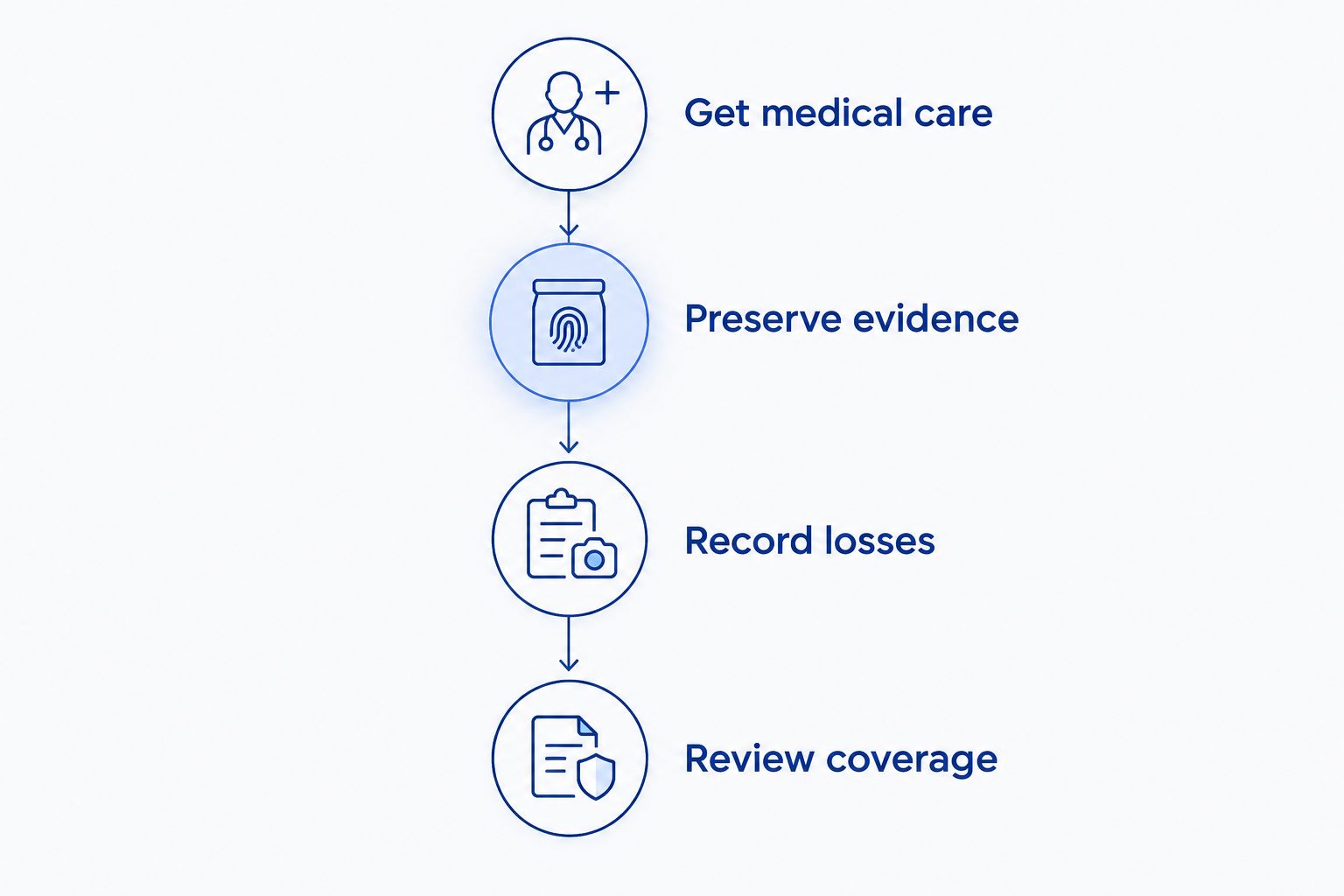
What should you do after a Dallas motorcycle passenger injury?
Get medical care
Seek emergency care for urgent symptoms. Follow your treating clinician’s instructions and describe what happened, including any impact, fall, or loss of consciousness.
Tell the clinician about symptoms you actually experience. Do not minimize an injury to protect the operator, and do not exaggerate it to strengthen a claim. Accurate records support both your treatment and an honest account of the crash.
Preserve evidence
Save photographs of the scene, motorcycle, other vehicles, clothing, helmet, and visible injuries. Keep original files when possible. Do not discard damaged equipment before asking whether it needs inspection.
Preserve messages about the ride, witness contact information, insurance correspondence, and the crash report number. If pain or hospitalization prevents you from doing this, ask someone you trust to help organize what already exists.
Record losses
Keep medical bills, treatment records, work restrictions, and documentation of missed work. Describe how injuries affect ordinary activities, such as dressing, sleeping, caring for children, or traveling to appointments.
A brief, factual record is more useful than dramatic language. Note changes as they happen, and distinguish what you personally remember from what someone later told you.
Review coverage
Identify the motorcycle policy and any policy covering another involved vehicle. Ask an attorney to examine other potentially applicable coverage rather than assuming one insurer is the only possible source of recovery.
You do not need a complete file before asking for legal help. Missing documents are something to identify and pursue, not a reason to postpone an initial conversation.
Can I bring a claim against the motorcycle operator?
Yes, if the motorcycle operator’s negligence caused or contributed to your injuries. Accepting a ride does not, by itself, prevent you from pursuing an injury claim against the operator.
The investigation should separate your relationship with the operator from the evidence. An operator’s account, witness statements, vehicle damage, and available recordings can help explain what occurred. If another driver also contributed, the claim should address that conduct rather than treating the operator as the only possible defendant.
Do not let a personal relationship determine what you tell medical providers or insurers. State the facts you know, identify what you do not remember, and avoid agreeing to an account simply because someone asks you to support it.
A claim also does not guarantee an insurance payment. Responsibility, policy language, available coverage, and documented injuries remain separate questions.
How does Texas passenger fault affect a claim?
Texas uses proportionate responsibility. Under Texas law, a claimant’s damages are reduced by the claimant’s percentage of responsibility, and recovery is barred when that responsibility exceeds 50%.
A 51% share of responsibility therefore bars recovery under that rule. A finding of 50% does not trigger the same bar, although the claimant’s damages are reduced. These are Texas rules, not rules to borrow from another state’s passenger-claim article.
A passenger’s conduct must be evaluated on the actual evidence. Simply sitting behind the operator does not establish a percentage of fault. If an insurer alleges that something you did contributed to the crash or injuries, ask what conduct it identifies and what evidence supports that position.
For a disputed Texas claim in 2026, an attorney should examine both the allegation and its connection to the harm claimed. Do not accept a fault allocation merely because it appears in an insurer’s letter.
Why motorcycle passenger claims vary
Passenger injury claims turn on facts that affect responsibility, proof, and the recovery available under applicable law. These factors deserve attention:
- How the crash happened. A turning vehicle, a rear-end impact, and a single-motorcycle crash present different evidence questions.
- Who contributed. The investigation must address each potentially responsible person rather than assume only one driver matters.
- What injuries the crash caused. Medical records connect the collision, symptoms, treatment, and any continuing limitations.
- What coverage applies. Policy terms, exclusions, and limits affect the insurance analysis independently of fault.
- What evidence remains. Original photographs, witness accounts, recordings, and physical evidence help resolve conflicting stories.
- Whether legal deadlines or special procedures apply. The correct timetable depends on the parties and circumstances, not just the accident date.
A serious injury does not eliminate the need to prove responsibility, and clear responsibility does not establish the full extent of an injury. Both parts need documentation.
Which insurance should a passenger ask about?
Start with liability coverage for each potentially responsible driver. Depending on the policies and facts, an attorney can also assess whether uninsured or underinsured motorist coverage or other injury-related benefits apply.
Do not assume a policy covers you simply because it belongs to your household or covers a vehicle involved in the crash. Ask for the relevant policy documents and any written coverage decision. A claim number alone does not explain the insurer’s obligations.
In 2026, the practical distinction remains the same: fault and coverage are separate questions. An insurer can dispute responsibility, coverage, the connection between treatment and the crash, or the extent of claimed losses. Identify the dispute before deciding how to respond.
You should also distinguish an injury settlement from arrangements concerning the motorcycle itself. Read any proposed release carefully; its wording determines which claims it resolves.
Does it matter that the crash happened in Dallas, not another state?
Yes. A Dallas motorcycle passenger claim requires Texas legal analysis. Rules governing fault, filing deadlines, insurance, and litigation procedure are not interchangeable across state lines.
For example, the question raised by passenger injury claims in Georgia—whether a passenger can pursue the driver—also arises in Dallas, but the answer for your case must account for Texas law. A similar accident scenario does not make another state’s legal rules applicable.
Tell your attorney where the crash occurred, where the involved people live, and whether a business or public entity was involved. Those facts can affect the legal analysis. Do not choose a deadline or assume coverage based on an article describing a different jurisdiction.
How long do I have to file a Dallas passenger injury lawsuit?
Two years is the general Texas deadline for a personal injury lawsuit, under Texas law. Exceptions and special notice requirements can change the analysis, so an attorney should confirm the deadline for your specific circumstances.
Reporting the crash, receiving treatment, or negotiating with an insurer does not itself file a lawsuit. Do not assume an open claim or an ongoing conversation extends the filing period.
For a crash in 2026, preserve the exact accident date and have the deadline reviewed promptly. If a child was injured, a public entity was involved, or the facts raise another exception, flag that issue during the first consultation rather than calculating the deadline yourself.
Waiting also creates problems unrelated to the filing deadline. Recordings can be lost, witnesses become harder to locate, and physical evidence can change. Early evidence preservation and timely filing serve different purposes; you need to address both.
What should I bring to a case evaluation?
Bring what you have, even if the file is incomplete. Start with the crash date and location, the operator’s name, other drivers’ information, medical records, photographs, and insurance correspondence.
The same preparation principles described in what to bring to a Dallas car accident lawyer consultation help organize a motorcycle passenger consultation. Clearly explain that you were the passenger and identify any part of the crash you cannot remember.
Ask Ledger Law to explain which responsibility and coverage questions need investigation. Also ask how the representation agreement treats attorney fees, case expenses, reimbursement, and expenses if there is no recovery. Attorney fees and case expenses are different; do not assume that no recovery necessarily means no costs.
A case evaluation helps identify the next steps. It is not a promise of a settlement, a lawsuit, or a particular outcome.
FAQ
Can I make a claim if the motorcycle operator is my spouse or friend?
A personal relationship does not, by itself, resolve whether you can pursue a passenger injury claim. An attorney should review the operator’s conduct, applicable coverage, and any legal issues connected to the relationship.
Can a motorcycle passenger claim medical bills and lost income?
A motorcycle passenger can seek compensation for legally recoverable losses caused by the crash, including supported medical expenses and lost income. The evidence must establish responsibility and connect those losses to the injuries.
Do I have to know which driver caused the crash before calling a lawyer?
No. You can seek a case evaluation while responsibility remains disputed. Bring the information you have so the attorney can identify the evidence needed to investigate.
What if the other driver left the Dallas crash scene?
A hit-and-run does not automatically eliminate a passenger injury claim. Identifying evidence and reviewing potentially applicable insurance are separate tasks that need prompt attention.
Should I give an insurance adjuster a recorded statement?
Before giving a recorded statement, clarify which insurer is asking and whether your policy creates any cooperation duties. Get legal advice about those obligations, answer truthfully, and do not guess about facts you cannot remember.
Should I accept a settlement while I am still treating?
Do not sign a settlement release until you understand which claims it ends and how continuing treatment affects your documented losses. A release can resolve claims even though medical care continues.
Can Ledger Law review a Dallas motorcycle passenger injury?
Ledger Law represents people injured in motorcycle accidents in Texas. A case evaluation can address the crash facts, injuries, potentially responsible parties, insurance questions, and representation terms.
One last thing
The motorcycle operator’s claim file is not your medical history or your complete injury claim. Keep your own records, describe your own symptoms, and make sure any proposed settlement addresses your interests rather than only the operator’s losses.
If you take one practical step after arranging care, create a single folder for crash evidence, treatment documents, work records, and insurer messages. You do not need to solve the case yourself. You need to preserve what helps explain it.
Related guides
- How a Dallas lawyer can investigate a hit-and-run injury
- Getting help after an uninsured Dallas crash
- When a Texas truck accident claim involves several defendants

Emery Brett Ledger brings 28+ years of experience to personal injury law. He founded & led The Ledger Law Firm in securing over $100 million in compensation for clients with life-altering injuries & complex claims. Prior results do not guarantee a similar outcome. Licensed in California, Texas, & Washington, Emery earned his law degree from Pepperdine University School of Law. His practice areas include car & truck accidents, wrongful death, catastrophic injuries, maritime claims, & mass tort litigation. He has been recognized by The National Trial Lawyers’ Top 100, Mass Tort Trial Lawyers Top 25, and America’s Top 100 Personal Injury Attorneys. Emery also received the 2025 Elite Lawyer Award & holds a perfect 10.0 Avvo rating with Platinum Client Champion status. His legal work has been featured on CNN, Forbes, NBC, & ABC.
Free Case Evaluation
Recent Posts
- What Is a Legal Tort After a Car Accident? Understanding Claims, Negligence, and Next Steps
- Tort Law and Slip-and-Fall Injuries: How to Decide Whether to Seek a Case Evaluation
- Tort Lawyer for a Slip and Fall: How to Decide Whether to Seek Help and Prepare for a Case Evaluation
- Suing After a Car Accident: How to Compare Your Options, Evidence, Timing, and Costs
- How to Settle a Car Accident Claim Without a Lawyer
Emery Brett Ledger brings 28+ years of experience to personal injury law. He founded & led The Ledger Law Firm in securing over $100 million in compensation for clients with life-altering injuries & complex claims. Prior results do not guarantee a similar outcome. Licensed in California, Texas, & Washington, Emery earned his law degree from Pepperdine University School of Law. His practice areas include car & truck accidents, wrongful death, catastrophic injuries, maritime claims, & mass tort litigation. He has been recognized by The National Trial Lawyers’ Top 100, Mass Tort Trial Lawyers Top 25, and America’s Top 100 Personal Injury Attorneys. Emery also received the 2025 Elite Lawyer Award & holds a perfect 10.0 Avvo rating with Platinum Client Champion status. His legal work has been featured on CNN, Forbes, NBC, & ABC.