What can an injured passenger claim after a Seattle car crash?

An injured passenger in a Seattle car crash can seek compensation for medical expenses, lost income, pain, and other injury-related losses from the party responsible for the collision. Available insurance, proof of fault, and documentation of your injuries determine which claims apply; compensation is not automatic, and more than one policy can be involved.
- Seattle passenger injury claims can include medical expenses, lost income, pain, and limitations caused by the crash.
- A seattle car accident lawyer passenger search should lead to Washington-specific advice about fault and insurance coverage.
- Liability insurance, personal injury protection, and underinsured motorist coverage serve different purposes; policy terms determine eligibility.
- Ledger Law represents injured people; a case evaluation should address responsible parties, coverage, evidence, and deadlines.
Why this matters
Being a passenger does not make your injury claim someone else's responsibility to manage. You still need to document what happened, connect your injuries to the collision, and identify the insurance that applies.
Start with the documents listed in what to bring to a Seattle car accident consultation. This article addresses Washington passenger injury claims in 2026, not California or Texas law.
What can an injured passenger claim after a Seattle car crash?
An injured Seattle passenger can claim losses caused by the crash, including necessary medical care, lost earnings, and the effect of injuries on daily life. Each category needs evidence. A diagnosis alone does not establish every loss you describe.
| Claim category | What it covers | Evidence that supports it |
|---|---|---|
| Medical expenses | Injury-related evaluation, treatment, medication, and rehabilitation | Treatment records, bills, prescriptions, and provider recommendations |
| Lost income | Earnings lost because injuries prevented work | Pay records, employer confirmation, and medical work restrictions |
| Reduced earning ability | Injury-related limits on your ability to earn income in the future | Medical opinions, job requirements, and appropriate vocational evidence |
| Pain and suffering | Physical pain and the personal effects of the injury | Consistent treatment notes and specific descriptions of daily limitations |
| Future care | Medical needs expected to continue after the claim is resolved | A supported prognosis and treatment recommendations |
| Other documented losses | Necessary injury-related expenses supported by the facts | Receipts and records connecting the expense to your injury |
Future losses require support, not guesses. If your recovery remains uncertain, ask how resolving the claim would address treatment needs that have not yet become clear.
A claim can involve the driver of your vehicle, another driver, or multiple responsible parties. Your relationship with a driver does not by itself answer who caused the collision or which insurer should respond.
Liability insurance: a claim against a responsible party
Best for: Seeking compensation when another person's fault caused your injuries.
A liability claim seeks payment from a party legally responsible for the collision. As a passenger, that can include the person driving your vehicle, even if that person is a friend or relative.
The strength of this route is that it addresses injury-related losses beyond immediate medical bills. Its limitation is that you must establish responsibility and damages, and available insurance limits affect what the policy can pay.
Do not choose a responsible driver simply because one insurer contacts you first. A collision involving disputed lane changes, a chain reaction, or conflicting accounts needs evidence before you accept an explanation of fault.
Personal injury protection: benefits without proving driver fault
Best for: Addressing covered medical expenses and certain other losses without first resolving who caused the crash.
Washington personal injury protection, often called PIP, can provide benefits for eligible injured occupants under an applicable policy. Washington's insurance rules require insurers to offer PIP, but policyholders can reject it in writing under RCW 48.22.085.
PIP can help while a liability investigation continues. It is not a substitute for every injury claim: coverage has limits, eligibility requirements, and conditions, and it does not compensate pain and suffering.
Ask for a written coverage explanation rather than assuming the vehicle has PIP. If benefits are paid, also ask whether reimbursement or coordination issues will affect a later recovery.
Uninsured or underinsured motorist coverage: another possible route
Best for: Investigating compensation when an at-fault driver lacks sufficient applicable liability coverage.
Uninsured or underinsured motorist coverage, commonly called UM or UIM, can apply to eligible injury claims involving an uninsured or inadequately insured driver. Washington addresses this coverage in RCW 48.22.030; policy terms and the circumstances of the collision matter.
This coverage can provide another source of compensation. Its limitation is that eligibility, exclusions, policy limits, and claim requirements still apply; it does not guarantee payment whenever another driver's insurance falls short.
Tell your attorney about the vehicle's policy and any auto policies in your household. Before signing a settlement with a responsible driver, ask whether the settlement affects a potential UIM claim.
How do these passenger claim options compare in 2026?
| Claim route | Best for | Main advantage | Main limitation |
|---|---|---|---|
| Liability claim | Injuries caused by a responsible party | Can address multiple categories of injury loss | Requires proof of fault and damages; coverage limits apply |
| PIP claim | Eligible expenses while fault remains unresolved | Does not require proving another driver caused the crash | Covers specified benefits, not every category of damages |
| UM or UIM claim | Eligible claims involving insufficient liability insurance | Can provide another applicable source of coverage | Depends on policy terms, eligibility, and claim requirements |
These routes are not necessarily alternatives. A passenger claim can involve several policies, but you cannot recover the same loss twice.
Why a Seattle passenger injury claim varies
The value and handling of a passenger claim depend on documented facts, not a standard passenger settlement amount. These factors shape the assessment:
- Responsibility for the collision: Disputed fault changes what evidence is needed and which parties receive a claim.
- Medical findings: Diagnoses, treatment, prognosis, and prior conditions affect how the injury is evaluated.
- Work impact: Missed shifts differ from lasting restrictions that change your ability to perform your job.
- Available coverage: Applicable policies, exclusions, and limits determine which insurance routes need investigation.
- Future needs: Continuing treatment or lasting limitations require support before a final settlement is evaluated.
- Competing injury claims: Other injured people can have claims against the same available liability coverage.
Do not use someone else's settlement as the measure of your case. Similar crash descriptions do not establish similar injuries, insurance, or financial losses.
What should an injured passenger do next in 2026?
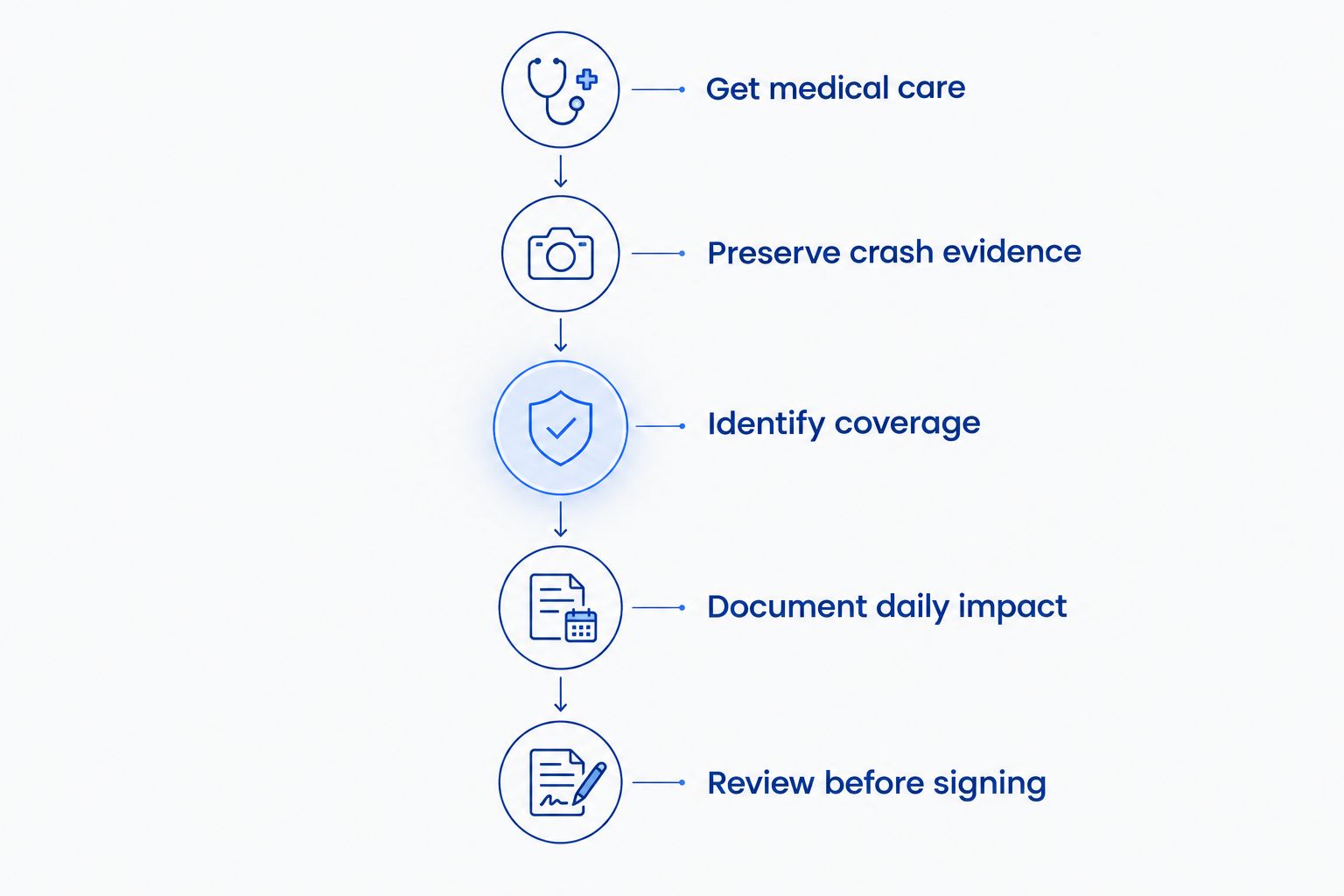
Protect your health first. Then preserve the information needed to explain the collision and its consequences without filling gaps with assumptions.
- Get medical care. Describe your symptoms accurately and tell the provider you were a passenger in a crash. Follow treatment instructions and raise new or worsening symptoms with a medical professional.
- Preserve crash evidence. Keep photographs, driver information, witness contacts, messages, and the collision report information you receive. Save original files rather than only edited copies.
- Identify coverage. Gather insurance information for the involved vehicles and relevant household auto policies. Ask which benefits are being considered and what documents the insurer needs.
- Document daily impact. Keep bills, receipts, work restrictions, and a factual record of activities your injuries prevent. Describe specific difficulties instead of using general statements about feeling worse.
- Review before signing. Understand medical authorizations, recorded-statement requests, settlement releases, and any coverage consequences before agreeing. Do not ignore your own policy's reporting or cooperation requirements.
Which records show what happened to you?
A useful medical file explains when symptoms began, what providers observed, and how the injury affected your function. Keep emergency care records, diagnostic reports, specialist notes, rehabilitation records, and discharge instructions together.
EMS and ambulance records can document observations at the scene and during transport, before later treatment creates a fuller picture. The linked discussion concerns Georgia; Washington law controls your Seattle claim, and an early record does not establish the full extent of an injury by itself.
Separate bills from clinical records. A bill shows a charge, while a treatment note explains symptoms, findings, and care; your claim needs the connection between the expense and the collision.
If an early record contains an error, ask the provider about the correction process. Do not change a document yourself or omit an earlier condition because you think it complicates the claim.
What if the passenger knew the driver or shares some fault?
You do not lose the right to pursue an injury claim merely because a friend or relative was driving. The practical questions remain responsibility, applicable coverage, and documented losses.
Washington follows comparative fault under RCW 4.22.005. Fault attributed to an injured person can reduce recoverable damages proportionately rather than automatically barring recovery.
Being in the passenger seat does not itself establish passenger fault. If an insurer alleges you contributed to the injury, ask what conduct and evidence support that position rather than accepting a general accusation.
What deadline applies to a Seattle passenger injury claim in 2026?
Washington generally gives you 3 years to file a personal injury lawsuit, under RCW 4.16.080. That is a general rule, not an individualized deadline calculation; exceptions and special procedures require separate review.
An insurance claim is not the same as filing a lawsuit. Do not assume negotiations, an adjuster's continuing investigation, or an open claim file stop the 3-year filing period.
Claims involving Washington local government entities can require a claim presentation process under RCW 4.96.020, including a 60-day waiting period before suit. That is not permission to delay: the interaction between presentation requirements and filing deadlines needs legal review.
For a 2026 crash, have an attorney identify the actual collision date, potential defendants, and any special circumstances. Children, government defendants, and other exceptions deserve a case-specific deadline analysis.
What should a passenger ask during a case evaluation?
Bring questions that help you decide whether representation fits your needs. Ledger Law represents people with personal injury claims, including car accident injuries.
Ledger Law is best suited to injured passengers seeking personal injury representation, rather than property-damage-only help. A useful evaluation should explain what needs investigation without promising a result.
Ask about:
- Which drivers or other parties need investigation.
- Which insurance policies and benefits should be reviewed.
- What evidence is missing and how to preserve it.
- Whether ongoing treatment makes settlement evaluation premature.
- Who will communicate with you and handle insurer requests.
- How attorney fees, case expenses, and repayment obligations work.
The benefit of representation is help evaluating responsibility, coverage, documentation, and legal procedure. Representation also creates contractual fee and expense obligations, and no attorney can guarantee compensation. Read the agreement, including what happens to expenses if there is no recovery.
Prepare for a passenger case evaluation
Organize your injury records, insurance information, and questions before discussing your Seattle claim.
Can I claim if my friend caused the Seattle crash?
You can pursue a passenger injury claim when a friend's fault caused your injuries, subject to the facts and applicable coverage. Being friends does not resolve liability, and an insurance claim still requires evidence of your losses.
Can I claim lost income if I was only a passenger?
You can claim injury-related lost income even though you were not driving. Keep employer records, earnings documentation, and medical restrictions that explain why the crash prevented you from working.
Do I have to settle before finishing treatment?
You do not have to accept an early settlement simply because an insurer offers one. A final release can close injury claims before future treatment needs are understood, so review its scope before signing.
FAQ
Can a Seattle passenger make claims against both drivers?
An injured Seattle passenger can pursue claims involving both drivers when the evidence supports responsibility by each. Multiple claims do not allow duplicate recovery for the same loss.
What if I do not have my own car insurance?
Not having your own auto policy does not automatically prevent a passenger injury claim. Investigate the responsible party’s liability coverage and any coverage applicable to the vehicle you occupied.
Does PIP pay for a passenger’s pain and suffering?
PIP does not compensate pain and suffering. An eligible passenger can seek covered PIP benefits while separately evaluating a claim against a responsible party.
How long do I have to sue after a Seattle passenger injury?
Washington generally allows 3 years to file a personal injury lawsuit under RCW 4.16.080. Exceptions and special procedures can affect the analysis, so have the actual deadline reviewed.
Should I give an insurance adjuster a recorded statement?
Clarify which insurer is requesting the statement and what obligations apply before agreeing. Your own policy can impose cooperation requirements that differ from requests by another driver’s insurer.
Can Ledger Law help with an injured passenger claim?
Ledger Law represents people injured in car accidents, including claims requiring review of responsibility and insurance. A case evaluation can address your circumstances without guaranteeing acceptance or an outcome.
One last thing
Keep the envelope, email, and attachments that accompany a settlement offer—not just the payment figure. Release language and related documents determine what you are being asked to give up. Have those terms reviewed alongside your medical outlook and remaining coverage questions.
This is general Washington legal information for 2026, not advice about your individual claim.
Related guides
- Which medical records help a Newport Beach car accident claim? — A California-focused records discussion; Washington law governs a Seattle claim.

Emery Brett Ledger brings 28+ years of experience to personal injury law. He founded & led The Ledger Law Firm in securing over $100 million in compensation for clients with life-altering injuries & complex claims. Prior results do not guarantee a similar outcome. Licensed in California, Texas, & Washington, Emery earned his law degree from Pepperdine University School of Law. His practice areas include car & truck accidents, wrongful death, catastrophic injuries, maritime claims, & mass tort litigation. He has been recognized by The National Trial Lawyers’ Top 100, Mass Tort Trial Lawyers Top 25, and America’s Top 100 Personal Injury Attorneys. Emery also received the 2025 Elite Lawyer Award & holds a perfect 10.0 Avvo rating with Platinum Client Champion status. His legal work has been featured on CNN, Forbes, NBC, & ABC.
Free Case Evaluation
Recent Posts
- Should you accept an early Newport Beach crash settlement offer?
- Can a Dallas car accident lawyer help after an uninsured crash?
- What can an injured passenger claim after a Seattle car crash?
- 7 steps to take after a car accident in California
- What should you bring to a Seattle car accident consultation?
Emery Brett Ledger brings 28+ years of experience to personal injury law. He founded & led The Ledger Law Firm in securing over $100 million in compensation for clients with life-altering injuries & complex claims. Prior results do not guarantee a similar outcome. Licensed in California, Texas, & Washington, Emery earned his law degree from Pepperdine University School of Law. His practice areas include car & truck accidents, wrongful death, catastrophic injuries, maritime claims, & mass tort litigation. He has been recognized by The National Trial Lawyers’ Top 100, Mass Tort Trial Lawyers Top 25, and America’s Top 100 Personal Injury Attorneys. Emery also received the 2025 Elite Lawyer Award & holds a perfect 10.0 Avvo rating with Platinum Client Champion status. His legal work has been featured on CNN, Forbes, NBC, & ABC.