Who pays when an uninsured driver injures you in Seattle?
If an uninsured driver injures you in Seattle, payment can come from your own uninsured/underinsured motorist coverage, personal injury protection, health insurance, or a claim against the responsible driver or another legally responsible party. None guarantees full payment: your policy terms, available coverage, fault, and the ability to collect determine what you can recover.
- An uninsured Seattle driver can remain legally responsible, but responsibility does not guarantee collectible compensation.
- Washington uninsured/underinsured motorist coverage can cover injury losses, subject to policy terms and limits.
- Personal injury protection and health insurance address medical bills differently from an injury settlement.
- Bring policies and medical records to a Seattle car accident lawyer uninsured driver consultation.
- Ledgerlaw represents injured people; a case evaluation can help identify the coverage questions that need answers.
Why this matters
An uninsured driver does not automatically leave you without an injury claim. But the insurance that pays your first medical bill is not necessarily the insurance that compensates you for lost income or pain and suffering.
For a Seattle crash in 2026, start with Washington law and the policies covering you—not California or Texas rules. Ledgerlaw represents people injured in car accidents across Washington, California, and Texas; this guide addresses Washington injury claims only.
Who pays when an uninsured driver injures you in Seattle?
Check your own coverage before assuming the uninsured driver is your only source of payment. Different policies cover different losses, and payments can involve reimbursement rights or offsets rather than separate recoveries for the same expense.
| Potential payment source | Best for | What it can address | Main limitation |
|---|---|---|---|
| Uninsured/underinsured motorist coverage | Covered people injured by uninsured or insufficiently insured drivers | Covered injury damages attributable to the responsible driver | Coverage, exclusions, limits, and fault still matter |
| Personal injury protection | Addressing covered expenses while fault is being investigated | Medical expenses and certain other benefits defined by the policy | Benefits have limits and do not replace the entire injury claim |
| Health insurance | Accessing covered medical treatment | Eligible treatment under the health plan | Network rules, patient responsibilities, and reimbursement rights can apply |
| Claim against the driver | Seeking recovery from the person responsible | Legally recoverable injury damages | A judgment does not ensure the driver has collectible assets |
| Claim against another responsible party | Crashes involving additional supported liability | Damages attributable to that party's conduct or legal responsibility | Requires evidence; another defendant cannot simply be assumed |
Washington law governs motorist coverage, personal injury protection, comparative fault, and injury filing deadlines relevant to a 2026 Seattle claim.
Uninsured/underinsured motorist coverage: Check the actual policy
Washington law generally requires insurers to offer uninsured/underinsured motorist coverage, commonly called UM or UIM, subject to statutory exceptions. Under Washington law, a named insured or spouse can reject this coverage in writing. Do not assume you bought it merely because you carry auto insurance.
Ask for the declarations page, complete policy, endorsements, and any written rejection. The declarations page summarizes coverage, but the policy explains who qualifies as an insured and which exclusions apply.
UIM coverage can address covered injury damages beyond medical bills, including supported lost earnings and noneconomic losses. The insurer can still dispute responsibility for the crash, whether the crash caused particular injuries, or the amount of damages.
UIM coverage is a potential source of compensation, not an automatic settlement. Report the crash promptly and follow applicable notice requirements. Before releasing the uninsured driver, have any settlement-consent or recovery-rights provisions reviewed.
A passenger, pedestrian, or family member should also ask whether a policy covers them. Ownership of the damaged vehicle is not the only coverage question.
Personal injury protection: Help with covered expenses
Personal injury protection, or PIP, provides specified benefits without requiring you to first prove another driver caused the crash. Washington insurers generally must offer PIP, and Washington law permits rejection in writing.
If you have applicable PIP coverage, it can help address covered medical expenses and other policy benefits while the liability claim develops. That makes it useful when treatment starts before an insurer completes its investigation.
The limitation is scope. PIP does not compensate every category of injury damage, and benefits remain subject to policy conditions and limits. Ask which expenses qualify, how to submit them, and how payments will be coordinated with other coverage.
For a 2026 injury claim, keep each benefit notice and explanation of payment. Those records help distinguish bills already paid from balances still outstanding.
Health insurance: Treatment coverage, not a full injury recovery
Health insurance can cover eligible treatment when auto coverage is absent, disputed, or exhausted. Give providers accurate information about the crash and any applicable auto insurance so billing follows the relevant coordination rules.
Health coverage does not ordinarily compensate you for pain and suffering or replace all crash-related income loss. Deductibles, copayments, network restrictions, and treatment authorization requirements can also affect your responsibilities.
A health plan can have reimbursement rights against a later recovery, depending on the plan and applicable law. Do not treat the settlement's headline amount as the amount you will keep. Medical balances, reimbursement claims, attorney fees, and case expenses need separate review.
The uninsured driver: Liability is not the same as collectability
A driver does not escape legal responsibility merely by lacking insurance. If evidence establishes that the driver caused your injuries, a claim against that driver remains a possible route.
The practical issue is collection. A favorable judgment does not create assets or income that the defendant does not have, and collection is subject to applicable exemptions and procedures.
An evaluation should examine both the strength of the injury claim and realistic recovery sources. It should also investigate whether the initial uninsured designation is accurate: a missing insurance card is not a final coverage determination.
Another driver, an employer, or another party can be relevant when the facts support legal responsibility. Do not assume an employer is liable simply because someone was driving during working hours; the employment relationship and circumstances require investigation.
What should you do after an uninsured-driver injury in Seattle?
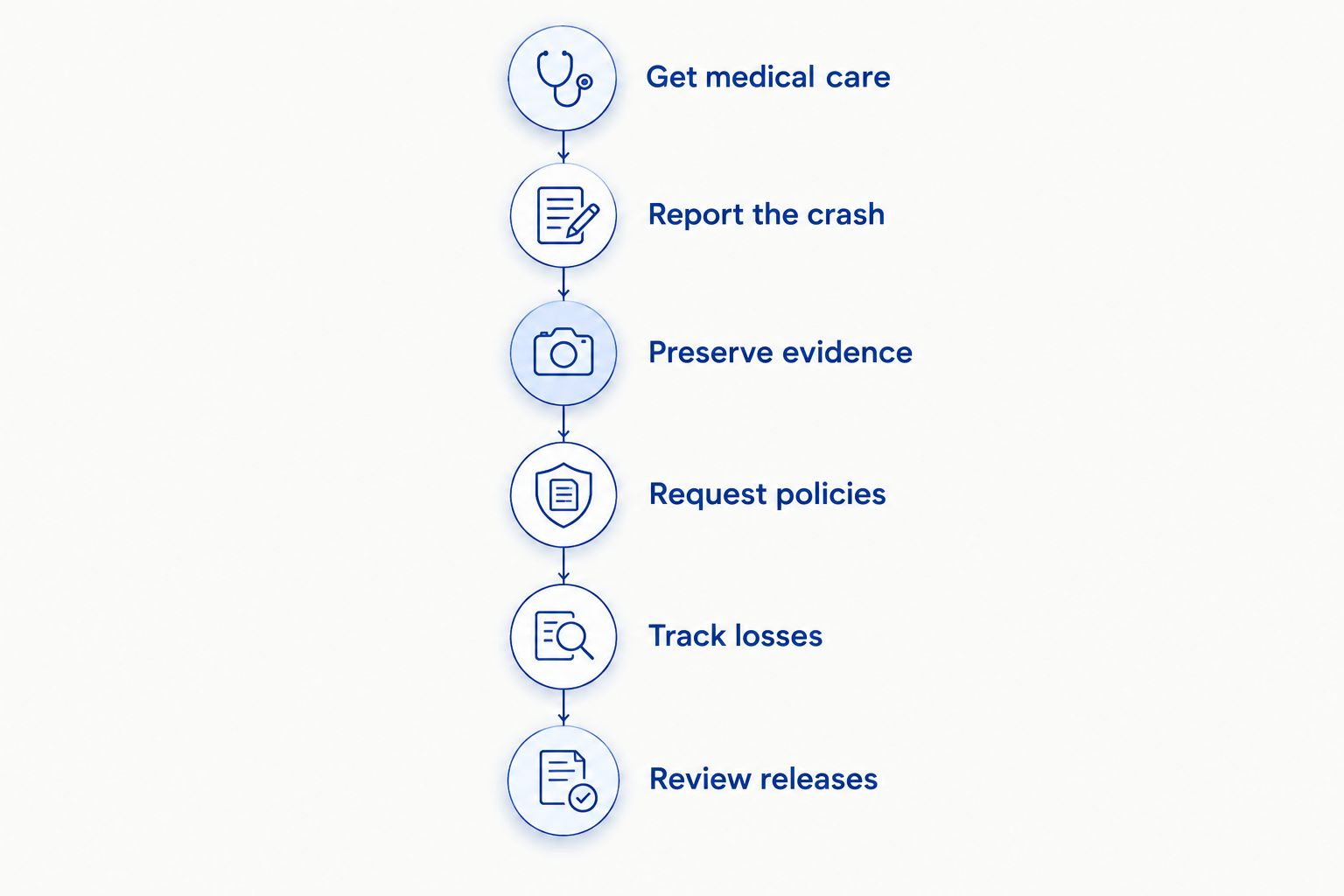
Use these steps to protect your health and preserve the information needed to evaluate payment sources. You do not need to resolve every insurance question before seeking care.
- Get medical care. Describe your symptoms and the crash accurately. Follow treatment recommendations and explain any barriers that prevent you from attending appointments.
- Report the crash. Notify the appropriate authorities and your insurer. Washington generally requires a written collision report within 4 days for an injury collision when an officer does not investigate; Washington law contains reporting requirements and exceptions.
- Preserve evidence. Save photographs, witness information, the collision report number, and messages from the other driver. Preserve original files rather than only screenshots when possible.
- Request policies. Obtain complete coverage documents and any rejection forms. Ask insurers to put coverage decisions and their reasons in writing.
- Track losses. Keep treatment records, bills, work restrictions, missed-work documentation, and receipts tied to the injuries.
- Review releases. Understand what a proposed release settles before signing. A payment labeled final can affect claims that extend beyond the immediate bill.
Your consultation does not need to wait until every record arrives. Bring what you have, identify what is missing, and explain whether an insurer has requested a statement or offered a release.
This guide is for injured people considering personal injury representation after a Seattle car crash. A case evaluation should identify coverage questions, evidence needs, and deadlines without promising a particular recovery.
Discuss your injury claim
Review the crash, your injuries, and the insurance questions affecting your next steps.
Why payment varies between uninsured-driver claims
The same uninsured-driver label can describe very different claims. These factors determine which payment routes deserve attention:
- Coverage selection. UIM or PIP benefits depend on applicable coverage, including any valid written rejection.
- Who qualifies for coverage. Policy definitions matter for drivers, passengers, resident relatives, and people injured outside a vehicle.
- Fault allocation. Washington's comparative-fault rule can reduce damages according to the injured person's share of fault.
- Medical and income evidence. Records must support the connection between the crash, treatment, restrictions, and claimed losses.
- Available recovery sources. Policy limits, other responsible parties, and collectible assets affect practical recovery.
- Reimbursement obligations. Payments already made by insurers or benefit plans can affect the final distribution.
For Washington claims in 2026, Washington law provides the comparative-fault framework. An insurer's assertion that you contributed to the crash is a position to examine against evidence—not a finding you must accept.
Can you recover compensation if you were partly at fault?
Washington allows an injury recovery to be reduced by your percentage of fault rather than automatically barred by partial fault. Washington law governs this rule; the uninsured driver's lack of coverage does not itself decide who caused the collision.
Preserve evidence relevant to both drivers' actions. Photographs, witness accounts, and vehicle or roadway evidence can matter when an insurer disputes responsibility.
Avoid guessing about speed, distance, or timing in a recorded statement. State what you actually remember and distinguish observations from assumptions.
How long do you have to file a Seattle injury lawsuit?
3 years is the general Washington limitations period for a personal injury lawsuit under Washington law. Exceptions, special defendants, and claim-specific requirements can change the analysis, so the general period is not a safe reason to postpone advice.
A UIM dispute also requires a separate deadline review. Policy notice provisions and the legal rules governing a contractual coverage claim are not interchangeable with the deadline for suing the driver.
For a crash occurring in 2026, have the relevant deadlines identified while evidence is still accessible. Negotiating with an insurer does not by itself establish that a filing deadline has been extended.
What should you ask during a case evaluation?
Ask which policies require review, what evidence is missing, and whether any immediate reporting or filing issue needs attention. Explain how the injuries affect work, treatment, caregiving, and everyday activities.
Ask about the fee agreement separately from case expenses. If representation uses a contingency fee, understand how the fee is calculated, which expenses can be charged, and who remains responsible for expenses if there is no recovery.
A Ledgerlaw case evaluation should focus on the injury and potential legal representation, not just vehicle repairs. Bring proposed releases, denial letters, and reimbursement notices so those documents can be considered alongside the crash evidence.
FAQ
Does my insurance pay if an uninsured driver hits me in Seattle?
Your insurance can pay if applicable coverage includes the loss. UIM, PIP, and health insurance serve different purposes, and each has its own terms and limits.
Is uninsured motorist coverage automatic in Washington?
No, you should not assume you have uninsured motorist coverage. Washington generally requires insurers to offer it, but a named insured or spouse can reject it in writing under Washington law.
Can I sue an uninsured driver for my injuries?
Yes, you can pursue an injury claim against an uninsured driver when the facts support liability. Whether a judgment can be collected is a separate question that deserves attention before litigation.
What if I was a passenger in the uninsured-driver crash?
A passenger should investigate coverage under the involved vehicles’ policies and any other policy that might cover the passenger. Coverage depends on policy terms and the circumstances, not simply who owned the vehicle.
How long do I have to sue after a Seattle car accident?
3 years is the general Washington personal injury limitations period under Washington law. Exceptions and separate coverage-related deadlines require individual review.
Should I accept an offer before finishing treatment?
Do not accept a final injury settlement without understanding the release and the unresolved medical issues. A release can close claims even when treatment needs or work restrictions remain uncertain.
Does no recovery always mean no case expenses?
No, a contingency fee arrangement does not automatically eliminate responsibility for case expenses. Read the written agreement and ask how expenses are handled both with and without a recovery.
One last thing
Ask for the rejection form, not just a verbal statement that coverage is missing. Washington's written-rejection rules make that document relevant when an insurer says you have no UIM or PIP coverage.
Keep the request and response with your claim records. Identifying the actual coverage position is more useful than assuming there is nothing to pursue because the other driver was uninsured.
For how the firm approaches Washington injury matters, see the Seattle personal injury attorney page.
Related guides
- What should you bring to a Seattle car accident consultation?
- What can an injured passenger claim after a Seattle car crash?
- Can a Dallas car accident lawyer help after an uninsured crash?

Emery Brett Ledger brings 28+ years of experience to personal injury law. He founded & led The Ledger Law Firm in securing over $100 million in compensation for clients with life-altering injuries & complex claims. Prior results do not guarantee a similar outcome. Licensed in California, Texas, & Washington, Emery earned his law degree from Pepperdine University School of Law. His practice areas include car & truck accidents, wrongful death, catastrophic injuries, maritime claims, & mass tort litigation. He has been recognized by The National Trial Lawyers’ Top 100, Mass Tort Trial Lawyers Top 25, and America’s Top 100 Personal Injury Attorneys. Emery also received the 2025 Elite Lawyer Award & holds a perfect 10.0 Avvo rating with Platinum Client Champion status. His legal work has been featured on CNN, Forbes, NBC, & ABC.
Free Case Evaluation
Recent Posts
- What Is a Legal Tort After a Car Accident? Understanding Claims, Negligence, and Next Steps
- Tort Law and Slip-and-Fall Injuries: How to Decide Whether to Seek a Case Evaluation
- Tort Lawyer for a Slip and Fall: How to Decide Whether to Seek Help and Prepare for a Case Evaluation
- Suing After a Car Accident: How to Compare Your Options, Evidence, Timing, and Costs
- How to Settle a Car Accident Claim Without a Lawyer
Emery Brett Ledger brings 28+ years of experience to personal injury law. He founded & led The Ledger Law Firm in securing over $100 million in compensation for clients with life-altering injuries & complex claims. Prior results do not guarantee a similar outcome. Licensed in California, Texas, & Washington, Emery earned his law degree from Pepperdine University School of Law. His practice areas include car & truck accidents, wrongful death, catastrophic injuries, maritime claims, & mass tort litigation. He has been recognized by The National Trial Lawyers’ Top 100, Mass Tort Trial Lawyers Top 25, and America’s Top 100 Personal Injury Attorneys. Emery also received the 2025 Elite Lawyer Award & holds a perfect 10.0 Avvo rating with Platinum Client Champion status. His legal work has been featured on CNN, Forbes, NBC, & ABC.