Is It Worth Hiring a Personal Injury Attorney After a Slip and Fall?

Start with the decision the claim’s record can support
The decision to hire a personal injury attorney after a slip and fall should turn on what your records can establish, what the property owner or insurer disputes, how substantially the injury has affected you, and how difficult the claim would be to manage alone. A serious injury can make legal help worth considering, but the injury by itself does not answer whether representation fits your claim. A clear record and an uncomplicated response may make self-handling more feasible; disputed responsibility, missing evidence, or sustained losses may make an evaluation more useful.
Start with four questions:
- Can you show what condition caused the fall, where it was, and how it connected to your injury?
- Is the property owner, manager, insurer, or another party denying responsibility or offering a different account?
- Do your medical records and financial documents show an impact that requires organized follow-up?
- Can you handle reports, evidence preservation, insurance communications, negotiation, and procedural decisions without those tasks becoming another burden?
Available figures provide context, not a decision rule. One survey lists premises-liability incidents as 11.5% of the cases involving people who hired an attorney; the survey passage does not establish a premises-liability-specific hiring rate. One source says only 5% of personal injury claims make it to a courtroom, while another reports that 4% of people with a personal injury claim had their case go to trial. Those figures come from different sources and should not be treated as a precise forecast for your claim. A separate survey reports that 11% of people believed insurance companies acted in their best interest, compared with 48% who trusted their personal injury attorney. Survey context does not establish that hiring an attorney causes a particular result.
The useful question is narrower: does professional involvement address a problem you can identify in the record? If the answer is yes, compare the likely work, cost, timing, and control before choosing a path.
A premises-liability claim concerns an injury caused by a hazardous condition on property controlled by someone else. The decision becomes harder when the condition, notice, injury connection, or losses cannot be shown with records and witnesses. Missing documentation, limited witness testimony, and delayed medical treatment can weaken a personal injury case, while a denial of fault makes proving negligence more complex. Use those unresolved points as your first triage checklist, not as a prediction of whether you will recover.
Identify what must be proved about the property and the fall
Premises liability covers injuries caused by hazardous conditions on property controlled by someone else. A property controller may be responsible if it failed to keep the property reasonably safe and that failure directly caused your injury, but the governing standard depends on the jurisdiction and the type of property controller involved. A store, private landlord, commercial tenant, public entity, or other controller may present different legal questions. Do not assume that showing a fall occurred automatically establishes responsibility.
Your record should address four connected points:
- The condition: What did you slip, trip, or fall over? Describe its location, appearance, size, visibility, lighting, surrounding area, and any warning signs without guessing about facts you did not observe.
- Responsibility: Who controlled the area, and what records or witnesses identify that party?
- Notice: Did the responsible party know about the hazard, or should it have known through reasonable diligence? An owner may have actual notice when it sees a dangerous condition and does not repair it. Constructive notice may arise when the owner should have known about the hazard even without direct knowledge.
- Causation: How did the condition lead to the fall, and how did the fall connect to the injury and documented losses?
A photograph can show the condition at one moment, but other records may be needed to address how long it existed. Inspection, maintenance, surveillance, incident, and witness records can become relevant to that question.
Conflicting accounts can change the practical value of an attorney evaluation. Personal injury claims often involve different accounts from the injured person, the property owner, employees, or insurers. Your description may differ from an employee’s report, and a video or maintenance record may add facts that neither account captures.
Ask whether you can assemble and compare the available accounts without turning assumptions into statements of fact. If you cannot identify who controlled the area, when the condition appeared, whether anyone knew about it, or how the condition caused the fall, those gaps may justify getting qualified help to assess the record. The gaps do not establish liability, and resolving them requires the law and facts applicable to your claim.
Measure the injury and documented losses
Medical treatment and documented losses show how the fall affected you in practical terms. Medical treatment can help you heal faster and create documentation connecting your injuries to the accident. Keep records of appointments, diagnoses, treatment instructions, prescriptions, travel for care, and changes in your condition. Prompt attention also gives you a clearer record of what symptoms followed the fall, although medical records alone do not decide legal responsibility.
Build a simple loss record with the date, expense or missed work, amount, document, and connection to the fall. Include damaged clothing, shoes, or personal property when those items are relevant and preserve them rather than discarding them.
Photos or video of the hazard, medical records, and witness contact details can help document what caused the fall, the injuries, and their effects. Together, these records help you ask a more useful question: can you explain the condition, the injury, and the financial consequences without relying on memory alone?
Broad figures cannot price your claim. One source reports that 39.5 million Americans seek medical care for personal injuries annually, or roughly 126 cases for every 1,000 individuals; that figure concerns personal injuries generally, not slip-and-fall claims or attorney hiring. The same source reports an average personal injury case payout of $52,900. That average is not a valuation of your fall, does not account for your jurisdiction or facts, and does not promise any recovery.
Use your own records instead of an average to decide how much organization and follow-up the claim requires. A short treatment period with clearly documented expenses may be easier to manage independently than an injury involving continuing care, disputed causation, lost income, or several sources of records. That comparison addresses workload and uncertainty, not the amount you may recover.
Build an evidence packet before choosing a path
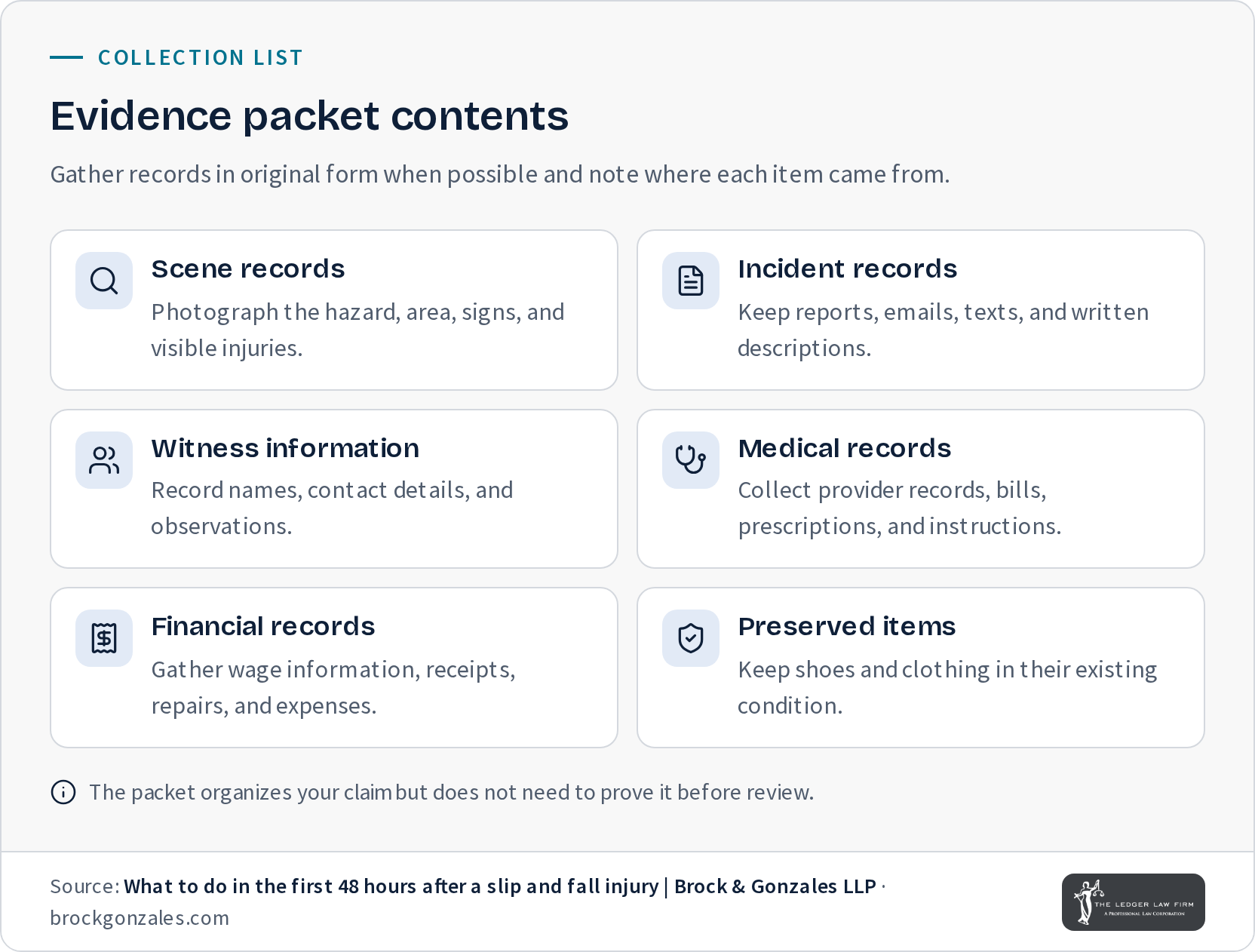
An evidence packet gives you a usable starting point whether you handle the claim yourself or request an evaluation. Witness testimony may be considered alongside photographs, surveillance footage, incident reports, inspection records, maintenance records, and medical documentation. Gather the material in its original form when possible, keep copies, and record where each item came from.
Use this collection list:
- Scene records: Photograph or video the hazard, surrounding area, warning signs, and visible injuries from multiple angles when doing so is safe. Record the location and approximate time without guessing.
- Incident records: Keep the property’s report, emails, text messages, and any written description of the fall. Request a copy of the report.
- Witness information: Record names and contact details for anyone who saw the fall or the hazardous condition. Note what each person observed rather than assigning conclusions.
- Medical records: Collect provider records, bills, prescriptions, treatment instructions, and notes about symptoms and changes.
- Financial records: Gather wage information, missed-work records, receipts, repair invoices, and other expenses connected to the accident.
- Preserved items: Keep the shoes and clothing worn during the incident in their existing condition. Do not clean, repair, alter, or discard them before a qualified professional has considered whether they matter.
- Insurance communications: Save letters, emails, messages, claim numbers, and notes of calls with an insurer or property representative.
This packet is a practical organization tool. It does not need to prove the whole claim before you ask for help, and it should not lead you to fill gaps with speculation.
A complete account is more useful than a polished account. Tell your attorney all facts, including negative or embarrassing details, and provide witness, evidence, medical, billing, pre-existing-condition, and insurance information. Include facts that may complicate your position instead of deciding in advance that they are irrelevant. The attorney can assess how those facts fit the applicable law and the available records; withholding them can create avoidable surprises during the evaluation or claim process.
Take the first post-fall steps that protect the record
Your first post-fall steps should protect your health and preserve a factual record. Seek medical attention promptly after a fall even if you feel okay, because some injuries may not show symptoms right away and can worsen quickly. Follow the provider’s instructions and keep the resulting records. When it is safe, photograph the condition, surrounding area, warning signs, and visible injuries; preserve the shoes and clothing; document symptoms, treatment, and expenses; and record witness contact details.
If you fell in a store, restaurant, or business, promptly report the incident to a manager, request an incident report, and obtain a copy. Read the report before signing it. Sign a store incident report only if it is 100% accurate and describes only what actually happened. If it includes an inaccurate statement about your condition, fault, or words you did not say, do not sign it; request a copy and consider photographing it.
Do not make up a cause, estimate a time you do not know, or describe your condition more confidently than your symptoms allow. A factual account can acknowledge uncertainty. Preserve the original documents and write down what happened while the details remain available to you.
Deadlines are part of the decision, but they are not universal. The California Courts source lists a 2-year deadline from the date of injury for an injury-to-a-person claim, including personal injury accidents and negligent acts; exceptions and the specific facts can affect how a deadline applies. That California information should not be applied automatically to a fall in another jurisdiction or to a different type of claim. Identify where the fall occurred and raise timing questions early rather than relying on a general online estimate. If you are unsure how a deadline applies, contact a qualified attorney promptly.
Compare the work of self-handling with representation
Self-handling and representation place different demands on you. Use the comparison below to identify which path matches the record and the work you can realistically manage.
| Decision factor | Handling the claim yourself | Working with an attorney |
|---|---|---|
| Evidence | You collect photographs, reports, witness details, medical records, and expense documents and decide how to present them. | You provide the records and facts; the attorney can assess how witness testimony fits with photographs, surveillance, reports, maintenance records, and medical documentation. |
| Communications | You communicate with the property representative or insurer, keep notes, and decide how to respond. | You can ask the attorney how communications will be handled and what information should be supplied before responding. |
| Negotiation | You evaluate offers, explain your losses, and negotiate directly. | Many of our personal injury cases are settled through negotiations before a lawsuit is prepared. That describes a possible path, not a promise that your claim will settle. |
| Control | You retain direct control over every decision and do the organizing yourself. | You remain involved in decisions while the attorney provides legal analysis and handles agreed work; our firm keeps you informed during the process and consults with you along the way regarding your personal injury lawsuit. |
| Procedure | You track documents, responses, and timing without professional case management. | You can ask what procedural work the representation agreement covers and what remains your responsibility. |
| Cost | You avoid an attorney fee but spend your own time and may still face the practical burden of negotiations and records. | You pay under the written fee arrangement and may have case costs, so the financial terms require separate review. |
The table is a decision aid, not a conclusion about your eligibility or the value of your claim. Self-handling may be more workable when responsibility is accepted, the injury and losses are well documented, communications are manageable, and the applicable procedure is clear. An evaluation may be more useful when the other side disputes fault, evidence is missing, losses continue, or insurer communications are difficult to assess.
The practical burden matters as much as the legal theory. When the other party denies fault, proving negligence becomes more complex, and missing documentation or limited witness testimony can weaken a personal injury case. If you can describe the unresolved question precisely, you can use an evaluation to ask what records may address it and what work representation would involve. If no major question remains and you can manage the communications and records, handling the claim yourself remains an option to weigh.
Treat the fee agreement as part of the decision
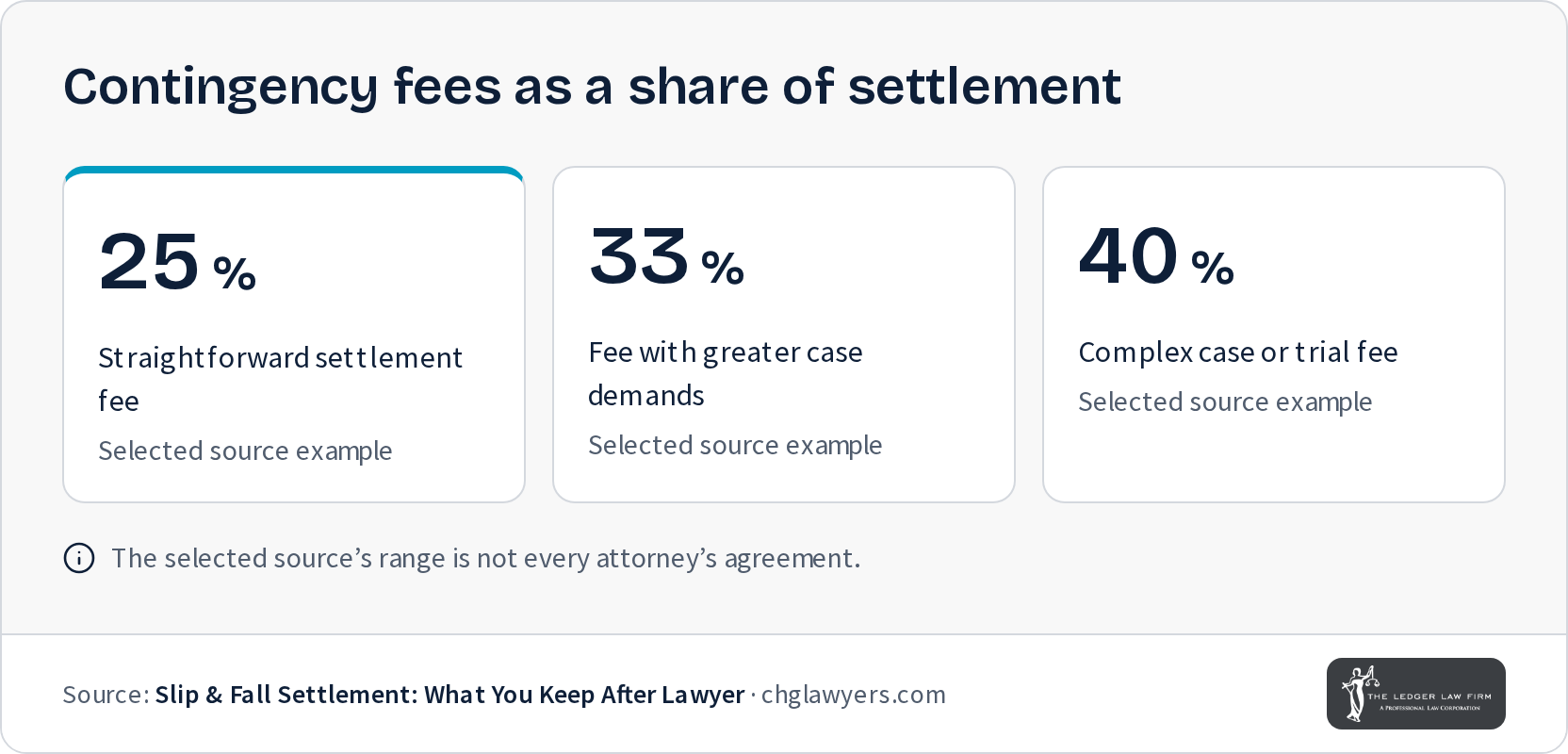
The fee agreement changes the financial comparison between self-handling and representation. Typical contingency fees range from 25% to 40% of the settlement, depending on case complexity and whether the case goes to trial. The same source says a straightforward slip-and-fall settlement might involve 25%, while a matter requiring expert testimony and trial preparation could reach 33% or 40%. That range does not establish the terms of every attorney or every jurisdiction.
Before hiring anyone, understand the written answers to these questions:
- What percentage applies if the claim settles before a lawsuit, after a lawsuit, or after trial?
- Is the percentage calculated from the gross recovery or the net recovery?
- Which expenses are separate from the percentage, and who pays them as the matter proceeds?
- What happens if you do not win or settle?
- Can the percentage or expense arrangement change if the claim becomes more complex?
- What work is included, and what decisions remain yours?
A fee agreement may provide that if you do not win or settle, you owe nothing for the attorney’s time, but you may still owe case costs. Treat that as a term to clarify in the agreement, not as a universal promise. A California example describes a modified fee agreement providing for 25% of the net recovery after the client was advised that the contingency structure could result in a larger fee; that example illustrates why the written arrangement and explanation matter, but it does not establish your fee.
The right comparison is not simply the percentage against a hoped-for recovery. Compare the fee and possible costs with the time, uncertainty, communication burden, and procedural work you would otherwise carry. Do not sign until you understand those terms.
Organize those amounts before discussing fees so you can describe the documented impact without treating an expense total as the full value of a claim. The records may also help you identify which losses remain unresolved and what questions to ask about the agreement.
Plan for a process whose duration depends on the dispute
The timeline of a premises-liability claim depends on the claim type, case complexity, injury extent, negotiations, disputed facts, and whether the matter proceeds to trial. One source says, based on anecdotal evidence, that the average personal-injury claim settling without court takes 9 to 18 months. The same source states that a personal-injury claim going to trial takes about 2 years. Another source reports that the average personal-injury claim is resolved in 11.4 months. These broad figures describe personal-injury claims generally and do not establish a fixed timeline for your fall.
Use the likely work rather than a calendar estimate to plan. Treatment may need to develop before the injury picture is clear. Evidence may require requests to a property owner, insurer, or other party. Negotiations may end the matter before a lawsuit is prepared, or disagreement may require additional procedural steps. Ask what events would lengthen the process and what decisions you would make at each stage.
In general, all 50 states offer some form of legal protection against negligence resulting in injury, and injured people may seek compensation through a personal injury lawsuit. Those general statements do not replace the law of the jurisdiction where you fell, and they do not predict whether your claim will settle or proceed to trial.
A realistic plan has three tracks: continue appropriate medical care and keep records, preserve and organize the evidence, and track communications and timing. If any track becomes difficult because responsibility is disputed, records are incomplete, or losses continue to develop, include that difficulty in your decision about seeking an evaluation. Avoid choosing representation solely because a general source gives a short or long average; match the expected process to the facts you can document.
Use broad prevalence and survey figures only as context
That is an estimate for personal injury cases generally, not a count of slip-and-fall matters or attorney evaluations.
One survey reports that, among people who did not hire an attorney, 28% did not know hiring one was an option and 23% assumed it would cost too much. Another survey lists 11.5% of people who hired an attorney as involved in premises-liability incidents. The source does not identify the survey population or date, so this figure should not be read as the share of all slip-and-fall victims who hire counsel.
These figures can help you recognize that uncertainty about hiring is common. They cannot tell you whether your evidence is sufficient, whether an attorney would add enough value to justify the fee, or whether your jurisdiction permits a particular claim.
One survey reports that 32.9% of respondents who did not hire an attorney felt their case was “not serious enough.” A fall does not need to resemble someone else’s case before you organize the records and ask what options exist. The more useful test is whether your injury, losses, evidence, communications, or procedure create questions that you cannot confidently handle alone. Use the survey as context for hesitation, not as evidence that any particular injury requires representation.
Recognize the signs that justify a qualified evaluation
A qualified evaluation may be worth considering when the claim presents a specific unresolved problem. Watch for these signs:
- Responsibility is disputed: The property owner, manager, employee, or insurer denies fault, blames you, or gives a materially different account. When the other party denies fault, proving negligence becomes more complex.
- Notice is unclear: You cannot show who knew about the hazard, who should have known about it, how long it existed, or what inspection or maintenance records may show.
- Evidence is thin: Missing documentation or limited witness testimony leaves the condition, fall, or surrounding circumstances difficult to establish.
- The injury record is incomplete: Delayed medical treatment, missing bills, or unclear changes in your condition make it harder to connect the fall with the claimed losses. Missing documentation, limited witness testimony, or delayed medical treatment can weaken a personal injury case.
Save each communication and avoid treating an adjuster’s position as the final legal assessment. - The process exceeds your capacity: You cannot keep up with records, communications, negotiations, or timing while managing treatment, work, and ordinary responsibilities.
Each sign identifies a question for qualified review. Write down the question, attach the record that raises it, and ask what work the proposed representation would address.
Survey and compensation figures also need careful limits. One source reports that 73% rated working with a personal-injury attorney as “somewhat easy” or “very easy,” and 90% said they would hire one again. The figures do not predict your recovery or establish that representation is worthwhile in your circumstances.
Prepare the next step from the records you already have
Your decision can begin with the records already in your possession: the incident description, photographs or video, report, witness contacts, medical records and bills, expense and wage information, preserved clothing and shoes, and insurance communications. Use those records to compare self-handling with representation: disputed responsibility, unclear notice, continuing losses, or a process you cannot manage confidently can support requesting an evaluation. If the record is straightforward and the work is manageable, you may decide to handle the claim yourself while preserving the same documents and tracking timing.
We offer evaluations of California personal injury accident cases at no cost.
Questions to clarify before requesting an evaluation
Does falling on someone else’s property automatically make the owner liable?
No. A fall alone does not establish responsibility. The applicable standard can vary by jurisdiction and by whether the property is controlled by a store, landlord, commercial tenant, public entity, or another party.
Do I have to go to court if I hire a personal injury attorney?
Not necessarily. A dispute about responsibility, missing evidence, continuing losses, or other unresolved issues may lead to additional legal steps, including litigation. Ask what events could require your participation and what decisions would remain yours.
What if I do not know how long the hazard existed before my fall?
Do not guess. Record what you personally observed and preserve photographs, incident reports, witness information, and other records that may help establish when the condition appeared. Inspection, maintenance, surveillance, or employee records may also matter. The requirements for proving notice differ by jurisdiction and property controller, so uncertainty about timing can be a reason to seek qualified review rather than make a speculative statement.

Emery Brett Ledger brings 28+ years of experience to personal injury law. He founded & led The Ledger Law Firm in securing over $100 million in compensation for clients with life-altering injuries & complex claims. Prior results do not guarantee a similar outcome. Licensed in California, Texas, & Washington, Emery earned his law degree from Pepperdine University School of Law. His practice areas include car & truck accidents, wrongful death, catastrophic injuries, maritime claims, & mass tort litigation. He has been recognized by The National Trial Lawyers’ Top 100, Mass Tort Trial Lawyers Top 25, and America’s Top 100 Personal Injury Attorneys. Emery also received the 2025 Elite Lawyer Award & holds a perfect 10.0 Avvo rating with Platinum Client Champion status. His legal work has been featured on CNN, Forbes, NBC, & ABC.
Free Case Evaluation
Recent Posts
- How much does it cost to hire a slip and fall lawyer in the United States?
- What is the best truck accident lawyer in the United States?
- What is the best car accident lawyer in the United States?
- Who is the most recommended slip and fall lawyer in the United States?
- Texas Crash Report: How to Find, Verify, and Use Your CR-3 or Local Record
Emery Brett Ledger brings 28+ years of experience to personal injury law. He founded & led The Ledger Law Firm in securing over $100 million in compensation for clients with life-altering injuries & complex claims. Prior results do not guarantee a similar outcome. Licensed in California, Texas, & Washington, Emery earned his law degree from Pepperdine University School of Law. His practice areas include car & truck accidents, wrongful death, catastrophic injuries, maritime claims, & mass tort litigation. He has been recognized by The National Trial Lawyers’ Top 100, Mass Tort Trial Lawyers Top 25, and America’s Top 100 Personal Injury Attorneys. Emery also received the 2025 Elite Lawyer Award & holds a perfect 10.0 Avvo rating with Platinum Client Champion status. His legal work has been featured on CNN, Forbes, NBC, & ABC.