Is It Worth Getting an Attorney for a Car Accident? How to Weigh the Tradeoffs

Compare self-handling with the representation actually offered
A Texas law firm says an auto accident claim can be settled without hiring an attorney. A useful comparison sets the risks of handling it yourself beside the specific work and written terms an attorney offers; neither option guarantees a particular result.
Handling a claim yourself means you remain responsible for reviewing records and insurer communications and deciding how to respond. A Texas law firm warns that people without representation may lack information, negotiation leverage, or legal knowledge needed to secure full compensation. Compare those potential disadvantages with the tasks an attorney would actually take on and the terms in the written agreement, rather than assuming representation will increase a recovery.
Your first screen can be brief. Write down the three issues you most need resolved, such as what losses you can document, what the insurer’s position is, and what you do not yet understand about the claim. If the answers are straightforward and the losses appear limited, self-handling may be an option to consider. If key questions remain open, use those specific questions - not a promise of a particular result - to decide whether to seek legal help.
Measure the claim’s documented impact
Your documented losses help show what the claim involves, but they do not by themselves establish what it is worth. We explain that damages depend on the damage caused by the crash, the other driver’s level of fault, your expenses following the crash, and the crash’s longer-term impact. Those factors give you a practical way to organize the questions before choosing how to proceed.
Economic damages are quantifiable losses such as medical bills, lost wages, and vehicle damage. Keep the amounts and the records supporting them together where you can. A list of figures is useful for understanding what you have documented; it is not a legal valuation or a prediction of what an insurer or court will accept.
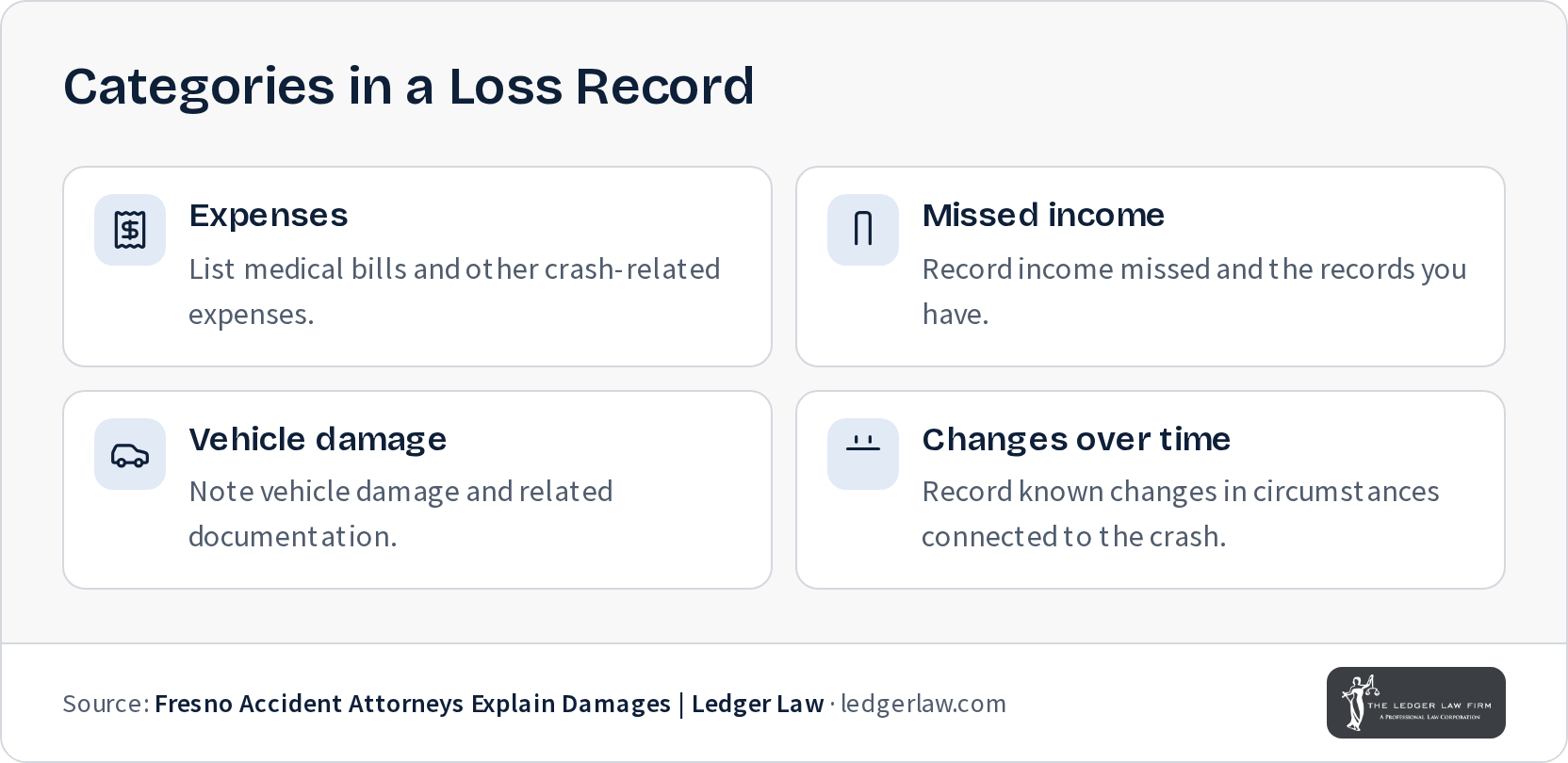
A simple loss record can help you see which parts of the impact are documented and which questions remain. Include:
- Medical bills and other crash-related expenses you can identify.
- Income you missed and the records you have for it.
- Vehicle damage and related documentation.
- Any known change in your circumstances over time that you connect to the crash.
Keep estimates, bills, and confirmed amounts distinct. That makes it easier to describe what you know without treating an unfinished picture as a final total. To make that record usable, label each entry as confirmed, estimated, or not yet known, and note which document supports it. Review each category separately: a confirmed bill identifies what has been charged, while a missing figure is a question to follow up, not a zero. Keep a short note beside any amount you cannot connect to a record. This prevents uncertainty from disappearing inside one combined total and makes clear what information is still needed.
After making that first pass, sort open questions by what they concern rather than leaving them in one “missing information” group. Is the amount itself uncertain, is the record incomplete, is responsibility disputed, or is the longer-term impact not yet clear? Those distinctions matter for your own summary because a documented expense and an account of how the crash happened address different parts of the picture. Keep the question beside the record that prompted it, and do not treat an unanswered point as evidence for either side. This makes it easier to explain the limits of your notes accurately.
Your notes can also clarify whether the decision is mainly about documenting a limited set of losses or resolving a more difficult question. For example, you may have amounts on hand but still be uncertain how fault affects the claim, or you may not yet understand the longer-term impact of the crash. Treat that uncertainty as a reason to pause before deciding that the first number in front of you settles the question.
Recognize circumstances that may make legal help useful
A serious injury or significant damages can make legal review more relevant because the claim may involve substantial losses or questions that take more work to assess. For California car-accident matters, we recommend considering an auto accident lawyer after a serious injury and contacting a lawyer when you have significant damages or need compensation decided in court. These are reasons to consider advice, not a promise about eligibility or the result.
An insurer’s offer may also leave an important issue unresolved. For California car-accident matters, we recommend considering a lawyer if the insurance company is not offering a fair settlement. If you are unsure how to assess an offer, identify the part that concerns you: the amount, the losses it addresses, or a point you and the insurer do not agree on. That gives you a concrete issue to discuss rather than relying on a general feeling that the offer is either good or bad. To make the question more specific, place the offer beside your loss record and note which items you understand, which you have a question about, and which explanation you disagree with. Do not infer from a missing detail alone that the insurer has accepted or rejected a loss; use the communication, if available, to identify what it actually says. Keep your question neutral - for example, “Which documented expenses does this offer address?” - and note any answer. This helps you describe the unresolved point without deciding in advance what the offer should be.
A disagreement about responsibility is another question to name clearly. We explain that the other driver’s level of fault is one factor affecting damages in a car accident case. If accounts of the crash differ, keep the disagreement separate from your list of expenses: they are different parts of the claim, and the documents or information relevant to each may differ.
To make that separation practical, note each different account separately and label its source, such as your recollection, an accident report, witness information, or an insurer communication. If you can identify the precise detail on which accounts differ, write it as a question rather than deciding which description is correct. This helps distinguish information about how the crash occurred from records that document expenses; the notes organize what you know but do not decide responsibility.
Use these circumstances as prompts, not as a checklist that automatically decides the answer. Serious injuries, substantial losses, an insurer dispute, or a need for a court decision can point toward getting legal input. If one of those applies to you, write down the specific concern and consider asking a lawyer to review it; if none applies, continue assessing what remains uncertain rather than assuming that you must hire counsel.
Examine the tasks an attorney may take on
An attorney’s potential work can be compared with the gaps in your own understanding of the claim. A personal-injury-lawyer source describes lawyers investigating incidents by gathering evidence such as medical records, witness statements, and accident reports. If you are unsure what the existing records show or how to organize different accounts of the crash, investigation may be one of the tasks to ask about.
A personal-injury-lawyer source also says lawyers assess case strength and estimate potential damages. That work may matter to you if the facts about responsibility, the documentation of losses, or the longer-term impact are still unclear. An estimate is an assessment, not a guarantee of what an insurer will offer or what a court would decide.
Insurer communication is another possible part of representation. A personal-injury-lawyer source says lawyers can handle communications and negotiations with insurers for clients. Ask yourself whether the current exchanges are understandable and manageable, or whether they involve an offer or disagreement that you cannot confidently assess.
Court paperwork can also be part of an attorney’s work. A personal-injury-lawyer source says attorneys prepare and file court documents and submit paperwork within specified deadlines. If you think your matter may need a court decision, that is a distinct reason to ask what legal work could be involved. You do not need to assume that every claim will go to court.
An attorney’s potential tasks are not the same as the work included in a particular engagement. Compare each service discussed with the agreement’s stated scope, what you would still handle, and how communication is described. The written terms show what this particular offer covers; general descriptions of lawyer duties do not. This comparison concerns scope, not the likelihood or amount of recovery.
When self-handling may be more feasible
Self-handling may be more feasible when the losses appear limited, records are organized, and neither responsibility nor the insurer’s position is actively disputed.
The possibility of settling without counsel should not be confused with certainty that the settlement will meet your needs. A Texas law firm warns that a settlement that seems acceptable at first may not cover some accident victims’ long-term needs. If your understanding of the impact is still changing or incomplete, treat that as an unresolved question - not as proof that a particular offer is inadequate or sufficient.
Compare self-handling risks with the written representation terms
The possible value of legal help should be weighed against the work and terms of representation, not against an assumed increase in compensation. A Texas law firm warns that people handling claims without representation may lack information, negotiation leverage, and legal knowledge needed to secure full compensation. That is a warning about possible disadvantages; it does not establish that hiring an attorney produces a larger recovery. The source does not quantify representation costs or show that every unrepresented person faces the same disadvantages, so treat this as one risk to weigh alongside the unresolved questions in your own claim.
The same Texas law firm says a settlement that initially seems acceptable may fall short of some accident victims’ long-term needs. Keep that possibility beside the question of what you know about your losses. If you have not yet understood the longer-term impact, avoid treating an early impression of the offer as a complete assessment.
Representation also has terms that you should understand before you agree to it. Ask what work the attorney would take on, how communication would work, and what the written agreement says about fees and costs. Do not assume that every lawyer uses the same terms, or that the amount of a fee alone tells you whether the work fits your needs. Read the actual terms presented to you and ask about anything you do not understand.
A side-by-side comparison focuses on the proposed exchange, not a predicted recovery. One side can list the tasks the attorney agrees to handle, what you would still do, how communication will work, and the written terms for fees and costs; the other can note which tasks you could manage without representation. Unclear tasks or terms remain points to clarify, not evidence of what the attorney will accomplish. The comparison describes the scope and obligations presented, not the outcome of the claim.
Check state-specific rules rather than relying on a general deadline
The state connected to your matter matters when you are assessing legal timing. Avoid relying on a number you find in a general article unless you know it applies to your situation and jurisdiction.
Your timing notes can help you explain the situation when you seek advice. Record the crash date, the dates of important insurer communications, and any notice or court document you have received. Keep the documents themselves with those notes where possible. This record is a starting point for discussing timing; it is not a calculation of a filing deadline.
A personal-injury-lawyer source describes attorneys preparing and filing court documents within specified deadlines. If your claim may involve court paperwork, ask what timing rules apply to your matter rather than assuming that a deadline from another state or a general webpage governs it. If you have received a court document or notice, include it in the information you bring when asking about next steps.
Use your records to assess the proposed work
Your records can help you explain the impact of the crash and identify what you still need answered. Ledger Law explains that damages depend on crash damage, the other driver’s level of fault, the client’s expenses following the crash, and the crash’s long-term impact. Ledger Law describes economic damages as quantifiable losses such as medical bills, lost wages, and vehicle damage. Use those categories to describe your situation, not to calculate a final case value. An expense list alone cannot establish a case value because the assessment also depends on responsibility and the crash’s longer-term impact; keep your summary limited to the records and uncertainties it covers.
A concise set of notes is often easier to use than a large pile of unorganized details. Gather what you have for:
- The crash account, accident report, and any witness information.
- Injuries, treatment information, and medical records.
- Medical bills, missed income, vehicle damage, and other expenses you can identify.
- The insurer’s communications, including any offer or point you dispute.
- Questions about responsibility, the impact of the crash, or what may happen next.
A personal-injury-lawyer source describes investigations that may include medical records, witness statements, and accident reports. Use your available records to explain what you know and what remains missing; do not delay asking a question simply because your file is not complete.
A case evaluation can be a way to discuss the questions that remain after you organize your information. A personal-injury-lawyer source says lawyers assess case strength and estimate potential damages. Bring your records and ask which facts or documents affect the assessment, what remains uncertain, and what work may be involved. An assessment or estimate is not a promise about an insurer’s response or a court’s decision. If information is missing, ask what can and cannot be assessed from the material currently available, and what specific information would help clarify the open question.
The decision can turn on whether the actual scope and written terms match the tasks you want handled, compared with what you would take on yourself. A case evaluation is an option for discussing that proposed work; it cannot predict an insurer’s response or a court’s decision.
Choose a next step that fits the questions your claim raises
Your next step can follow the main uncertainty in your claim: the extent of your documented losses, the other driver’s fault, the insurer’s position, or the longer-term impact of the crash. Bring the records you have and identify the question you want answered, even if parts of the picture are still incomplete. A qualified attorney who reviews your circumstances can assess your individual legal options; this guide cannot decide whether representation is suitable for you.
We offer a free consultation with an auto-accident lawyer. Have your crash, injury, loss, insurance, and insurer-communication information ready so you can explain what remains unresolved.
Questions to consider before deciding whether to hire an attorney
Is it worth getting an attorney for a car accident with minor injuries?
It depends on what remains unresolved, not just how the injury first appears. Handling a claim yourself may be an option when losses seem limited, records are available, and you understand the insurer’s position. If your symptoms or the crash’s longer-term impact are still unclear, or fault or an offer is disputed, consider getting legal input before treating the claim as settled.
When should I hire an attorney after a car accident?
Consider speaking with a lawyer when you have a serious injury, significant losses, disagreement about fault, an insurer offer you cannot assess, or a matter that may require a court decision. These are reasons to seek advice, not guarantees about eligibility or results.
What information should I have ready for a car accident case evaluation?
Gather what you have about the crash, injuries and treatment, medical bills, missed income, vehicle damage, and insurer communications or offers. Include any accident report, witness information, court document, or notice you received. A concise list of what you know, what you estimate, and what remains disputed can help frame your questions; an incomplete file need not stop you from asking for guidance.
What should I ask before agreeing to hire a car accident lawyer?
Ask what work the lawyer would handle, how communication would work, and what the written agreement says about fees and costs. Clarify which of your unresolved questions the proposed representation would address, and ask about any term you do not understand. Review the actual agreement rather than assuming terms are the same from one lawyer to another.

Emery Brett Ledger brings 28+ years of experience to personal injury law. He founded & led The Ledger Law Firm in securing over $100 million in compensation for clients with life-altering injuries & complex claims. Prior results do not guarantee a similar outcome. Licensed in California, Texas, & Washington, Emery earned his law degree from Pepperdine University School of Law. His practice areas include car & truck accidents, wrongful death, catastrophic injuries, maritime claims, & mass tort litigation. He has been recognized by The National Trial Lawyers’ Top 100, Mass Tort Trial Lawyers Top 25, and America’s Top 100 Personal Injury Attorneys. Emery also received the 2025 Elite Lawyer Award & holds a perfect 10.0 Avvo rating with Platinum Client Champion status. His legal work has been featured on CNN, Forbes, NBC, & ABC.
Free Case Evaluation
Recent Posts
- What Is a Legal Tort After a Car Accident? Understanding Claims, Negligence, and Next Steps
- Tort Law and Slip-and-Fall Injuries: How to Decide Whether to Seek a Case Evaluation
- Tort Lawyer for a Slip and Fall: How to Decide Whether to Seek Help and Prepare for a Case Evaluation
- Suing After a Car Accident: How to Compare Your Options, Evidence, Timing, and Costs
- How to Settle a Car Accident Claim Without a Lawyer
Emery Brett Ledger brings 28+ years of experience to personal injury law. He founded & led The Ledger Law Firm in securing over $100 million in compensation for clients with life-altering injuries & complex claims. Prior results do not guarantee a similar outcome. Licensed in California, Texas, & Washington, Emery earned his law degree from Pepperdine University School of Law. His practice areas include car & truck accidents, wrongful death, catastrophic injuries, maritime claims, & mass tort litigation. He has been recognized by The National Trial Lawyers’ Top 100, Mass Tort Trial Lawyers Top 25, and America’s Top 100 Personal Injury Attorneys. Emery also received the 2025 Elite Lawyer Award & holds a perfect 10.0 Avvo rating with Platinum Client Champion status. His legal work has been featured on CNN, Forbes, NBC, & ABC.