Should You Contact Car Collision Lawyers? A Practical Handoff Guide

Start with the insurer-question record
After a collision, an insurer-question record can help you decide what to discuss with car collision lawyers. Gather insurer messages alongside the collision account, injury and treatment information, losses, and available documentation, then flag whether the file involves disputed fault, slow handling of collision damage, or accusations of fault.
The collision record can help you arrange the sequence of events and their consequences, but the record alone does not establish what a court would decide. Use that boundary as the test: if the main task is collecting dates, names, reports, photographs, treatment records, and insurer messages, begin with organization. If the unresolved issue concerns who may be responsible, how the injuries relate to the crash, how losses should be presented, or how an insurer is responding, prepare for a legal discussion instead.
A practical handoff test has three questions:
- What is known? Record the collision account, people involved, visible damage, medical care, and communications without deciding fault.
- What remains connected? Match injuries, treatment, expenses, vehicle damage, and lost wages to the records that describe them.
- What remains disputed or unclear? Mark responsibility, insurance handling, causation, and possible claim steps as questions for case-specific review.
If the first two questions produce a usable record and the third produces no unresolved issue, you can continue preparing. If the third produces a substantial question, request an evaluation with the information you have.
The point is not to produce a complete legal file before asking for help. It is to recognize when sorting documents has stopped answering the question you need answered. A short, organized account with clearly marked gaps can be more useful for that conversation than a large file with no sequence.
What you can organize before contacting a lawyer
Your crash record may include scene information, driver and witness details, photographs, police information, medical records, and insurer communications. You do not need to turn those materials into a legal argument before asking for help. Start by preserving the information in the form in which you received or created it, then make a second working copy that is easier to review.
A collision chronology gives each event a place in time and identifies where the information came from. Begin with the collision itself, then add the first reports of injury, treatment dates, vehicle or property damage, insurance contacts, and later expenses or work effects. Label each entry as a police record, medical record, photograph, witness account, insurer message, bill, repair record, or your own recollection. Keep uncertainty visible instead of filling gaps with assumptions.
Use this preparation sequence before contacting a lawyer:
- Preserve the account. Write down what you remember about the location, traffic conditions, vehicles, people involved, and immediate events while keeping facts separate from conclusions.
- Gather the record. Put photographs, reports, witness details, medical information, insurer communications, and repair information in one working set.
- Place treatment beside the timeline. Add injury reports and treatment dates next to the collision events they may relate to.
- Match each loss to a document. Use a bill or treatment record for medical expense, work information for lost wages, and damage or repair information for vehicle or property loss.
- Mark open questions. Identify any point that cannot be answered from the materials you have.
This organization can make review more concrete, but it does not prove causation or liability. Take the organized record into an evaluation rather than treating it as a final legal conclusion.
Keep the original files separate from your notes. Your working summary can explain what each document appears to show, but it should not replace the document itself. When a date, name, amount, or account is uncertain, label it as uncertain and leave the underlying material available for discussion.
When the questions are no longer routine
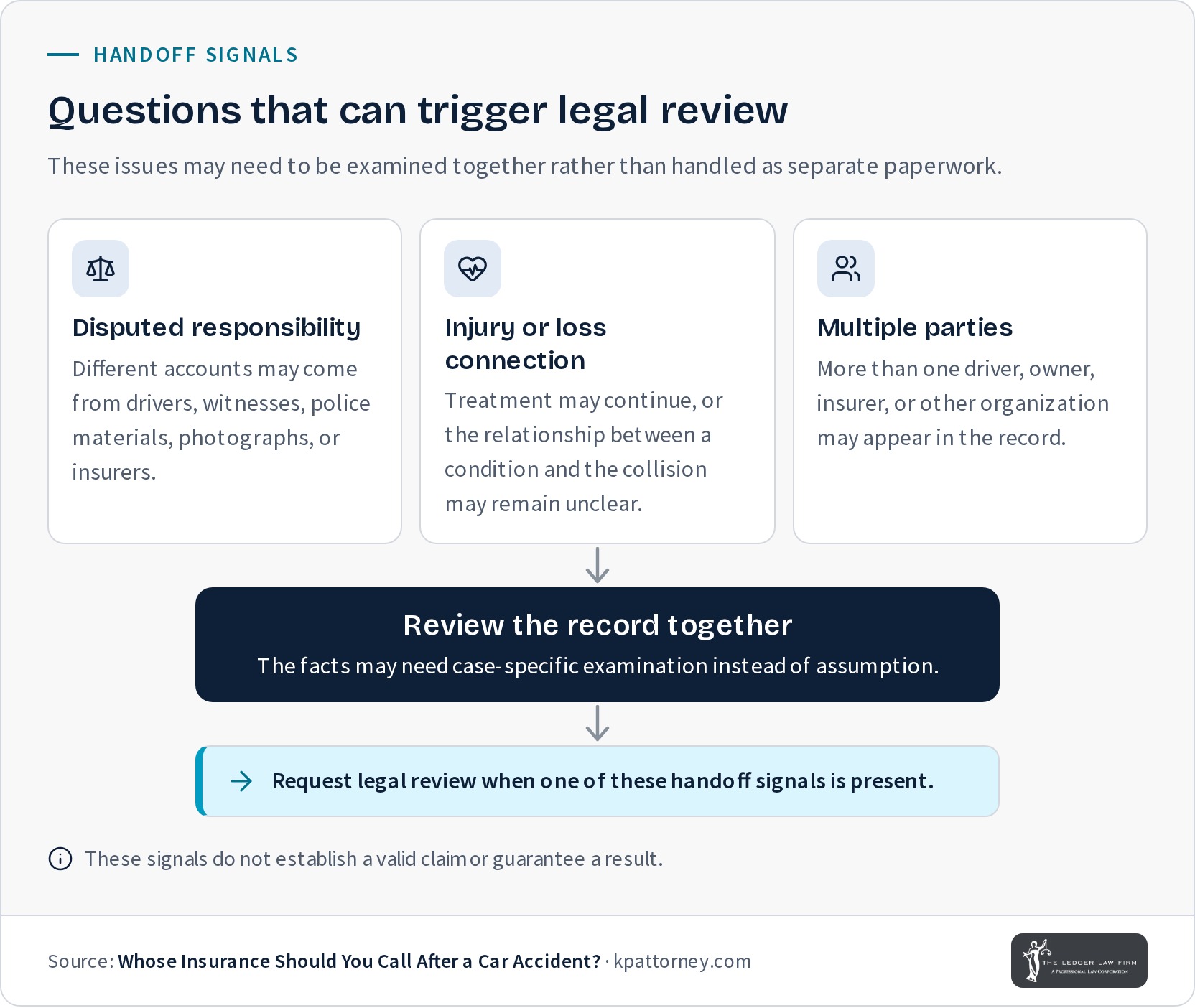
Unresolved responsibility, significant or developing injuries, multiple potentially responsible parties, or difficult insurer communications can move a collision beyond routine self-directed preparation. Those circumstances do not establish that you have a valid claim or guarantee a result. They indicate that the facts may need to be examined together rather than handled as separate paperwork.
Disputed responsibility is a handoff signal because the collision record may contain different accounts from drivers, witnesses, police materials, photographs, and insurers. More than one driver, owner, insurer, or other potentially responsible party can also make the record harder to keep separate. List each person or organization connected to the collision and the question attached to that connection; do not label anyone liable based only on the list.
Injury questions may also justify legal review when treatment is continuing, the relationship between the collision and a condition remains unclear, or the consequences affect daily life and work. Medical records can show injuries, their severity, treatment received, and effects on daily life. Place those records beside the collision timeline and identify what still needs case-specific discussion.
Insurance problems are another handoff signal. If the other driver’s insurer disputes fault or is slow to process a collision-damage claim, your own insurance might pay for repairs and then pursue compensation from the other driver’s insurer.
Use a direct action rule: if fault is disputed, an injury or loss is difficult to connect to the collision, more than one potentially responsible party appears in the record, or an insurer is difficult to deal with, request legal review rather than trying to resolve the question by assumption. If none of those issues is present, continue organizing the record and preserve the questions that could change later.
Separate the four kinds of work lawyers may perform
A collision lawyer’s role can involve several different kinds of work, and separating them helps you ask a focused question instead of expecting one conversation to predict an outcome. The possible work includes examining the collision record, communicating with insurers, presenting documented losses, and handling the claim’s next procedural stage. Each task depends on the facts and on whether the lawyer is hired.
1. Examining collision facts. The work may include reviewing the chronology, reports, photographs, witness information, medical records, and insurer communications. We interview witnesses and obtain their official statements for auto accident cases. Witness accounts can provide information about what occurred, while photographs can provide visual evidence of injuries and damage. Preserve names and contact details, and try to secure witness statements promptly because memories can fade.
2. Communicating with insurers. After you hire a lawyer, the lawyer can generally manage your injury claim, submit supporting documentation, respond to adjusters, and negotiate settlement offers. An attorney can submit a demand for payment that lists your losses and provides accident-related evidence; the insurer then reviews the submission. These are possible claim tasks, not a promise that an insurer will accept a position or make an offer.
3. Connecting losses to records. A lawyer may advise whether a settlement offer fairly accounts for the losses documented in your file. Potential recovery can depend on liability, injury severity, medical expenses, lost wages, property damage, pain and suffering, and applicable policy limits. Your role before the evaluation is to identify and document those categories, not to assign a legal value to them.
4. Discussing the claim’s possible path. Many personal injury accident cases are settled through negotiations between the plaintiff and defendant before a lawsuit is prepared. That does not mean every case settles or that every collision leads to court. Ask what unresolved issue controls the next stage of your situation, and keep the answer tied to the record rather than assuming a particular path.
These categories should remain separate in your notes. A witness question is not the same as an insurance question, and a documented expense is not the same as a conclusion about what you may recover. Put each concern under the type of work it may require so the initial discussion can address the actual gap.
Build the record by question, not by volume
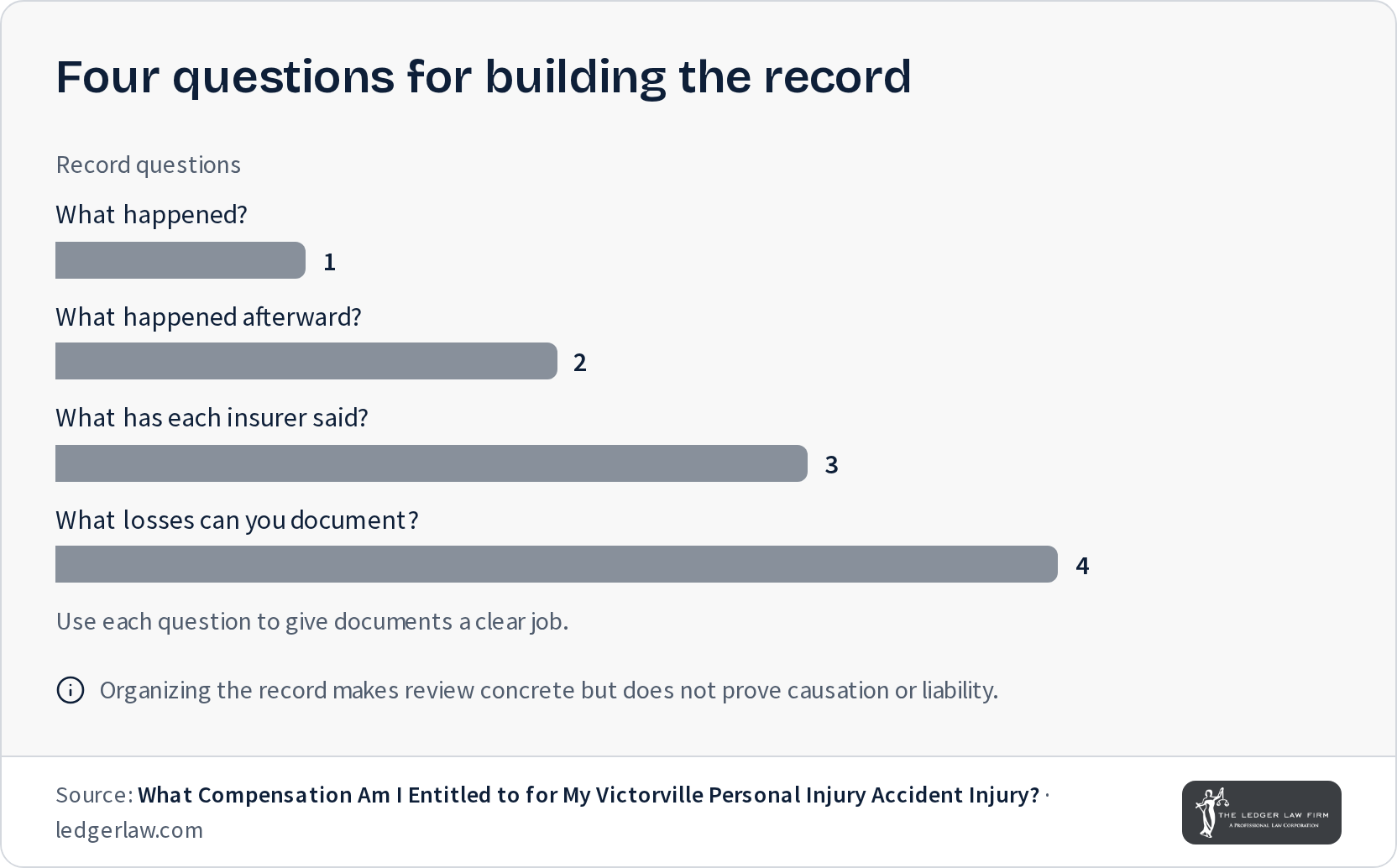
A question-based record is easier to use than a large unsorted folder because each document has a job. Organize the material around what happened, what injuries and treatment followed, how insurance communications developed, and what losses you can document. The purpose is to make the sequence and open questions visible, not to create a larger pile of papers.
Question 1: What happened? Gather the accident report, location and timing information, photographs, driver and witness details, and any account from a police officer or other witness. Accident reports can record where and when an injury occurred and who was involved. If a police officer was present, the officer may be able to provide a statement about fault. Keep a separate note for what you personally remember and do not combine it with someone else’s account.
Question 2: What happened afterward? Place medical records, treatment dates, diagnoses or reported symptoms, and changes to daily activities beside the collision timeline. Medical records can show your injuries, their severity, the treatment you received, and how injuries affected daily life. If a condition, treatment, or expense may have more than one possible explanation, mark that as an open question rather than treating the timeline as proof of causation.
Question 4: What losses can you document? Keep medical bills, hospital bills, examination costs, repair or replacement information for personal property, and work information showing lost wages. Economic damages can include medical bills, hospital bills, examination costs, expenses to repair personal property, and lost wages resulting from an accident. Match every amount to its supporting record and note whether the amount is paid, estimated, disputed, or still developing.
For each item, add a short description rather than a conclusion. A photograph can be labeled with what it depicts and when it was taken if known. A medical record can be identified by the visit or treatment it documents. A message can be summarized by the request it contains. This approach lets you distinguish the record itself from your interpretation of it.
Finish the record with a short unresolved-questions page. Include disputed responsibility, missing witness or report information, unclear injury connections, incomplete loss documentation, and insurer responses you do not understand. Bring that page with the supporting records to the evaluation. The organization can make review more concrete, but it does not prove causation or liability.
Use the insurer file as an escalation signal
Create a communication log with five entries for each contact:
- the date and insurer;
- the person or department involved;
- what information was requested or provided;
- what position, delay, or issue appeared; and
- what response or document is still needed.
After you hire a lawyer, the lawyer may handle communications and negotiations with insurers, including responding to adjusters and negotiating settlement offers. Until then, keep the file complete and take unclear or disputed issues into a case-specific discussion.
Use the insurer file as an escalation signal, not as a verdict. If the file contains disputed fault, delayed damage handling, or accusations directed at you, request legal review with the relevant messages and documents. If the file is straightforward, continue preserving every communication and add it to the chronology.
Keep property damage, injury communications, and responsibility questions identifiable in the log. A repair estimate may address vehicle damage, while a medical record addresses treatment. Keeping those categories distinct makes it easier to explain what the insurer has handled and what remains unresolved.
Prepare the information an evaluation can actually review
Start with the contact information needed for follow-up:
- your name;
- your phone number;
- your email address; and
- a short description of the collision and the issue you want reviewed.
Use a reliable phone number and email address, then keep the description factual. State the date and location if known, the vehicles and people involved, the immediate injuries or damage, and whether an insurer has contacted you.
A useful collision description answers these questions in a few sentences:
- Where and when did the collision occur?
- Who was involved, and who may have witnessed it?
- What do the photographs, accident report, or other records show?
- What injuries or symptoms were reported, and what treatment followed?
- What vehicle, property, medical, or work-related losses are documented?
- Which insurer has been contacted, and what response or dispute remains?
Medical records can show injury severity, treatment, and effects on daily life. Include the location of those records in your working file rather than trying to summarize every page.
Arrange the supporting material so each item can be found quickly. Group the collision account and accident report together, keep photographs with their identifying notes, place medical records and bills near the treatment timeline, and keep insurer messages in date order. Add witness names and contact details to the collision portion of the file. If an item is missing, mark the gap instead of suggesting that the record says more than it does.
An attorney can submit a demand for payment to an insurance company, listing your losses and providing accident-related evidence. The insurer then reviews the submission. That later step does not mean you should calculate a demand now. Submit the facts and documents you have, and identify amounts that are estimated, incomplete, or disputed.
Before sending the request, read the description once for sequence and once for gaps. Remove speculation, separate your observations from other people’s statements, and mark questions you want answered. Then provide your contact details, collision description, and available records through the evaluation form.
Keep the evaluation’s limits visible
A potential recovery assessment may involve several factors. Those factors can interact, and your documents may leave some connections unresolved. List the relevant records and questions without promising yourself a result or assigning a value to the claim.
Keep these questions separate during the evaluation:
- What facts about responsibility still need examination?
- Which injuries, treatment records, and losses appear connected in the chronology, and which connections remain open?
- What do the insurer communications ask, dispute, or leave unanswered?
- What information would be needed to discuss a possible claim path?
Jurisdiction-specific deadlines, fault rules, coverage questions, fees, and individualized legal conclusions require direct discussion rather than an assumption drawn from this guide.
This boundary also applies to your own records. A police report, photograph, medical record, bill, or insurer message can document part of the situation, but it does not by itself answer every legal question. Present the materials together with the uncertainty that remains.
Use the insurer file as an escalation signal
Use the insurer file as the handoff record. Put insurer communications in sequence with the collision timeline and label what each item says. Note whether the other driver’s insurer disputes fault or is slow to process a collision-damage claim, and whether the other driver’s insurer has contacted your insurer seeking payment for damages. Keep photographs, police information, medical records, witness details, and loss records with the related entries. When the file shows an unresolved insurer issue, describe it in a case evaluation request. These materials can organize the questions for review, but they do not establish what a court would decide.
We offer a free consultation with an auto-accident lawyer. We keep clients informed during the entire process and consult them along the way regarding their personal injury lawsuit. A qualified attorney must assess your individual circumstances, and the evaluation does not promise representation, compensation, or a particular outcome.
What should you bring to a car collision lawyer evaluation?
What information should I prepare for a case evaluation with a car collision lawyer?
Gather your contact details, a brief description of the collision, and any supporting records such as accident reports, medical records, photographs, and insurer communications. Organize this information to facilitate discussion during the evaluation.
When is it advisable to contact a car collision lawyer?
Consider reaching out to a lawyer if there are unresolved questions about responsibility, significant injuries, multiple potentially responsible parties, or difficulties in dealing with insurers.
What role does a car collision lawyer play in handling insurance claims?
A car collision lawyer can manage communications with insurers, submit supporting documentation, negotiate settlement offers, and advise you on whether an offer fairly accounts for your losses.
What types of documentation are important for a personal injury case after a car collision?
Key documentation includes medical records, accident reports, photographs of the scene and injuries, witness statements, and any communications with insurers.
How can I determine if my case requires legal assistance after a car collision?
If you face disputes over fault, ongoing medical treatment, or complications with insurance claims, these may indicate that legal assistance is warranted.
What should I avoid assuming when preparing for a case evaluation?
Do not assume that your organized records will prove causation or liability; they are meant to facilitate discussion and clarify unresolved issues.
What are the potential outcomes of contacting a car collision lawyer?
While contacting a lawyer can provide guidance and support in navigating your case, it does not guarantee representation, compensation, or a specific outcome.

Emery Brett Ledger brings 28+ years of experience to personal injury law. He founded & led The Ledger Law Firm in securing over $100 million in compensation for clients with life-altering injuries & complex claims. Prior results do not guarantee a similar outcome. Licensed in California, Texas, & Washington, Emery earned his law degree from Pepperdine University School of Law. His practice areas include car & truck accidents, wrongful death, catastrophic injuries, maritime claims, & mass tort litigation. He has been recognized by The National Trial Lawyers’ Top 100, Mass Tort Trial Lawyers Top 25, and America’s Top 100 Personal Injury Attorneys. Emery also received the 2025 Elite Lawyer Award & holds a perfect 10.0 Avvo rating with Platinum Client Champion status. His legal work has been featured on CNN, Forbes, NBC, & ABC.
Free Case Evaluation
Recent Posts
- What Is a Legal Tort After a Car Accident? Understanding Claims, Negligence, and Next Steps
- Tort Law and Slip-and-Fall Injuries: How to Decide Whether to Seek a Case Evaluation
- Tort Lawyer for a Slip and Fall: How to Decide Whether to Seek Help and Prepare for a Case Evaluation
- Suing After a Car Accident: How to Compare Your Options, Evidence, Timing, and Costs
- How to Settle a Car Accident Claim Without a Lawyer
Emery Brett Ledger brings 28+ years of experience to personal injury law. He founded & led The Ledger Law Firm in securing over $100 million in compensation for clients with life-altering injuries & complex claims. Prior results do not guarantee a similar outcome. Licensed in California, Texas, & Washington, Emery earned his law degree from Pepperdine University School of Law. His practice areas include car & truck accidents, wrongful death, catastrophic injuries, maritime claims, & mass tort litigation. He has been recognized by The National Trial Lawyers’ Top 100, Mass Tort Trial Lawyers Top 25, and America’s Top 100 Personal Injury Attorneys. Emery also received the 2025 Elite Lawyer Award & holds a perfect 10.0 Avvo rating with Platinum Client Champion status. His legal work has been featured on CNN, Forbes, NBC, & ABC.