Should You Contact an Auto Crash Lawyer? A Practical Decision Guide

Set the boundary for the initial consultation
Before contacting an auto crash lawyer, use the initial consultation to establish its review boundary rather than seek a prediction. Ask what it will examine—accident facts, witnesses, treatment, losses, insurance information, responsibility, and potential losses under applicable law—and what the representation agreement would cover.
In California, someone who consults a lawyer about retaining the lawyer or obtaining legal service or advice is a prospective client under California Rule 1.18. Ask when representation would begin and who will explain the next step. If you are outside California, the rules governing a consultation may differ.
Separate the questions you need answered from the outcome you hope for
Your case-evaluation questions should describe what needs review, not assume what the answer will be. A useful question might be, “What facts would affect responsibility?” Another might be, “Which insurance information should be examined?” You might also need to ask whether the treatment records and financial losses are organized well enough to discuss the consequences of the crash.
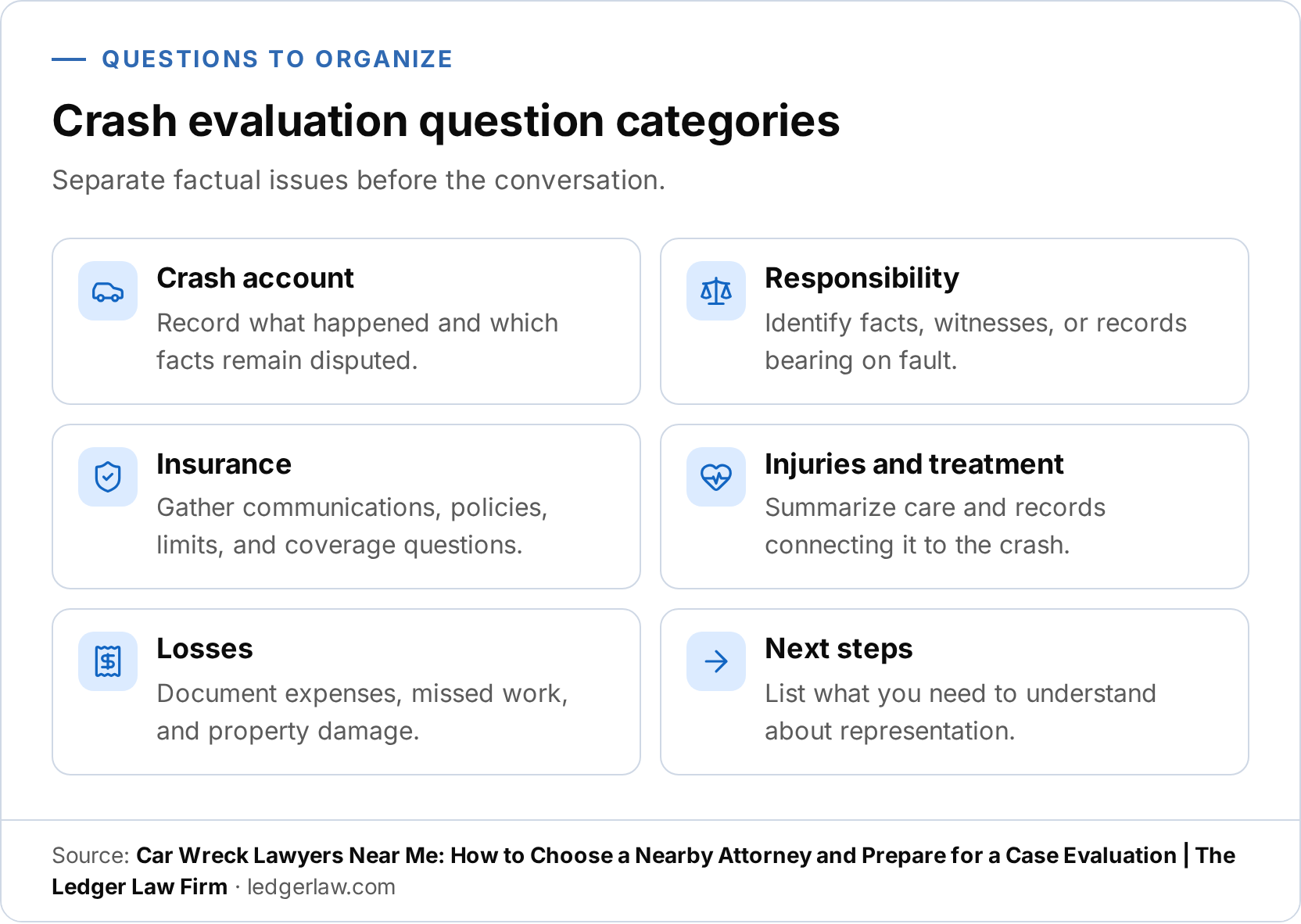
Separate your concerns into categories before the conversation:
- Crash account: What happened, where the vehicles were, and which facts remain disputed.
- Responsibility: Which facts, witnesses, or records may bear on who caused the crash.
- Insurance: What communications, policies, limits, or coverage questions need review.
- Injuries and treatment: What care you received and what records connect that care to the crash.
- Losses: What expenses, missed work, property damage, or other consequences you need to document.
- Next steps: What you need to understand about the legal process and possible representation.
This separation keeps a hoped-for compensation figure from replacing the factual questions a lawyer would actually need to examine.
A nearby office, a confident description, or a broad promise cannot answer those questions by itself. Ask what the evaluation would examine and what information the lawyer would need from you. The evaluation can then focus on the accident facts, witnesses, treatment, losses, insurance information, responsibility, and potential losses under applicable law rather than on a prediction made before the record is reviewed.
Write each question so that it can be answered with facts, records, or an explanation of the applicable law. “What should I do?” is broad. “Which insurance communication should I bring, and what issue does it raise?” gives the conversation a clearer starting point.
Build a factual record before the conversation
A short crash timeline gives your conversation an orderly starting point. Write down the state where the wreck occurred, the basic sequence of events, when symptoms or treatment began, important communications, and the losses you already know about. Keep the entries factual and mark any date or detail you do not know.
Do not wait until every detail is perfect. Mark each item as either available or missing:
- Available: records, messages, bills, policy information, or names you already have.
- Missing: records you expected but do not have, unclear dates, unanswered questions, or information held by another person or organization.
Finish with the two or three questions that matter most to you. For example, you may need to understand whether responsibility is disputed, which insurance information matters, or how your treatment and losses should be discussed. A short, honest list is more useful than a long account that hides the gaps.
Use the timeline as a memory aid, not as a final legal conclusion. Keep observations separate from assumptions: record what you remember, what a document says, and what you do not know. That distinction helps the lawyer see where the factual record is clear and where additional review may be needed.
A practical preparation sheet can have four columns:
- Event or issue: the crash, treatment, communication, expense, or unanswered question.
- What you know: the fact or document you currently have.
- What is missing: the record, date, witness detail, or explanation you still need.
- Question for the lawyer: what you want the evaluation to address.
Gather records that connect the crash to its consequences
Crash records help connect the event to the questions you want reviewed. A police report may document the crash, the parties involved, witness statements, and initial fault assessments. Treat it as part of the factual record, not as a complete answer about responsibility.
Gather the records you already have and label any gaps. Your packet may include:
- The police report or other crash documentation.
- Names and contact information for witnesses, if available.
- A short timeline of what happened and when.
- Insurance policies, claim numbers, letters, emails, messages, and other insurance communications.
Keep a simple list of what each item is and which question it may help address. You do not need to decide which document matters most before the evaluation.
To make the packet easier to review, add a brief index. List each item by type, date if known, related question, and whether it is available or missing. Keep documents grouped by issue or chronology, but do not discard an item merely because you are unsure of its relevance. The purpose of the index is to show the path from the crash record to the questions about treatment, losses, insurance, and responsibility. If two items appear to conflict, flag both rather than choosing one in advance. That gives the evaluation a visible list of materials to examine and unresolved points to explain.
Medical records document diagnosis, treatment, and care after an accident; they can help connect the crash with the reported injuries. Gather records from the care you received and note any missing dates or providers. Itemized medical bills document treatment charges and can help quantify economic damages in a personal-injury claim.
Proof of missed work can also help calculate accident-related financial losses. Examples include pay stubs, employer statements, or tax records. Put those records in a separate group from medical materials so you can explain which loss each document relates to. Organizing these materials does not decide what is recoverable; it gives the lawyer a clearer factual record to assess.
If a record does not match your memory, do not rewrite either one to make them agree. Note the difference in your timeline, identify which version comes from a document and which comes from recollection, and put the discrepancy in your questions. The point of gathering records is to make the factual record visible, including gaps or conflicts, so the evaluation can address what needs clarification. This is especially useful when a date, provider, expense, or insurance communication is uncertain: label the uncertainty instead of presenting an assumption as settled fact.
Bring relevant insurance policies or insurance information because those materials describe coverage, limits, and party responsibilities that may matter when a claim is evaluated. Include information for your policy and any information you received about another policy, but do not assume that a policy limit or coverage label answers the legal questions in your case. Put uncertain items in your question list instead.
If you have already exchanged messages or letters with an insurer, keep those communications with the policy information. Note the date and purpose of each communication in your timeline. That gives the lawyer a clearer view of what has already been discussed and what remains unresolved.
Use the evaluation to test what can actually be reviewed
A case evaluation should have a defined scope. Ask what the conversation will examine and whether the lawyer wants you to focus on the accident facts, witnesses, treatment, losses, insurance information, responsibility, potential losses under applicable law, or several of those areas.
You can use your question list to test that scope:
- Which facts in your timeline need clarification?
- Which missing records could affect the review?
- How will witness information be considered?
- Which treatment records and bills should be discussed?
- What insurance communications or policy details should be included?
- Which questions require current, jurisdiction-specific legal analysis?
A clear answer about scope helps you understand what the first conversation can address. It also prevents you from treating a short intake discussion as a final assessment of every issue.
After the conversation, use a scope check rather than relying on how reassuring it felt. A useful review boundary should let you answer four separate questions:
- What issue or question was actually identified for review?
- Which records, witnesses, or missing details does the lawyer need to examine?
- Which part of the discussion depends on current, jurisdiction-specific law rather than the general information in this guide?
- What remains open, and what would the next review or representation step address?
These answers do not predict responsibility, damages, or compensation. They show what the initial conversation established, what information is still missing, and where the agreement or further review begins. That distinction can help you compare the proposed work without treating confidence or a short intake discussion as a case conclusion.
Use the evaluation to identify what can be reviewed from the information you provide. It may clarify which facts, records, and legal questions deserve further attention, but it should not be treated as a prediction made without examining the relevant circumstances.
Before the conversation ends, ask what information is still needed, what issue remains open, and what the next step would address. If the proposed review does not include the question that matters most to you, ask how that question fits within the representation being discussed or whether another form of legal review is needed.
Compare lawyers by the problem your crash presents
Comparing lawyers works better when you compare the work your crash may require rather than a label or location. Ask whether each lawyer handles accidents like yours. Car accidents, bicycle crashes, and slip-and-fall cases can involve different records and questions, so a general accident description may not show whether the lawyer’s experience matches your facts.
Use the same questions for each lawyer you are considering:
- How does the lawyer’s work relate to the type of accident you experienced?
- Does the practice focus include personal-injury matters that match your problem?
- What would the proposed evaluation examine?
- Which facts, records, witnesses, treatment details, losses, or insurance information would be discussed?
- What local legal setting is relevant to the matter?
The answers give you a more useful comparison than a broad practice label alone. A broad practice label does not show how much of the lawyer’s work concerns accident cases.
A nearby address is not proof of experience in the courts relevant to your matter. Ask directly whether the lawyer has handled cases in the courts relevant to the crash and understands their procedures. Distance may affect convenience, but it does not answer the experience question.
After each conversation, record what the lawyer would review, what remains unclear, and whether the explanation matched your circumstances. Compare the answers rather than trying to rank firms from a name, location, or broad practice description. Choose based on the information you received about the proposed work and fit, not on proximity alone.
A useful comparison note can include the accident types the lawyer handles, the questions the proposed evaluation would address, the relevant legal setting, and the records the lawyer wants to review. Keep the notes factual. They are for comparing the proposed work, not for predicting the outcome of your case.
Check whether the working relationship fits
The working relationship should be clear before you accept representation. Ask who will communicate updates, how you will receive them, and who will explain the next step. Also ask when the relationship would begin, what the agreement covers, and whether the proposed approach fits the facts and questions you brought to the conversation.
Pay attention to whether the lawyer answers the questions you actually asked. A useful explanation should identify the proposed review and its limits without turning uncertainty into a promise. If your main concern involves treatment, insurance communications, responsibility, or losses, ask how that concern would fit within the proposed work.
Before deciding, write down the answers to these practical questions:
- Who will be your main contact?
- How will updates be delivered?
- Who will explain the next step after the initial conversation?
- What work begins if you accept representation?
- What issues or tasks are outside the agreement?
- What information does the lawyer still need from you?
This list does not tell you which lawyer to choose. It gives you concrete points for comparing communication, scope, and fit. If an answer is unclear, turn it into a written question before you make a decision.
For a California matter, someone who consults a California lawyer about retaining the lawyer or obtaining legal service or advice is a prospective client under California Rule 1.18. That California rule describes the status created by the consultation; it does not decide whether the lawyer will represent you or what legal options apply. Keep the consultation separate from any later decision about representation and ask what the proposed relationship would cover.
Under the cited California rule, the consultation can also carry a confidentiality boundary even if no lawyer-client relationship results: information learned from a prospective client generally may not be used or revealed, subject to the rule’s stated exception. That boundary concerns information learned during the consultation; it does not promise representation, decide whether the lawyer will accept the matter, or determine the merits of the crash claim. If privacy is a concern, ask how information provided before representation is handled and what the proposed relationship would cover. Keep that answer with your notes so you can distinguish the protections associated with the consultation from the services and responsibilities in a later agreement.
Read fee and cost terms before accepting representation
Fee and cost terms should be clear before you accept representation. Ask what the proposed arrangement includes, what it excludes, and whether additional charges may apply. Use the agreement itself as the reference point and ask about any term that does not make sense to you.
The questions change with the arrangement:
- Fixed fee: Ask what work the fixed fee includes and whether other charges may be added.
- Hourly arrangement: Ask how much time the lawyer expects the matter to require, while recognizing that the amount of work may change.
- Retainer: Ask what the retainer means in this agreement and what work or availability it covers.
A retainer can have different meanings, including guaranteeing a lawyer’s availability or covering work over a period of time. Read the retainer agreement carefully and ask what it covers before accepting it.
Fee questions are also a comparison of responsibilities, not just price. Ask who is responsible for obtaining records, communicating with insurers, and explaining additional charges, and record the answer beside the agreement term. For a California matter, the cited fee-rule passage states that a lawyer may not agree to, charge, or collect an illegal or unconscionable fee. Because fee rules are jurisdiction-specific, confirm that any California-specific explanation reflects the current rule before relying on it; do not treat it as a universal rule for another jurisdiction. It also does not tell you whether a particular arrangement covers the work you need. Read the actual agreement for that scope, and ask about any responsibility it leaves with you before accepting representation.
Do not compare fees by looking only at a starting amount. Compare what each arrangement covers, which additional charges may apply, how work is billed, and what responsibilities each side has. Ask how a change in the scope of the matter would affect the arrangement.
Write the answers next to the terms you are reviewing. If a fee or cost remains unclear, make that a specific question rather than assuming the most favorable meaning. Understanding the agreement is part of deciding whether the proposed working relationship fits.
Before accepting representation, make sure you understand the document you are being asked to sign, the work included, the charges that may be separate, and the point at which the lawyer-client relationship begins. Keep a copy of the agreement and your questions for your records.
Keep jurisdiction and case-specific limits visible
Jurisdiction matters because responsibility, losses, insurance issues, deadlines, and legal options depend on the facts and the law that applies where the crash occurred. Note the state of the wreck at the start of your timeline and tell the lawyer if the crash, treatment, witnesses, insurance contacts, or losses involve more than one state.
Do not assume that a rule, deadline, coverage term, or process from another matter applies to yours. Bring the insurance information you have and ask which questions require current, jurisdiction-specific review. A policy can describe coverage, limits, and party responsibilities, but the policy language does not by itself determine the full legal position in your case.
When more than one state is involved, make a separate note for each connection: where the crash occurred, where treatment happened, where an insurer communication occurred, and where a loss arose. That list is not a choice of governing law. It helps identify which parts of the discussion may require jurisdiction-specific review and prevents a single state assumption from silently shaping every question. Give the list to the lawyer with the policies and timeline, and ask which items need current legal analysis.
For California insurance terminology, the state glossary defines auto liability coverage as coverage for a policyholder’s legal liability for injuries to other people or damage to their property resulting from an auto accident. That definition explains a coverage term; it does not establish that a particular policy applies to your crash or decide responsibility. Bring the actual policy and related communications for case-specific review.
Keep the state where the crash occurred, the insurance materials you have, and the questions raised by your timeline together. Ask about any deadline, coverage issue, responsibility question, or legal option that depends on the facts of your matter. Treat general information as a starting point for that discussion, not as a substitute for reviewing the circumstances that control your case.
Submit the available free case-evaluation request
Our firm offers a free consultation with an auto-accident lawyer.
Bring the records you have and note any gaps before requesting a review. A consultation does not guarantee representation, a liability finding, eligibility, or compensation.
Questions to resolve before requesting an auto crash lawyer evaluation
When should I consider contacting an auto crash lawyer?
You may want to contact an auto crash lawyer if you have serious injuries, significant losses, questions about responsibility, difficult insurance communications, or uncertainty about the legal process.
What should I prepare before my initial case evaluation with a lawyer?
Before your evaluation, prepare a short timeline of the crash, gather relevant records such as police reports and medical documents, and list any gaps in information along with the two or three questions that matter most to you.
How can I compare different auto crash lawyers?
When comparing lawyers, ask about their experience with cases similar to yours, their focus on personal injury law, the scope of the evaluation they propose, and how they communicate updates and next steps.
What types of records should I gather for my case evaluation?
You should gather police reports, medical records, itemized medical bills, proof of missed work, and relevant insurance policies or communications to help establish the connection between the crash and your injuries.
What is the significance of jurisdiction in my case?
Jurisdiction matters because the laws regarding liability, damages, insurance issues, and deadlines depend on the state where the crash occurred. Make sure to inform your lawyer about any multi-state issues.
What should I know about legal fees before hiring a lawyer?
Understand the fee structure proposed by the lawyer, including whether it is a fixed fee, hourly rate, or retainer, and clarify what services are included and if any additional charges may apply.
What does it mean to be a prospective client under California law?
Under California Rule 1.18, a person who consults a lawyer for the purpose of retaining them or obtaining legal advice is considered a prospective client, which establishes certain confidentiality protections.

Emery Brett Ledger brings 28+ years of experience to personal injury law. He founded & led The Ledger Law Firm in securing over $100 million in compensation for clients with life-altering injuries & complex claims. Prior results do not guarantee a similar outcome. Licensed in California, Texas, & Washington, Emery earned his law degree from Pepperdine University School of Law. His practice areas include car & truck accidents, wrongful death, catastrophic injuries, maritime claims, & mass tort litigation. He has been recognized by The National Trial Lawyers’ Top 100, Mass Tort Trial Lawyers Top 25, and America’s Top 100 Personal Injury Attorneys. Emery also received the 2025 Elite Lawyer Award & holds a perfect 10.0 Avvo rating with Platinum Client Champion status. His legal work has been featured on CNN, Forbes, NBC, & ABC.
Free Case Evaluation
Recent Posts
Emery Brett Ledger brings 28+ years of experience to personal injury law. He founded & led The Ledger Law Firm in securing over $100 million in compensation for clients with life-altering injuries & complex claims. Prior results do not guarantee a similar outcome. Licensed in California, Texas, & Washington, Emery earned his law degree from Pepperdine University School of Law. His practice areas include car & truck accidents, wrongful death, catastrophic injuries, maritime claims, & mass tort litigation. He has been recognized by The National Trial Lawyers’ Top 100, Mass Tort Trial Lawyers Top 25, and America’s Top 100 Personal Injury Attorneys. Emery also received the 2025 Elite Lawyer Award & holds a perfect 10.0 Avvo rating with Platinum Client Champion status. His legal work has been featured on CNN, Forbes, NBC, & ABC.