Should You Contact an 18-Wheeler Crash Lawyer? A Practical Case-Evaluation Guide

Begin with the decision a case evaluation can actually answer
An 18-wheeler case evaluation can help you organize the questions that remain after a commercial-truck crash. It is not a prediction of fault, eligibility, compensation, or the final value of a claim. The useful question is narrower: would a legal review help you understand who may need to be examined, which records matter, what losses should be documented, and how insurance or litigation questions fit together?
Contacting a lawyer may be sensible when your situation includes serious injuries, significant damages, or a need to have compensation decided in court. Those circumstances do not determine the outcome of a claim. They indicate that the consequences or unresolved questions may justify discussing the crash with counsel rather than relying on a general explanation alone.
Use these signals as a starting point:
- Serious injuries: Gather treatment information and describe what remains unresolved.
- Significant damages: Organize medical expenses, lost wages, property damage, and other documented losses.
- A possible court decision: Ask how negotiation, a lawsuit, and possible trial would affect the issues you need to resolve.
A case evaluation can focus the first conversation on facts instead of assumptions. You can explain when and where the crash occurred, identify the vehicles and businesses involved, describe your injuries and losses, and show the communications or records already in your possession. Counsel can then explain which questions require further investigation and which matters depend on the law that applies to your circumstances.
That approach also gives you a practical boundary. You do not need to arrive with a finished theory of fault or a calculated demand. You need a clear account, an organized record, and a list of questions you cannot answer.
Map the people and businesses a crash review may need to examine
An 18-wheeler crash review may need to examine both the truck driver and the trucking company. That two-part review can make the claim more complex than a collision involving only a private driver. Personal injury causation can also involve multiple defendants sharing liability, so the first conversation should identify every known person or business connected to the vehicle, trip, crash, and resulting losses without treating that connection as proof of responsibility.
Start with a simple map:
- Driver: Record the driver’s name, employer information, statements, and role at the time of the crash if you have them.
- Trucking company: Note the carrier’s name, markings on the truck, insurer communications, and any documents identifying the company.
- Other connected parties: List any additional names appearing in the police report, medical records, insurance letters, bills of lading, or other materials you possess.
- Unresolved links: Mark what you do not know instead of filling the gap with an assumption.
A responsibility map helps you ask better questions. What person or business controlled the vehicle? Which entity employed or hired the driver? Which records could connect the trip, vehicle, and collision? Which losses are tied to the crash, and which facts still need support? The answers require case-specific review; the map simply keeps the inquiry from stopping at the first name you recognize.
Keep responsibility separate from the fee arrangement. A selected example describes a 33.33% contingency fee on a $150,000 settlement as $50,000, leaving $100,000 for the client before other possible deductions. That example illustrates arithmetic from a particular agreement and settlement; it does not estimate your claim or establish a fee for any lawyer.
Use federal trucking records to identify investigation questions
Federal motor-carrier rules require a carrier to have each driver record duty status for each 24-hour period using specified methods. Records of duty status must be kept current, including each change in duty status and the relevant city, town, or village and state. Those requirements create questions about the trip timeline, but the existence or absence of a particular entry does not by itself decide responsibility for a crash.
Ask whether the available account can be compared with duty-status records. A useful comparison may involve the reported time and location of the collision, the driver’s stated route, and the sequence of events before impact. Keep the question factual: what does each record show, and what remains unexplained?
Federal motor-carrier rules require each motor carrier and intermodal equipment provider to systematically inspect, repair, and maintain the commercial motor vehicles under its control. A crash review can therefore identify vehicle-condition and maintenance questions without assuming that a mechanical issue caused the collision.
Write down any detail that may help counsel frame that inquiry, including visible vehicle damage, statements about a problem before the crash, photographs, and references to inspection or repair work. Do not convert a damaged part or an incomplete record into a fault conclusion. The practical purpose is to show where a focused investigation may be needed.
The selected FMCSA material states that a carrier must request each driver’s motor vehicle record every 12 months, keep it for 3 years, and review it for safe-driving qualifications and disqualifications. This recordkeeping requirement can give counsel another line of inquiry about the driver’s qualification history and the carrier’s records.
Treat these materials as investigation questions rather than answers. Ask what records are available, what time period they cover, and how their contents relate to the crash facts. Federal rules may be significant, but their legal effect depends on the facts and applicable law in the particular matter.
Organize the records that may test the crash account
Trip records can help test the timeline you describe, but no single document necessarily proves what happened. During a safety audit, a motor carrier may be asked for documents supporting a driver’s record of duty, such as toll records, fuel records, bills of lading, and trip reports. An FMCSA safety-audit guide also identifies documents auditors may request to verify compliance with federal motor-carrier and hazardous-materials regulations.
Place the records you already have into practical groups:
- Travel and timing: Toll records, fuel receipts, route information, bills of lading, and trip reports.
- Vehicle and carrier materials: Inspection, repair, maintenance, and vehicle-identification records.
- Driver materials: Duty-status information and documents that identify the driver or employer.
- Crash materials: Police or incident reports, photographs, video, witness information, and insurance communications.
Driver-qualification records can raise separate questions from trip records. The selected driver-qualification checklist states that a carrier must request an updated motor vehicle record annually and retain it for 3 years from the date of execution. The selected FMCSA material also states that applicants may authorize prior employers to release safety-performance records and may dispute information from prior employers through a correction request or rebuttal.
You do not need to obtain or interpret another person’s employment file before asking for legal review. Note the names, references, and record descriptions that appear in materials you already possess. Give counsel the source and date of each item so the discussion can distinguish a missing record from a record that simply has not yet been located.
FMCSA’s Crash Statistics A&I provides data on large-truck and bus crashes to highlight safety trends and factors associated with crashes. The CMV Report provides large-truck and bus crash data at the national, state, and service-center levels. That information can provide broad context for questions about commercial-truck crashes, but broad crash data does not establish what caused your collision or who is responsible for your losses.
Keep general crash information separate from case-specific proof. Your packet should make that distinction visible so a discussion about national, state, or service-center data does not replace examination of your own photographs, records, witnesses, and communications.
Build a fact-and-record packet before the first conversation
An 18-wheeler crash packet should give counsel a readable account of the collision, the consequences, and the records that support each part of your description. Evidence in a truck accident case tends to be more complex than evidence in other accident claims, so a clear structure can help separate what you personally observed from what another document or person reports.
Build the packet in these sections:
- Collision account: Write the date, location, direction of travel, vehicles involved, sequence you remember, and the names of responding agencies or witnesses.
- Images and vehicle information: Add photographs, video, vehicle descriptions, visible damage, and any repair or inspection material in your possession.
- Medical information: Gather bills, examination records, hospital records, treatment dates, and descriptions of continuing effects.
- Work and financial effects: Add wage information, missed-work records, and documented expenses connected to the collision.
- Communications: Save letters, emails, texts, claim references, recorded-message details, and requests from insurers or other parties.
A usable packet separates original material from your notes. Keep photographs and electronic files in their original form when possible, label copies with the date received or created, and write a short description beside each item. A simple chronology can show when the collision occurred, when treatment began, when an insurer contacted you, and when a new document arrived.
Witness information deserves its own page. Record each person’s name and contact information as it appears in your materials, what the person may have observed, and whether a statement or recording exists. Do not rewrite another person’s account as if it were your own observation.
We interview witnesses and obtain their official statements for auto accident cases. If your packet contains witness names, statements, photographs, or communications, identify where each item came from and what question it may help answer. That organization gives the first conversation a concrete starting point without requiring you to decide which witness or document will ultimately matter most.
To make that organization easier to use, add a short index at the front of the packet. Give each item a number and record its date, source, related question, and status: in hand, mentioned but not available, or needs clarification. Use the same number in the file name or note so a conversation can move from a question to the underlying material without searching through the entire packet.
Then review the index in three passes. First, check completeness: are the documents you refer to actually attached or clearly marked as missing? Second, check consistency: do the dates in the collision account, treatment timeline, work records, and insurer log line up, or is there an unexplained gap? Third, check questions: which item needs interpretation rather than simple description? For example, a document may show that a communication occurred without answering what a request means, and a record may identify a date without resolving how it relates to the crash. Mark those issues for discussion instead of trying to resolve them in the index. This preserves the difference between organizing information and drawing a legal conclusion.
If a file contains several pages, identify the relevant page or section in the index rather than assuming the whole file answers the same question. Keep a separate list of items received after the first review, including the date received and where each item is stored. This lets counsel see what was available at the outset and what was added later, while keeping the packet current without rewriting the underlying records.
Record the losses without trying to price the claim
Economic losses from a crash can have an easily ascertainable quantitative value, including medical bills, lost wages, and vehicle damage. Economic damages may also include out-of-pocket medical bills, hospital bills, examination costs, personal-property repair expenses, and lost wages resulting from an accident.
Record the categories separately rather than combining everything into one estimate:
- Medical care: Bills, hospital charges, examination costs, treatment records, and out-of-pocket payments.
- Work-related loss: Wage records, missed-work dates, and documents describing the financial effect of time away from work.
- Vehicle and property damage: Repair estimates, invoices, photographs, and expenses involving personal property.
- Other documented expenses: Receipts or bills that show a direct connection to the collision and are already available to you.
A loss log can contain the date, category, provider or business, amount shown on the document, and the file name where the supporting record is stored. Add a brief description of what the expense represents. This format helps you identify missing documents and explain the financial effects without treating the total as a prediction of what any claim may recover.
Keep medical information and financial information linked but distinct. A bill shows an expense; a treatment record may explain the care; a work record may show a wage effect. Counsel can assess how those records relate to the crash and which additional questions require attention.
The purpose of a loss log is completeness of organization, not valuation. Do not subtract insurance payments, assign a settlement number, or assume that every listed expense will be recoverable based only on this guide. Bring the documents and the questions to the evaluation so the legal significance of each category can be addressed in context.
Treat insurer communications as questions for case-specific review
Insurance communications can involve more than one coverage path, and the first task is to identify what each communication concerns. We handle both first-party and third-party claims in auto accident cases. For your packet, label each insurer, claim number, sender, date, and the person or business whose coverage is being discussed.
Create a communication log with these fields:
- Date and method of contact.
- Name, title, and insurer or business associated with the message.
- Documents, statement, authorization, or response requested.
- Deadline or response date shown in the communication.
- Your response, if any, and the file where the original message is stored.
The communication log should lead to questions rather than quick conclusions. Ask which policy or claim is involved, what information the request is meant to address, whether another insurer or party is also involved, and how the communication fits with the collision account and documented losses. Bring the actual letters, forms, emails, and messages so those questions can be reviewed in their full wording.
A general guide cannot decide how you should answer a particular request, statement, release, or settlement communication. Mark each item as answered, awaiting a response, or needs legal review. That simple status label helps keep an urgent message from disappearing inside a larger packet.
An insurer’s position is not the same thing as a final determination of responsibility or loss. Record what the insurer asked, offered, accepted, or disputed, then separate that information from your own account of the crash. The evaluation can address which communications require a response and which questions remain open.
Understand the possible path from negotiation to court
Many personal injury accident cases are settled through negotiations between the plaintiff and defendant before a lawsuit is prepared. Negotiation can therefore be one possible path after the facts, responsibility questions, insurance positions, and losses have been reviewed. A negotiation is not an assurance that the parties will agree, and an offer is not a measure you can apply to another crash.
Ask what information would support a negotiation, what issue is preventing agreement, and which losses or responsibility questions remain disputed. Keep every proposal and response with the communication log. A dated record can help you explain how the discussion developed.
We may sue responsible parties to seek compensation for your losses. If litigation becomes a possibility, ask what filing a lawsuit would change, which parties would be named, what records or testimony would need to be developed, and whether discovery or other court proceedings would affect your role. Those questions describe topics for counsel to assess; they do not determine whether litigation is appropriate in your situation.
You should understand the potential risks and rewards of taking a personal injury case to trial. A trial discussion should cover the disputed facts, the evidence available to address them, the time and cost issues identified in the representation agreement, and the possibility that a court or jury will decide unresolved matters. Ask what would make negotiation preferable, what would make litigation necessary, and what information would be needed before choosing between those paths.
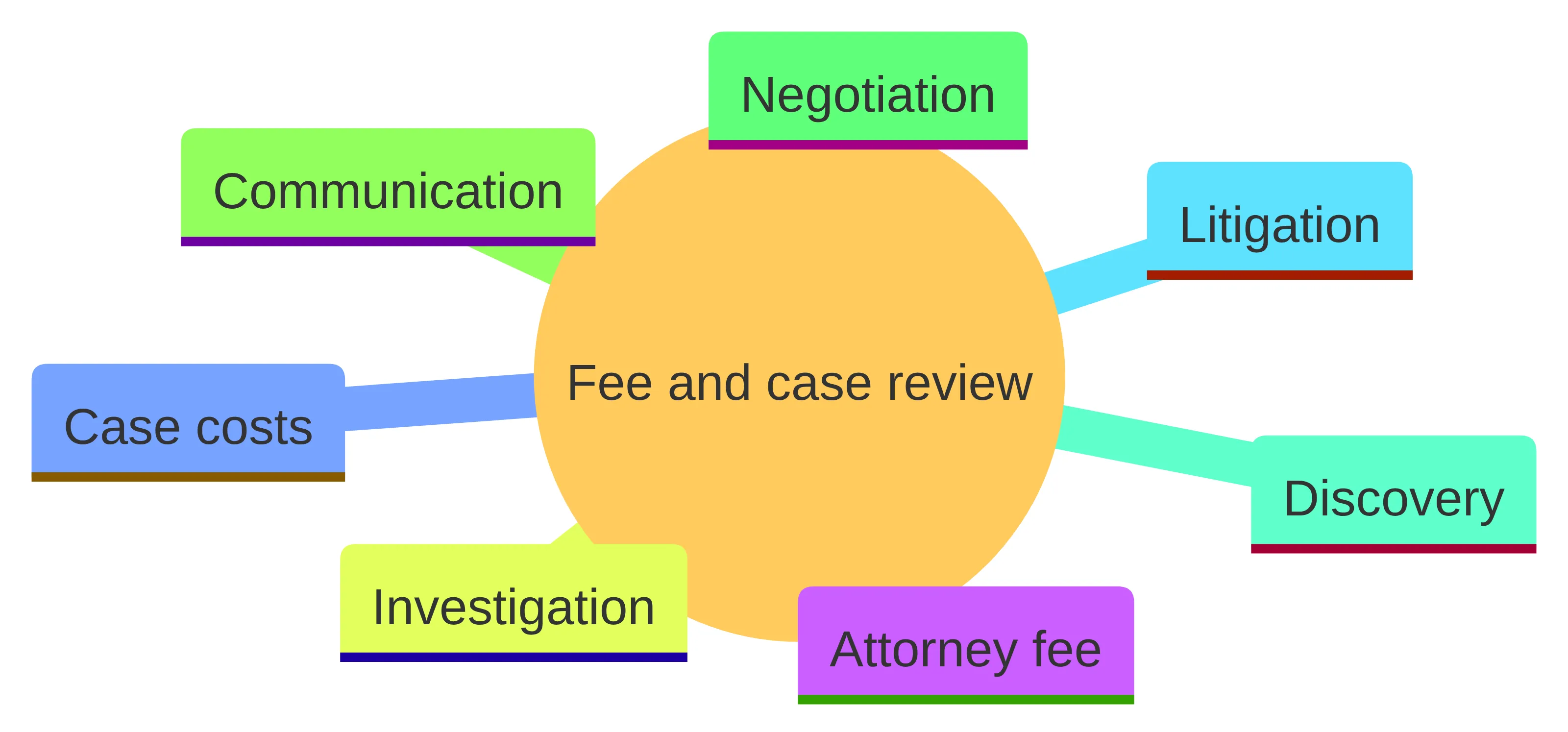
A practical process map can use four headings: investigation, insurance communication, negotiation, and possible court proceedings. Put each known event under the correct heading and place unresolved questions beneath it. This map keeps you from treating a negotiation, lawsuit, discovery request, or trial discussion as inevitable when the matter still requires direct assessment.
Ask how investigation, fees, and case costs would work
In many contingency-fee truck accident claims, you do not pay attorney fees up front. The amount and terms of a truck-accident lawyer’s fee depend on the representation agreement, including how the fee is calculated, whether case costs are separate, and what happens if there is no recovery.
Ask for plain answers to these questions before signing an agreement:
- How is the attorney fee calculated?
- Is the calculation made before or after particular costs or expenses?
- Which case costs are separate from the attorney fee?
- Who pays those costs while the case is pending?
- What happens if there is no recovery?
- How will a settlement, judgment, or other recovery be distributed?
We work on a contingency-fee basis for truck accident cases. We also keep clients informed throughout the process and consult with them along the way regarding their personal injury lawsuit. Those are firm-specific process statements, not a substitute for reading the representation agreement or discussing how a particular matter would be handled.
Ask how communication would work in practical terms. Who would contact you about a new document, offer, request, or court development? How would you receive updates? Which decisions would require your input? Place the answers beside your questions about investigation, negotiation, discovery, and possible litigation.
Investigation questions should connect the fee discussion to the work your packet may require. Ask whether the proposed review would examine the driver and trucking company, duty-status and maintenance questions, witness information, medical and wage records, vehicle damage, and insurer communications. Ask which work is included in the agreement and which expenses would be treated separately.
A clear agreement should let you distinguish the legal fee from case costs and the investigation from the result. If a term is unclear, write down the exact question and request an explanation before making a decision.
Turn unresolved questions into an evaluation checklist
An 18-wheeler case-evaluation checklist should turn your packet into a short list of decisions and unknowns. Use the checklist to keep the first conversation focused, not to reach a legal conclusion before the facts have been reviewed.
Bring or prepare:
- A one-page collision account with the date, place, vehicles, sequence, and known witnesses.
- Photographs, video, vehicle information, incident reports, and communications.
- Medical records, bills, examination costs, wage information, repair records, and other documented losses.
- Names of the driver, trucking company, insurers, witnesses, and other people or businesses identified in your materials.
- A timeline of treatment, work effects, insurer contact, and important documents.
- A list of records you do not have but believe may matter.
- Your representation-agreement and case-cost questions.
Before the conversation, separate what you know from what you infer. The collision account should use your own observations and identify where memory is incomplete. A photograph can show a damaged vehicle or roadway condition, while it does not by itself answer who caused the crash. A bill can show an amount charged, while a treatment record may provide different context. Labeling where each item came from helps counsel compare the account with the records.
The responsibility portion of the packet can remain open-ended. Include the driver’s name, the trucking company’s identifying information, insurer communications, and names of any other person or business appearing in your materials. Note whether each entry is confirmed, appears in a document, or still needs clarification. This approach recognizes that a claim may involve the driver and trucking company and that causation can involve multiple defendants sharing liability without assigning responsibility yourself.
For the process portion, group questions under investigation, insurance communications, negotiation, possible discovery, and court proceedings. Ask which records would address each question and what information is missing. Add a separate fee-and-cost page that lists how the fee is calculated, whether case costs are separate, and what happens if there is no recovery. A written list makes it easier to discuss the representation agreement before deciding whether to proceed.
Use a final review to check that the packet does not present an assumption as a confirmed fact. Mark statements based on your memory, documents, or another person’s account, and keep unresolved points visible. The purpose of the checklist is to give the first conversation a clear starting point while leaving responsibility, legal significance, and possible next steps for direct review.
Use these questions to guide the discussion:
- Which responsibility questions should be investigated first?
- Which records may test the crash timeline or the account of what happened?
- How should the medical, work, vehicle, and property records be organized?
- What insurer communications require attention, and what information is still missing?
- What would negotiation involve, and when might litigation or discovery become relevant?
- How would the fee be calculated, which costs would be separate, and what happens without a recovery?
- How would updates and decisions be handled during the matter?
Ask how that process would apply to the work your particular packet may require.
Finish the checklist with three columns: known, documented, and unresolved. Put a fact in the first column only when you can describe it clearly, add a file or source in the second when you have supporting material, and place open questions in the third. This gap-first format helps you explain what happened without overstating what the records establish.
Keep jurisdiction, timing, and legal significance open for direct review
Jurisdiction can change the legal questions that apply to an 18-wheeler crash. Keep the crash location, treatment locations, residence information, vehicle and carrier information, and places named in communications together in the packet. Those details help counsel identify which federal and state-law issues require current review without turning this guide into a deadline or fault determination.
That guidance does not supply a filing deadline or decide whether your claim is timely. Write down the collision date, the date of each insurer communication, the treatment timeline, and any date shown on a legal or insurance document, then raise the dates directly during the evaluation.
Federal duty-status, maintenance, and driver-record requirements can create investigation questions, but their significance depends on the facts, the records available, and the applicable law. Keep each question tied to its subject: driver hours and location, vehicle inspection or repair, driver qualification, insurer communications, responsibility, damages, or procedure.
Avoid filling legal gaps with broad statements about what a record must mean. Mark the issue as unresolved and bring the underlying document, date, and surrounding facts to counsel. A direct review can then address the jurisdiction, timing, and legal significance together.
Use the information you gathered to request an initial evaluation
The information you gathered can turn a difficult 18-wheeler crash story into a focused set of questions. Bring the collision account, responsibility map, federal-record questions, evidence list, loss log, insurer communications, process concerns, and fee questions together. A qualified lawyer must assess individual suitability and the legal significance of the facts in your case, but an organized packet can make that discussion more concrete.
Before submitting your information, check that your contact details are current, your crash description is clear, and the documents or questions most connected to your concerns are easy to find. Then take the next step that gives you a direct opportunity to discuss whether further legal review is appropriate.
Questions to resolve before requesting an 18-wheeler crash lawyer evaluation
What should I gather before contacting an 18-wheeler crash lawyer?
Before reaching out to a lawyer, compile a clear account of the collision, including the date, location, vehicles involved, and any known witnesses. Organize relevant records such as medical bills, vehicle damage estimates, and insurance communications.
How do I know if I need to contact a lawyer after an 18-wheeler crash?
Consider contacting a lawyer if you have serious injuries, significant damages, or if you need compensation determined in court.
What types of evidence are important in an 18-wheeler crash case?
Key evidence includes duty-status records, maintenance logs, trip records, police reports, medical records, and any communications with insurers.
What should I expect during the initial consultation with a truck accident lawyer?
During the initial consultation, you can expect to discuss the details of your case, review the evidence you have gathered, and ask questions about the lawyer’s process, fees, and how they can assist you.
How can I prepare for negotiations or litigation after an 18-wheeler crash?
Prepare by organizing all relevant documentation, understanding your losses, and being ready to discuss the facts of the case. Knowing what you want to achieve in negotiations can also help guide the process.
What are common categories of losses I can claim after an 18-wheeler crash?
Common categories of losses include medical expenses, lost wages, property damage, and other out-of-pocket costs related to the accident. Documenting these losses is essential for your claim.

Emery Brett Ledger brings 28+ years of experience to personal injury law. He founded & led The Ledger Law Firm in securing over $100 million in compensation for clients with life-altering injuries & complex claims. Prior results do not guarantee a similar outcome. Licensed in California, Texas, & Washington, Emery earned his law degree from Pepperdine University School of Law. His practice areas include car & truck accidents, wrongful death, catastrophic injuries, maritime claims, & mass tort litigation. He has been recognized by The National Trial Lawyers’ Top 100, Mass Tort Trial Lawyers Top 25, and America’s Top 100 Personal Injury Attorneys. Emery also received the 2025 Elite Lawyer Award & holds a perfect 10.0 Avvo rating with Platinum Client Champion status. His legal work has been featured on CNN, Forbes, NBC, & ABC.
Free Case Evaluation
Recent Posts
- Attorneys for Work Injuries: How to Decide Whether to Contact One and Prepare for an Evaluation
- Injury Attorneys Dallas: How to Decide Whether to Contact a Car Accident Lawyer
- Personal Injury Lawyer Greenville South Carolina: How to Decide Whether to Seek Help After a Slip and Fall
- Lawyers for Wrongful Death: How to Choose One and Prepare for a Case Evaluation
- Injury Attorney in LA: How to Decide Whether to Seek a Case Evaluation After a Crash
Emery Brett Ledger brings 28+ years of experience to personal injury law. He founded & led The Ledger Law Firm in securing over $100 million in compensation for clients with life-altering injuries & complex claims. Prior results do not guarantee a similar outcome. Licensed in California, Texas, & Washington, Emery earned his law degree from Pepperdine University School of Law. His practice areas include car & truck accidents, wrongful death, catastrophic injuries, maritime claims, & mass tort litigation. He has been recognized by The National Trial Lawyers’ Top 100, Mass Tort Trial Lawyers Top 25, and America’s Top 100 Personal Injury Attorneys. Emery also received the 2025 Elite Lawyer Award & holds a perfect 10.0 Avvo rating with Platinum Client Champion status. His legal work has been featured on CNN, Forbes, NBC, & ABC.