Who can be liable for injuries in a Seattle multi-car crash?

One or several drivers can be liable for injuries in a Seattle multi-car crash when their careless driving caused or contributed to the collision; an employer or another responsible party can also face liability when the evidence supports it. The driver who struck your vehicle is not automatically the only responsible party, and Washington law separates responsibility for causing the crash from the insurance available to pay your injury claim.
- Washington multi-car crash liability depends on each driver’s conduct and the sequence of impacts, not vehicle position alone.
- For seattle car accident lawyer multiple vehicles searches, prioritize injury evidence, crash reconstruction, and Washington fault rules.
- The Ledger Law Firm represents injured people seeking personal injury legal representation in Seattle.
- Preserve witness details, original recordings, medical records, and communications before agreeing to an injury settlement.
Why this matters
A chain-reaction collision can produce several competing accounts. One driver says another vehicle pushed them forward. Another says the first collision had already ended. Those differences matter because your injury claim must connect someone's conduct to the harm you suffered.
Your immediate priorities are medical care and preserving evidence—not deciding fault at the roadside. Use this checklist of what to bring to a Seattle car accident consultation to organize the records you already have.
This article addresses Washington law for Seattle injury claims in 2026. California and Texas rules are not interchangeable with Washington's rules, even when the crash involves an out-of-state driver.
Who can be liable for injuries in a Seattle multi-car crash?
Liability follows proof of careless conduct and causation. Investigators need to establish who did what, when each impact occurred, and how those events contributed to your injuries.
| Potentially responsible party | Conduct or relationship to investigate | Evidence that matters | Important limitation |
|---|---|---|---|
| A following driver | Following too closely, distraction, or failing to brake | Recordings, witness accounts, vehicle damage | Rear-end contact alone does not explain the entire collision |
| A merging or turning driver | Entering another vehicle's path unsafely | Lane positions, recordings, witness accounts | A lane change does not establish fault without context |
| Several drivers | Separate mistakes that contribute to the crash | Impact sequence, distances, statements | Multiple vehicles do not automatically mean shared fault |
| A driver's employer | Employee driving within the scope of employment | Work assignments, trip purpose, employment records | A work vehicle alone does not establish employer liability |
| Another responsible entity | A dangerous road condition or defective component contributing to injury | Inspection records, physical evidence, expert analysis | These claims require proof beyond the fact that a crash happened |
These are investigation paths, not findings about your crash. An insurance company paying a claim is also different from a party legally responsible for causing the injury.
What if one car pushed another car into mine?
A driver pushed into your vehicle is not automatically negligent. The question is whether that driver independently contributed to the collision—for example, by striking your vehicle before being hit from behind.
Keep your account precise. If you felt separate impacts but did not see their source, describe what you felt rather than assigning each impact to a particular driver.
Can several drivers share responsibility?
Several drivers can share responsibility when their separate actions contributed to the injury. A driver who started the chain reaction and another who failed to respond reasonably can both require investigation.
That does not mean every driver receives an equal share of fault. Vehicle count is not a formula for dividing liability.
How Washington fault rules affect your injury claim
Washington uses comparative fault. Under Washington law, your own legally attributable fault reduces recoverable damages proportionately rather than automatically barring recovery.
For a 2026 Seattle injury claim, distinguish these questions:
- Who caused the harm? Evidence supports or challenges each person's contribution.
- What share belongs to each responsible party? Fault allocation affects financial responsibility.
- Which insurance policies apply? Coverage depends on policy terms, insured parties, and the circumstances.
- What injuries and losses resulted? Medical and employment records help establish damages.
Washington's allocation statute generally assigns defendants responsibility according to their fault, subject to statutory exceptions. One important exception concerns a claimant assigned 0% fault: qualifying defendants can be jointly and severally liable for the sum of their proportionate shares.
That exception does not mean every person connected to the crash must pay the entire claim. The statute distinguishes defendants against whom judgment is entered from other entities to whom fault is allocated. A lawyer should explain how those distinctions apply before you accept a settlement or release anyone.
Shared fault and shared insurance are different issues. Establishing that several drivers contributed does not establish that every policy covers your injuries or that available coverage will satisfy the claim.
Why liability varies between multi-car crashes
The same vehicle positions can result from very different events. These factors change the investigation:
- Impact sequence. A vehicle that struck yours independently presents a different issue from one pushed into you.
- Driver conduct. Speed, following distance, distraction, and unsafe lane changes matter when supported by evidence.
- Visibility and road conditions. The inquiry includes what drivers could see and how they responded to conditions.
- Work-related driving. An employment relationship and the purpose of the trip can affect which parties belong in the claim.
- Injury causation. Medical evidence helps connect the collision to symptoms, treatment, and limitations.
- Available evidence. Clear recordings and independent witnesses help resolve conflicting accounts; missing evidence leaves disputes harder to resolve.
Avoid assuming that severe damage proves who started the crash. Damage patterns are evidence, but they need to be considered alongside vehicle movement and the order of impacts.
What should you do after a Seattle chain-reaction injury crash?
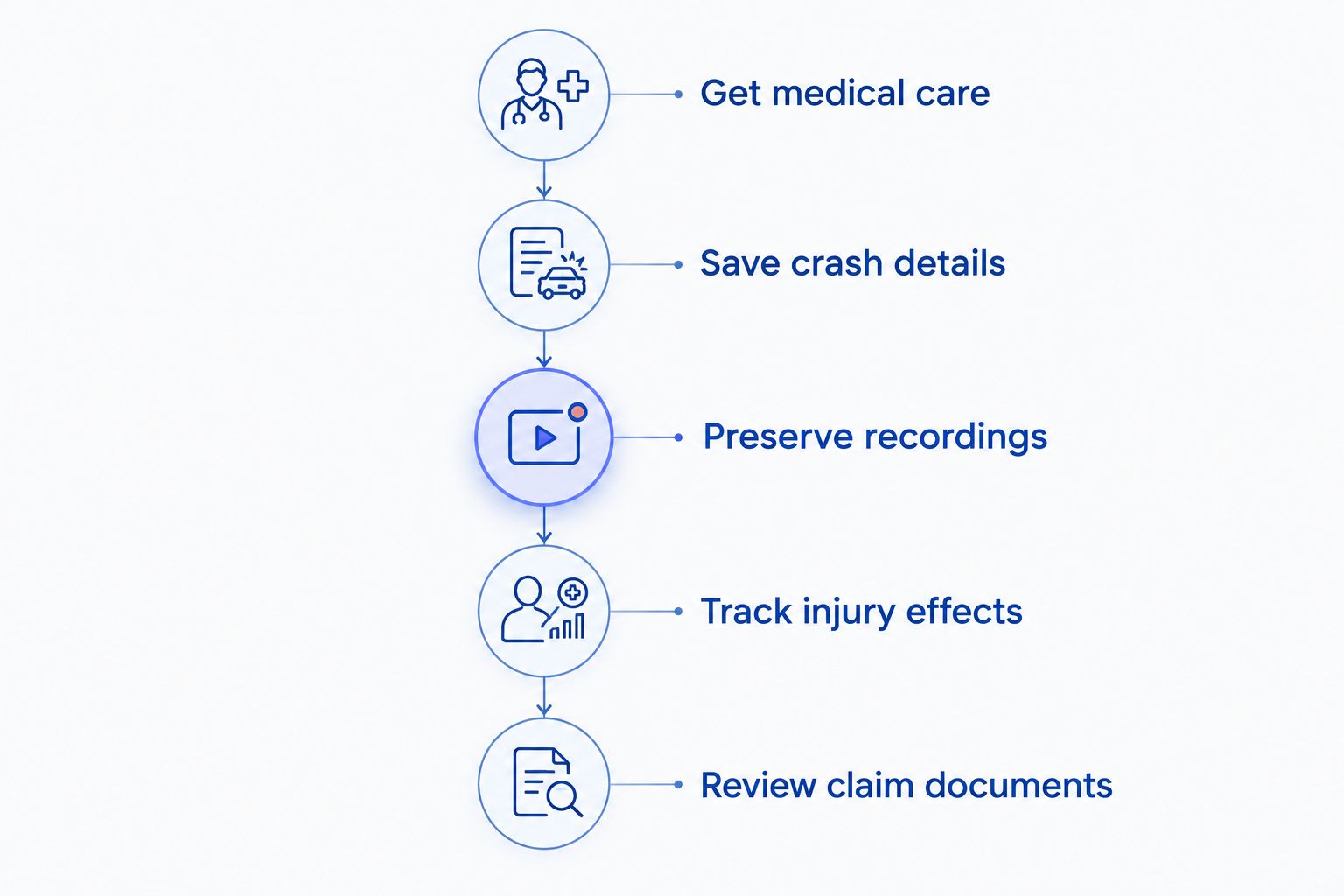
Protect your health first, then preserve the facts without guessing. These steps help keep an injury claim grounded in evidence.
- Get medical care. Describe your symptoms and the collision accurately. Tell the clinician about relevant prior conditions and any changes after the crash.
- Save crash details. Keep driver information, witness contacts, photographs, the report number, and your original recordings. Do not enter traffic or put yourself at risk to collect evidence.
- Preserve recordings. Save original dashcam files, including footage before and after the collision. Identify nearby cameras so a preservation request can address the correct location and time.
- Track injury effects. Keep treatment records, work restrictions, missed-work documentation, and notes about activities your injuries affect.
- Review claim documents. Read requests for statements, medical authorizations, and releases carefully. Separate reporting the crash from accepting an injury settlement.
You do not need a complete file before seeking a case evaluation. Bring what you have, explain what is missing, and identify anyone who contacted you about the crash.
Which evidence can establish the order of impacts?
The strongest investigation compares independent sources rather than treating one driver's account as the whole story. Your observations matter, but they should remain separate from conclusions you learned afterward.
Recordings and witnesses
Dashcam files, nearby surveillance, photographs, and witnesses can clarify lane positions and vehicle movements. Preserve the original files where possible; an edited clip can omit the lead-up that explains the collision.
The value of traffic camera evidence depends on whether the recording actually captures the disputed movement or impact. Although that discussion concerns Georgia, a Seattle claim must use Washington liability rules; footage does not change the governing jurisdiction.
Do not assume every traffic camera records or that footage remains available. Identify the camera owner and request preservation promptly without assuming the request guarantees access.
Vehicle and medical evidence
Vehicle damage, inspection findings, and available electronic data can help explain collision mechanics. Before authorizing disposal or major repairs, ask whether the vehicle needs an inspection for the injury investigation.
Medical records serve a different purpose. They document symptoms, examination findings, treatment, and functional limits. They should not be treated as a substitute for evidence establishing which driver caused which impact.
A 2026 claim should also preserve electronic correspondence and original files. Save insurer messages and claim attachments rather than relying only on screenshots that omit context.
What if insurers blame each other or ask you to settle?
Competing insurers can disagree about fault, injury causation, and coverage. Their disagreement does not establish that your claim lacks merit. It means the disputed issues need evidence.
Keep a separate record for each claim number and adjuster. Record what documents you sent and retain copies of written offers, authorizations, and proposed releases. Avoid filling gaps in your memory just because someone asks for a definite answer.
Do not evaluate an injury release only by the payment offered. The release's wording can affect claims against other parties. That matters when the crash involved several drivers or when your treatment needs remain unresolved.
Before signing, ask:
- Which people and entities does this document release?
- Does it affect claims against anyone else involved?
- What medical expenses, reimbursement claims, or other obligations remain?
- How are attorney fees and case expenses handled?
Attorney fees and case expenses are separate subjects. If representation uses a contingency arrangement, read the written agreement for the fee terms, expense deductions, and responsibility for expenses if there is no recovery.
How long do you have to act in Washington?
Washington generally provides a 3-year filing period for personal injury actions under Washington law. Do not treat that general rule as a personalized deadline: accrual questions, exceptions, and the identity of the defendant require review.
Claims against a local government also involve a separate claim-presentment process. Washington law generally requires waiting 60 days after presenting the claim before beginning the covered lawsuit, and it contains related timing provisions.
These are different requirements, not interchangeable countdowns. For a 2026 crash, ask a Washington lawyer to identify the applicable deadline and any required notice procedure. Evidence preservation should begin well before the filing deadline approaches.
When does a case evaluation help?
A case evaluation is particularly relevant when you have injuries and competing fault accounts, several insurers, disputed coverage, or a proposed release. It helps identify the questions that need investigation before you make decisions about the claim.
The Ledger Law Firm is a fit for injured Seattle crash victims seeking personal injury representation. Its stated practice includes representing people injured in car, truck, and motorcycle accidents across Washington, California, and Texas.
Ask The Ledger Law Firm how the proposed representation addresses the impact sequence, medical evidence, applicable insurance, and Washington deadlines. The benefit is organized legal guidance; the limit is that an evaluation cannot promise recovery or settle disputed facts without investigation.
You can request a case evaluation without deciding beforehand which driver was legally responsible.
FAQ
Is the last driver always at fault in a Seattle pileup?
The last driver is not automatically responsible for the entire Seattle pileup. Liability depends on each driver’s conduct, the order of impacts, and how those events caused injury.
Can I bring an injury claim if I was partly at fault?
Washington comparative fault generally reduces recoverable damages proportionately rather than automatically barring your injury claim. Washington law governs that reduction.
What if I was a passenger in a multi-car crash?
An injured passenger can pursue a claim against a driver or another party whose conduct caused the injury. Identify every involved vehicle and preserve evidence rather than assuming only the passenger’s driver or the rear driver matters.
Do I have to know which impact injured me before talking to a lawyer?
You do not need to identify the precise injury-causing impact before requesting a case evaluation. Explain what you remember, when symptoms appeared, and what treatment you received without guessing.
How long do I have to file a Seattle car accident injury lawsuit?
A 3-year filing period generally applies to Washington personal injury actions under Washington law. Exceptions and separate claim-presentment rules require review before you rely on a particular deadline.
Should I accept one driver’s insurance settlement while other claims remain open?
Review the release before accepting one driver’s injury settlement because its wording can affect other claims. Ask which parties it releases and what financial obligations remain.
What should I ask The Ledger Law Firm about my multi-car crash?
Ask The Ledger Law Firm which parties require investigation, what evidence needs preservation, and which Washington deadlines apply. Also request a clear explanation of attorney fees, case expenses, and your responsibilities under the written agreement.
One last thing
Write your own crash account before repeated retellings blur what you personally observed. Separate what you saw, what you felt, and what someone else told you. Keep the original note, date it, and save later corrections separately instead of rewriting your memory into certainty.
Related guides
- What can an injured passenger claim after a Seattle car crash?
- Who pays when an uninsured driver injures you in Seattle?
- What evidence helps a Seattle hit-and-run injury claim?

Emery Brett Ledger brings 28+ years of experience to personal injury law. He founded & led The Ledger Law Firm in securing over $100 million in compensation for clients with life-altering injuries & complex claims. Prior results do not guarantee a similar outcome. Licensed in California, Texas, & Washington, Emery earned his law degree from Pepperdine University School of Law. His practice areas include car & truck accidents, wrongful death, catastrophic injuries, maritime claims, & mass tort litigation. He has been recognized by The National Trial Lawyers’ Top 100, Mass Tort Trial Lawyers Top 25, and America’s Top 100 Personal Injury Attorneys. Emery also received the 2025 Elite Lawyer Award & holds a perfect 10.0 Avvo rating with Platinum Client Champion status. His legal work has been featured on CNN, Forbes, NBC, & ABC.
Free Case Evaluation
Recent Posts
- What Is a Legal Tort After a Car Accident? Understanding Claims, Negligence, and Next Steps
- Tort Law and Slip-and-Fall Injuries: How to Decide Whether to Seek a Case Evaluation
- Tort Lawyer for a Slip and Fall: How to Decide Whether to Seek Help and Prepare for a Case Evaluation
- Suing After a Car Accident: How to Compare Your Options, Evidence, Timing, and Costs
- How to Settle a Car Accident Claim Without a Lawyer
Emery Brett Ledger brings 28+ years of experience to personal injury law. He founded & led The Ledger Law Firm in securing over $100 million in compensation for clients with life-altering injuries & complex claims. Prior results do not guarantee a similar outcome. Licensed in California, Texas, & Washington, Emery earned his law degree from Pepperdine University School of Law. His practice areas include car & truck accidents, wrongful death, catastrophic injuries, maritime claims, & mass tort litigation. He has been recognized by The National Trial Lawyers’ Top 100, Mass Tort Trial Lawyers Top 25, and America’s Top 100 Personal Injury Attorneys. Emery also received the 2025 Elite Lawyer Award & holds a perfect 10.0 Avvo rating with Platinum Client Champion status. His legal work has been featured on CNN, Forbes, NBC, & ABC.