Should You Contact a Drunk Driving Accident Lawyer? A California Case-Evaluation Guide

Start with the three questions a DUI evaluation must keep separate
A California suspected drunk-driving injury evaluation is easier to understand when three questions stay separate: what the available record shows about the collision and suspected impairment; how the collision connects to documented injuries and losses; and what insurance and California timing issues affect the civil claim. A suspected DUI does not automatically establish liability, determine your claim’s value, or guarantee a recovery. The related criminal DUI case is relevant context, but its outcome does not by itself answer the civil questions. The review should identify which link is supported, which is disputed, and which question still needs legal analysis.
Use a DUI-focused review to ask:
- What do the available driver, witness, scene, and police-related records show about the collision and suspected impairment?
- What is known about any related criminal DUI case, and what remains unknown?
- How do the reported injuries, treatment, work effects, and property damage connect to the collision?
- Could comparative negligence, the other driver’s policy limits, or UM/UIM coverage affect the civil claim?
- Which insurer communications or coverage conditions need explanation?
- Which California timing rule applies to the injury or property-damage claim?
Potential recovery can depend on injury severity, medical expenses, lost wages, property damage, pain and suffering, liability, and applicable insurance policy limits. This sequence keeps a criminal-case development from standing in for proof of the civil claim. It also keeps the civil record focused on causation, documented losses, coverage, and timing rather than on a prediction.
We recommend considering an auto accident lawyer after a serious injury. We also recommend contacting a lawyer when you have significant damages, need compensation decided in court, or have questions about the legal process. An evaluation is especially useful when the facts, losses, coverage, or deadline are difficult for you to sort out alone; it is not a decision in advance that you have a viable claim.
Treat suspected impairment as an evidence question, not an automatic result
Suspected impairment can make the crash record an important part of the evaluation, but suspected impairment is not the same as an automatic finding of liability. The review still needs to connect the collision to your injuries and documented losses while considering the available information about responsibility, insurance, and any competing account of what happened. A lawyer can help identify which questions the records answer and which questions remain open.
The crash record may include scene information, driver and witness details, photographs, police information, medical records, and insurer communications. Those materials can help organize the sequence of events and the consequences that followed, but they do not by themselves establish what a court would decide. Potential recovery can depend on liability as well as injury severity, medical expenses, lost wages, property damage, pain and suffering, and applicable policy limits. To make that review concrete, sort the record into a sequence rather than treating impairment as a complete explanation. Start with what each item says about the collision and label the source of the information. Then place injury reports and treatment dates next to the collision timeline, while keeping open any question about whether a particular condition or expense is connected to the crash. Finally, match each loss to the record that describes it: a bill or treatment record for medical expense, work information for lost wages, and damage or repair information for vehicle or property loss. This does not prove causation or liability. It gives the reviewer a way to identify missing links, conflicting accounts, and questions that require legal analysis. If the criminal case record and the civil materials point in different directions, preserve both and describe the difference instead of choosing one as conclusive.
A related criminal DUI case does not by itself decide whether a California civil claim can proceed. A California civil claim against a drunk driver can proceed even if the related criminal DUI case is dropped, reduced, or ends in an acquittal. That distinction does not determine your claim; it means that the civil review and the criminal case should not be treated as the same process.
California comparative negligence can reduce a settlement proportionally to the injured person’s degree of fault. That rule makes the full crash account relevant even when another driver is suspected of impairment. Preserve information about your own actions, the roadway, traffic controls, impact, injuries, and communications rather than assuming one fact resolves every liability question.
Your account should distinguish what you personally observed from what someone else told you. Keep photographs, names, police information, treatment records, and insurer messages in their original form when possible, then add a short timeline of events. That structure helps an evaluation examine causation and liability without asking you to decide those issues before the review.
Preserve the contemporaneous record of the crash and suspected impairment
Preserve the contemporaneous record that may help a later review examine both the collision and any suspected impairment. California crash guidance calls for stopping immediately and moving only if it is safe. Call 911 if anyone is injured and notify the police. Gather the available driver and witness information and photograph the scene and damage when possible. These steps preserve information; they do not establish liability or determine what a civil claim is worth.
The first crash record should contain the identifying information available from every involved driver, passenger, and witness. Gather names, addresses, telephone numbers, driver’s license information, license plates, vehicle identification numbers, and insurance-related information when possible. Photograph vehicle damage and the accident scene when possible, including traffic controls or visual obstacles that may help describe the setting.
Your photographs and contact information are most useful when kept with the rest of the accident record. Add the date and location you associate with each item, identify the person connected to each contact, and write down questions or gaps while the sequence is still clear to you. Do not fill an uncertainty with a guess; mark it for later discussion. Preservation is also an organization task. Create one index for the items you have and one list of items you expected but could not obtain. For each photograph, contact, message, or record, note the date associated with it, its source, and the question it may help answer. Keep a separate note for later recollections so that a memory added after the crash is not confused with a photograph, witness account, or police-related record created closer to the event. If two accounts differ, retain both versions and identify the difference for review. This approach does not require you to resolve the dispute yourself. It helps a lawyer see whether the uncertainty concerns the collision, suspected impairment, an injury, a loss, or coverage.
Your medical and work records should be added to the crash record as they become available. Keep treatment dates, bills, work absences, and communications together with the event timeline so the connection between the collision and its consequences can be examined. Separate records of what happened from your later questions about what the information may mean.
A preserved record cannot guarantee that a claim will succeed. It gives a later review something concrete to examine instead of relying only on memory. If you were unable to gather information at the scene, organize whatever you do have and identify what is missing.
Trace documented losses to the collision, not the DUI label
Medical records should show the care you received, the dates of treatment, and the expenses associated with that care. Relevant economic losses can include medical bills, hospital bills, examination costs, and other accident-related out-of-pocket expenses. Keep bills, statements, treatment information, and your own account of how the injury has affected daily activities together so the sequence is easier to understand.
Lost wages should be recorded separately from medical expenses. Note the work absence, the dates involved, the income or benefits affected, and the records that show the change when those records are available. Do not convert that information into a predicted recovery; use it to describe the financial consequence that needs review.
Keep photographs, repair estimates, invoices, rental information, and related communications together when you have them. Pain, emotional distress, and reduced quality of life are separate consequences, but their presence does not produce a fixed value by itself.
Your loss summary should answer four basic questions: what changed, when it changed, what record supports the change, and how the change relates to the crash. That structure helps separate documented consequences from assumptions about what a claim may ultimately recover.
Map insurance separately from suspected intoxication
Do not treat suspected intoxication as a substitute for an insurance analysis. Map the other driver’s policy, applicable limits, and your own possible UM/UIM coverage separately from the evidence about the crash and injuries. An at-fault driver’s policy limits may cap recovery, so other options may need to be reviewed if damages exceed those limits. The existence of a suspected DUI does not tell you which policy applies or how much coverage may be available.
These minimums describe required liability limits, not the amount your particular claim will recover.
Your own California policy may also need attention if the other driver is uninsured or underinsured. An injured person may have a first-party UM/UIM claim under their own California policy in that situation, subject to policy limits. Gather your policy information and insurer communications so the coverage question can be considered alongside the other driver’s insurance.
Your coverage file should identify the other driver’s insurer, your own insurer, claim numbers, policy information available to you, and any statement about limits or available benefits. Keep in mind that a policy limit is not the same as a determination of what your claim may recover. Use the coverage file to distinguish what is known from what still needs confirmation. For the other driver, record the insurer and any available policy or limits information; for your own policy, record the insurer, policy information, and any UM/UIM material. Mark an unknown limit as unknown rather than assuming that the presence of insurance means all losses are covered. Then place each policy beside the losses and liability questions it may need to address. The purpose is not to calculate recovery from a policy limit. It is to prevent a coverage question from being overlooked because the crash record focuses on suspected intoxication. If more than one insurer has contacted you, keep each exchange connected to the relevant claim number while maintaining one overall accident timeline. The evaluation must still consider the injuries, losses, liability questions, and applicable coverage conditions.
Coverage questions cannot be answered from the allegation of intoxication alone. A useful evaluation separates the evidence about the crash, the records of your losses, the available policies, and the limits or conditions that may affect each source of payment.
Place insurer communications on the DUI civil-claim timeline
Read insurer communications on the same DUI-specific timeline as the crash record and the civil loss record. Save claim numbers, letters, emails, text messages, requests for information, recorded-interview requests, estimates, offers, and explanations of position when they are available. Add the date, sender, subject, and any reference to coverage or the related criminal case so a later review can distinguish an insurance issue from a question about the crash or losses.
An insurer’s request or offer can raise questions about what information is being sought, which loss is being addressed, and whether the position accounts for the records you have. The point of legal review is to examine the communication in context, not to assume that every request or offer has the same significance. An efficient log can sort each communication by its function: a request for documents or information, a question about coverage, a position about responsibility or losses, or an offer. Preserve the original wording before adding your summary. Then note which part of the record you believe answers the communication and which part remains unanswered. For example, a request can be linked to the medical, loss, crash, or policy material it concerns, while an offer can be kept with the explanation and supporting records that accompanied it, if any. This organization does not tell you whether the insurer’s position is correct or whether an offer is fair. It gives the evaluation a way to compare the communication with the underlying record and identify the next question.
First-party and third-party claims can involve different insurers and different communications. We have experience dealing with both first-party and third-party claims in auto-accident cases. Keep each insurer’s correspondence in a separate group while retaining one timeline for the entire collision and its consequences.
Your communication log should identify what you sent, what the insurer requested, what response you received, and what question remains unanswered. That log gives an initial evaluation a clear starting point and helps distinguish a missing document from a disagreement about the claim.
Keep the communication record factual. Note the wording of a request or offer, the date you received it, and the response you gave instead of relying on a later summary. If an insurance exchange raises a question about your injuries, losses, coverage, or next step, place that question beside the original message for the evaluation.
Keep California civil timing separate from criminal-case developments
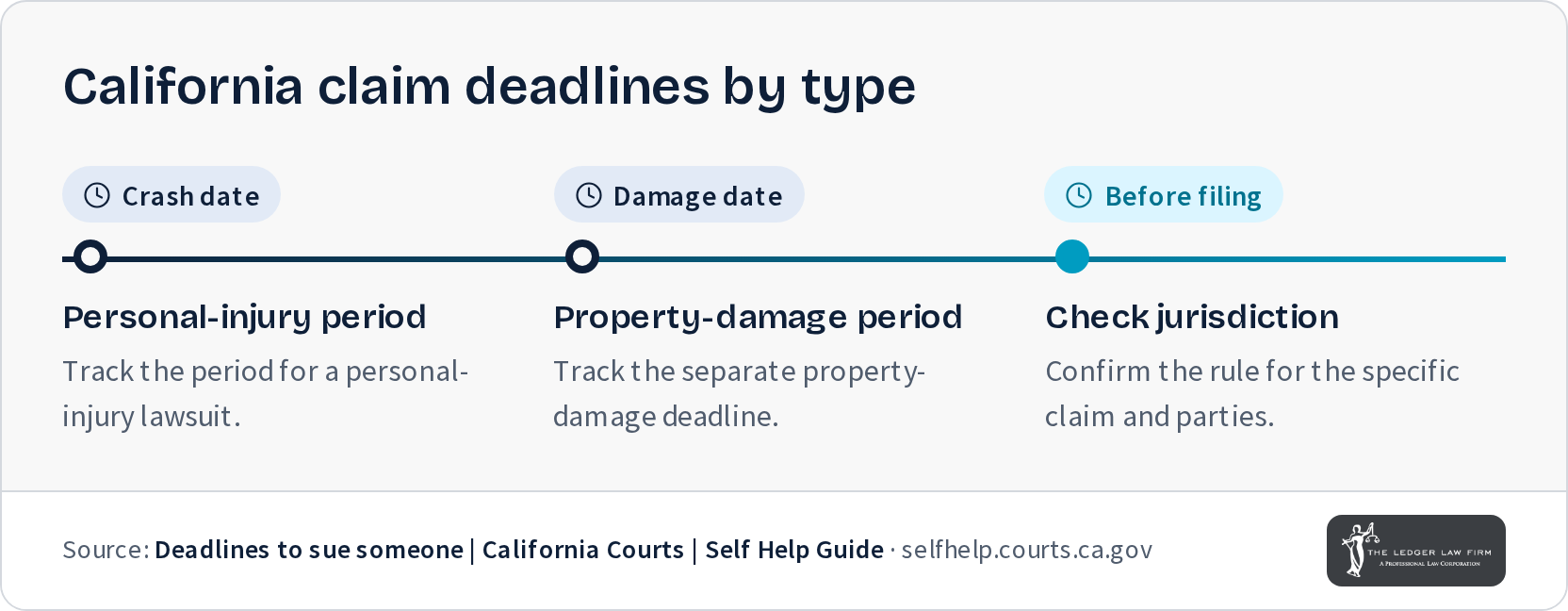
Keep the civil-claim timeline separate from the criminal DUI timeline. California personal-injury timing must be checked for the specific claim; it should not be inferred from whether a criminal case is pending, dropped, reduced, or resolved by acquittal. Record the crash date, injury date if different, property-damage date, and dates in legal or insurance communications. The timing question belongs beside the evidence, loss, and coverage review rather than at the end of it.
California property-damage claims involve a different period. The California Courts guide lists a three-year deadline from the date property was damaged for a property-damage case. A property-damage deadline does not replace the personal-injury deadline, and the two periods should not be combined into one general deadline for every part of a crash claim.
Your claim type, the date of the event, the parties involved, and the jurisdiction can affect which timing rule matters. A claim involving a particular public entity or another special party may raise a different timing issue than an ordinary claim between private parties. If your crash occurred outside California, do not apply these California periods as though they were universal.
Write down the crash date, injury date if different, property-damage date, insurer contact dates, and any date mentioned in a legal or insurance communication. Include the deadline question in your evaluation materials. A lawyer can then address the timing issue together with the facts, losses, and policies rather than treating it as an afterthought. Because the applicable period can depend on the claim and parties, treat the date list as a prompt for verification, not as a substitute for that verification. Confirm the deadline that applies to the specific California claim promptly with a qualified California attorney or an authoritative current source, and do not assume that the property-damage period applies to an injury claim. If the crash or relevant party is outside California, identify that fact at the start of the review so the California discussion is not carried over by mistake. Preserve any date-sensitive communication with the rest of the file.
Choose the next step from the unresolved DUI link
The decision point is the unresolved link in the DUI record. Instead of treating the label “DUI” as the answer, sort the remaining uncertainty into five questions: what the crash record shows, how the collision relates to the injuries or losses, what coverage may respond, which timing rule applies, and what information is still missing. An initial evaluation can focus on the question that remains open; a straightforward property-damage matter with no unresolved injury, coverage, deadline, or liability issue may call only for continued record organization. This is a way to match the next task to the uncertainty still affecting you, not a conclusion that a viable claim or recovery exists. If the uncertainty concerns a witness, an insurer’s position, a treatment record, or a date, identify that item in the materials rather than treating the gap as proof for or against the claim. A clear question can make an initial conversation more focused without deciding the legal result in advance.
Witness information can make legal review more useful when the crash account, impairment evidence, or responsibility is disputed. We interview witnesses and obtain their official statements for auto-accident cases. That service does not promise that a witness will resolve the case; it identifies one type of information that may require attention.
Your practical decision can follow three paths:
- Seek an initial evaluation now when serious injuries, significant losses, unresolved insurance questions, missing evidence, or timing concerns make the claim difficult to assess. Bring the records you have.
- Organize the record before contacting a lawyer when your immediate need is to assemble medical bills, photographs, witness details, insurer messages, and loss information. Set a clear date to address the unresolved questions.
- Handle a straightforward property-damage issue without representation for now when no injury, coverage, deadline, or liability question remains unresolved. Keep the records and reconsider if a new dispute appears.
None of these paths determines whether you have a viable claim. The boundary is practical: choose the next step that matches the uncertainty still affecting you.
Assemble a DUI-focused case-evaluation record
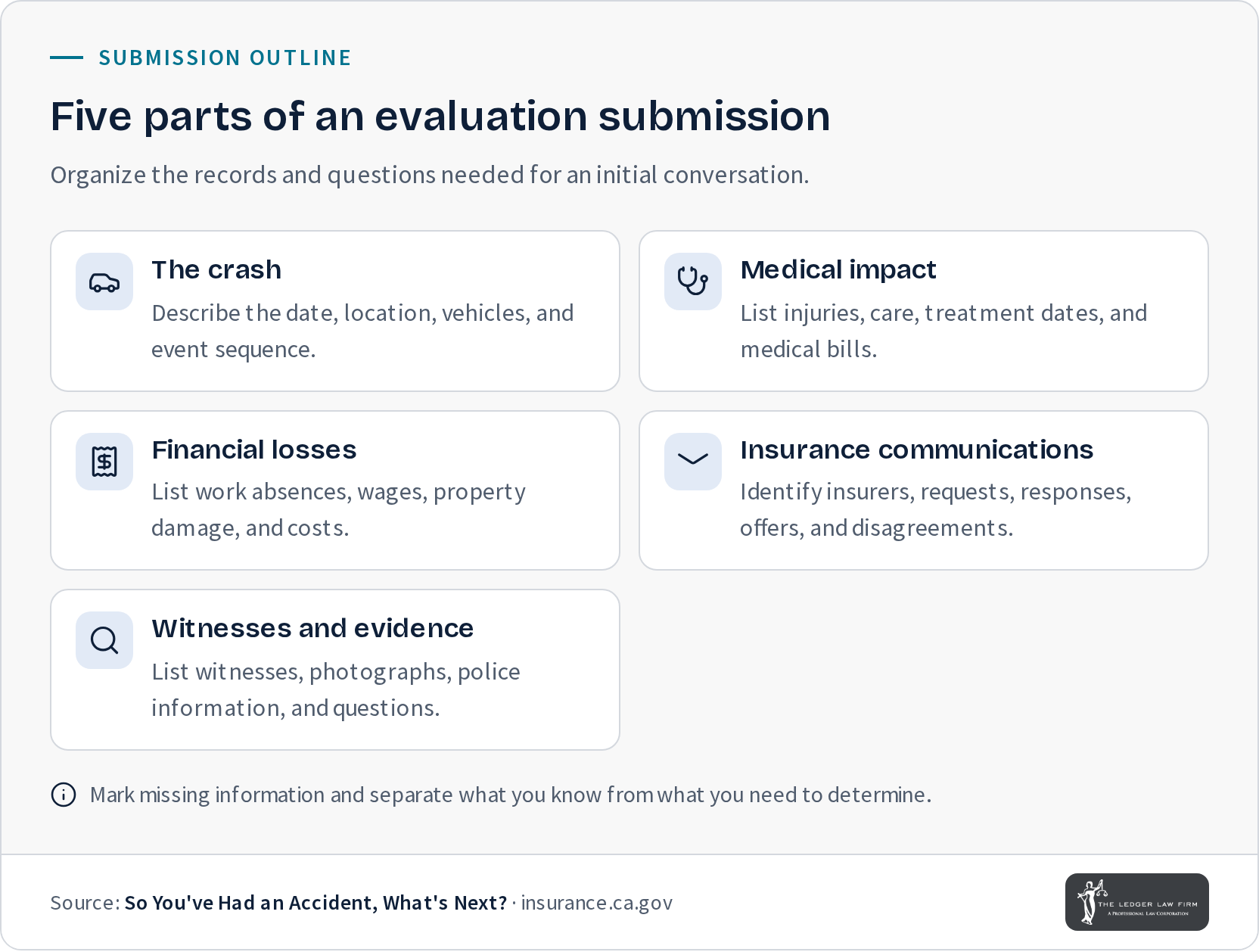
The crash section should describe the date, location, vehicles, people involved, sequence of events as you remember it, police involvement, and any information gathered at the scene. Add photographs of the damage and scene when available, along with driver, passenger, and witness contact information. California crash guidance specifically identifies driver and witness information and scene photographs as useful items to gather.
The medical section should identify the injuries reported, the care received, treatment dates, providers, medical bills, hospital bills, examination costs, and any continuing appointments or restrictions recorded in your materials. Include a short description of how the injuries have affected ordinary activities without trying to translate that effect into a dollar figure. Injury severity and medical expenses are among the factors that can affect potential recovery.
The losses section should list work absences, lost wages, affected benefits, vehicle damage, repair or replacement information, rental expenses, and other documented out-of-pocket costs. Pain and suffering and reduced quality of life can also be relevant consequences, but your submission should describe them rather than predict what they are worth.
The insurance section should identify each insurer, claim number, policy information available to you, communications received, information requested, responses sent, and any offer or disagreement. First-party and third-party claims may require separate attention, and policy limits may affect the available recovery. Keep the original messages and place your timeline beside them.
The witness and evidence section should list each witness, the contact information you have, photographs, police information, scene details, and unanswered questions about the crash. Note any known status or development of a related criminal DUI case without treating it as a substitute for the civil record. Bring the names and details you have rather than waiting for a complete packet; missing information can be identified during the evaluation.
Before sending your materials, check that the five parts answer these questions:
- What happened, and when?
- What injuries and treatment followed?
- Which financial or property losses are documented?
- What has each insurer requested or offered?
- Who may have information about the crash, and what evidence remains available?
A clear submission does not need to prove the case. It needs to show what happened, what changed, what records exist, and what you still need help understanding.
Clarify representation and costs before moving forward
A contingency-fee arrangement generally means paying a lawyer a percentage of money received if the case is won or settled. If the case is lost, the lawyer receives no payment from you under that arrangement, but court costs and other expenses may still be owed. The fee arrangement therefore has two parts: the lawyer’s percentage and the costs that may remain your responsibility.
A written contingency-fee agreement should state the lawyer’s percentage and whether the percentage is calculated before or after other costs are deducted. Before agreeing to the arrangement, read those terms and identify how court costs and other expenses are handled. Ask direct questions about any provision you do not understand.
Your fee questions can include:
- What percentage applies if the case settles or proceeds further?
- Is the percentage calculated before or after costs are deducted?
- Which court costs and other expenses may remain your responsibility?
- When are those costs charged?
- Which terms will appear in the written agreement?
These questions concern the working arrangement, not the likely value or outcome of your claim.
A consultation and a representation agreement are different steps. Use the initial conversation to describe the crash, losses, insurance issues, and timing concerns, then understand the fee and cost terms before deciding whether to move forward. After the conversation, keep a copy of the written agreement and compare it with the explanations you received. If the percentage, timing of charges, or treatment of costs is unclear, ask for clarification before deciding. The purpose of this check is to understand the financial arrangement; it is separate from deciding whether the facts, losses, coverage, and timing justify representation. A clear fee record also keeps the initial evaluation from being confused with a commitment to proceed.
Request an evaluation with the record you have
An initial case evaluation can place your crash facts, documented injuries and losses, insurance communications, evidence questions, and timing concerns into one focused review. We assist victims of drunk driving to identify their losses and pursue legal action, and we offer a free consultation with an auto-accident lawyer.
A completed request is a request for review, not a prediction of liability, eligibility, settlement value, or recovery. When we represent clients, we keep them informed throughout the process and consult them along the way regarding their personal-injury lawsuit. A qualified professional must decide whether your specific circumstances support representation and what legal options apply.
If unresolved injuries, losses, evidence, insurance issues, or deadlines are making the next step difficult, gather the record you have and begin with an initial review.

Emery Brett Ledger brings 28+ years of experience to personal injury law. He founded & led The Ledger Law Firm in securing over $100 million in compensation for clients with life-altering injuries & complex claims. Prior results do not guarantee a similar outcome. Licensed in California, Texas, & Washington, Emery earned his law degree from Pepperdine University School of Law. His practice areas include car & truck accidents, wrongful death, catastrophic injuries, maritime claims, & mass tort litigation. He has been recognized by The National Trial Lawyers’ Top 100, Mass Tort Trial Lawyers Top 25, and America’s Top 100 Personal Injury Attorneys. Emery also received the 2025 Elite Lawyer Award & holds a perfect 10.0 Avvo rating with Platinum Client Champion status. His legal work has been featured on CNN, Forbes, NBC, & ABC.
Free Case Evaluation
Recent Posts
Emery Brett Ledger brings 28+ years of experience to personal injury law. He founded & led The Ledger Law Firm in securing over $100 million in compensation for clients with life-altering injuries & complex claims. Prior results do not guarantee a similar outcome. Licensed in California, Texas, & Washington, Emery earned his law degree from Pepperdine University School of Law. His practice areas include car & truck accidents, wrongful death, catastrophic injuries, maritime claims, & mass tort litigation. He has been recognized by The National Trial Lawyers’ Top 100, Mass Tort Trial Lawyers Top 25, and America’s Top 100 Personal Injury Attorneys. Emery also received the 2025 Elite Lawyer Award & holds a perfect 10.0 Avvo rating with Platinum Client Champion status. His legal work has been featured on CNN, Forbes, NBC, & ABC.