Can a Dallas car accident lawyer help after an uninsured crash?

Yes. A Dallas car accident lawyer can help after an uninsured crash by checking available coverage, preserving evidence, and identifying who is legally responsible for your injuries. A claim still needs a source of payment: proving that another driver caused the crash does not establish that the driver has insurance or collectible assets. This guide explains your next steps after an injury crash in Dallas, Texas, in 2026.
- Dallas car accident lawyer uninsured driver searches should lead to a coverage review, not a promised settlement.
- Texas uninsured motorist coverage depends on your policy, applicable exclusions, and any written rejection.
- Preserve medical records, crash evidence, and insurance correspondence before discussing a final settlement.
- Ledger Law represents injured people seeking personal injury representation after car accidents in Texas.
Can a Dallas car accident lawyer help after an uninsured crash?
Yes. The first useful step is separating legal responsibility from available insurance. A lawyer examines both, then explains whether pursuing an injury claim has a practical path to payment. Ledger Law represents people injured in car accidents, including claims in Texas.
The review should address the other driver's coverage, your own policy, and evidence connecting the crash to your injuries. These possible routes are different; none guarantees compensation.
| Possible claim route | Best for | What it can address | Main limitation |
|---|---|---|---|
| Uninsured motorist coverage | Injured people with applicable UM coverage | Covered losses caused by an uninsured motorist | Policy terms, exclusions, limits, and proof requirements apply |
| Personal injury protection | Injured people with applicable PIP coverage | Covered medical expenses and certain other losses without deciding fault first | Benefits are limited and do not replace a full injury claim |
| Another responsible party's liability coverage | Crashes involving evidence of another legally responsible person or business | Injuries connected to that party's conduct | Responsibility and applicable coverage must be established |
| A claim against the uninsured driver personally | Cases with a realistic collection path | Damages the driver is legally responsible for paying | A judgment does not guarantee collection |
A useful case evaluation explains which route fits the evidence and which does not. Filing more claims is not the goal; identifying a supported claim is.
Why this matters after a Dallas injury crash
An uninsured driver changes the payment question, not your need for treatment or documentation. You still need evidence showing how the collision happened, what injuries it caused, and how those injuries affect your daily life.
For a 2026 Texas claim, start with the policy that covered you on the crash date. A current insurance card alone does not establish which coverages applied then. Request the declarations page, the complete policy, endorsements, and any coverage rejection forms.
Do not assume that an uninsured driver means no claim—or that having auto insurance means every injury is covered. Both assumptions skip the policy review that determines your next move.
Uninsured motorist coverage: check the policy and rejection forms
Texas Insurance Code Section 1952.101 generally requires uninsured and underinsured motorist coverage in covered auto policies unless a named insured rejects it in writing. That requirement does not mean every person injured in Texas has UM coverage. The actual policy and any valid rejection matter.
Ask the insurer to identify the coverage applicable to your crash in writing. Give your lawyer the full response, including attachments, rather than only a summary from a phone call.
A coverage review should examine:
- Whether you qualify as an insured under the applicable policy.
- Whether the crash falls within the policy's coverage terms.
- Whether a written rejection affects the claim.
- What notice, cooperation, and documentation requirements apply.
- Which limits or exclusions affect the requested benefits.
Your own insurer still evaluates a UM claim. Treat the claim as a documented request for benefits, not an automatic payment. Keep copies of everything you submit and ask for the stated basis of any denial.
Personal injury protection: review available benefits separately
Texas Insurance Code Sections 1952.151–1952.153 address personal injury protection, including covered benefits, required coverage, and written rejection. Texas generally requires an offer of at least $2,500 in PIP coverage unless a named insured rejects the coverage in writing. That figure is a coverage amount, not a settlement estimate.
PIP can cover qualifying medical expenses and certain other losses without requiring a fault determination first. Eligibility, documentation, and policy limits still apply.
For your 2026 review, ask whether PIP was included on the crash date and what records the insurer needs. Do not assume a UM claim automatically opens a PIP claim or that submitting a hospital bill completes either process.
Keep medical bills and payment records organized. Your lawyer should explain how available benefits, outstanding bills, and reimbursement obligations affect the claim rather than treating each payment as unrelated.
Can someone besides the uninsured driver be responsible?
Yes, another person or business can be responsible when the evidence supports a legal basis for liability. For example, a driver's work activity can make employment records relevant. Vehicle ownership alone does not establish that the owner owes compensation.
Tell your lawyer whether the driver was making a delivery, driving a company vehicle, or working when the collision occurred. Preserve photographs showing business names or vehicle markings, but do not treat those details as proof of responsibility by themselves.
A lawyer can investigate a supported lead and request relevant records. A possible additional defendant is an investigation question, not a promised source of insurance.
Why uninsured crash claims vary
An uninsured crash does not produce a standard result. These factors determine what needs investigation and which claims deserve attention:
- Applicable coverage: UM and PIP depend on the policy, insured status, and any effective rejection.
- Fault evidence: Photographs, witness accounts, video, and vehicle damage help establish how the collision happened.
- Injury documentation: Treatment records and medical opinions help connect claimed injuries to the crash.
- Additional responsibility: Evidence of work activity or another party's conduct can change the investigation.
- Collection prospects: An uninsured driver's ability to pay affects whether a personal claim offers a practical recovery route.
- Deadlines and cooperation: Filing deadlines and policy duties require separate attention; satisfying one does not necessarily satisfy another.
These are reasons to review the facts early, not reasons to guess a settlement amount. A responsible evaluation distinguishes established facts from issues that still need evidence.
What should you do after an uninsured crash in Dallas?
Protect your health first, then preserve the information needed to evaluate your injury claim. You do not need to solve the insurance dispute at the scene.
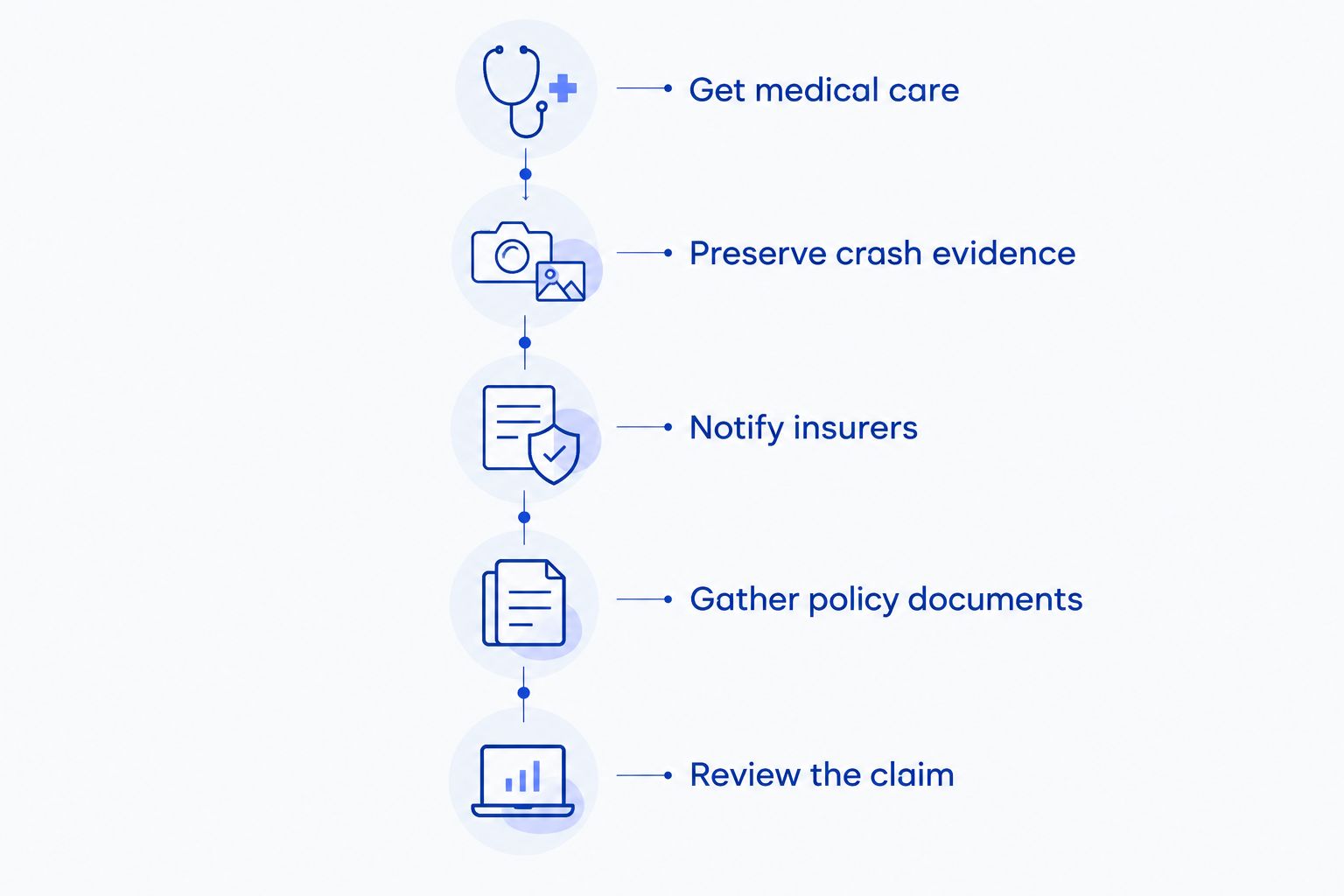
- Get medical care. Seek appropriate treatment and describe your symptoms accurately. Tell providers when the crash happened and explain relevant prior conditions rather than leaving gaps in your history.
- Preserve crash evidence. Save photographs, witness details, the report information, and messages from the other driver. Keep original files when possible, and do not put yourself in danger to collect evidence.
- Notify insurers. Report the collision as required by applicable policies. Ask how to submit an injury claim and keep a record of the claim number, contact person, and requested documents.
- Gather policy documents. Collect policies, declarations pages, endorsements, and rejection forms. Include correspondence about a coverage denial or an assertion that the other driver was uninsured.
- Review the claim. Bring your injury records, insurance documents, and questions to a legal consultation before signing a final release.
If someone requests a recorded statement, ask what coverage or claim the request concerns. Your own policy can impose cooperation duties, so get advice about your obligations rather than ignoring the request or assuming every insurer has the same role.
How does shared fault affect a Texas injury claim?
Texas Civil Practice and Remedies Code Section 33.001 generally bars recovery under its proportionate-responsibility framework when your responsibility exceeds 50%. Section 33.012 generally reduces recoverable damages by your percentage of responsibility when recovery is otherwise allowed. A 51% finding therefore has a different consequence from a 50% finding under that framework.
An uninsured driver is not automatically the at-fault driver. Lack of insurance and responsibility for the collision are separate questions. Your lawyer still needs evidence addressing the conduct that caused the crash.
For a 2026 Dallas claim, preserve facts rather than arguing percentages with an adjuster. Report what you observed, avoid guessing about speed or distance, and identify witnesses who saw the collision.
How long do you have to pursue an injury claim in Texas?
Texas Civil Practice and Remedies Code Section 16.003 generally provides a 2-year limitations period for personal injury lawsuits. That general rule is not a complete deadline analysis: exceptions, different defendants, and insurance-related claims can require separate review.
Do not assume that negotiating with an insurer pauses a lawsuit deadline. Policy notice obligations also need attention before the general filing deadline approaches.
If the collision caused a death, tell the lawyer immediately that your family needs a wrongful death evaluation. The proper claimants, claims, and deadline analysis require a separate review rather than simply reusing an injured driver's checklist.
What should you bring to a Dallas case evaluation?
Bring what you have; do not postpone asking for help because a report or medical record is still pending. The Dallas car accident lawyer consultation guide provides a focused starting point for organizing your documents.
Prioritize the crash date and location, insurance correspondence, policy documents, photographs, treatment information, medical bills, and records of missed work. Add any document you have been asked to sign.
Ledger Law is for injured people seeking personal injury representation after a Texas car crash. A useful evaluation should explain the available claim routes, unresolved coverage questions, and practical next steps without promising an outcome.
Ask about attorney fees and case expenses separately. A contingency fee ties the attorney's fee to a recovery under the agreement, but responsibility for expenses depends on the contract. Do not assume that no recovery necessarily means no costs; request a plain-language explanation before signing.
FAQ
Can a Dallas car accident lawyer help if the other driver has no insurance?
Yes. A lawyer can review your coverage, investigate responsibility, preserve evidence, and assess collection options. An uninsured driver does not automatically eliminate an injury claim, but payment requires an applicable source of recovery.
Does Texas require uninsured motorist coverage on every policy?
No. Texas generally requires UM coverage unless a named insured rejects it in writing under Texas Insurance Code Section 1952.101. Review the actual policy and rejection documents rather than assuming coverage exists.
Can I use PIP if the uninsured driver caused the crash?
Applicable PIP coverage can provide qualifying benefits without deciding fault first. The policy, covered-person requirements, documentation, and limits determine the benefits available.
Is the uninsured driver automatically responsible for my injuries?
No. Being uninsured does not establish who caused the crash. An injury claim still requires evidence of legal responsibility and the losses caused by the collision.
How long do I have to file a Texas car accident injury lawsuit?
Texas generally provides a 2-year limitations period for personal injury lawsuits under Section 16.003. Exceptions and different claim types require separate review, and insurance negotiations should not be treated as an extension.
Can Ledger Law evaluate an uninsured crash injury claim in Texas?
Ledger Law represents people injured in car accidents in Texas. A case evaluation can address the collision, injuries, insurance documents, and potential claim routes without guaranteeing a recovery.
Will I owe case expenses if there is no recovery?
Your fee agreement determines responsibility for case expenses. Ask separately about the attorney’s fee, expenses advanced during the case, and obligations if the claim produces no recovery.
One last thing
Ask for the reason the driver is considered uninsured—not just the label. No insurance card at the scene, a coverage denial, and an expired policy are different facts to investigate. Save the underlying documents so your lawyer can evaluate the actual coverage issue.
Legal references for this 2026 Texas overview include Texas Insurance Code Sections 1952.101 and 1952.151–1952.153, and Texas Civil Practice and Remedies Code Sections 16.003, 33.001, and 33.012. This is general information, not advice about your particular claim.
Related guides
These guides concern California or Washington. Use them for document organization and general preparation, not as statements of Texas law.
- Which medical records help a Newport Beach car accident claim?
- Steps to take after a car accident in California
- What should you bring to a Seattle car accident consultation?

Emery Brett Ledger brings 28+ years of experience to personal injury law. He founded & led The Ledger Law Firm in securing over $100 million in compensation for clients with life-altering injuries & complex claims. Prior results do not guarantee a similar outcome. Licensed in California, Texas, & Washington, Emery earned his law degree from Pepperdine University School of Law. His practice areas include car & truck accidents, wrongful death, catastrophic injuries, maritime claims, & mass tort litigation. He has been recognized by The National Trial Lawyers’ Top 100, Mass Tort Trial Lawyers Top 25, and America’s Top 100 Personal Injury Attorneys. Emery also received the 2025 Elite Lawyer Award & holds a perfect 10.0 Avvo rating with Platinum Client Champion status. His legal work has been featured on CNN, Forbes, NBC, & ABC.
Free Case Evaluation
Recent Posts
- Should you accept an early Newport Beach crash settlement offer?
- Can a Dallas car accident lawyer help after an uninsured crash?
- What can an injured passenger claim after a Seattle car crash?
- 7 steps to take after a car accident in California
- What should you bring to a Seattle car accident consultation?
Emery Brett Ledger brings 28+ years of experience to personal injury law. He founded & led The Ledger Law Firm in securing over $100 million in compensation for clients with life-altering injuries & complex claims. Prior results do not guarantee a similar outcome. Licensed in California, Texas, & Washington, Emery earned his law degree from Pepperdine University School of Law. His practice areas include car & truck accidents, wrongful death, catastrophic injuries, maritime claims, & mass tort litigation. He has been recognized by The National Trial Lawyers’ Top 100, Mass Tort Trial Lawyers Top 25, and America’s Top 100 Personal Injury Attorneys. Emery also received the 2025 Elite Lawyer Award & holds a perfect 10.0 Avvo rating with Platinum Client Champion status. His legal work has been featured on CNN, Forbes, NBC, & ABC.