What should families bring to a Texas wrongful death consultation?

Bring the records you already have about the death, the accident, your family relationship, financial losses, and any insurance or legal correspondence to a Texas wrongful death consultation. You do not need a complete file before speaking with a lawyer; identify missing documents, preserve original evidence, and bring questions about who can file, deadlines, attorney fees, and case expenses.
- Texas wrongful death lawyer family checklist: bring incident records, relationship documents, financial records, and insurance correspondence.
- Ledger Law represents injured people and families; a consultation should address legal eligibility and evidence preservation.
- Do not delay a consultation because a death certificate, police report, or medical record is missing.
- Ask separately about attorney fees and case expenses, including what you owe if there is no recovery.
Why this matters
A wrongful death consultation concerns more than the accident itself. The lawyer needs to understand who died, what happened, which family members are involved, and what evidence needs protection.
Your job is to explain what you know, not to prove the entire case before the meeting. If you are arranging a consultation in 2026, start with available records and a short list of unanswered questions. You can use Ledger Law’s contact page to ask how to provide sensitive documents before sending them.
This guide addresses Texas consultations. California and Washington have different wrongful death rules; living in Dallas, Newport Beach, or Seattle does not by itself determine which state’s law applies.
What should families bring to a Texas wrongful death consultation?
Bring a simple folder organized by subject. Copies are useful for review; keep originals secure and tell the lawyer when an original document or device exists.
| What to bring | What it helps the lawyer assess | If you do not have it |
|---|---|---|
| Death certificate or available death-related records | Identity, date of death, and recorded cause | Explain whether records have been requested |
| Marriage, birth, adoption, or other relationship records | Your relationship to the person who died | Give names and explain the family relationships |
| Police, crash, incident, or investigation information | What happened and which agencies investigated | Bring the agency name and report number, if known |
| Photos, videos, messages, and witness details | Available evidence about responsibility | Identify who holds the originals |
| Medical and emergency-treatment records | Treatment between the injury and death | List facilities and approximate treatment dates |
| Income, benefit, funeral, and household records | Documented financial effects on the family | Identify employers, providers, and outstanding bills |
| Insurance letters and legal paperwork | Claims already opened and documents requiring attention | Describe calls, emails, or papers you received |
Do not obtain records by entering another person’s account without authorization. Tell the lawyer what exists and ask how it can be requested lawfully.
Death and family relationship records
Bring a death certificate if available, along with documents showing your relationship to the person who died. Include a list of the deceased person’s spouse, children, and parents, even when someone does not plan to attend.
Under Texas Civil Practice and Remedies Code Section 71.004, wrongful death actions benefit the surviving spouse, children, and parents. A family relationship does not automatically establish eligibility: explain adoption, disputed marriage status, or other relevant circumstances rather than deciding the legal question yourself.
Also bring any will, probate paperwork, or documents appointing an executor or administrator that you already possess. An estate representative and a wrongful death beneficiary can have different roles.
Accident and investigation records
Bring the crash report, incident report, investigating agency’s details, and any available photographs or video. For a fatal truck crash, identify the trucking company, vehicle, driver, and other businesses shown in the records without guessing who bears legal responsibility.
Separate your own observations from information someone else supplied. A note saying that a witness described a red light is more useful than presenting the statement as something you personally saw.
Include correspondence from employers, property owners, vehicle operators, or investigators. Preserve envelopes and attachments when they help explain when and how a document arrived.
Medical, funeral, and financial records
Bring records of emergency care, hospitalization, and treatment connected to the fatal injury. Include bills, payment statements, and provider names; do not assume the lawyer needs every unrelated medical record at the first meeting.
For financial information, gather available pay statements, tax records, employment benefits information, and funeral or burial invoices. Explain unpaid household work as well: childcare, transportation, home maintenance, and caregiving can help describe the support your family lost.
Avoid assigning a settlement value to these records. The consultation should identify potentially relevant losses and the evidence needed to evaluate them.
How should you organize the file before the meeting?
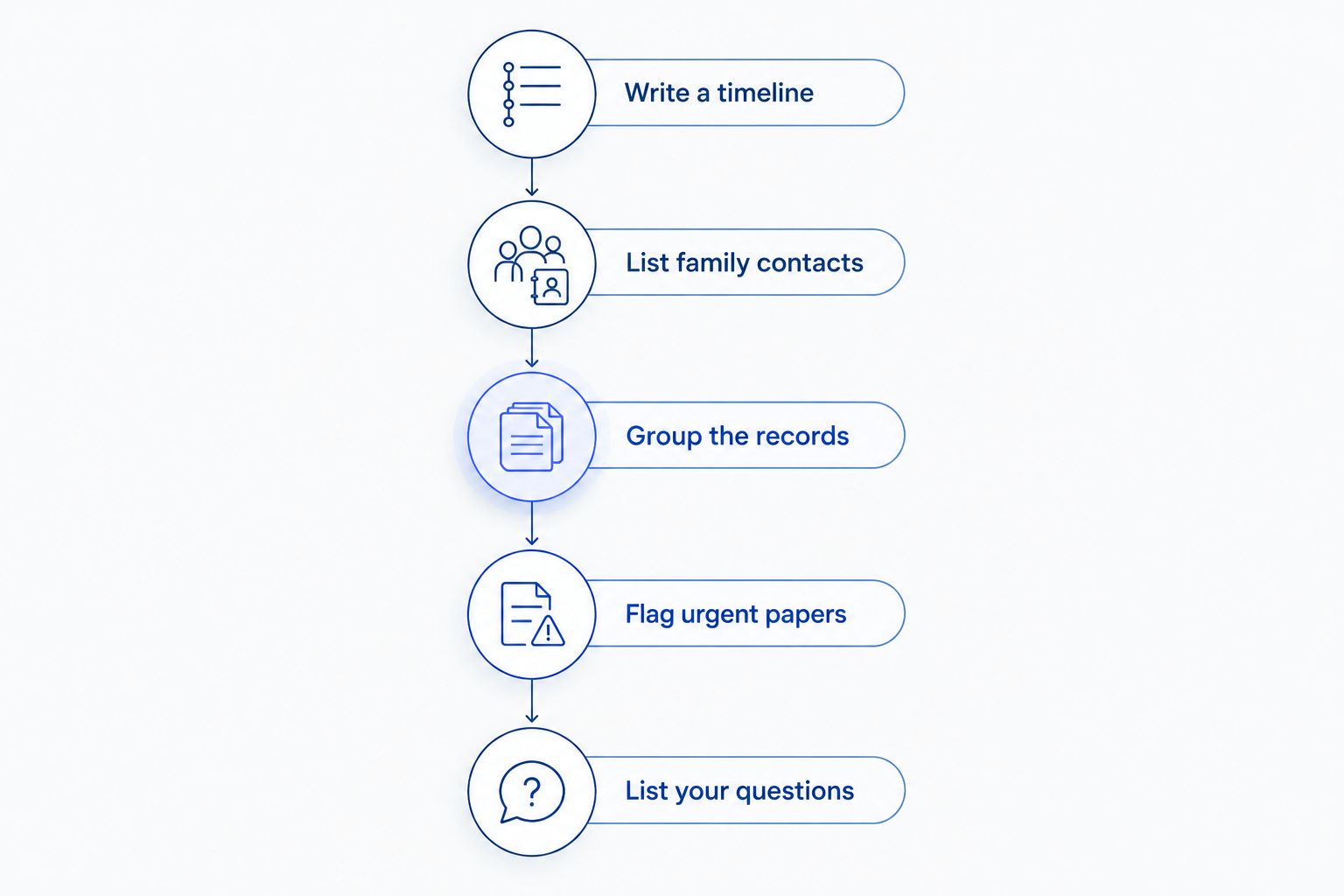
Use this sequence to make the conversation easier. An ordinary folder works; you do not need special software or a polished presentation.
- Write a timeline. Note the accident date, treatment, death, insurance communications, and any papers received. Mark uncertain dates as uncertain.
- List family contacts. Identify immediate family members and any appointed estate representative. Choose a contact person for scheduling without assuming that person has authority to decide for everyone.
- Group the records. Separate incident evidence, medical documents, relationship records, financial information, and correspondence.
- Flag urgent papers. Put settlement offers, releases, court documents, and letters with response dates where the lawyer will see them first.
- List your questions. Start with eligibility, deadlines, preservation, fees, expenses, and the next decision your family needs to make.
Keep your timeline factual. If you do not know why a vehicle crossed a lane or why treatment changed, write down the question rather than filling the gap with an assumption.
Why consultation preparation varies between families
The right documents depend on what happened and what has already occurred after the death. These factors change the preparation, not your obligation to arrive with a finished case:
- The incident involved. A truck collision, unsafe property condition, or other fatal event produces different records and evidence holders.
- The family relationships. Marriage, parentage, adoption, and surviving relatives affect the eligibility discussion.
- Treatment before death. Hospitalization creates medical records and bills that differ from an incident involving an immediate death.
- Estate administration. Existing probate proceedings or an appointed representative affect which paperwork the lawyer needs to review.
- Prior communications. Insurance statements, signed documents, settlement discussions, and another lawyer’s involvement require attention.
- Evidence held elsewhere. Businesses, witnesses, government agencies, or vehicle owners can hold material the family cannot access directly.
For a 2026 consultation, explain the current status of each issue rather than trying to resolve it alone. Missing records and disputed facts belong on the question list.
Who in the family can bring a Texas wrongful death claim?
Texas Civil Practice and Remedies Code Section 71.004 identifies the surviving spouse, children, and parents as wrongful death beneficiaries. The statute permits these individuals to bring the action, or one or more to bring it for the benefit of all.
Section 71.004 also addresses an executor or administrator bringing the action if the eligible individuals have not done so within 3 months after death, unless all those individuals request otherwise. That provision is not a reason to wait before seeking advice. Bring estate documents and tell the lawyer about all eligible relatives.
For a consultation in 2026, ask the lawyer to apply the current statute to your family’s circumstances. Siblings and other relatives should not assume that handling funeral arrangements or being named in a will establishes wrongful death eligibility.
How long do Texas families have to file?
Texas generally applies a 2-year limitations period to wrongful death claims under Civil Practice and Remedies Code Section 16.003(b), running from the death. Exceptions and separate notice requirements can change the analysis, so the general rule is not a personalized filing deadline.
Bring the exact date of death, the incident date, and any information suggesting that a government entity was involved. Do not assume an insurance investigation, criminal case, or ongoing family discussion protects the civil deadline.
Ask for the deadline analysis early. For a death occurring before your 2026 consultation, give the lawyer the actual historical dates rather than estimating how much time remains.
What is the difference between wrongful death and an estate claim?
A Texas wrongful death claim addresses losses suffered by eligible surviving family members. A survival claim preserves an eligible claim the deceased person could have pursued; Texas Civil Practice and Remedies Code Section 71.021 governs survival of certain claims.
| Claim | Main focus | Useful consultation records | Important limit |
|---|---|---|---|
| Wrongful death | Eligible family members’ losses from the death | Relationship records and evidence of lost support | Eligibility follows Texas law, not simply closeness to the deceased |
| Survival | The deceased person’s surviving legal claim | Treatment records and estate documents | Authority to pursue it must be established |
Tell the lawyer about both the family’s losses and what happened between injury and death. Ask who would bring each claim and how the claims would be coordinated; do not assume every family member has the same legal role.
What should you ask before hiring a lawyer?
Ledger Law is for Texas families seeking legal representation after a fatal accident. A case evaluation should clarify the potential claim, immediate preservation needs, and the terms of representation without promising a result.
Bring these questions to the meeting:
- Who would handle the matter and communicate with our family?
- Which relatives and estate representatives need to participate?
- What evidence needs to be preserved now, and who will request it?
- What does the attorney fee agreement cover?
- Which case expenses are separate from attorney fees?
- Who pays expenses if there is no recovery or representation ends?
- What information is needed before you can assess the claim?
A contingency fee arrangement ties attorney compensation to the agreement’s recovery terms. It does not, by itself, answer who owes case expenses. Read the written agreement and request an explanation of deductions, expenses, and termination provisions before signing.
Prepare for a family case evaluation
Ask about Texas eligibility, evidence preservation, deadlines, and the terms of representation.
FAQ
Can we meet with a Texas wrongful death lawyer without a death certificate?
Yes. Bring the information and records you have, explain which documents are missing, and ask how the remaining records should be obtained.
Should every family member attend the consultation?
Not necessarily. Identify the surviving spouse, children, parents, and any estate representative, then ask the lawyer who should participate and how separate family interests will be addressed.
What if we already spoke with the insurance company?
Bring the correspondence and explain what you said or signed. Include any recorded-statement request, release, settlement offer, or authorization so the lawyer can review it.
Should we bring the deceased person’s phone?
Tell the lawyer that the phone exists and ask how to preserve it securely. Avoid deleting messages, resetting the device, or accessing accounts without legal authority.
How long do families generally have to file a Texas wrongful death lawsuit?
Texas generally provides 2 years from the death under Civil Practice and Remedies Code Section 16.003(b). Exceptions and separate notice requirements require an individualized deadline review.
Can a sibling file a Texas wrongful death claim?
A sibling is not included in the spouse, children, and parents identified as beneficiaries in Texas Civil Practice and Remedies Code Section 71.004. A separate estate role requires its own legal analysis.
Does no recovery mean our family owes no case expenses?
Not necessarily. Attorney fees and case expenses are different, and the written agreement should explain responsibility for expenses if there is no recovery.
One last thing
A list of missing evidence can be more useful than another stack of documents. Write down where you believe video, vehicle data, witness information, or original records exist, and give that list to the lawyer.
For your 2026 consultation, preserve what you have without editing files, deleting messages, or annotating originals. You can explain a photograph in a separate note while keeping the original unchanged.
Related guides
- What evidence should a Texas truck accident attorney preserve?
- Can a Texas truck accident claim involve several defendants?
- What should you bring to a Dallas car accident lawyer consultation?
- What should a California family bring to a wrongful death lawyer?

Emery Brett Ledger brings 28+ years of experience to personal injury law. He founded & led The Ledger Law Firm in securing over $100 million in compensation for clients with life-altering injuries & complex claims. Prior results do not guarantee a similar outcome. Licensed in California, Texas, & Washington, Emery earned his law degree from Pepperdine University School of Law. His practice areas include car & truck accidents, wrongful death, catastrophic injuries, maritime claims, & mass tort litigation. He has been recognized by The National Trial Lawyers’ Top 100, Mass Tort Trial Lawyers Top 25, and America’s Top 100 Personal Injury Attorneys. Emery also received the 2025 Elite Lawyer Award & holds a perfect 10.0 Avvo rating with Platinum Client Champion status. His legal work has been featured on CNN, Forbes, NBC, & ABC.
Free Case Evaluation
Recent Posts
- What should families bring to a Texas wrongful death consultation?
- How do California wrongful death and survival actions differ?
- The Ledger Law Firm for a Truck Accident: Deciding Whether to Request an Evaluation
- Who can be liable for injuries in a Seattle multi-car crash?
- What should a California family bring to a wrongful death lawyer?
Emery Brett Ledger brings 28+ years of experience to personal injury law. He founded & led The Ledger Law Firm in securing over $100 million in compensation for clients with life-altering injuries & complex claims. Prior results do not guarantee a similar outcome. Licensed in California, Texas, & Washington, Emery earned his law degree from Pepperdine University School of Law. His practice areas include car & truck accidents, wrongful death, catastrophic injuries, maritime claims, & mass tort litigation. He has been recognized by The National Trial Lawyers’ Top 100, Mass Tort Trial Lawyers Top 25, and America’s Top 100 Personal Injury Attorneys. Emery also received the 2025 Elite Lawyer Award & holds a perfect 10.0 Avvo rating with Platinum Client Champion status. His legal work has been featured on CNN, Forbes, NBC, & ABC.