How can uninsured motorist coverage help an injured Californian?

Uninsured motorist coverage can help pay for injuries caused by an uninsured driver in California, including medical expenses, lost earnings, and pain and suffering, subject to your policy and proof of fault. In 2026, the key limitation is that coverage does not guarantee payment: you still need to establish that an insured person suffered covered injuries and satisfy the claim requirements.
- California uninsured motorist bodily injury coverage addresses covered injuries, not just damage to your vehicle.
- Uninsured and underinsured motorist coverage have different triggers; neither guarantees full payment of every loss.
- Searching california car accident attorney uninsured motorist? Prioritize coverage review, injury evidence, and deadlines.
- Ledger Law represents injured Californians seeking personal injury legal representation after car accidents.
Why this matters
An uninsured driver does not make your injuries less serious. It changes where you look for payment and which insurance requirements you need to meet.
Do not assume that having an auto insurance policy means you have uninsured motorist bodily injury coverage. Review the declarations page, policy language, endorsements, and any signed rejection or coverage-selection documents. California law allows uninsured motorist coverage to be rejected through a written agreement.
Ledger Law represents people injured in California car accidents. A case evaluation can help you identify the coverage questions and injury evidence that need attention, without assuming a particular outcome.
This guide addresses California injury claims in 2026. Washington and Texas have different rules; their uninsured motorist procedures should not be substituted for California's.
How can uninsured motorist coverage help an injured Californian?
Uninsured motorist bodily injury coverage gives an eligible injured person a potential claim under an applicable auto policy when the responsible driver lacks liability insurance. California Insurance Code section 11580.2 governs important parts of this coverage, including uninsured vehicles, arbitration, and claim-preservation requirements.
The coverage can address medical treatment, earnings lost because of an injury, and noneconomic harm such as pain and suffering. Payment depends on the evidence, applicable limits, policy terms, and California law—not simply on submitting a medical bill.
Do not confuse an uninsured driver with an underinsured driver. The distinction changes how the claim proceeds.
| Coverage | When it becomes relevant | Main benefit | Important limitation |
|---|---|---|---|
| Uninsured motorist bodily injury | A responsible driver has no applicable liability insurance, or another qualifying uninsured-vehicle situation applies | Provides a possible source of compensation for covered injuries | You must establish coverage, liability, and damages; policy limits still apply |
| Underinsured motorist bodily injury | A responsible driver's bodily injury liability limits are lower than the applicable underinsured motorist limits | Can address a qualifying shortfall after the liability coverage is exhausted | California generally credits the responsible driver's liability limits against the underinsured motorist limit |
The strongest starting point is the policy itself, not an assumption about what an uninsured-driver claim should pay. Request the complete policy rather than relying only on an insurance card or a summary in an app.
Uninsured motorist coverage: an injury claim under applicable insurance
Uninsured motorist coverage is relevant when another driver's lack of liability insurance leaves you without the usual insurance source for an injury claim. The insurer still evaluates whether that driver caused the crash and whether the crash caused your claimed injuries.
Best for: an eligible injured person whose claim involves a qualifying uninsured driver or vehicle. Its benefit is access to applicable insurance; its limitation is that the insurer can dispute fault, coverage, or the extent of the injury.
Useful evidence includes the collision report, witness information, photographs, treatment records, and written information about the other driver's insurance status. A driver's statement that they have no insurance is a reason to investigate, not a substitute for checking the available coverage.
Ask for a written explanation if an insurer disputes coverage. Identify the specific policy provision and factual reason being used rather than accepting a verbal statement that the claim is not covered.
Underinsured motorist coverage: protection against insufficient limits
Underinsured motorist coverage concerns a driver who has liability insurance, but whose applicable bodily injury limits are lower than your applicable underinsured motorist limits. California's rules generally require exhaustion of the responsible driver's liability coverage before underinsured motorist benefits become payable.
Best for: an eligible injured person with a qualifying gap between the responsible driver's liability limits and the applicable underinsured motorist limits. The benefit is potential additional injury compensation; the limitation is that the limits generally do not simply add together.
California Insurance Code section 11580.2 explains the exhaustion and credit rules. For a 2026 claim, compare the actual policies and limits before treating underinsured motorist coverage as an additional payment source.
Get advice before signing the responsible driver's settlement release. Payment, exhaustion, release language, and notice requirements need to be considered together. A settlement should not create an avoidable problem for another part of your injury claim.
What should you do after an uninsured-driver injury crash?
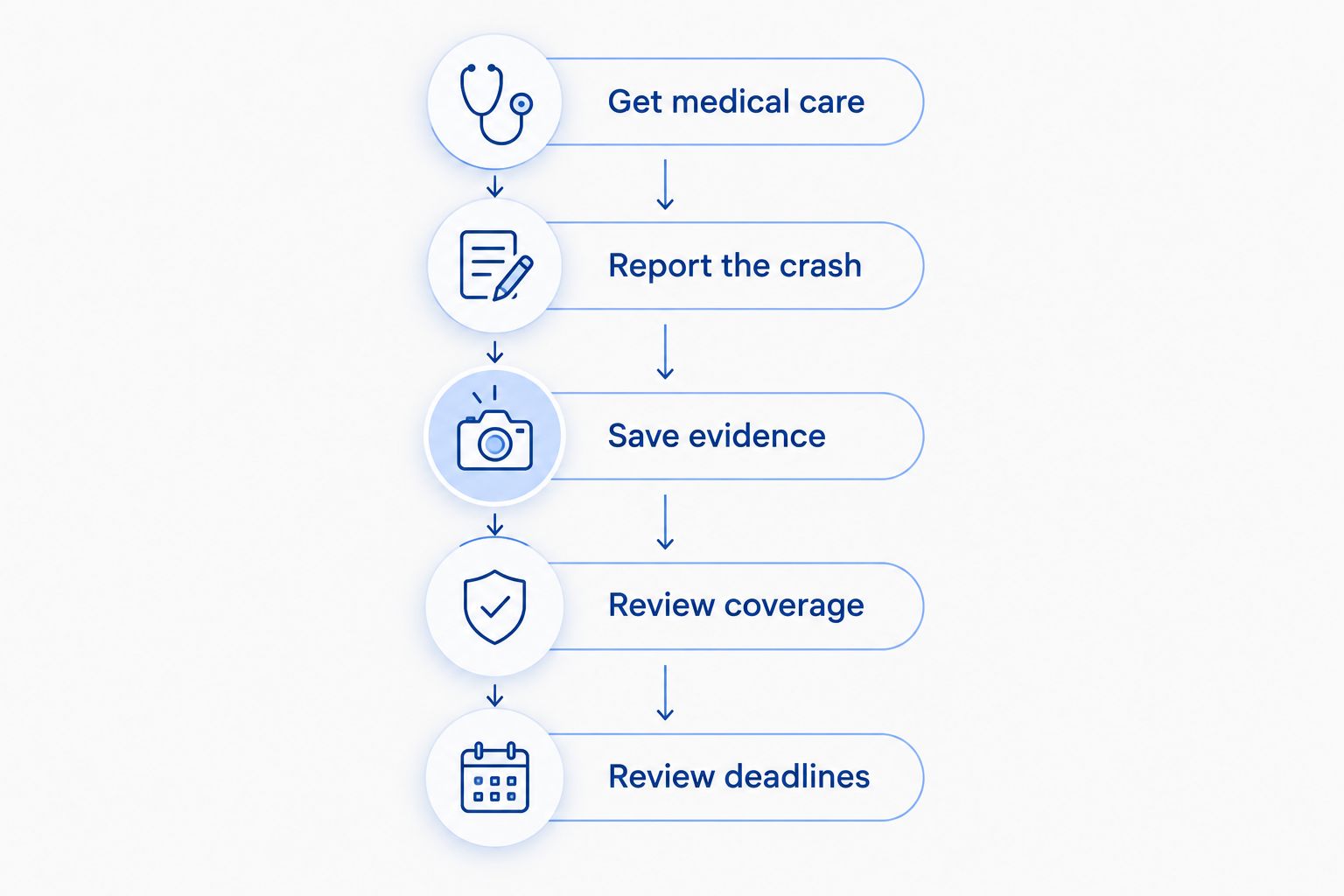
Your immediate priorities are medical care, accurate reporting, and preserving evidence. You do not need to settle the insurance questions at the roadside.
- Get medical care. Describe your symptoms accurately and follow the treatment instructions you receive. Keep records of referrals, restrictions, and follow-up appointments.
- Report the crash. Contact the appropriate law enforcement agency and notify potentially applicable insurers promptly. Hit-and-run claims have additional California requirements discussed below.
- Save evidence. Keep photographs, witness details, the collision-report information, and correspondence about the other driver's insurance. Preserve original files when possible.
- Review coverage. Request the declarations page, complete policy, endorsements, and coverage-selection documents. Ask which policy provisions apply to your circumstances.
- Review deadlines. Have the claim-preservation requirements checked separately from ordinary insurance correspondence. Opening a claim is not the same as completing every legal step.
Keep one organized file for treatment records, insurance letters, and employment documents. If a family member helps, ask them to preserve the documents rather than paraphrase or replace them.
For a case evaluation, bring what you have. You do not need to resolve every coverage question before asking for legal help.
Request an injury case evaluation
Discuss your California crash injuries, insurance documents, and questions about next steps.
Why uninsured motorist claims vary
The uninsured driver's insurance status is only part of the analysis. These factors affect whether coverage applies and how the injury claim is evaluated:
- Who qualifies as insured. The policy's definitions matter, including provisions addressing named insureds, family members, and occupants.
- How the collision happened. Fault disputes require evidence even when the other driver lacks insurance.
- Which injuries the crash caused. Medical records should explain the symptoms, treatment, and connection to the collision.
- What coverage applies. Policy limits, exclusions, endorsements, and other potentially applicable policies need review.
- Whether claim requirements were met. Reporting, documentation, and formal claim-preservation steps can affect the claim.
A larger treatment bill does not automatically establish a larger payable claim. The evidence must support the treatment, causation, and claimed losses, and the available coverage remains limited by the applicable contract and law.
Which California deadlines need immediate attention?
An open insurance file does not, by itself, preserve every California uninsured motorist right. California Insurance Code section 11580.2 contains requirements separate from an insurer's routine claim process.
For an uninsured motorist claim, the statute generally requires a qualifying preservation step within 2 years of the accident. The statute identifies alternatives involving a lawsuit against the uninsured motorist, an agreement about the amount due, or formal institution of arbitration. Do not assume that telephone calls, a claim number, or continuing negotiations satisfy the requirement.
For a qualifying unidentified hit-and-run vehicle claim, California's statutory uninsured motorist provisions generally require reporting to an appropriate law enforcement agency within 24 hours of the accident and filing a sworn statement with the insurer within 30 days of the accident. The statutory framework also generally requires physical contact involving the unidentified vehicle.
Exceptions and fact-specific issues require legal review. These are not the only deadlines that can affect an injury case, and underinsured motorist claims have additional rules.
For a 2026 crash, identify the actual accident date and have the applicable requirements checked promptly. Do not wait for treatment to finish before reviewing deadlines.
Can you claim uninsured motorist benefits as a passenger?
An injured California passenger can qualify for uninsured motorist benefits under applicable coverage, but passenger status alone does not resolve the claim. The occupied vehicle's policy and other potentially applicable policies need review.
Bring information about the vehicle you occupied, the driver, and your household auto insurance. Do not assume that every policy applies or that multiple limits can be added together.
A passenger's claim also requires identifying who caused the collision. The available claims can differ when the occupied vehicle's driver, another driver, or several drivers contributed to the crash.
What if the uninsured driver leaves the scene?
An unidentified driver raises reporting and proof issues beyond a known uninsured driver's claim. Preserve photographs, witness accounts, vehicle descriptions, and information about nearby cameras without putting yourself at risk.
Physical-contact questions can be legally significant under California's uninsured motorist statute. Describe exactly what happened, including any contact between vehicles, rather than trying to fit the event into an insurance category yourself.
If there was no contact, do not assume that every possible injury claim is unavailable. Have the facts and all potentially applicable coverage reviewed, while recognizing that the statutory uninsured motorist requirements still matter.
What should a California car accident attorney review?
A useful evaluation connects the crash evidence, insurance documents, and injury records. It should address more than whether the other driver has insurance.
Ask these practical questions:
- Which policies potentially cover this injured person and this collision?
- What evidence is needed to establish the other driver's responsibility?
- Which reporting and formal preservation requirements apply?
- Are any settlement documents or releases awaiting a signature?
- What records will help document treatment, missed work, and daily limitations?
Ledger Law is a fit for injured Californians seeking personal injury representation after a car accident. An evaluation should clarify the issues that need work, not promise payment or predict a settlement without supporting evidence.
How should you discuss attorney fees and case expenses?
Ask for the written fee agreement and an explanation of expenses before hiring an attorney. Attorney compensation and case expenses are separate subjects; understand both.
If representation uses a contingency arrangement, ask how the attorney's fee is calculated and how expenses affect the amount you receive. Also ask who is responsible for expenses if there is no recovery. Do not assume that no recovery necessarily means no costs.
Medical bills and reimbursement claims deserve separate discussion. A settlement amount and the amount ultimately available to you are not necessarily the same.
FAQ
Can uninsured motorist coverage pay my medical bills after a California crash?
Uninsured motorist bodily injury coverage can include compensation for crash-related medical expenses when the injured person and collision qualify. Payment depends on liability, injury evidence, policy terms, and applicable limits; it does not automatically pay each bill as it arrives.
Do I automatically have uninsured motorist coverage in California?
No. California permits written rejection of uninsured motorist coverage, so review the declarations page, complete policy, and any signed coverage documents rather than relying on your insurance card.
Is underinsured motorist coverage the same as uninsured motorist coverage?
No. Uninsured motorist coverage concerns qualifying uninsured vehicles, while underinsured motorist coverage addresses qualifying insufficient liability limits. California’s exhaustion and credit rules affect underinsured motorist claims.
Can I use uninsured motorist coverage if I was a passenger?
An injured passenger can qualify under applicable uninsured motorist coverage. Eligibility depends on the policy, the person’s insured status, the collision facts, and California law.
Will opening a claim preserve my California uninsured motorist rights?
Opening a claim alone does not necessarily satisfy California’s formal preservation requirements. California Insurance Code section 11580.2 generally requires a qualifying step within 2 years of the accident, subject to the applicable rules and exceptions.
Does California uninsured motorist coverage apply to a hit-and-run crash?
A qualifying hit-and-run crash can fall within California uninsured motorist coverage. Unidentified-vehicle claims generally involve physical-contact requirements, a law enforcement report within 24 hours, and a sworn insurer statement within 30 days, subject to legal review of the circumstances.
What should I bring to a California uninsured motorist consultation?
Bring your policy documents, insurer correspondence, collision-report information, photographs, medical records, and missed-work documentation. Bring any proposed release or settlement paperwork before signing it.
One last thing
Save the envelope as well as the insurance letter. Mailing information and dated correspondence help preserve a clear record of what was sent and when.
For a California injury claim in 2026, keep your medical recovery and your claim deadlines on separate tracks. Treatment can continue while coverage, evidence, and preservation requirements receive attention.
Related guides
- Who can an injured California car passenger bring a claim against?
- Which medical records help a Newport Beach car accident claim?
- Should you accept an early Newport Beach crash settlement offer?

Emery Brett Ledger brings 28+ years of experience to personal injury law. He founded & led The Ledger Law Firm in securing over $100 million in compensation for clients with life-altering injuries & complex claims. Prior results do not guarantee a similar outcome. Licensed in California, Texas, & Washington, Emery earned his law degree from Pepperdine University School of Law. His practice areas include car & truck accidents, wrongful death, catastrophic injuries, maritime claims, & mass tort litigation. He has been recognized by The National Trial Lawyers’ Top 100, Mass Tort Trial Lawyers Top 25, and America’s Top 100 Personal Injury Attorneys. Emery also received the 2025 Elite Lawyer Award & holds a perfect 10.0 Avvo rating with Platinum Client Champion status. His legal work has been featured on CNN, Forbes, NBC, & ABC.
Free Case Evaluation
Recent Posts
- How can uninsured motorist coverage help an injured Californian?
- Can you bring a Seattle car injury claim if fault is disputed?
- Do I Need a Lawyer for a Car Accident Settlement in California?
- How do Texas wrongful death and estate claims differ?
- Who can an injured California car passenger bring a claim against?
Emery Brett Ledger brings 28+ years of experience to personal injury law. He founded & led The Ledger Law Firm in securing over $100 million in compensation for clients with life-altering injuries & complex claims. Prior results do not guarantee a similar outcome. Licensed in California, Texas, & Washington, Emery earned his law degree from Pepperdine University School of Law. His practice areas include car & truck accidents, wrongful death, catastrophic injuries, maritime claims, & mass tort litigation. He has been recognized by The National Trial Lawyers’ Top 100, Mass Tort Trial Lawyers Top 25, and America’s Top 100 Personal Injury Attorneys. Emery also received the 2025 Elite Lawyer Award & holds a perfect 10.0 Avvo rating with Platinum Client Champion status. His legal work has been featured on CNN, Forbes, NBC, & ABC.