6 steps to take after a motorcycle accident in Dallas

The first steps to take after a motorcycle accident in Dallas are to get out of immediate danger, call 911 for injuries, and get medical care. This 2026 Texas checklist then explains how to preserve evidence, handle insurance questions, and prepare for a case evaluation without putting paperwork ahead of your health.
- The steps to take after a motorcycle accident in Dallas start with emergency care, not insurance negotiations.
- Preserve motorcycle crash evidence, including damaged gear, witness details, photographs, and treatment records.
- Ledgerlaw represents injured motorcyclists in Texas; a case evaluation can address fault, insurance, and legal deadlines.
- Do not sign an injury settlement release before understanding the injuries and claims it covers.
Why this matters
A motorcycle injury can leave you managing treatment, missed work, and calls from adjusters at the same time. You do not need to complete every task at the roadside. Ask someone you trust to help, and leave dangerous evidence collection to emergency responders.
Ledgerlaw is an option for injured Dallas motorcyclists seeking personal injury representation. Ledgerlaw represents people injured in motorcycle and other vehicle accidents across Texas, California, and Washington. This article addresses Dallas crashes under Texas law, not the rules in those other states.
What makes an effective post-crash plan
Use these priorities to decide what needs attention first:
- Safety: Nothing on this checklist requires standing in traffic or delaying emergency treatment.
- Accuracy: Separate what you remember from what someone else told you.
- Preservation: Keep original photographs, messages, damaged equipment, and documents.
- Continuity: Track treatment and symptoms beyond the first hospital visit.
- Informed decisions: Understand insurance requests and settlement documents before agreeing to them.
The six steps at a glance
These are priorities, not competing options. Medical needs take precedence over the order shown below.
| Step | Best for | Main benefit | Key limitation |
|---|---|---|---|
| 1. Get safe and get help | Immediate danger or injury | Puts emergency needs first | You might be unable to gather evidence yourself |
| 2. Report and identify | Establishing who was involved | Creates a starting point for the crash record | A report does not resolve every fault dispute |
| 3. Preserve evidence | Protecting the factual record | Keeps details that become harder to recover | Roadside collection must never create danger |
| 4. Document recovery | Connecting injuries with daily consequences | Organizes treatment, expenses, and work disruption | A diary does not replace medical records |
| 5. Handle insurance carefully | Responding to claim requests | Helps you make informed statements and decisions | Duties differ between policies and insurers |
| 6. Prepare for legal evaluation | Injuries, disputed fault, or complex coverage | Identifies issues requiring investigation | Representation does not guarantee recovery |
1. Get safe and get medical help
Best for: anyone facing immediate danger, pain, or possible injury. Call 911 when someone is injured or there is an emergency. Give the dispatcher your location, direction of travel, nearby intersection, and any continuing traffic hazard.
Move away from traffic if you can do so safely. If you suspect a serious neck or back injury, avoid unnecessary movement and follow emergency instructions. Do not ask an injured passenger to stand up simply to photograph the scene.
Tell medical personnel what happened and describe your symptoms accurately. Include a head impact, loss of consciousness, dizziness, numbness, or trouble breathing. Seek prompt care for new or worsening symptoms rather than waiting for an insurance decision.
Benefit: Emergency assessment puts your health ahead of claim administration.
Limit: Being treated does not automatically establish who caused the collision. Evidence and medical documentation serve different purposes.
If you cannot make calls or collect belongings, ask a trusted person to help when appropriate. You do not need to remain at a dangerous scene to protect an injury claim.
Verdict: Act now on safety and medical needs; wait on nonessential paperwork.
2. Report the crash and identify everyone involved
Best for: establishing a reliable starting record. Tell responding officers what you personally observed. Give factual answers, and say when you do not remember something instead of filling in the gap.
When safe, collect:
- Driver names and contact details.
- Insurance company and policy information.
- Vehicle descriptions and license plates.
- Witness names and a way to reach them.
- The responding agency and incident or report number.
Do not argue about fault at the scene. An apology, accusation, or roadside debate cannot substitute for an investigation. If the other driver leaves, do not pursue the vehicle; record what you safely remember and tell police.
For your 2026 crash file, save the report number separately from the report itself. It helps you identify the incident while you are still obtaining records.
Benefit: Identifying information helps connect vehicles, witnesses, and insurance claims.
Limit: A police report can contain omissions or disputed descriptions. Preserve supporting evidence and raise factual errors through the appropriate agency process.
Verdict: Get identifying details, but skip confrontation and speculation.
3. Preserve the scene, motorcycle, and riding gear
Best for: protecting evidence before conditions change. If someone can safely take photographs, capture wide views as well as close-ups. Show vehicle positions, road markings, traffic controls, visible damage, debris, and the surrounding roadway.
Keep original image files. Do not rely solely on cropped screenshots or pictures posted to social media. Write down where nearby businesses or homes have cameras, but do not assume footage will remain available indefinitely.
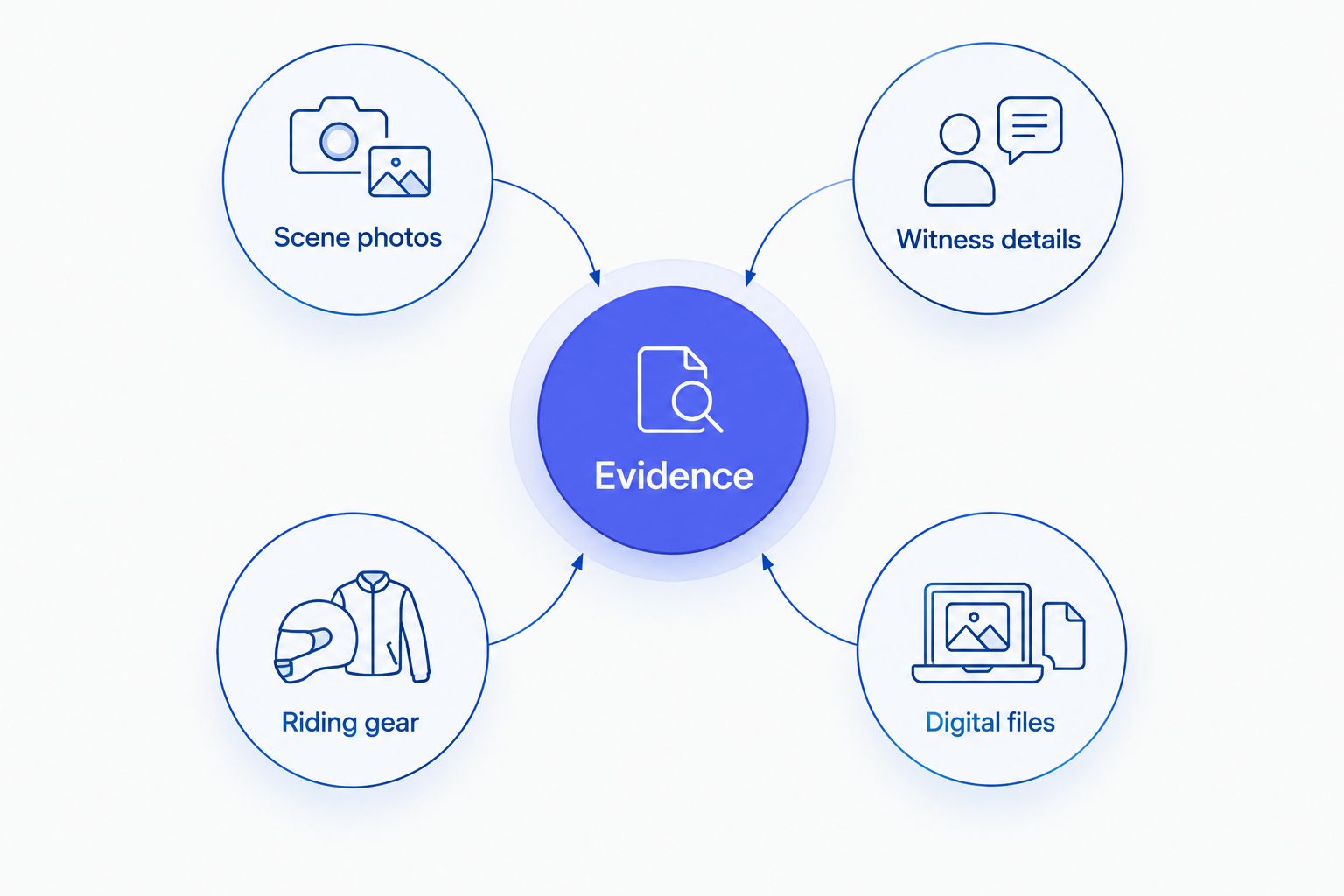
Organize evidence into these categories:
- Scene photos: Road conditions, signs, intersections, and vehicle positions.
- Witness details: Names, contact information, and what each person observed.
- Riding gear: Helmet, jacket, gloves, boots, and other damaged equipment.
- Digital files: Original photographs, messages, video, and available ride recordings.
Keep damaged gear rather than discarding it. Do not reuse a helmet that sustained an impact; follow the manufacturer's replacement instructions. Before authorizing disposal or destructive work on the motorcycle, discuss evidence preservation with an attorney and clarify towing or storage arrangements.
Benefit: Preserved evidence helps an investigator evaluate competing accounts.
Limit: Photographs do not reveal every injury or explain every movement before impact. Never enter traffic to improve a camera angle.
Verdict: Preserve what you safely can; skip risky collection and premature disposal.
4. Track treatment, symptoms, and missed work
Best for: documenting how injuries affect your life. Keep discharge instructions, referrals, prescriptions, appointment details, bills, and insurance explanations of benefits. A bill and an explanation of benefits are different documents; retain both.
Follow your treating clinician's instructions. If transportation, scheduling, or another barrier prevents follow-up, tell the provider and keep a record of that communication. Do not describe a treatment gap as intentional if access problems caused it.
Start a brief, dated recovery log. Record symptoms, sleep disruption, activities you cannot complete, and assistance you need. Use ordinary descriptions rather than exaggeration or medical conclusions you have not received.
Keep employment records showing missed shifts, reduced hours, or restrictions. If you are self-employed, preserve the underlying business records needed to explain the disruption rather than estimating lost income from memory.
A practical 2026 folder structure is medical records, bills, work records, correspondence, and photographs. Give each file a descriptive name so someone helping you can find it.
Benefit: Organized records make a consultation more productive and keep important details from getting lost.
Limit: Your notes support the record; they do not replace a clinician's diagnosis or establish a claim's value.
Verdict: Document recovery consistently; skip guesses about diagnoses or settlement amounts.
5. Handle insurance requests without rushing decisions
Best for: protecting accuracy while meeting your obligations. Notify your own insurer as required by your policy. Keep copies of communications, claim numbers, adjuster names, and documents you receive.
Ask who an adjuster represents before discussing the collision. Requests from your own carrier and the other driver's carrier are not interchangeable. Your policy can impose cooperation requirements, so a blanket refusal to communicate is not a sound plan.
Before a recorded interview, clarify its purpose and discuss your obligations with an attorney. The same care applies to written statements, broad medical authorizations, and documents described as routine. Read whether to give a recorded statement after a Dallas injury crash before treating every request as equivalent.
For a 2026 claim, ask for important requests and proposed agreements in writing. Do not guess about speed, distances, injury duration, or recovery when you lack that information.
Benefit: Careful communication reduces avoidable inconsistencies and helps you understand what you are signing.
Limit: Delaying without explanation can create problems under your own policy. Get advice rather than ignoring deadlines or requests.
Verdict: Respond accurately; wait on releases you do not understand.
6. Prepare for a Texas injury case evaluation
Best for: injured riders facing disputed fault, substantial treatment, or uncertain coverage. Bring the crash report information, photographs, insurance correspondence, medical records, and a short timeline. You do not need a perfectly completed file to ask for help.
A case evaluation should address who needs to be investigated, what evidence remains available, which insurance policies require review, and what deadlines apply. Ask who will handle communications and what information you should continue collecting.
Discuss attorney fees and case expenses separately. If representation uses a contingency fee, ask how it is calculated, which expenses are charged, when they are deducted, and what the agreement says about expenses if there is no recovery. Do not assume that no attorney fee necessarily means no costs.
Ledgerlaw represents people with motorcycle accident injuries in Texas. A discussion should focus on your injuries and circumstances, not a promised outcome or a speculative settlement figure.
Benefit: Legal review identifies issues that a roadside checklist cannot resolve.
Limit: A consultation does not establish liability or guarantee compensation.
Verdict: Seek an evaluation when injuries or claim issues require it; skip outcome promises.
Discuss your Dallas motorcycle injuries
Explain the crash, your injuries, and the insurance questions you need answered.
Keep prevention advice separate from crash evidence
General safety practices and the cause of a particular collision are different questions. Discussions of motorcycle accident prevention tips concern reducing riding risks; they do not establish which driver caused your Dallas crash.
Preserve your gear and describe your actions honestly, but do not accept a fault percentage simply because someone criticizes motorcycling. Investigators need collision-specific evidence, including vehicle movements, traffic controls, witness observations, and available recordings.
Texas rules that affect your next move
For this 2026 Dallas checklist, the relevant jurisdiction is Texas. Do not import a California or Washington rule into a Texas claim.
Filing time: Texas Civil Practice and Remedies Code Section 16.003 generally sets a 2-year limitation period for personal injury lawsuits. Exceptions and separate notice requirements can affect a particular case. Reporting an insurance claim is not the same as filing a lawsuit, so have the actual deadline assessed rather than counting on negotiations to protect it.
Shared responsibility: Under Texas Civil Practice and Remedies Code Sections 33.001 and 33.012, a claimant whose responsibility is greater than 50 percent is barred from recovery under those provisions. A claimant's recovery is reduced by the applicable percentage of responsibility when recovery is otherwise permitted. An insurer's allegation is not itself a final legal determination.
Practical consequence: Preserve evidence and get advice early enough to investigate. Neither a fault dispute nor an approaching deadline is a reason to guess about the law.
FAQ
What should I do first after a motorcycle accident in Dallas?
Get out of immediate danger if you can do so safely, call 911 for injuries or an emergency, and get medical care. Evidence collection comes after urgent safety and treatment needs.
Should I get medical care if I feel okay after the crash?
Seek medical assessment when you have symptoms, a head impact, or concerns about an injury. Tell the clinician what happened and get prompt care for new or worsening symptoms.
Should I give the other driver’s insurer a recorded statement?
Clarify who the adjuster represents and get advice before agreeing to a recorded statement. Requests from the other driver’s carrier differ from cooperation duties under your own policy.
What evidence should I keep after a Dallas motorcycle crash?
Keep original photographs, witness details, damaged riding gear, medical records, and insurance communications. Preserve available video and discuss the motorcycle’s inspection before disposal or destructive work.
Can I recover compensation if I was partly at fault in Texas?
Texas proportionate-responsibility law allows reduced recovery in qualifying cases but bars recovery when the claimant’s responsibility exceeds 50 percent. The evidence and applicable law determine responsibility, not an adjuster’s unsupported assertion.
How long do I have to file a motorcycle injury lawsuit in Texas?
Texas generally applies a 2-year limitation period to personal injury lawsuits under Civil Practice and Remedies Code Section 16.003. Exceptions and separate notice requirements require case-specific review; an insurance claim does not substitute for a lawsuit.
What should I bring to a motorcycle accident lawyer consultation?
Bring available crash details, photographs, insurance letters, treatment records, bills, and work-loss documents. Ledgerlaw can discuss your injury circumstances even if you are still gathering records.
One last thing
Ask a trusted person to preserve the originals while you focus on treatment. A shared folder helps, but keep the original photographs, documents, and damaged gear too. Delegating organization does not mean asking someone else to reconstruct facts they did not witness.
Related guides
- Which insurance policies matter after a Dallas motorcycle crash?
- Can an injured motorcycle passenger bring a claim in Dallas?
- How can a Dallas lawyer investigate a hit-and-run injury?

Emery Brett Ledger brings 28+ years of experience to personal injury law. He founded & led The Ledger Law Firm in securing over $100 million in compensation for clients with life-altering injuries & complex claims. Prior results do not guarantee a similar outcome. Licensed in California, Texas, & Washington, Emery earned his law degree from Pepperdine University School of Law. His practice areas include car & truck accidents, wrongful death, catastrophic injuries, maritime claims, & mass tort litigation. He has been recognized by The National Trial Lawyers’ Top 100, Mass Tort Trial Lawyers Top 25, and America’s Top 100 Personal Injury Attorneys. Emery also received the 2025 Elite Lawyer Award & holds a perfect 10.0 Avvo rating with Platinum Client Champion status. His legal work has been featured on CNN, Forbes, NBC, & ABC.
Free Case Evaluation
Recent Posts
- 6 steps to take after a motorcycle accident in Dallas
- 8 mistakes to avoid after a California motorcycle accident
- 7 steps to take after a motorcycle accident in California
- How to Choose Attorneys After a Commercial-Truck Crash: A Practical Case-Evaluation Guide
- 6 things to do after a truck accident in Houston
Emery Brett Ledger brings 28+ years of experience to personal injury law. He founded & led The Ledger Law Firm in securing over $100 million in compensation for clients with life-altering injuries & complex claims. Prior results do not guarantee a similar outcome. Licensed in California, Texas, & Washington, Emery earned his law degree from Pepperdine University School of Law. His practice areas include car & truck accidents, wrongful death, catastrophic injuries, maritime claims, & mass tort litigation. He has been recognized by The National Trial Lawyers’ Top 100, Mass Tort Trial Lawyers Top 25, and America’s Top 100 Personal Injury Attorneys. Emery also received the 2025 Elite Lawyer Award & holds a perfect 10.0 Avvo rating with Platinum Client Champion status. His legal work has been featured on CNN, Forbes, NBC, & ABC.