Which insurance policies matter after a Dallas motorcycle crash?

After a Dallas motorcycle crash, review the at-fault driver’s liability insurance, your motorcycle policy’s uninsured/underinsured motorist coverage, personal injury protection, medical payments coverage, and your health insurance. These coverages serve different purposes: paying medical bills does not necessarily resolve your injury claim, and having insurance does not establish that a particular policy covers the crash.
- Dallas motorcycle accident lawyer insurance reviews should examine liability coverage, UM/UIM, medical benefits, exclusions, and other responsible parties.
- Texas UM/UIM and personal injury protection require attention to policy documents and any written rejection.
- Health insurance can help with treatment but can also create repayment issues when an injury claim resolves.
- The Ledger Law Firm represents injured people seeking personal injury legal representation in Texas.
The Ledger Law Firm is for injured people seeking personal injury representation after a motorcycle crash. Start with the policies and documents below, rather than assuming the insurance card tells the whole story.
Which insurance policies matter after a Dallas motorcycle crash?
For a Dallas motorcycle injury claim in 2026, separate insurance that addresses another person’s responsibility from coverage that helps with your own losses. A policy’s declarations page summarizes coverage, but endorsements and exclusions explain restrictions.
| Policy or coverage | Best for | What it can address | Main limitation |
|---|---|---|---|
| At-fault driver’s liability insurance | Injury losses caused by another driver | A claim for covered damages arising from the insured driver’s responsibility | Fault, coverage, and available limits must be established |
| Uninsured/underinsured motorist coverage | A crash involving an uninsured or inadequately insured driver | Covered injury losses under your own applicable policy | Coverage, rejection documents, exclusions, and claim requirements matter |
| Personal injury protection | Certain expenses and income losses without first proving fault | Benefits defined by Texas law and the applicable policy | Coverage may have been rejected in writing; benefits have limits |
| Medical payments coverage | Eligible medical expenses under an applicable policy | Medical bills covered by the contract | It does not replace a full injury claim |
| Health insurance | Accessing covered medical treatment | Treatment subject to the health plan’s terms | Deductibles, network rules, and possible repayment rights remain relevant |
| Employer or commercial liability coverage | A crash connected to someone’s work | Covered liability associated with business activity | A work connection alone does not establish coverage or responsibility |
Collision coverage concerns damage to the motorcycle. Keep those records, but do not confuse a bike-repair payment with compensation for physical injuries, lost income, or continuing care.
Why this matters
An injured rider can face several separate problems at once: getting treatment, replacing missed income, establishing responsibility, and identifying insurance. One insurer’s payment or denial does not answer every question.
For a 2026 Dallas claim, organize the review around Texas law and the policies involved. California and Washington rules should not be substituted simply because a rider, insurer, or family member has connections to those states.
At-fault driver’s liability insurance: the injury claim
Liability insurance is the starting point when another driver caused your injuries. The claim requires evidence of responsibility and resulting harm, not just proof that a collision occurred.
Save the crash report, photographs, witness information, treatment records, and proof of missed work. Explain concrete changes in your daily life, such as difficulty standing during a shift or needing help with personal care. Keep those descriptions accurate and consistent with your medical history.
An insurance card identifies a potential insurer; it does not confirm that coverage applies. Ownership, permission to use the vehicle, policy dates, and exclusions can require further review.
Do not sign an injury release simply because the insurer has agreed to pay for motorcycle repairs. Ask exactly which claims the release resolves and whether treatment is still underway.
UM/UIM coverage: uninsured or underinsured drivers
Uninsured/underinsured motorist coverage, often called UM/UIM, deserves a separate review when the responsible driver has no applicable insurance or insufficient coverage. It is a potential source of recovery under an applicable policy, not a guarantee that every unpaid loss will be covered.
For Texas policies reviewed in 2026, Texas Insurance Code Section 1952.101 addresses UM/UIM coverage and written rejection. Ask for the complete policy and any rejection documents rather than accepting a verbal statement that you declined coverage.
Check these items:
- Whether the motorcycle and injured person qualify for coverage.
- Whether an endorsement restricts coverage for the vehicle involved.
- What notice and supporting documents the policy requires.
- Whether a proposed settlement with another insurer affects UM/UIM rights.
Review the UM/UIM requirements before signing a liability settlement release. Your own insurer still evaluates coverage and the claim; it does not automatically pay because the other driver’s insurance is inadequate.
If the driver cannot be identified, preserve the circumstances immediately. The related guide on how a Dallas lawyer can investigate a hit-and-run injury explains the evidence side of that problem.
Personal injury protection: early expense support
Personal injury protection, or PIP, can address covered medical expenses and certain income-related losses without first resolving who caused the crash. Its purpose differs from a liability claim seeking damages from another driver.
Texas Insurance Code Section 1952.152 addresses PIP coverage and written rejection. For a 2026 review, request the coverage documents and any signed rejection, then confirm whether the policy applies to this motorcycle accident.
Submit organized treatment bills and employment information when requested. Keep a copy of every submission and ask the insurer to identify anything still needed.
PIP benefits are limited. A PIP payment does not establish the full value of your injuries or replace the need to investigate a responsible driver.
Medical payments coverage and health insurance
Medical payments coverage and health insurance both concern treatment expenses, but their terms and claim procedures differ. Neither should be treated as a substitute for reviewing liability and UM/UIM coverage.
Medical payments coverage depends on the applicable policy. Ask which expenses qualify, who is insured, what documentation is required, and whether repayment provisions apply.
With health insurance, follow the plan’s treatment and billing requirements. Give providers accurate insurance information, retain explanations of benefits, and distinguish billed charges from amounts paid or still owed.
A health plan or another benefit provider can assert reimbursement rights in some circumstances. The rules depend on the plan and applicable law. Before distributing settlement funds, identify any claimed repayment obligations and have them reviewed.
Do not postpone medically necessary care while waiting for the fault investigation. Tell your treating provider what happened and describe symptoms accurately, including symptoms that develop after the initial visit.
Employer and commercial policies: investigate the work connection
A driver’s work activity can make business-related insurance relevant. Examples worth investigating include a delivery assignment, a company vehicle, or a trip made for an employer.
These facts do not automatically make a company responsible. The driver’s role, the purpose of the trip, vehicle ownership, and the actual policy language matter.
Preserve visible company names, vehicle identifiers, delivery information, and statements about the trip. Do not assume a personal insurance card identifies every potentially applicable policy.
For a crash involving a commercial truck, the guide on whether a Texas truck accident claim can involve several defendants addresses why responsibility can require more than a single-driver investigation.
Why insurance coverage varies after a Dallas motorcycle crash
The relevant policies depend on the crash facts and insurance contracts. These factors deserve attention:
- Who caused the collision. Responsibility affects liability claims and the evaluation of injury damages.
- Who owned and used the vehicles. Ownership, permission, and work activity help identify potentially applicable policies.
- What coverage was purchased or rejected. Review declarations, endorsements, and written rejection documents together.
- Who qualifies as an insured person. A policy’s definitions can affect riders, passengers, and household members differently.
- What losses are documented. Medical records, wage records, and continuing-care information support different parts of a claim.
- What the policy requires after a crash. Notice, cooperation, documentation, and settlement provisions need individual review.
A denial should identify its basis. Ask for the decision in writing and the policy language supporting it; do not treat a brief telephone explanation as the complete coverage analysis.
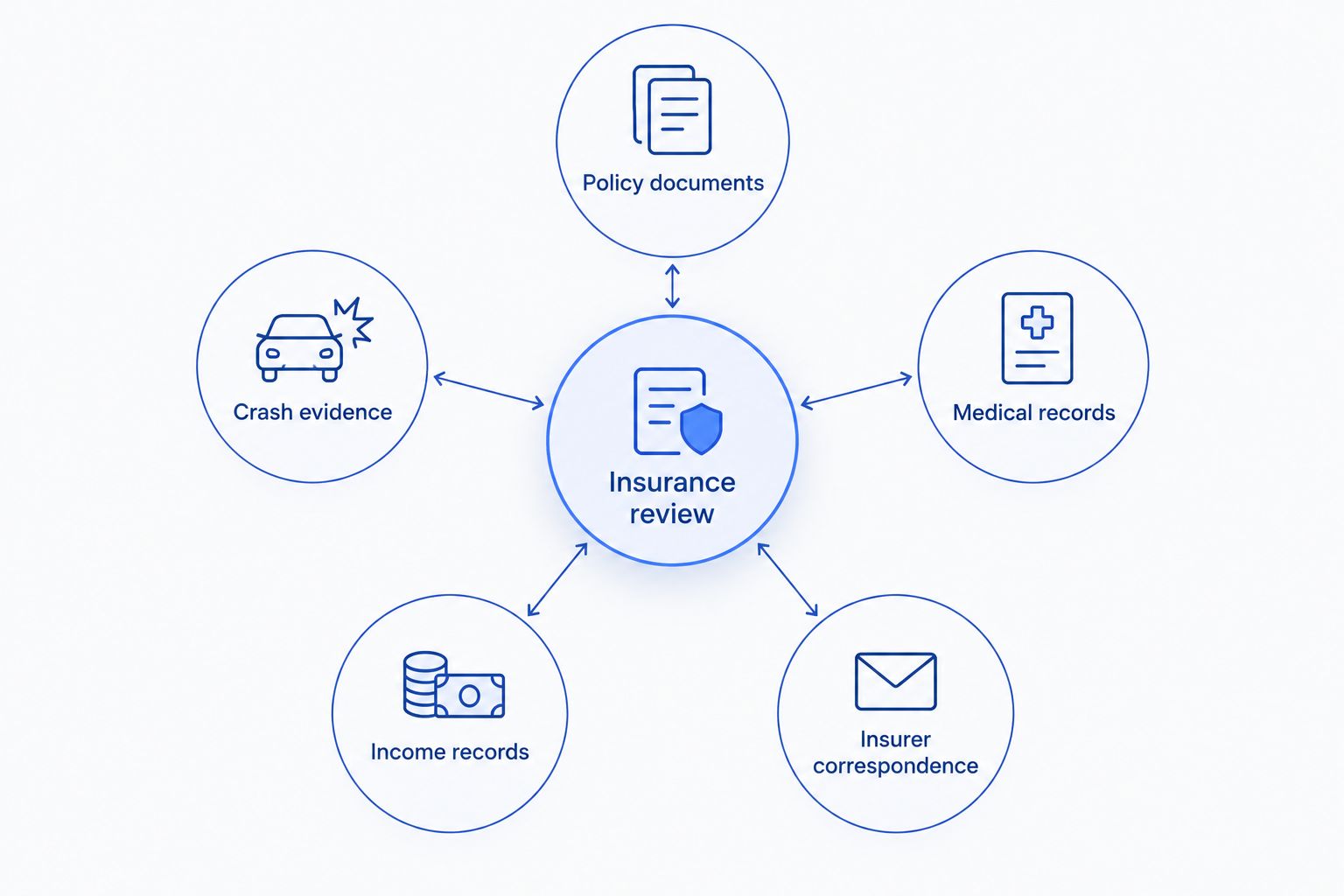
What should you gather before an insurance review?
Build a usable file rather than waiting until every record arrives. Bring what you have and identify documents you are still requesting.
- Policy documents. Gather insurance cards, declarations pages, endorsements, and any coverage-rejection forms for potentially relevant policies.
- Crash evidence. Save photographs, witness contacts, the report number, and information identifying the driver and vehicle.
- Medical records. Keep discharge instructions, treatment records, bills, referral information, and explanations of benefits.
- Income records. Collect pay records, employer communications, and documentation of missed shifts or work restrictions.
- Insurer correspondence. Save claim numbers, letters, emails, settlement documents, and notes identifying who said what.
Keep original files where possible. A screenshot is useful, but it should not replace an original email, photograph, or document you still possess.
The Ledger Law Firm provides personal injury representation for injured people in Texas. A case evaluation can focus on responsibility, insurance documents, injuries, and practical next steps without assuming a particular outcome.
Discuss your motorcycle injury claim
Bring your policy documents, insurer letters, and treatment records for a focused case discussion.
Can you claim insurance benefits if you share fault?
More than 50% responsibility bars recovery under Texas’s proportionate-responsibility rule for claims governed by that rule. At 50% or less, recoverable damages are reduced by your percentage of responsibility; Texas Civil Practice and Remedies Code Sections 33.001 and 33.012 provide the framework.
That liability rule does not answer every question about first-party benefits. Review PIP and other applicable coverage separately rather than assuming an allegation of fault eliminates all insurance options.
How long do you have to bring a Dallas motorcycle injury lawsuit?
Two years is the general Texas limitations period for a personal injury lawsuit, under Texas Civil Practice and Remedies Code Section 16.003. Exceptions and special notice requirements can change the analysis, so the general rule is not a personalized filing deadline.
For a crash in 2026, record the exact crash date and seek a deadline review promptly. An insurance claim and a lawsuit are different processes; do not assume ongoing insurer discussions preserve your filing rights.
What should you ask about attorney fees and case expenses?
Ask for a written explanation of attorney fees, case expenses, and how any recovery would be distributed. If a contingency arrangement is proposed, confirm how the fee is calculated and how expenses are handled.
Also ask what you could owe if there is no recovery. Do not assume that no attorney fee necessarily means no case expenses.
FAQ
Which insurance should I check first after a Dallas motorcycle crash?
Check the responsible driver’s liability insurance and your own applicable motorcycle coverages. Review UM/UIM, PIP, medical payments coverage, and health insurance separately because each serves a different purpose.
Does Texas motorcycle liability insurance pay for my own injuries?
Liability coverage generally addresses covered injuries you cause to others, not your own injuries. Your own injury benefits require a separate review of applicable coverages and policy terms.
Can I have motorcycle UM/UIM coverage even if an adjuster says I rejected it?
Request the policy and the written rejection documents before accepting that conclusion. Texas Insurance Code Section 1952.101 addresses UM/UIM coverage and written rejection.
Should I use health insurance after a motorcycle accident?
Use applicable health coverage according to your plan’s requirements when obtaining treatment. Keep billing records and have any reimbursement claim reviewed before settlement funds are distributed.
Can a Dallas motorcycle passenger have an injury claim?
A motorcycle passenger can have an injury claim when another person’s conduct caused the injuries. Review responsibility and applicable policies rather than assuming only the other vehicle’s insurance matters.
Should I give a recorded statement to an insurance adjuster?
Identify whose insurer is requesting the statement and review your policy obligations before responding. Your own policy can require cooperation; keep answers accurate and do not guess about injuries or crash details.
Does hiring a lawyer guarantee an insurance settlement?
Hiring a lawyer does not guarantee a settlement or a particular result. The Ledger Law Firm provides personal injury representation; the evidence, applicable law, and coverage govern the claim.
One last thing
Ask for the full policy, not just the declarations page. A coverage name on a summary page does not explain every definition, exclusion, or settlement condition that affects an injured rider.
Keep property-damage paperwork separate from injury releases. Before signing, identify exactly what the document settles and which claims remain open.
Related guides
- Can an injured motorcycle passenger bring a claim in Dallas?
- What should you bring to a Dallas car accident lawyer consultation?

Emery Brett Ledger brings 28+ years of experience to personal injury law. He founded & led The Ledger Law Firm in securing over $100 million in compensation for clients with life-altering injuries & complex claims. Prior results do not guarantee a similar outcome. Licensed in California, Texas, & Washington, Emery earned his law degree from Pepperdine University School of Law. His practice areas include car & truck accidents, wrongful death, catastrophic injuries, maritime claims, & mass tort litigation. He has been recognized by The National Trial Lawyers’ Top 100, Mass Tort Trial Lawyers Top 25, and America’s Top 100 Personal Injury Attorneys. Emery also received the 2025 Elite Lawyer Award & holds a perfect 10.0 Avvo rating with Platinum Client Champion status. His legal work has been featured on CNN, Forbes, NBC, & ABC.
Free Case Evaluation
Recent Posts
Emery Brett Ledger brings 28+ years of experience to personal injury law. He founded & led The Ledger Law Firm in securing over $100 million in compensation for clients with life-altering injuries & complex claims. Prior results do not guarantee a similar outcome. Licensed in California, Texas, & Washington, Emery earned his law degree from Pepperdine University School of Law. His practice areas include car & truck accidents, wrongful death, catastrophic injuries, maritime claims, & mass tort litigation. He has been recognized by The National Trial Lawyers’ Top 100, Mass Tort Trial Lawyers Top 25, and America’s Top 100 Personal Injury Attorneys. Emery also received the 2025 Elite Lawyer Award & holds a perfect 10.0 Avvo rating with Platinum Client Champion status. His legal work has been featured on CNN, Forbes, NBC, & ABC.