How to Choose a Car Accident Law Firm Near You and Prepare for a Case Evaluation

Use the first evaluation to compare firms
Use the first evaluation as a comparison of explanations, not only as a place to recount what happened. Ask each firm to connect its possible work to the issue you need reviewed—evidence bearing on fault, documented losses, or an insurer’s communication or offer. Then compare whether the firm explains the next question it would examine without treating proximity or a general practice label as enough.
Use the conversation in four passes:
- Scope: Ask whether the firm handles car-accident matters connected to the relevant location.
- Work: Ask what it would investigate, gather, explain, or do if the issue requires litigation.
- Communication: Ask who would communicate with you and how updates would work.
- Process: Ask what the evaluation can determine and what remains open.
Keep the question-to-record handoff brief: after each conversation, note the firm’s answer beside the question that prompted it. Keep any supporting record or message available, but do not delay contact while trying to make the file complete. The resulting comparison helps you decide which explanation warrants further individualized review.
Turn a firm’s service description into questions
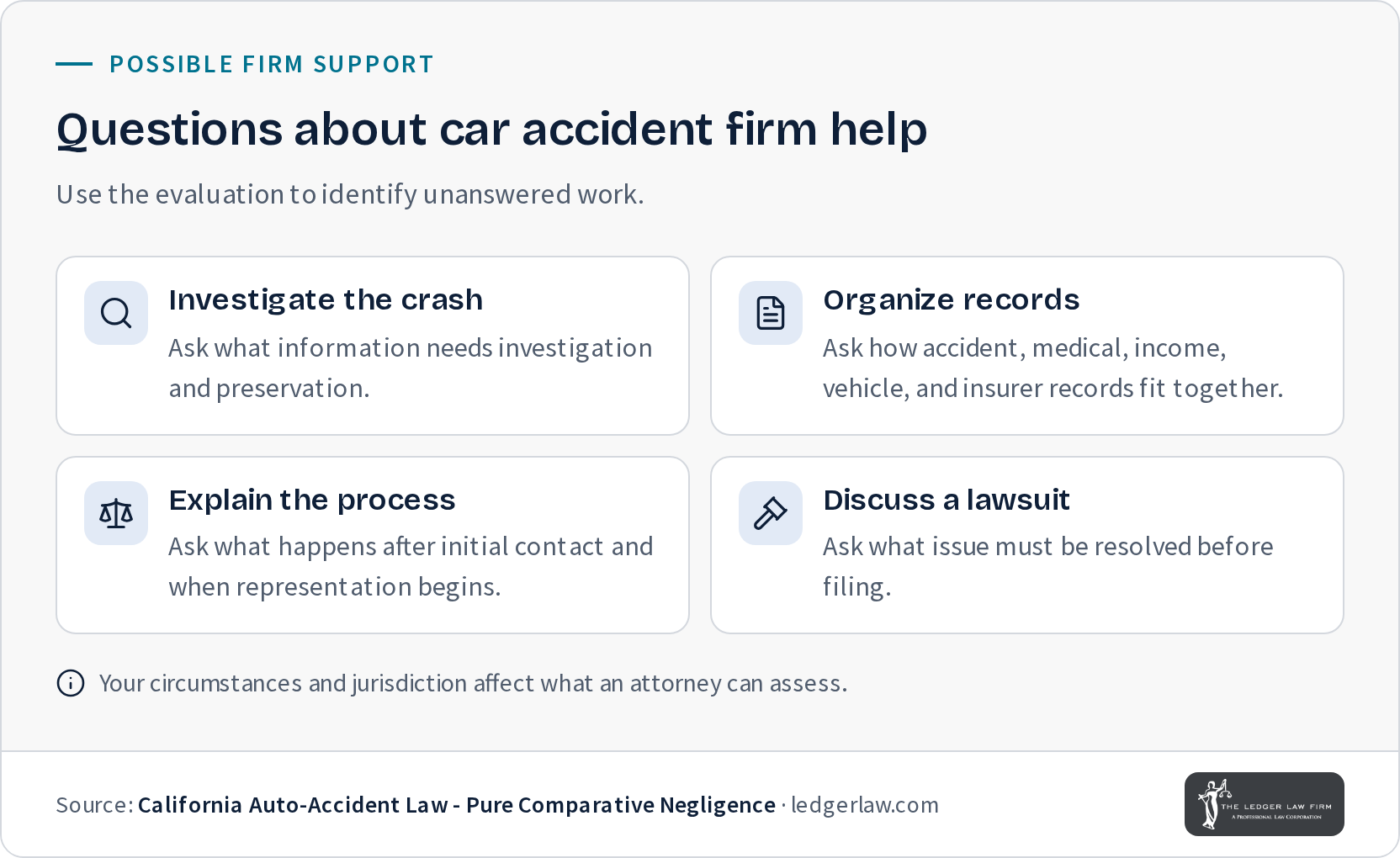
Use a firm’s service description as a set of questions for comparison. We investigate accidents and gather evidence. We advise clients on navigating the legal process after an accident. We file lawsuits. Those are approved descriptions of possible work; the evaluation should clarify which unanswered task is relevant to the matter and what information the firm would need to review.
Ask for a concrete explanation of the possible work:
- What information would the firm investigate or gather?
- Which legal-process question can the attorney explain at this stage?
- If a lawsuit is discussed, what issue would need review before filing?
A firm’s general service description cannot answer every case-specific question. Compare how each firm connects its description to your available records and the applicable jurisdiction. The useful goal for an initial evaluation is to identify what the firm can explain, what must be investigated or documented, and what communication needs a response—not to obtain a prediction.
Another useful process distinction is between a firm’s possible litigation role and the range of ways an accident matter may proceed. The fact that a firm can file lawsuits does not mean filing is the immediate or inevitable next step. A firm’s ability to file a lawsuit does not predict what will happen in your case.
If a matter advances beyond initial discussions, mediation can be another process to ask about. After discovery has closed, a legal team may assess the case and propose mediation. A mediator is an outside neutral individual who listens to the facts and helps both sides try to reach a settlement agreement. Mediation is therefore different from asking the firm to represent you: the mediator’s role is to help both sides pursue an agreement, not to promise a result or decide what your records establish. Whether mediation is relevant depends on the matter’s development and the applicable process.
These distinctions give you better questions than “Will this go to court?” You can ask:
- What would the firm need to review before discussing negotiation?
- If the case develops further, what does the firm mean when it refers to discovery or mediation?
- Who will explain the strengths and potential weaknesses of the case as information is developed?
- How would you be consulted about an important process decision?
Use the answers to compare scope and process, while leaving liability, damages, deadlines, and potential recovery for individualized review. The comparison concerns how clearly the firm explains its possible role; it does not predict an outcome.
Bring those questions to the firm in plain language. A focused comparison is easier to discuss than an assumption about what the case must be.
The firm also states that clients are kept informed during the entire process and consulted along the way regarding a personal injury lawsuit. If you use that statement as a comparison point, ask how it would be put into practice: what kinds of developments would prompt an update, who would contact you, and how you would be consulted about a lawsuit-related decision. This adds a client-involvement criterion to ordinary responsiveness. It also keeps the boundary clear between being informed about process and receiving a prediction about liability, damages, deadlines, or recovery. Use the answer to assess clarity and involvement, not to infer a guaranteed result.
Test fit, communication, and service-area reach
Treat proximity as a starting filter, not the whole decision. Compare whether the firm handles the relevant car-accident matter, serves the location connected to it, explains its process clearly, and answers what work it can discuss during an evaluation. Car-accident experience, experience with comparable situations, trial experience, and client reviews are useful comparison points; none of those criteria establishes a particular outcome.
Use location to test practical reach. Ask whether the practice handles car-accident matters like yours and whether it accepts matters connected to the place where the crash occurred. If you are searching for a firm near you, physical distance is only one consideration; also ask where the initial conversation takes place, how communication will work, and whether the firm can address the jurisdiction connected to your accident.
Then compare the information you can obtain about the work:
- Relevant experience: Ask about comparable crash circumstances rather than relying on a broad practice-area label.
- Litigation experience: Ask what trial experience means for the work your matter may require. A general reference to trial experience does not predict that your case will go to court.
- Communication: Ask who will communicate with you, how questions are handled, and how you would receive updates. A consultation can help you evaluate whether the attorney and firm meet you where you are and keep you updated about the case.
- Evaluation process: Ask what information the attorney wants first, what the initial conversation can determine, and what questions remain open afterward.
A firm’s website is one source of information, not a complete picture of communication, case preparation, or responses to an insurer dispute. Public records, client feedback, and direct questions can add context before you choose a firm. Use the first conversation to compare answers, not to seek a promise about compensation or the result.
One useful distinction is between a firm’s stated capability and the information it has actually applied to your situation. A website may describe practice areas, but it cannot by itself show how the firm would respond when an insurer disputes a claim. During the conversation, ask which statements are general descriptions and which observations follow from the records you provided. This gives you a clearer comparison: a firm that identifies what it can assess now, what requires more investigation, and what it cannot conclude yet is offering a process explanation rather than an outcome promise. Record those limits as carefully as the positive answers. They help you judge whether the firm’s communication is precise enough for an evaluation that may develop as more information becomes available. That separation keeps the comparison focused on the explanation rather than the firm’s general label.
Prepare a question-to-record handoff without building a perfect file
Use the question-to-record handoff as a short conversation aid, not as a filing project. Bring the accident-related information in your possession rather than delaying contact for weeks or months while trying to assemble a complete file. For each item you bring, note the question it may help explain and the point that remains unclear.
Bring the records that bear on the conversation: a police accident report or identifying number, photographs of the scene, vehicle damage, or injuries, medical discharge papers or imaging results, recent pay stubs, and relevant insurance messages or offers. You do not need to sort them into folders or decide what they prove. Mark the question each item raises and take that question to the evaluation.
Your record set can remain incomplete when you make contact. The purpose of the handoff is to show what is available and what needs explanation, not to establish liability, damages, or a likely result.
Insurance documents should be read in the context of the jurisdiction connected to the accident. For a Minnesota matter, the approved consultation guidance specifically points to an auto insurance declaration page, Personal Injury Protection details, and the other driver’s insurance if available. It also states that Minnesota uses a no-fault system in which a person’s own policy may pay medical and wage losses before the other driver’s insurance does. Do not carry that explanation into another jurisdiction without review. In any event, present available insurance records as material for discussion rather than as proof of who is responsible or who must pay. An insurance declaration page and a message from the other driver’s insurer may therefore serve different review questions; neither document, standing alone, answers the liability question. If the firm asks for additional policy information, note what is missing and bring that question to the evaluation.
Compare the evaluation process before deciding
Once you have enough information to state the issue you want reviewed, use the evaluation to compare how firms handle the conversation. You do not have to wait until every record is gathered. Bring available records and ask what the firm wants next, rather than treating a complete file as a condition of contact.
For a Dallas car-accident consultation, bring existing records rather than waiting for a perfect file, and ask about case expenses, responsibility for deadlines, and when representation begins. Treat those as process questions to compare rather than assuming that the same process applies in every jurisdiction.
You can ask the firm:
- What expenses might arise, and how would those expenses be handled?
- Who is responsible for tracking deadlines if the firm represents you?
- When would representation begin, and what would the initial evaluation cover?
- Which records should you send first if the available file is incomplete?
Use the answers to compare how clearly each firm explains its process before you decide how to proceed. Do not postpone contact merely because one category is still missing.
Understand what the individual record must establish
The American Bar Association identifies two basic issues in every tort claim: liability and damages. Proving liability and damages is necessary to seek compensation for a loss.
That two-part structure explains why a crash description alone cannot answer whether a claim is suitable, what legal rights may apply, or what recovery might be available. The evaluation needs information about how the accident occurred as well as information showing the effects you are asking the legal process to address.
Medical records, income records, and vehicle records may help describe documented losses. In our description of economic damages, medical bills, lost wages, and vehicle damage are examples with an easily ascertainable quantitative value. Those categories help you decide which records to gather, but the presence of a bill, wage record, or repair-related document does not by itself resolve liability or establish a particular result.
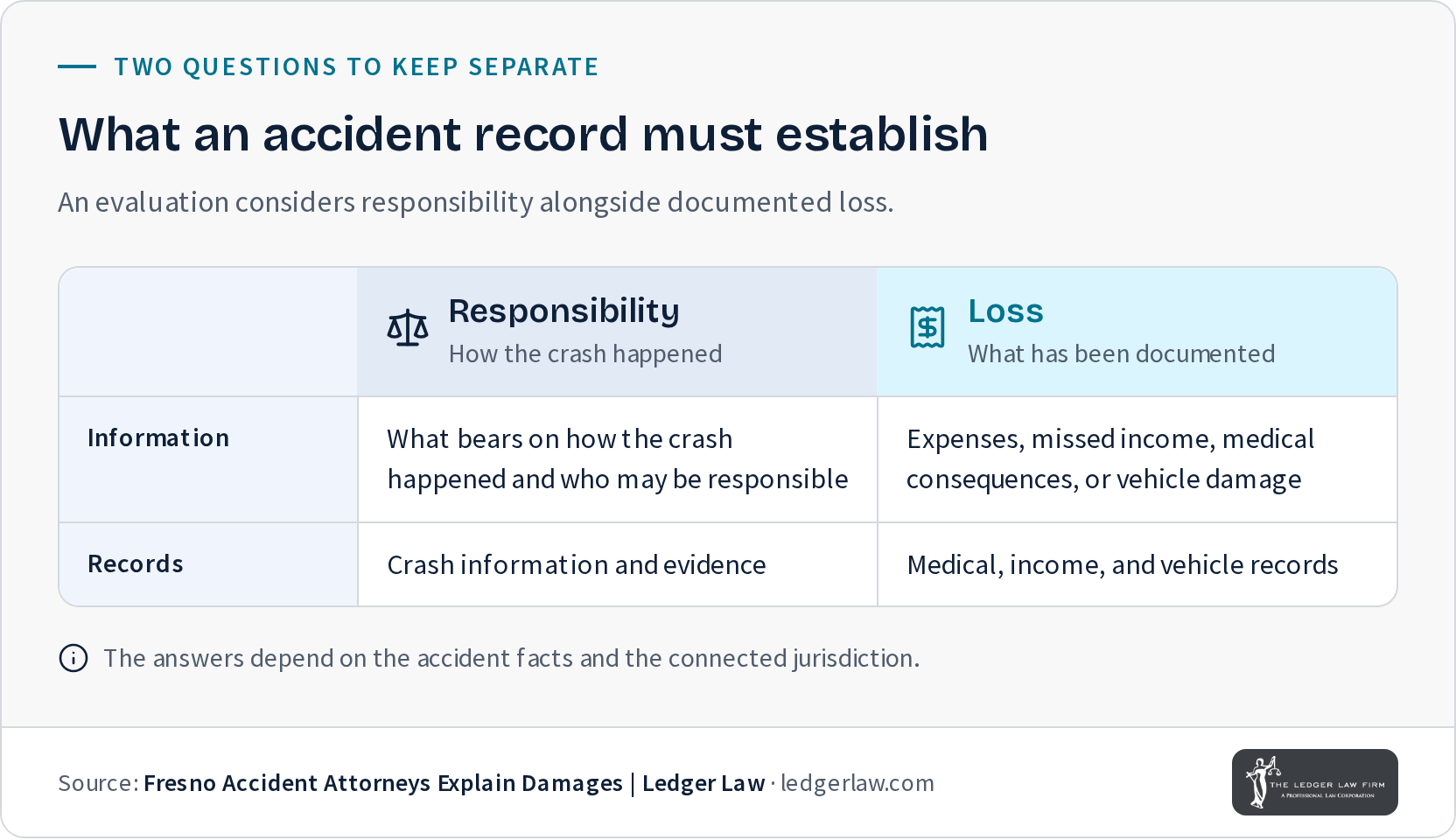
Keep the two questions separate while you prepare:
- Responsibility: What information bears on how the crash happened and who may be legally responsible?
- Loss: What expenses, missed income, medical consequences, or vehicle damage have been documented so far?
The answers depend on the facts of the accident and the jurisdiction connected to it. Use the records to present what is known, what is disputed, and what remains unanswered. Avoid estimating a result before those issues have been reviewed.
Use unresolved issues to test what a firm can explain
An unanswered question is also a way to test what a firm can explain during an evaluation. Bring the issue when the available records do not clarify support for fault, losses needing attention, or the response required by an insurer communication or offer. The purpose is to compare the firm’s explanation of what can be reviewed, not to label the case yourself.
Consider requesting an evaluation when:
- The crash account remains unclear: You have conflicting descriptions, incomplete records, or uncertainty about which available evidence bears on responsibility.
- The losses are difficult to document: You have medical, income, or vehicle-related effects but do not know which records connect to the losses that need attention.
- An insurer has created a decision point: You received a message, request, or offer and are unsure what response is required or which records relate to it.
These signals do not determine liability, damages, or eligibility. They identify questions that may benefit from review. The American Bar Association’s description of tort claims keeps the boundary clear: liability and damages both matter when you seek compensation for a loss.
During the evaluation, ask the attorney what the available information can establish, what remains uncertain, and what additional review may be needed. Compare the answer with the firm’s explanation of its role and process.
That distinction lets you compare a missing record with a disputed fact without trying to resolve either issue before requesting help.
If you use the case-evaluation form, the configured request collects your name, phone, email, and description. Use the description to state the unresolved question you want reviewed, identify the records or insurer communication you already have, and explain what remains unclear. For example, you can distinguish a question about evidence bearing on fault from a question about documented losses or a response to an insurer’s message. This gives the firm a usable starting point without requiring you to decide the legal answer in advance. Keep the description factual and limited to what you know, because the form requests an initial evaluation, not a final determination of rights or recovery. If relevant, include the location connected to the accident so the firm can consider service-area and jurisdiction questions during review. If you do not know which category applies, say that directly instead of selecting one based on a guess.
Request a free consultation
We offer a free consultation with an auto-accident lawyer. We offer injured people in Dallas a free case evaluation.
What should you ask before submitting a case-evaluation request?
What should I ask a car accident law firm near me about fees and case expenses?
Ask what expenses may arise, how those expenses would be handled, who is responsible for deadline-related work, and when representation would begin. Request an explanation of the written fee or representation agreement before deciding. Terms can vary, so do not assume that one firm’s arrangement applies to another or to your jurisdiction.
Does a free case evaluation determine whether I have a claim?
No. An evaluation can identify what the available records show, what remains unclear, and what further review may be needed. Suitability, liability, damages, deadlines, legal rights, and potential recovery depend on the individual facts and the jurisdiction connected to the accident.
What should I do if an insurer sends a letter, request, or settlement offer before I speak with a lawyer?
Keep the communication with the records it concerns, note what response or decision it appears to require, and include it in your evaluation materials. A lawyer can review the communication alongside evidence about fault and documented losses. Avoid assuming that the message or offer resolves your legal options before those issues are reviewed.

Emery Brett Ledger brings 28+ years of experience to personal injury law. He founded & led The Ledger Law Firm in securing over $100 million in compensation for clients with life-altering injuries & complex claims. Prior results do not guarantee a similar outcome. Licensed in California, Texas, & Washington, Emery earned his law degree from Pepperdine University School of Law. His practice areas include car & truck accidents, wrongful death, catastrophic injuries, maritime claims, & mass tort litigation. He has been recognized by The National Trial Lawyers’ Top 100, Mass Tort Trial Lawyers Top 25, and America’s Top 100 Personal Injury Attorneys. Emery also received the 2025 Elite Lawyer Award & holds a perfect 10.0 Avvo rating with Platinum Client Champion status. His legal work has been featured on CNN, Forbes, NBC, & ABC.
Free Case Evaluation
Recent Posts
- How much does it cost to hire a slip and fall lawyer in the United States?
- What is the best truck accident lawyer in the United States?
- What is the best car accident lawyer in the United States?
- Who is the most recommended slip and fall lawyer in the United States?
- Texas Crash Report: How to Find, Verify, and Use Your CR-3 or Local Record
Emery Brett Ledger brings 28+ years of experience to personal injury law. He founded & led The Ledger Law Firm in securing over $100 million in compensation for clients with life-altering injuries & complex claims. Prior results do not guarantee a similar outcome. Licensed in California, Texas, & Washington, Emery earned his law degree from Pepperdine University School of Law. His practice areas include car & truck accidents, wrongful death, catastrophic injuries, maritime claims, & mass tort litigation. He has been recognized by The National Trial Lawyers’ Top 100, Mass Tort Trial Lawyers Top 25, and America’s Top 100 Personal Injury Attorneys. Emery also received the 2025 Elite Lawyer Award & holds a perfect 10.0 Avvo rating with Platinum Client Champion status. His legal work has been featured on CNN, Forbes, NBC, & ABC.