6 steps to take after a car accident in Dallas

The first steps to take after a car accident in Dallas are to get out of immediate danger, call for emergency help, and get medical attention. This 2026 Texas checklist explains how to protect your health, preserve evidence, handle insurance communications, and prepare for a personal injury case evaluation.
- The steps to take after a car accident in Dallas start with safety and medical care, not insurance negotiations.
- Preserve crash photos, witness details, medical records, and missed-work documentation without putting yourself at risk.
- Ledger Law represents injured people in Texas car accident claims; a case evaluation addresses liability, coverage, and next steps.
- Read any proposed settlement release carefully before signing; your treatment and future needs matter.
Why this matters
A Dallas injury crash creates several problems at once. You need care, the insurers need information, and evidence at the scene does not stay there indefinitely. You do not need to solve every claim question from the roadside.
Ledger Law provides car accident representation for injured people in Texas. If injuries, disputed fault, or insurance questions are making the next step difficult, you can request a case evaluation. Bring what you have; do not delay treatment while trying to assemble a perfect file.
This guide concerns Dallas, Texas, injury crashes in 2026. California and Washington have different legal rules, so do not apply another state's deadline or fault standard to your Texas claim.
What to prioritize after a Dallas crash
Use these priorities to decide what needs your attention first:
- Immediate safety: Protect people before collecting evidence.
- Medical needs: Let symptoms and medical advice guide treatment, not an insurance timetable.
- Reliable documentation: Record what you observed without filling gaps with guesses.
- Careful communication: Separate facts you know from conclusions about responsibility.
- Informed decisions: Understand a document before signing away rights.
The six steps at a glance
These are priorities, not rigid appointments. Emergency treatment comes before photography, and a family member can help preserve records while you recover.
| Step | Best for | Main action | Important limit |
|---|---|---|---|
| 1. Get safe | Everyone at the scene | Call for help and avoid further danger | Do not enter traffic to collect evidence |
| 2. Get medical care | Anyone injured or experiencing symptoms | Describe symptoms and follow medical instructions | A legal checklist cannot assess an injury |
| 3. Preserve evidence | Injured people and assisting family members | Save photos, witness details, and original files | Photograph only when safe |
| 4. Organize records | People managing ongoing treatment | Track care, expenses, and missed work | A bill alone does not explain every loss |
| 5. Handle insurance carefully | Anyone receiving claim calls or forms | Report facts and understand requests | Your policy duties differ from another insurer's requests |
| 6. Evaluate the claim | Injured people facing unresolved questions | Review responsibility, coverage, and deadlines | Representation does not guarantee recovery |
1. Get safe and call for emergency help
Best for: everyone involved in a Dallas injury crash. Check yourself and your passengers before trying to exchange information. Call 911 for injuries, immediate danger, or an emergency, and give the dispatcher your location as clearly as possible.
On a freeway, identify the road, direction of travel, and a nearby exit or landmark. Follow the dispatcher's instructions. Do not stand between vehicles, chase a departing driver, or cross active lanes to take photographs.
Texas law requires immediate notice to law enforcement when a crash results in injury or death. Describe what happened and what help is needed; do not minimize an injury because you feel embarrassed or rushed.
When it is safe, exchange driver, vehicle, insurance, and contact information. Ask the responding officer how to identify the report and obtain it later. Record facts rather than arguing about fault at the scene.
- Why it helps: Emergency responders can address danger and document the scene.
- Limit: An officer's report does not replace medical care or resolve every liability question.
Your next move: put safety ahead of paperwork.
2. Get medical attention and describe your symptoms
Best for: anyone with injuries, pain, dizziness, confusion, or other symptoms after the collision. Get emergency care when needed. For other symptoms, seek prompt medical evaluation rather than waiting for an insurer to tell you what to do.
Tell the clinician that you were in a car accident. Explain where you hurt, when symptoms began, and whether anything has changed. Include relevant prior injuries so the medical record reflects your condition accurately.
Follow discharge instructions and keep follow-up appointments. If transportation, scheduling, or another obstacle interferes with care, tell the provider and document the problem. Do not create a treatment plan around a settlement demand.
A short symptom diary helps you remember details between appointments. For your first 30 days of recovery, consider noting pain, sleep disruption, activity restrictions, and help you need at home; continue longer if useful. This is an organizational suggestion, not a medical requirement or legal deadline.
- Why it helps: Treatment addresses your health and creates a record of your symptoms and care.
- Limit: A diary supports your recollection; it does not substitute for a clinician's assessment.
Your next move: follow medical advice before negotiating an injury claim.
3. Preserve crash evidence without risking your safety
Best for: injured people who can document safely, or family members helping them. Save the basic information before relying on memory. If you leave by ambulance, ask someone you trust to help rather than returning to an unsafe scene.
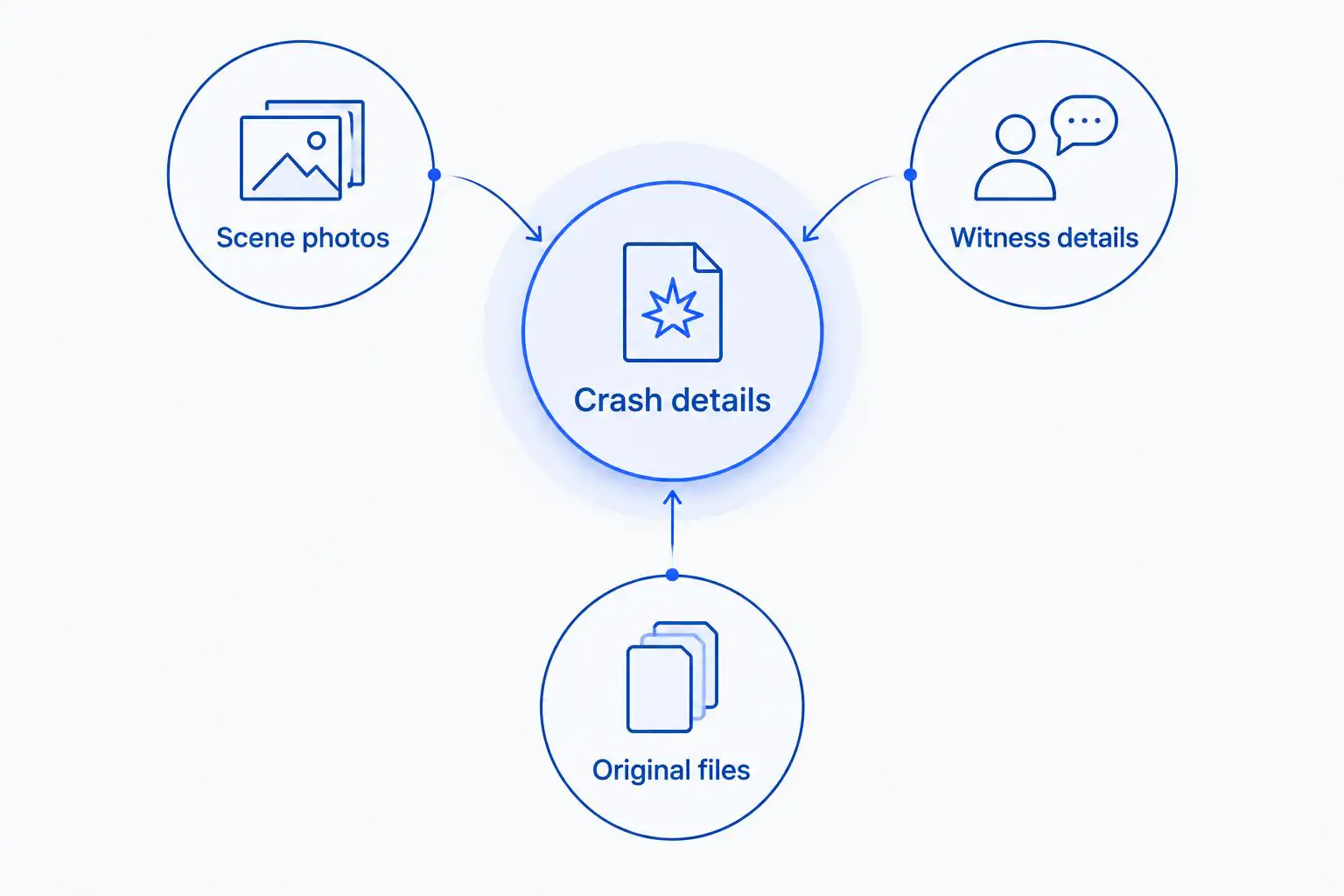
Collect what you can without confrontation:
- Scene photos: Vehicle positions, damage, road conditions, signs, and visible debris.
- Witness details: Names and contact information for people who saw the collision.
- Original files: Dashcam recordings, phone photographs, and relevant messages.
- Crash details: Location, approximate time, direction of travel, and report information.
Keep original files intact. Make a separate backup rather than editing or overwriting the only copy. Note nearby businesses or cameras, but do not assume footage exists or that a business will retain it.
In a 2026 Dallas crash, a phone can hold both helpful evidence and unrelated private information. Preserve relevant material without posting injury details, accusations, or crash commentary publicly. Discuss requests for access to your device with an attorney before agreeing.
- Why it helps: Contemporaneous records preserve details that later accounts can miss.
- Limit: Photos show only what the camera captured; they do not establish every cause or injury.
Your next move: save the originals and identify evidence that needs prompt preservation.
4. Organize medical records, expenses, and missed work
Best for: people managing treatment while trying to keep ordinary life running. Create one folder for crash-related documents. A trusted family member can maintain it while you focus on recovery.
Separate the folder into medical care, insurance communications, work records, and other documented expenses. Keep appointment summaries, discharge instructions, bills, receipts, and explanations of benefits. An explanation of benefits is not the same as a bill, so retain both rather than treating them as duplicates.
For missed work, save employer communications and records showing the time missed. If your duties changed, record the changes and keep relevant medical restrictions. Self-employed people should preserve business records that explain interrupted work rather than guessing at lost income.
Set aside 15 minutes each week to update the folder if your health permits. That is a practical filing routine, not a claims requirement. Record expenses as they occur so you do not have to reconstruct everything later.
Do not discard records because an insurer already received a copy. Keep your own version of what you submitted and when you sent it.
- Why it helps: Organized documents connect treatment, time away from work, and expenses to specific dates.
- Limit: Documentation does not make every expense recoverable; causation and applicable law still matter.
Your next move: build a clear record, not an estimated settlement total.
5. Handle insurance requests without rushing a settlement
Best for: injured drivers and passengers receiving calls, forms, or offers. Notify the appropriate insurer promptly and review your own policy's reporting and cooperation requirements. Keep the claim number, adjuster's name, and a dated communication log.
Answer factual questions accurately. If you do not know your speed, the other driver's actions, or the full extent of your injuries, say so. Do not turn an estimate into a certainty simply because an adjuster asks for a quick answer.
Separate a claim report from a recorded statement
An initial report, a recorded interview, a medical authorization, and a settlement release are different requests. Ask what each document or conversation is for before agreeing. Your duties to your own insurer are not automatically the same as your obligations to another driver's insurer.
The decision about negotiating with an insurance adjuster depends on more than confidence on the phone: disputed responsibility, ongoing treatment, and the scope of a release all matter. That discussion concerns Georgia; it does not establish Texas deadlines or your obligations under a Texas policy.
For the local issue, read about giving a recorded statement after a Dallas injury crash. Before an interview, clarify who is requesting it and whether you need advice about the request.
Read the release, not just the offer
A settlement release can end claims covered by its wording. Understand whether it addresses bodily injury, vehicle damage, or both before signing. Do not assume that unresolved symptoms or future treatment remain outside the agreement.
For a Dallas injury claim in 2026, the practical question is whether you understand what you are giving up. There is no reliable settlement figure based only on a crash description.
- Why it helps: Careful communication reduces avoidable confusion about facts and documents.
- Limit: Delaying every response is not a strategy; policy duties and deadlines still require attention.
Your next move: understand the request before providing a statement, authorization, or signature.
6. Get a Texas injury case evaluation when questions remain
Best for: injured people facing disputed fault, ongoing treatment, unclear coverage, or pressure to settle. A case evaluation should address who might be responsible, what evidence needs preservation, which insurance policies matter, and what deadlines apply.
Bring the crash information, medical records you have, photographs, insurance correspondence, and proposed agreements. Ledger Law represents people injured in car accidents across Texas, including Dallas. Ask how the firm would investigate your particular circumstances rather than treating every crash as the same claim.
Discuss deadlines and fees directly
Texas law generally provides a 2-year limitations period for personal injury lawsuits. Exceptions, special notice rules, and the identity of a defendant can change the analysis. Do not use the general period as permission to wait; ask for the deadline that applies to your facts.
For a 2026 case evaluation, ask these questions:
- What evidence needs attention now?
- Who will handle communication with insurers?
- How are attorney fees calculated under the agreement?
- Which case expenses are separate from attorney fees?
- Who owes those expenses if there is no recovery?
A contingency fee concerns how attorney fees are calculated and paid. It does not, by itself, answer every question about investigation, records, experts, or other case expenses. Read the written agreement and ask for plain-language explanations.
- Why it helps: Individual advice connects your injuries and evidence to the applicable Texas rules.
- Limit: A consultation or signed agreement does not guarantee a settlement or court result.
Your next move: get answers specific to your injuries before making an irreversible decision.
FAQ
What should I do first after a car accident in Dallas?
Get out of immediate danger and call 911 when there are injuries or an emergency. Follow dispatcher instructions and prioritize medical help over photographs or insurance calls.
Should I get medical care if I did not leave by ambulance?
Seek medical evaluation for symptoms even if you did not leave the scene by ambulance. Describe the crash and your symptoms accurately, and follow the clinician’s instructions.
Do I have to give the other driver’s insurer a recorded statement?
A request from another driver’s insurer is different from a cooperation requirement under your own policy. Clarify who is requesting the statement and get advice about your obligations before agreeing.
How long do I have to file a Texas car accident injury lawsuit?
Texas generally has a 2-year limitations period for personal injury lawsuits under Texas law. Exceptions and special requirements can change the analysis, so have an attorney assess your specific deadline.
What should I bring to a Dallas car accident case evaluation?
Bring crash information, photographs, insurance correspondence, available medical records, and any proposed settlement documents. Include work-loss records and a list of questions, but do not delay seeking advice because your file is incomplete.
Does a contingency fee mean I cannot owe any case expenses?
A contingency fee does not automatically eliminate responsibility for case expenses. The written agreement should explain attorney fees, separate expenses, and what happens to those expenses if there is no recovery.
Can I accept a settlement while I am still receiving treatment?
Get advice about the release and your unresolved medical needs before accepting an injury settlement. A signed release can end the claims covered by its terms even when treatment continues.
One last thing
Preserve your existing records before trying to make your claim sound stronger. An unedited photograph, an honest symptom description, and a dated message are more useful than a polished account that fills gaps with guesses. Tell Ledger Law what you know, what you do not know, and what has changed since the crash.
Related guides
- What to bring to a Dallas car accident lawyer consultation
- How a Dallas lawyer can investigate a hit-and-run injury
- How a Dallas car accident lawyer can help after an uninsured crash

Emery Brett Ledger brings 28+ years of experience to personal injury law. He founded & led The Ledger Law Firm in securing over $100 million in compensation for clients with life-altering injuries & complex claims. Prior results do not guarantee a similar outcome. Licensed in California, Texas, & Washington, Emery earned his law degree from Pepperdine University School of Law. His practice areas include car & truck accidents, wrongful death, catastrophic injuries, maritime claims, & mass tort litigation. He has been recognized by The National Trial Lawyers’ Top 100, Mass Tort Trial Lawyers Top 25, and America’s Top 100 Personal Injury Attorneys. Emery also received the 2025 Elite Lawyer Award & holds a perfect 10.0 Avvo rating with Platinum Client Champion status. His legal work has been featured on CNN, Forbes, NBC, & ABC.
Free Case Evaluation
Recent Posts
- How much does it cost to hire a slip and fall lawyer in the United States?
- What is the best truck accident lawyer in the United States?
- What is the best car accident lawyer in the United States?
- Who is the most recommended slip and fall lawyer in the United States?
- Texas Crash Report: How to Find, Verify, and Use Your CR-3 or Local Record
Emery Brett Ledger brings 28+ years of experience to personal injury law. He founded & led The Ledger Law Firm in securing over $100 million in compensation for clients with life-altering injuries & complex claims. Prior results do not guarantee a similar outcome. Licensed in California, Texas, & Washington, Emery earned his law degree from Pepperdine University School of Law. His practice areas include car & truck accidents, wrongful death, catastrophic injuries, maritime claims, & mass tort litigation. He has been recognized by The National Trial Lawyers’ Top 100, Mass Tort Trial Lawyers Top 25, and America’s Top 100 Personal Injury Attorneys. Emery also received the 2025 Elite Lawyer Award & holds a perfect 10.0 Avvo rating with Platinum Client Champion status. His legal work has been featured on CNN, Forbes, NBC, & ABC.