Is It Worth Suing After a Car Accident? How to Decide Before You Escalate

Begin with the problem a lawsuit would solve
A car accident lawsuit is worth considering when it could address an unresolved problem that insurance negotiations have not resolved - not simply because you were hurt or because filing feels like the only way to push back. The unresolved issue might involve responsibility for the crash, the connection between the crash and your injuries, the amount of your losses, the insurer’s position, or the lack of a workable resolution.
Whether an injury claim or personal injury lawsuit is worthwhile depends on your facts, evidence, and early actions; your chances are not a fixed number. That makes the first question practical: what would pursuing a lawsuit need to accomplish for you? You can then test whether the records support that objective and whether escalation makes sense under the law that applies to your accident.
A lawsuit is also not the same as a trial. Filing may create a formal path for resolving disputed issues, while the case may later end through settlement, dismissal, arbitration, a court trial, or a jury trial. You should not treat filing as a promise that a judge or jury will decide the dispute.
Use this guide to sort the decision into separate questions:
- What injuries and financial losses can you document?
- Who may be responsible, and what evidence supports that position?
- What is the insurer disputing, offering, or asking you to do?
- Would continued negotiation or settlement address the problem?
- What burdens and risks would litigation add?
- Which state’s rules and deadlines control your situation?
The goal is not to predict a payout. The goal is to identify the next step that fits the documented circumstances.
Measure the documented harm before judging the case
The documented harm from a car accident gives you the starting point for deciding what a claim would need to address. Separate the physical effects from the bills, income loss, vehicle damage, and other out-of-pocket consequences instead of reducing everything to a single number.
Symptoms from whiplash, neck or back sprains, or concussions may take days to surface after a car accident. If symptoms appeared later, record when they began, how they changed, and what treatment followed. If you did not see a doctor immediately after the accident, you may schedule an appointment to evaluate delayed symptoms and document your injuries.
Economic damages have an easily ascertainable quantitative value, such as medical bills, lost wages, and vehicle damage. Economic damages can also include hospital bills, examination costs, expenses to repair personal property, and other out-of-pocket expenses resulting from the accident. Gather the amount charged, the amount paid, what remains due, and the dates connected to each expense.
A useful loss record separates:
- Emergency, urgent-care, hospital, and follow-up treatment;
- Imaging, prescriptions, referrals, and related medical expenses;
- Medical bills, payment histories, insurance explanations of benefits, and balances still due;
- Missed work, lost wages, or other documented income effects;
- Vehicle or personal-property damage and repair information; and
- The continuing effect of the injury on treatment, daily activities, and work, stated accurately rather than exaggerated.
Pain and suffering is evaluated differently from a receipt. The insurance company analyzes several factors to determine monetary damages for pain and suffering after a car accident.
The size of a loss record does not by itself answer whether suing is worthwhile. A documented injury may warrant closer evaluation, while a disputed loss may still require review if responsibility or coverage is contested. Your records should show what happened, what care you received, what you paid or lost, and what remains unresolved.
Test responsibility and the proof behind it
Responsibility for a car accident must be examined separately from the seriousness of your injury. A severe injury does not by itself prove who caused the crash, and a clear account of the crash still needs evidence connecting responsibility to your losses.
Your evidence may include the crash account, scene documentation, police materials, medical records, employment records, insurance policies, and other relevant files. The useful question is not whether you have a large folder; it is whether the records answer the disputed questions consistently.
In California, liability may involve the at-fault driver, the vehicle’s owner, an employer, a government entity, or multiple defendants in a multi-vehicle crash, depending on the facts. The possible responsible party can change the records you need and the procedural rules that apply. California’s example does not automatically determine responsibility in Texas, Washington, or another state.
A clearer responsibility case may improve the position for settlement, while contested responsibility can reduce what an insurer offers because trial risk affects both sides. One 2026 source describes insurers pursuing comparative-fault arguments, including claims that an injured person was partially responsible. The same source states that even a 10-20% reduction in your liability percentage can significantly lower an insurer’s offer. That reported figure describes a change in the liability percentage attributed to you and an insurer’s offer; it does not predict the reduction in any particular claim.
Review the record for questions such as:
- Does the physical evidence support your account of how the crash happened?
- Does the police or incident record identify a conflicting account?
- Does the medical record connect the symptoms to the accident and document the treatment?
- Is another driver, owner, employer, government entity, or more than one party potentially involved?
- Has the insurer accepted responsibility, disputed it, or assigned some responsibility to you?
If the core facts remain disputed, a qualified evaluation can help you understand what the dispute is about and what evidence would address it. Do not turn an uncertain fact into an admission simply to make the story sound complete.
In California, the cited process description uses a pure comparative negligence rule: recovery at trial may still be available, but it is reduced by the claimant’s percentage of fault. That rule does not decide whether your account is supported, how fault will be allocated, or what rule applies elsewhere. It does show why an insurer’s comparative-fault position is a decision issue rather than a reason to assume the claim has no value. Ask which facts support the alleged share of fault and which records contradict or leave it uncertain.
Separate filing a lawsuit from going to trial
A filed car accident lawsuit does not automatically end in a trial. California superior-court data for fiscal year 2024-25 counted motor vehicle injury, property damage, and wrongful death lawsuits seeking more than $35,000 that closed during that year. About 1.0% - 389 of 38,355 qualifying lawsuits - closed after a jury or court trial, while about 0.6% - 211 cases - closed after a jury trial.
Those percentages measure qualifying lawsuits that closed in California superior courts during that fiscal year. They do not measure every insurance claim, every car accident, every state, or the likelihood that your case will reach trial. They also do not tell you whether filing would improve your position.
A case that ends without trial did not necessarily settle. Settlement, dismissal, arbitration, bench trial, and jury trial are different outcomes. The distinction matters because filing can preserve a formal route for disputed issues while still leaving room for a negotiated resolution.
A case may be more likely to reach trial when responsibility, medical causation, damages, or insurance coverage remains genuinely disputed. That does not mean every dispute needs a trial. It means you should ask what the lawsuit would need to resolve and whether the record is prepared for that dispute.
Before you treat the California figures as a reason to file or not file, check the category being measured:
- The cases were lawsuits that had already been filed and closed, not all accident claims.
- The cases sought more than $35,000, so the data does not describe every claim value.
- The cases involved motor vehicle injury, property damage, and wrongful death matters together.
- The figures describe one California fiscal year, not a general outcome for your accident.
The practical conclusion is narrower: filing and trial are different decisions. You can evaluate whether formal litigation is needed without assuming a courtroom will be the endpoint.
Compare negotiation, settlement, and litigation as different choices
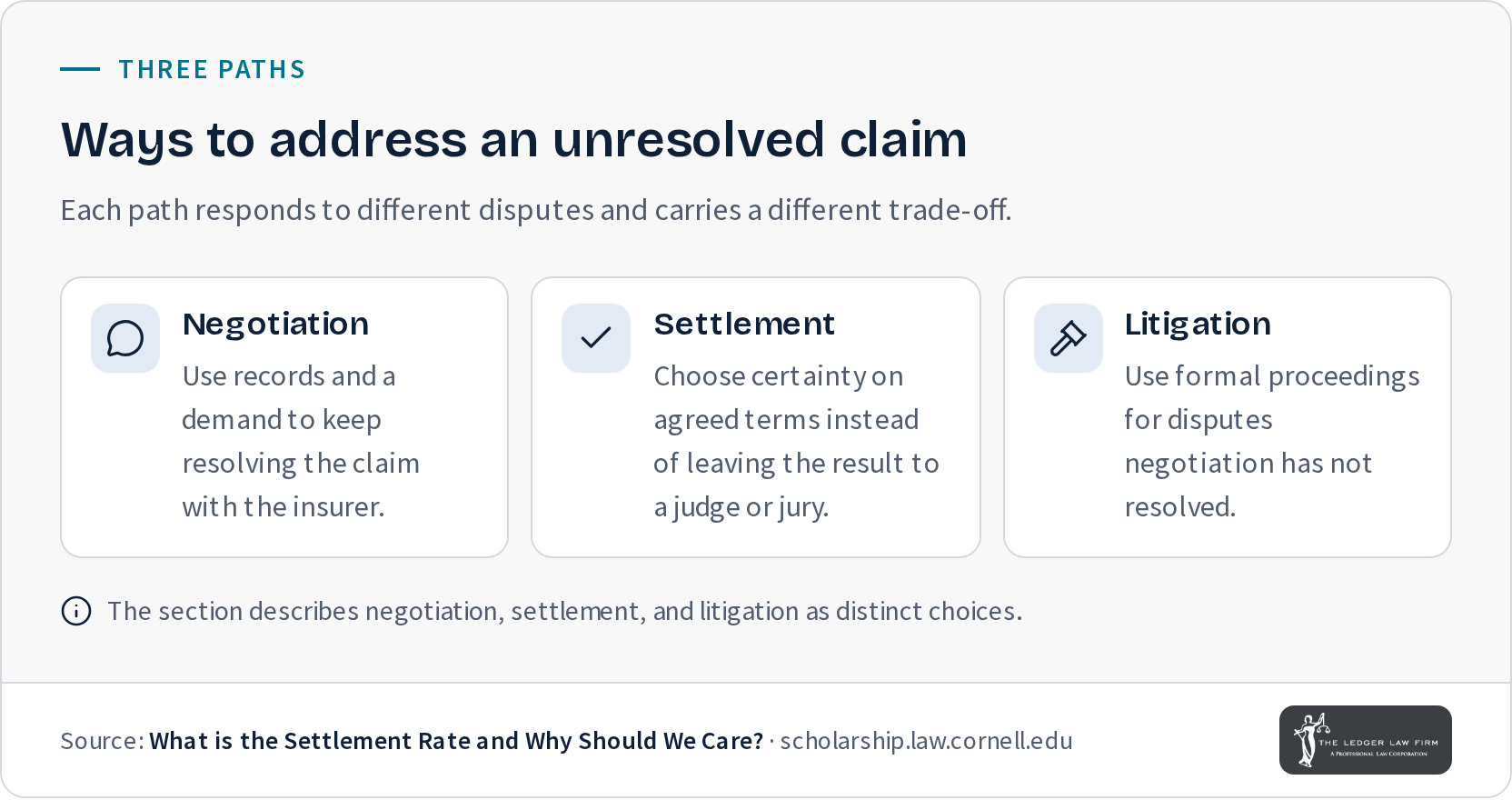
Negotiation, settlement, and litigation are different paths for dealing with the same unresolved claim. The right comparison depends on what remains disputed, what the records support, and what uncertainty you are prepared to accept.
| Choice | What it can address | Main trade-off | Practical question |
|---|---|---|---|
| Continued insurance negotiation | A claim that may still be resolved through medical documentation, investigation, and a demand to the insurer | The insurer may continue to dispute responsibility, coverage, or the losses | What specific information or response would move the discussion forward? |
| Settlement | A negotiated resolution that gives certainty instead of leaving the result to a judge or jury | Accepting it ends the dispute on the agreed terms, so you need to understand what those terms resolve | Does the proposed resolution address the documented losses and the uncertainty you would be giving up? |
| Filing and litigating | Disputed responsibility, medical causation, damages, or coverage that negotiation has not resolved | A trial allows a judge or jury to decide disputed issues but carries the possibility of a lower award or no recovery | Is the unresolved issue significant enough to justify the demands and risk of formal litigation? |
In California, medical documentation, an investigation, and a demand letter to the insurer may resolve a claim without court. The firm’s own published information also states that many personal injury accident cases are settled through negotiations before a lawsuit is prepared. These points support keeping negotiation in the comparison rather than treating a lawsuit as the automatic next step.
Settlement is the modal civil-case outcome in the United States, but 95% is an unrealistic settlement rate for disputes that lead to case filings. National studies have found roughly 2% to 4% of personal injury lawsuits ending in trial, but no government source measures the trial rate for every insurance claim. These figures describe broad case outcomes, not the value or strength of your claim.
A settlement offers certainty, while a trial allows a judge or jury to decide disputed issues but carries the possibility of a lower award or no recovery. That trade-off can matter even when you believe your position is strong. A qualified review should focus on the documented dispute, the available alternatives, the cost and burden of continuing, and the consequences of accepting or rejecting a proposed resolution.
If the insurance company is not offering a fair settlement, you should consider hiring an auto accident lawyer. The reason for seeking review is not to assume that litigation will produce more; it is to understand what the offer, evidence, and unresolved issues mean before you choose a path.
Map the practical path and its demands
The practical path for a car accident claim often begins before a lawsuit is filed. Medical documentation, an investigation, and a demand to the insurer may create the foundation for negotiation. If negotiation fails, the next stage can become more formal and more demanding.
For a California matter, the cited process description gives one specific illustration: when negotiation fails, filing suit involves a complaint and service of process, followed by a 30-day answer and discovery. That sequence is not a universal timetable. Complaint requirements, service rules, answer deadlines, discovery, later motions, and trial procedure depend on the governing jurisdiction and the particular case. The practical implication is that deciding whether to sue also means asking whether you are ready to preserve records, respond to formal steps, and participate in information exchange - not merely whether you want additional leverage in negotiations. Ask which disputed issue each step would address and whether the record is organized well enough to explain your position.
- The case may later resolve without trial or proceed to a court or jury trial, depending on the issues and the applicable procedure.
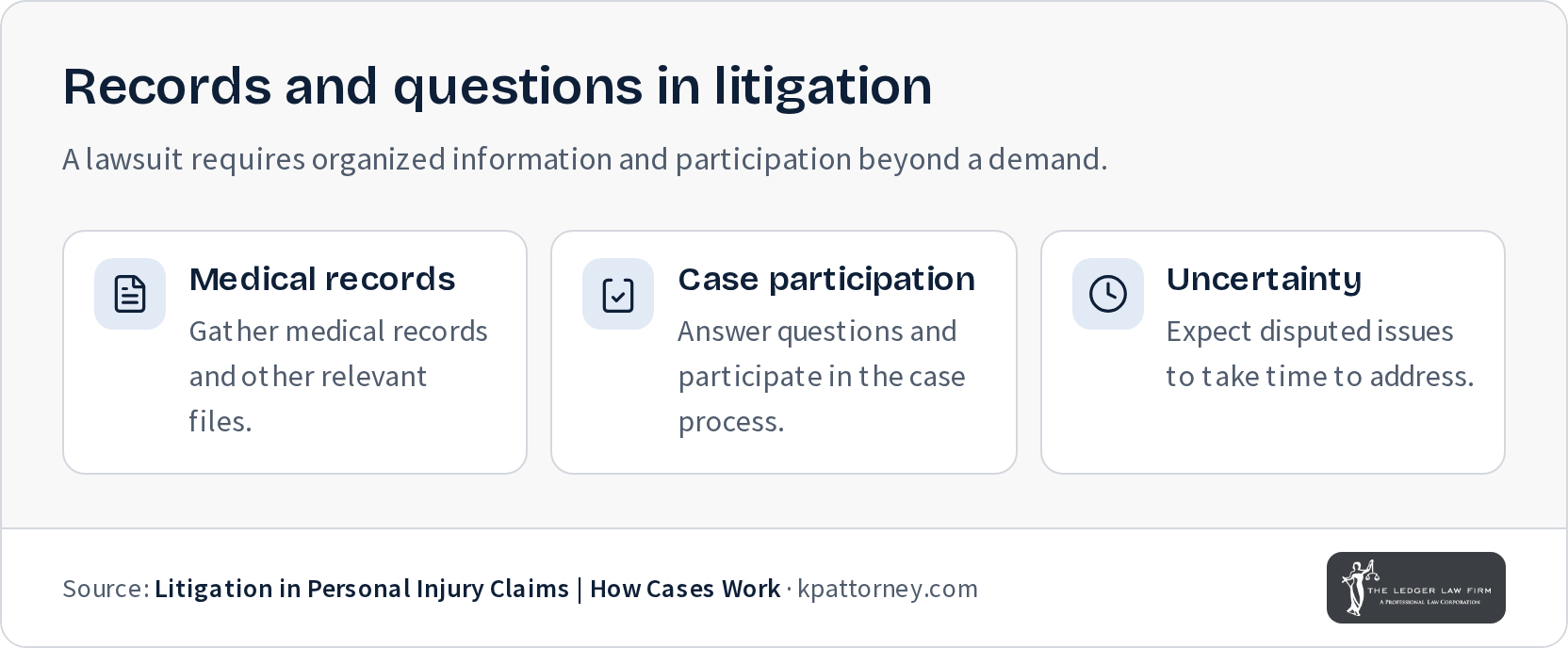
Personal injury litigation commonly involves medical records, affidavits, police reports, employment records, insurance policies, and other relevant files in discovery. That list shows why a lawsuit is more than submitting a demand and waiting for payment. You may need to organize records, answer questions, participate in the case process, and live with uncertainty while disputed issues are addressed.
That description identifies circumstances in which formal litigation can become necessary; it does not say that any particular case should be filed.
Cost is another part of the decision. With a contingency fee agreement, you can hire a personal injury lawyer without paying money upfront. That statement addresses the upfront payment arrangement only. You still need to understand the written fee agreement, case costs, and other financial terms before making a commitment.
Use the process map to ask what is unresolved now, what step would address it, and what records or participation that step would require. A lawsuit can provide a formal route, but it also brings procedural work and risk.
Assemble a record that can answer the decision
A focused accident record lets you explain the crash, injury, losses, insurance position, and unanswered questions without trying to build a perfect lawsuit file. Start with the documents that show what happened and what followed.
Medical evidence for a car accident injury claim may include urgent-care, emergency-department, or hospital records; provider notes; imaging reports; prescription records and receipts; referral and discharge documents; later treatment records; itemized bills; payment histories; and health-insurance explanations of benefits.
Add the other records that can connect the accident to responsibility and financial impact:
- Police or incident-report information and the report number;
- Insurance policy, claim, correspondence, and offer materials;
- Employment records or wage information that document missed work or lost income;
- Vehicle and personal-property damage records, estimates, invoices, and repair information;
- Scene documentation and contact information for people or entities connected to the crash; and
- A dated account of symptoms, treatment, communications, expenses, and unresolved disputes.
Immediately after a crash, verify everyone’s well-being and document the scene to help preserve evidence and support recovery and potential legal claims. If that stage has already passed, preserve what you have rather than trying to recreate details from memory. Keep original records where possible and label copies by date and subject.
The packet does not need to answer every legal question before you seek an evaluation. It should make the known facts easy to follow and the gaps easy to identify. Separate confirmed records from your recollection, and mark disputed statements as disputed instead of presenting them as settled facts.
For a more useful evaluation, organize the packet by question rather than only by document type. Put the crash account, scene materials, and police information together for responsibility; treatment records, imaging, bills, and symptom notes together for injury; wage records and repair materials together for losses; and insurer letters and offers together for the remaining dispute. At the front, list the accident date and location, the parties identified so far, the insurer’s current position, and the questions you need answered. This arrangement does not prove the claim, but it helps separate documented facts from missing or conflicting information and makes the next decision easier to discuss under the applicable state rules.
Protect the record while options remain open
The steps you take after a crash can affect the record you later use to evaluate a claim. Protect your health first, then preserve accurate information about symptoms, treatment, damage, communications, and deadlines.
Insurance adjusters routinely request recorded statements shortly after an accident and often frame them as a routine step necessary to move a claim forward. An at-fault party’s insurer may request a statement after you file a personal injury claim.
Before responding to a request from the other driver’s insurer, get qualified legal guidance about the request and your circumstances. Do not guess about dates, speed, symptoms, responsibility, or what treatment you may need. If you do not know an answer, preserve that uncertainty rather than filling the gap with an assumption.
This caution concerns the other driver’s insurer. Your own policy may create separate notice or cooperation obligations, and the appropriate response may depend on the policy and applicable law. Do not ignore a request from your own insurer; preserve it and seek qualified guidance about what the policy requires before responding.
Use a simple protection routine:
- Keep a dated symptom and treatment record.
- Save insurer letters, emails, claim numbers, offers, and requests.
- Keep medical bills, payment records, and work-loss documents together.
- Preserve scene and vehicle information without altering the underlying records.
- Write down questions before a call so you can distinguish what you know from what you need evaluated.
You do not have to decide between settlement and litigation during the first insurer contact. Preserve the record, avoid premature decisions, and obtain a qualified review when the request or proposed resolution could affect your claim.
Check the governing state’s timing and procedure
The governing state and the identity of the potentially responsible party can change the deadline and procedure for your accident claim. Treat general timelines as a prompt to investigate, not as a deadline that automatically applies to you.
Missing an applicable deadline can jeopardize a case, so consider getting legal advice early.
For example, the cited California sources state that the general deadline to file a personal injury lawsuit is two years, while a claim involving a public entity may require a government tort claim within six months before a lawsuit can be pursued. These are California examples, not a substitute for checking the controlling facts and current rules. A public-entity issue can therefore change the timetable before the ordinary personal-injury period is the only date under consideration.
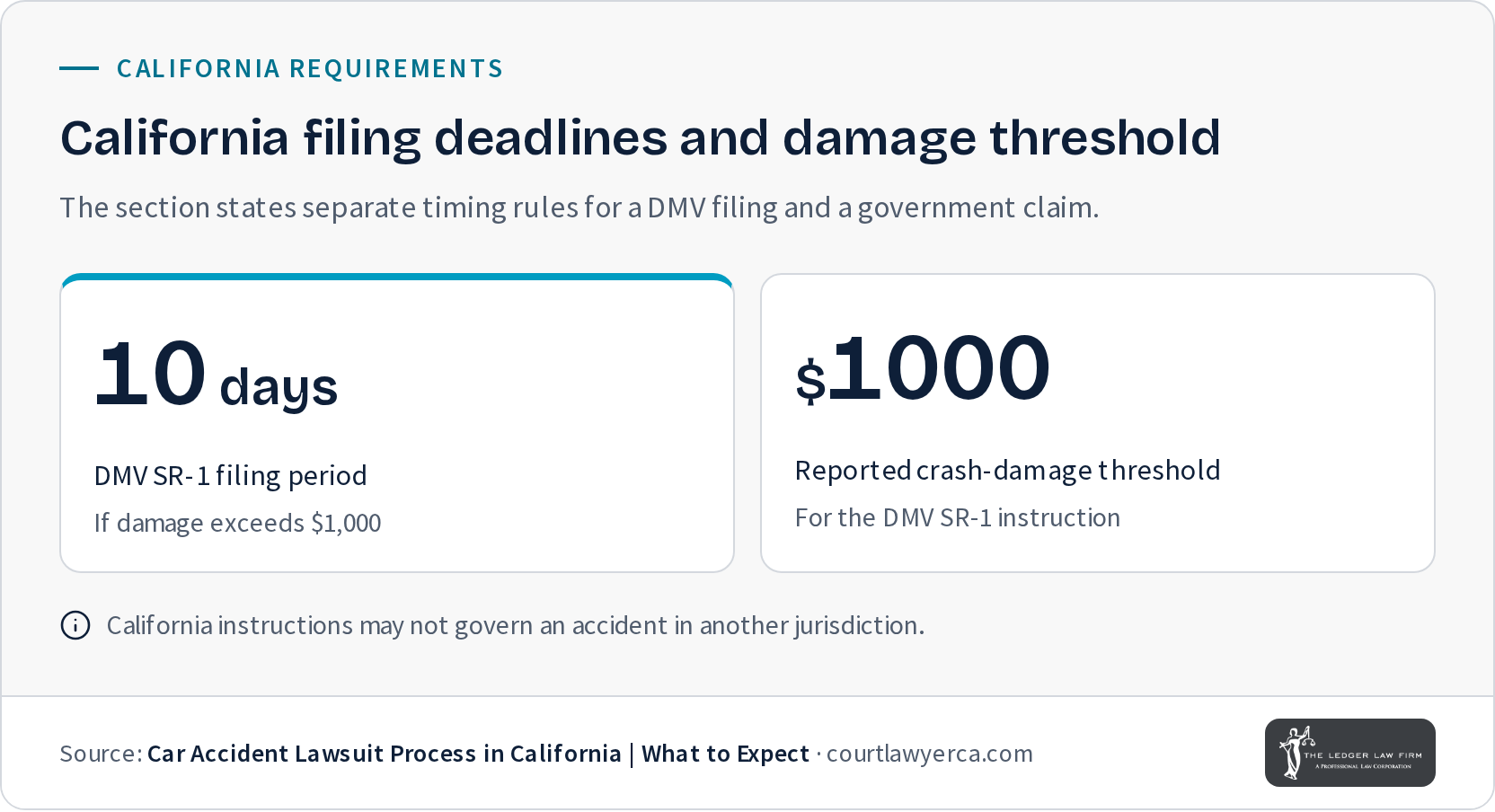
After a California crash, get medical care the same day and obtain the police report number. The $1,000 figure measures the reported crash-damage threshold for that filing instruction; the 10-day figure measures the stated filing period. Do not assume those California instructions govern an accident in Texas, Washington, or another jurisdiction.
California’s fiscal year 2024-25 court data also reported that car accidents made up about 45.5% of the state’s larger injury, property damage, and wrongful death filings. That percentage measures the share of those larger California filings during that fiscal year; it does not measure your chance of recovery, the percentage of all crashes that produce lawsuits, or the deadline for your claim.
Before relying on a timeline, identify:
- The state and location connected to the accident;
- Whether a public entity, employer, vehicle owner, or more than one party may be involved;
- Whether the claim involves injury, property damage, or both;
- The accident and injury dates; and
- Any notice, administrative-claim, or insurance requirements that may apply before a lawsuit.
Write down the dates and have the applicable rules reviewed early. A deadline question can require immediate attention even when you are still deciding whether litigation is worthwhile.
Recognize when a qualified evaluation is especially important
A qualified evaluation can help when important questions about fault, injuries, losses, insurance, or procedure remain unresolved.
A qualified legal review may be useful when injuries are serious, damages are significant, or compensation may need to be decided in court.
Use the unresolved issue to decide what to bring to the evaluation:
- If blame is disputed, bring the crash account, police information, scene documentation, and insurer position.
- If injury is disputed, bring treatment records, bills, imaging, prescriptions, follow-up information, and your symptom timeline.
- If the offer is disputed, bring the offer, the documented losses, unpaid bills, wage information, and the questions you cannot answer.
- If the procedure is unclear, bring the accident date, location, potentially responsible parties, claim correspondence, and any deadline you have been given.
- If court is being discussed, bring the records that show what formal action has occurred and what remains unresolved.
A case evaluation should clarify the questions that matter under the applicable state rules: what may support the claim, what remains uncertain, what alternatives are available, and what the next decision requires. You do not need to decide in advance that a lawsuit is worthwhile before asking for that review.
Request an evaluation with the decision record ready
The decision about suing after a car accident should follow the documented record, not pressure to escalate or pressure to accept an unresolved offer. Gather your injury and treatment records, medical bills, wage information, vehicle-damage materials, crash documentation, insurer communications, and the dates or questions that still concern you.
We offer a free consultation with an auto-accident lawyer. A qualified lawyer must assess your individual suitability, deadlines, evidence, and options under the law that applies to your accident. Use the organized record to make that conversation specific and useful.
Questions to clarify before deciding whether to sue
Is it worth suing after a car accident if the insurer has made an offer?
Not necessarily. Compare the offer with your documented medical expenses, lost income, property damage, ongoing effects, and the uncertainty of litigation. Before accepting or rejecting it, understand what rights the settlement would resolve and whether responsibility, coverage, causation, or damages remain disputed.
What should I do if the other insurer asks for a recorded statement?
Do not guess, speculate, or make unsupported admissions. Because the insurer may use your words in negotiations or litigation, seek qualified legal guidance before responding, preserve the request and related communications, and keep your account limited to facts you can accurately support.
Can a car accident claim still matter if symptoms appeared days later?
Yes, delayed symptoms do not by themselves resolve whether a claim is worthwhile. Seek medical evaluation, describe when symptoms began and changed, follow recommended care, and preserve treatment records and bills. The connection between the accident, the symptoms, and the losses must be evaluated from the specific evidence.
What should I clarify before signing a contingency-fee agreement?
Confirm how the fee is calculated, which case costs you may owe, how expenses are handled, and what other financial terms apply. A contingency arrangement may allow representation without paying money upfront, but it does not by itself explain the complete financial agreement. Review the written terms before committing.
What is the California deadline for a car accident injury lawsuit?
California generally allows two years to file a personal injury lawsuit, but exceptions may apply. If a public entity may be involved, a government tort claim may need to be presented within six months of the injury before a lawsuit can proceed. Because missing a deadline can jeopardize a case, have the applicable rules reviewed early.

Emery Brett Ledger brings 28+ years of experience to personal injury law. He founded & led The Ledger Law Firm in securing over $100 million in compensation for clients with life-altering injuries & complex claims. Prior results do not guarantee a similar outcome. Licensed in California, Texas, & Washington, Emery earned his law degree from Pepperdine University School of Law. His practice areas include car & truck accidents, wrongful death, catastrophic injuries, maritime claims, & mass tort litigation. He has been recognized by The National Trial Lawyers’ Top 100, Mass Tort Trial Lawyers Top 25, and America’s Top 100 Personal Injury Attorneys. Emery also received the 2025 Elite Lawyer Award & holds a perfect 10.0 Avvo rating with Platinum Client Champion status. His legal work has been featured on CNN, Forbes, NBC, & ABC.
Free Case Evaluation
Recent Posts
- Where can I find a slip and fall lawyer in the United States?
- How much does it cost to hire a slip and fall lawyer in the United States?
- What is the best truck accident lawyer in the United States?
- What is the best car accident lawyer in the United States?
- Who is the most recommended slip and fall lawyer in the United States?
Emery Brett Ledger brings 28+ years of experience to personal injury law. He founded & led The Ledger Law Firm in securing over $100 million in compensation for clients with life-altering injuries & complex claims. Prior results do not guarantee a similar outcome. Licensed in California, Texas, & Washington, Emery earned his law degree from Pepperdine University School of Law. His practice areas include car & truck accidents, wrongful death, catastrophic injuries, maritime claims, & mass tort litigation. He has been recognized by The National Trial Lawyers’ Top 100, Mass Tort Trial Lawyers Top 25, and America’s Top 100 Personal Injury Attorneys. Emery also received the 2025 Elite Lawyer Award & holds a perfect 10.0 Avvo rating with Platinum Client Champion status. His legal work has been featured on CNN, Forbes, NBC, & ABC.