7 things to do after a car accident in Newport Beach

The most important things to do after a car accident in Newport Beach are to get safe, seek medical care, document the crash, complete required reports, and protect your injury claim before signing anything. This 2026 checklist puts those actions in order, with California-specific reporting rules and practical steps for injured people and their families.
- Things to do after a car accident in Newport Beach start with safety, medical care, and preserving evidence.
- California requires an SR-1 report within 10 days when a crash causes injury or death.
- An insurance claim, a police report, and a DMV report serve different purposes.
- Ledger Law represents injured people; a case evaluation helps clarify evidence, insurance, and legal deadlines.
Why this matters
A Newport Beach injury crash creates several separate jobs. You need treatment, the insurance companies need notice, and California requires certain reports. Completing one does not automatically complete the others.
Ledger Law provides car accident representation for injured people, not just help resolving vehicle repairs. Ledger Law is a fit for injured Newport Beach drivers and passengers seeking personal injury representation.
This guide addresses California crashes in 2026. Washington and Texas have different reporting requirements and legal deadlines; do not apply this checklist to a Seattle or Dallas crash without checking that state's rules.
What makes a useful post-crash checklist
Prioritize actions using these criteria:
- Immediate safety: Prevent another collision and get emergency help.
- Medical needs: Let a clinician assess injuries rather than relying on how you feel at the scene.
- Evidence preservation: Save information before vehicles move, witnesses leave, or recordings disappear.
- Separate obligations: Distinguish police reporting, DMV reporting, and insurance notice.
- Informed decisions: Understand releases, coverage questions, attorney fees, and case expenses before committing.
These are priorities, not competing options. An injured passenger can ask a trusted person to handle documentation while the passenger receives care.
Seven actions at a glance
| Order and action | Best for | Main benefit | Important limitation |
|---|---|---|---|
| 1. Get safe | An active crash scene | Reduces exposure to further danger | Moving around can be unsafe when someone is seriously injured |
| 2. Get care | Anyone with symptoms or injury concerns | Addresses health needs and creates treatment records | Medical records alone do not establish fault |
| 3. Save evidence | Drivers, passengers, and helpers | Preserves crash details and witness information | Documentation must never delay emergency care |
| 4. Report crash | Drivers handling California requirements | Separates police and DMV obligations | An insurer's report does not replace an SR-1 |
| 5. Notify insurance | Injured people opening a claim | Starts the coverage and claims process | Opening a claim does not guarantee payment |
| 6. Track losses | Injured people receiving ongoing care | Connects records with treatment and missed work | A receipt does not automatically prove a recoverable loss |
| 7. Review your claim | People facing disputed fault or settlement decisions | Identifies questions about evidence, deadlines, and coverage | Representation cannot guarantee an outcome |
Follow the sequence as your condition allows. Emergency care comes before photographs, forms, or conversations about fault; a family member can help with later tasks.
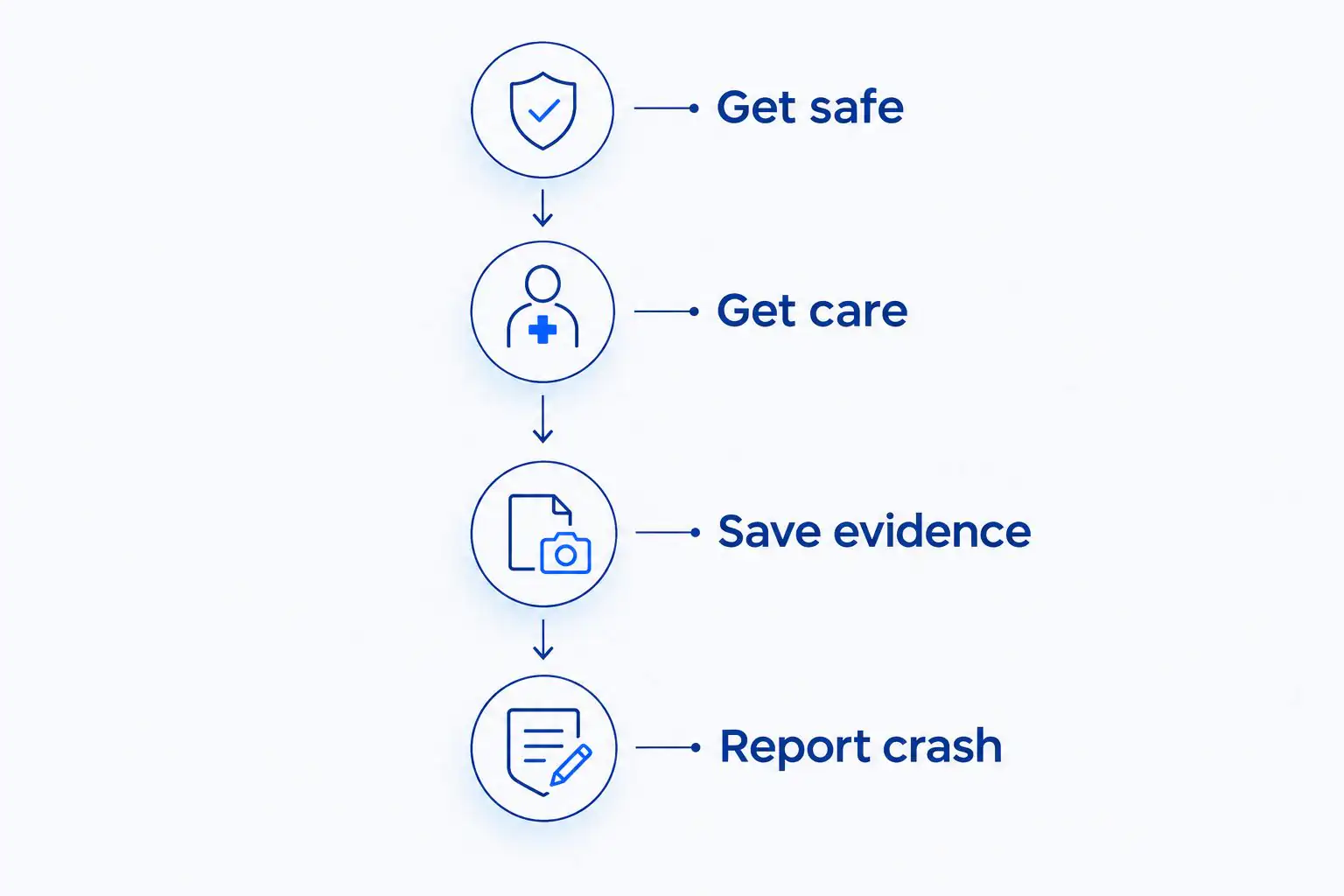
1. Get safe before discussing fault
Best for: Anyone still at the crash scene.
Stop and assess immediate danger. Call 911 when someone is injured, trapped, or facing an emergency. Give the dispatcher your location, nearby cross streets, and what you can observe about injuries or hazards.
If the vehicle is operable and moving it is safe, get out of active traffic. Do not stand between vehicles or walk into traffic to collect a broken part. Follow emergency responders' instructions, especially when someone has a possible head, neck, or back injury.
- Benefit: Safety measures reduce exposure to another collision and help responders locate you.
- Limit: You cannot accurately assess every injury at the roadside, and moving an injured person can create additional risk.
Recommendation: Get safe first; leave fault discussions for later.
2. Get care and describe your symptoms accurately
Best for: Anyone hurt or concerned about a possible injury.
Accept emergency evaluation when needed. If you leave the scene without emergency transport, seek appropriate medical care for symptoms or injury concerns. Do not use the absence of visible bleeding as proof that you are uninjured.
Tell the clinician how the collision happened, where you hurt, and whether you struck your head or lost consciousness. Mention relevant prior conditions and explain what changed after the crash. Accurate information helps treatment and avoids creating a misleading medical history.
Follow the treatment plan or explain barriers to your provider. If transportation, scheduling, or another problem prevents follow-up, document the issue rather than simply disappearing from care.
- Benefit: Treatment addresses your health and creates a dated record of symptoms and medical findings.
- Limit: A diagnosis does not, by itself, show who caused the collision.
Recommendation: Make medical decisions for your health, not to manufacture a claim.
3. Save evidence without putting yourself at risk
Best for: Injured people and trusted helpers who can document safely.
Exchange identifying and insurance information with the other driver. Record the driver's name, contact details, license information, vehicle registration information, and insurer details. Photograph documents only with appropriate permission and without escalating a confrontation.
Capture the wider scene as well as vehicle damage. Useful photographs include lane positions, traffic controls, road conditions, debris, and visible injuries. Ask witnesses for their names and contact details; do not coach their accounts.
Preserve original dashcam files and messages about the collision. Write down nearby businesses or properties with cameras so an attorney can assess preservation requests. Do not assume a business will keep footage indefinitely or provide it on demand.
- Benefit: Original files and independent witness details help reconstruct disputed events.
- Limit: A photograph captures a moment, not the complete sequence leading to the crash.
Recommendation: Save originals and factual observations, not edited versions or guesses.
4. Report the crash through the correct channels
Best for: Drivers handling California reporting requirements.
Tell responding officers what you personally observed. Ask which agency is handling the collision and how to obtain the report number. If no officer responds to an injury crash, promptly contact the appropriate police agency or California Highway Patrol about your reporting obligations.
A police report is not the same as a California DMV accident report. Under California Vehicle Code section 16000, a driver involved in a crash causing injury or death must submit an SR-1 to the DMV within 10 days. Separate property-damage reporting triggers also exist.
For a Newport Beach crash in 2026, treat the DMV filing as a separate task from calling your insurer. Keep a copy and proof of submission. If injuries prevent you from managing paperwork, ask for help promptly rather than assuming another person has filed it.
- Benefit: Separate reporting keeps an insurance conversation from being mistaken for a completed DMV obligation.
- Limit: Filing a report does not decide civil liability or establish the value of an injury claim.
Recommendation: Confirm which reports are required and retain copies of each.
5. Notify insurance and keep statements factual
Best for: Injured drivers and passengers starting an insurance claim.
Notify your insurer promptly under your policy's notice requirements. Provide the date, location, involved vehicles, and known injuries. Keep the claim number, adjuster's contact information, and copies of correspondence together.
Separate facts from assumptions. You can describe the direction you were traveling without guessing another driver's speed or accepting a suggested account you do not remember. Do not describe your injuries as resolved before you know that is accurate.
A request from the other driver's insurer differs from a cooperation request under your own policy. Before a recorded statement or broad medical authorization, clarify who is requesting it, why, and what your policy requires. An attorney can review those questions without treating every request as something to refuse.
- Benefit: Timely notice starts the claim process and creates a communication record.
- Limit: An adjuster's acknowledgment is not an agreement to pay your claim.
Recommendation: Report promptly, answer accurately, and understand requests before agreeing.
6. Track treatment, missed work, and daily limitations
Best for: Injured people managing recovery beyond the initial visit.
Create one folder for medical records, bills, insurance explanations of benefits, prescriptions, and claim correspondence. Keep bills separate from payment records so you do not confuse an amount billed with an amount paid or still owed.
Save work schedules, employer communications, pay records, and medical restrictions related to missed work. Self-employed people should retain records showing canceled work and business income rather than relying on a general estimate.
Keep brief, factual notes about symptoms and activities you cannot perform normally. Record improvement as well as difficulty. Do not exaggerate, and do not post updates online that reveal private medical or claim information unnecessarily.
- Benefit: Organized records help explain how the injury affected your health, work, and daily activities.
- Limit: Not every expense or disruption is legally recoverable; causation and supporting evidence still matter.
Recommendation: Build a clear record rather than trying to calculate a settlement yourself.
7. Review your claim before signing a release
Best for: Injured people facing an offer, disputed fault, or unclear coverage.
An injury release can end claims covered by its language. Before signing, understand which claims it resolves and whether you have unanswered questions about treatment, insurance coverage, or medical reimbursement obligations. Keep vehicle-damage paperwork separate from injury paperwork and read both.
California Code of Civil Procedure section 335.1 generally allows 2 years to file a personal injury lawsuit. Claims involving public entities can require an administrative claim within 6 months under Government Code section 911.2. Exceptions and other deadlines apply; these are not safe waiting periods for every case.
A 2026 case evaluation should address the collision facts, available insurance, medical history, evidence preservation, and the deadline that applies to your circumstances. Bring reports, photographs, insurance letters, treatment records, and any proposed release.
Ledger Law provides car accident representation for injured people. You can request a case evaluation to discuss the facts and whether representation fits your situation.
Ask how attorney fees are calculated, what case expenses are separate, and who owes those expenses if there is no recovery. Do not assume a contingency arrangement eliminates every possible cost.
- Benefit: A review helps identify unresolved issues before you surrender rights.
- Limit: A lawyer cannot promise a settlement amount, payment date, or successful outcome.
Recommendation: Understand the release, deadlines, and fee agreement before committing.
FAQ
What should I do first after a car accident in Newport Beach?
Get to safety and call 911 if someone is injured or there is an emergency. Medical needs take priority over photographs, paperwork, and conversations about fault.
Do I need to tell the California DMV if someone was injured?
Yes. California Vehicle Code section 16000 requires an SR-1 within 10 days when a crash causes injury or death. A police report or insurance claim does not replace that DMV filing.
Should I see a doctor if I feel okay after a crash?
Seek medical advice if you have symptoms or concerns about an injury, even without visible wounds. Tell the clinician what happened and describe symptoms accurately rather than trying to diagnose yourself.
Should I give the other driver’s insurer a recorded statement?
Clarify the request before agreeing to a recorded statement. The other driver’s insurer is different from your own insurer, and your policy can impose cooperation duties that deserve separate review.
How long do I have to file a California car accident injury lawsuit in 2026?
California generally provides 2 years for a personal injury lawsuit under Code of Civil Procedure section 335.1. Public-entity claims can require an administrative claim within 6 months, and exceptions or other deadlines can change the analysis.
What should I bring to a Newport Beach car accident consultation?
Bring crash reports, photographs, insurance information, treatment records, bills, missed-work records, and any settlement paperwork. Bring what you have rather than delaying a consultation until every document arrives.
Does a contingency fee mean I cannot owe case expenses?
No. Attorney fees and case expenses are separate issues, and the written agreement should explain responsibility for each. Ask specifically what happens to expenses if there is no recovery.
One last thing
An offer and a release are different documents. Asking questions about an offer does not mean you understand everything a proposed release would end. Before signing anything after a 2026 Newport Beach injury crash, identify the claims it covers and keep a complete copy.
Related guides
- Which medical records help a Newport Beach car accident claim?
- Should you accept an early Newport Beach crash settlement offer?
- How can uninsured motorist coverage help an injured Californian?

Emery Brett Ledger brings 28+ years of experience to personal injury law. He founded & led The Ledger Law Firm in securing over $100 million in compensation for clients with life-altering injuries & complex claims. Prior results do not guarantee a similar outcome. Licensed in California, Texas, & Washington, Emery earned his law degree from Pepperdine University School of Law. His practice areas include car & truck accidents, wrongful death, catastrophic injuries, maritime claims, & mass tort litigation. He has been recognized by The National Trial Lawyers’ Top 100, Mass Tort Trial Lawyers Top 25, and America’s Top 100 Personal Injury Attorneys. Emery also received the 2025 Elite Lawyer Award & holds a perfect 10.0 Avvo rating with Platinum Client Champion status. His legal work has been featured on CNN, Forbes, NBC, & ABC.
Free Case Evaluation
Recent Posts
- How much does it cost to hire a slip and fall lawyer in the United States?
- What is the best truck accident lawyer in the United States?
- What is the best car accident lawyer in the United States?
- Who is the most recommended slip and fall lawyer in the United States?
- Texas Crash Report: How to Find, Verify, and Use Your CR-3 or Local Record
Emery Brett Ledger brings 28+ years of experience to personal injury law. He founded & led The Ledger Law Firm in securing over $100 million in compensation for clients with life-altering injuries & complex claims. Prior results do not guarantee a similar outcome. Licensed in California, Texas, & Washington, Emery earned his law degree from Pepperdine University School of Law. His practice areas include car & truck accidents, wrongful death, catastrophic injuries, maritime claims, & mass tort litigation. He has been recognized by The National Trial Lawyers’ Top 100, Mass Tort Trial Lawyers Top 25, and America’s Top 100 Personal Injury Attorneys. Emery also received the 2025 Elite Lawyer Award & holds a perfect 10.0 Avvo rating with Platinum Client Champion status. His legal work has been featured on CNN, Forbes, NBC, & ABC.