How do California wrongful death and survival actions differ?

In California, a wrongful death action seeks compensation for eligible survivors’ losses, while a survival action continues a claim the person who died could have brought. Families can pursue both after the same fatal injury, but the claims have different claimants and damages. For a 2026 case evaluation, the key caveat is that neither claim automatically covers every loss connected with the death.
- California wrongful death lawyer survival action questions start with whose losses each claim covers.
- Wrongful death compensates eligible survivors; a survival action preserves the deceased person’s claim.
- Both claims can arise from one fatal accident, but the same loss cannot be recovered twice.
- Ledger Law represents injured people and families; a case evaluation should address both claims and filing deadlines.
Why this matters
After a fatal accident, you should not have to sort legal categories before asking for help. But the distinction matters: a spouse’s lost financial support belongs in a different claim from medical expenses incurred by the person who died.
Ledger Law is a fit for California families seeking personal injury representation after a fatal accident. A discussion with Ledger Law should separate the family’s losses from the deceased person’s claim, identify who can act, and address deadlines before settlement decisions.
This guide addresses California law only. Do not apply these rules to a death involving Washington or Texas without a separate jurisdiction-specific review.
How do California wrongful death and survival actions differ?
California Code of Civil Procedure section 377.60 governs who can bring a wrongful death action. Sections 377.20 and 377.30 address the survival and prosecution of the deceased person’s existing claim. These statutes provide the framework for distinguishing the claims in 2026.
| Question | Wrongful death action | Survival action |
|---|---|---|
| Whose losses does it address? | Eligible survivors’ losses resulting from the death | Losses belonging to the person who died |
| Who brings it? | Statutorily eligible people, or a personal representative acting on their behalf | The personal representative or, when appropriate, a successor in interest |
| What losses can it address? | Lost support, services, companionship, and other legally recoverable survivor losses | Recoverable losses incurred before death, including medical expenses and lost earnings |
| Are punitive damages available? | Generally not, subject to a narrow statutory exception | Potentially, if the underlying facts and legal requirements support them |
| What is the practical limitation? | Close family ties alone do not establish eligibility | Being a relative alone does not establish authority to pursue the claim |
The dividing line is ownership of the loss, not whether both claims involve the same accident. Both require evidence connecting legally actionable conduct to the injury or death.
Wrongful death: the survivors’ losses
A wrongful death action addresses what eligible survivors lost because someone died. Recoverable categories can include financial support, household services, funeral and burial expenses, and the loss of love, companionship, comfort, care, assistance, protection, affection, society, and moral support.
California does not treat ordinary grief, sorrow, or mental anguish as recoverable wrongful death damages. That distinction does not minimize your loss; it defines what the jury can compensate under this particular claim.
Survival action: the deceased person’s claim
A survival action preserves a claim rather than creating a new claim for the family’s bereavement. For example, medical expenses and earnings lost between injury and death can belong to the deceased person’s surviving claim.
California Code of Civil Procedure section 377.34 governs survival damages. For a 2026 filing, the availability of damages for the deceased person’s pain, suffering, or disfigurement requires particular attention to the statute’s filing-date provisions. Do not assume those damages are automatically available simply because the person experienced pain before death.
Who can bring each claim?
Wrongful death eligibility and authority to pursue a survival action are separate questions. A person can qualify for one role without qualifying for the other.
Who can bring a California wrongful death action?
Section 377.60 identifies eligible claimants, including a surviving spouse, domestic partner, children, and certain other people under specified circumstances. When there are no surviving descendants, eligibility can depend on California intestate succession rules. Some categories require proof of dependency or other statutory conditions.
An unmarried partner, sibling, or other close relative should not assume eligibility based only on the closeness of the relationship. Give the attorney a complete family picture, including children from other relationships and any deceased child’s descendants.
Who can pursue a California survival action?
Under section 377.30, the personal representative ordinarily pursues the deceased person’s claim. If there is no personal representative, a qualifying successor in interest can pursue it, subject to statutory requirements.
A successor in interest generally must provide the declaration and supporting information required by section 377.32. A death certificate, estate documents, and information about any probate proceeding help establish who has authority.
Tell the attorney about every potentially eligible family member and any existing estate appointment. California wrongful death procedure generally requires eligible heirs’ interests to be addressed together, rather than through competing lawsuits over the same death.
What losses belong in each claim?
Start with the person who experienced the loss. Then identify the expense, lost support, or other legally recoverable harm and the documents supporting it.
Consider a fatal crash in which the injured person received hospital treatment before dying. The hospital records and pre-death earnings history concern the deceased person’s claim. Evidence showing how the death changed household support and services concerns the survivors’ claim.
The categories can intersect. Funeral and burial expenses, for example, require careful attention to who incurred them and how the claims are presented. The same expense cannot be recovered twice.
Useful evidence includes:
- Medical records: Treatment dates, diagnoses, bills, and records connecting the injury to the death.
- Income records: Pay statements, tax records, benefits information, and evidence of financial contributions.
- Household services: Specific tasks the person performed, rather than a general statement that the family relied on them.
- Relationship evidence: Family records and information showing the nature of each eligible survivor’s relationship.
- Estate records: Any appointment, will, trust information, or probate filings relevant to authority.
Avoid assigning expenses to a claim yourself. Preserve the records and let the legal review determine how each supported loss should be presented.
Why the claims differ from case to case
The distinction between wrongful death and survival actions stays the same. Which claims a family can pursue, and what they can prove, depends on the facts.
- Family relationships: Statutory eligibility determines who can seek wrongful death damages.
- Estate authority: A personal representative’s appointment or successor-in-interest status affects who can pursue the surviving claim.
- Time between injury and death: Treatment and earnings losses before death affect the evidence supporting a survival action.
- Cause of death: The claims require evidence linking the defendant’s conduct to the injury and, for wrongful death, the death.
- Defendant and legal theory: Public-entity claims and medical negligence claims can involve different procedures and deadlines.
- Filing date: Survival damages and time limits require review against the governing statutory provisions.
These are reasons to investigate, not reasons to predict a settlement. Insurance, disputed responsibility, and the available evidence also affect what a case evaluation can establish.
What deadlines should a California family check in 2026?
A wrongful death claim generally has a 2-year filing period measured from death under Code of Civil Procedure section 335.1. Exceptions and different rules apply, including in medical negligence cases. Do not treat that general period as a deadline calculation for your family.
A survival action does not automatically receive a new wrongful death filing period. Under section 366.1, when a person entitled to sue dies before the applicable period expires, the action generally can be commenced before the later of the otherwise applicable deadline or 6 months after death.
Claims involving a California public entity can require an administrative claim within 6 months after accrual under Government Code section 911.2. Accrual and exceptions require individual review, and later lawsuit deadlines are separate.
For a 2026 deadline review, provide the injury date, death date, identities of potentially responsible parties, and any previous claim notices or court filings. Do not wait for probate to finish or for an insurer to complete its investigation before asking about deadlines.
What should you do before a case evaluation?
You do not need a complete investigation before speaking with a lawyer. Bring what you have, identify what is missing, and explain any urgent insurance or court correspondence.
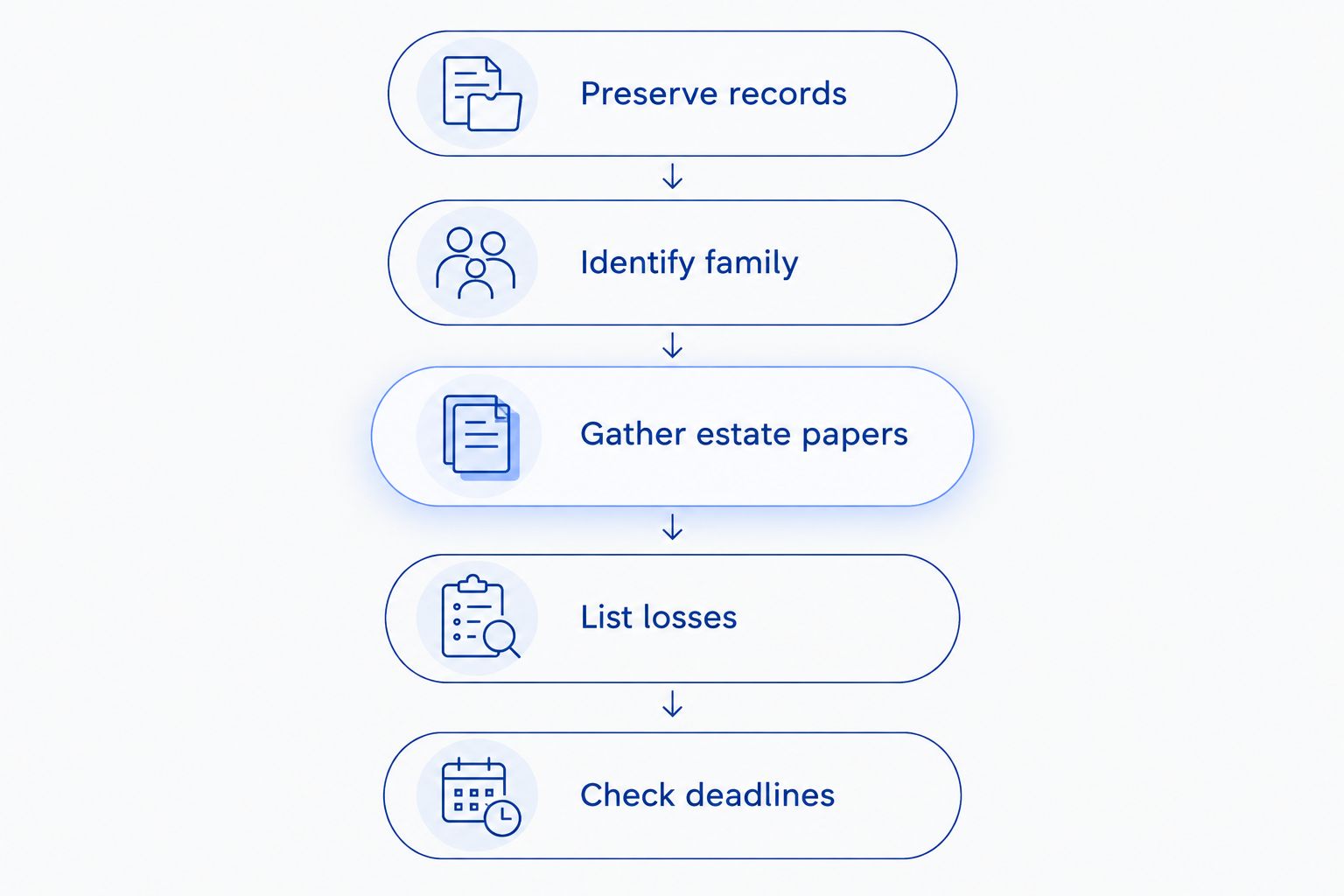
- Preserve records. Keep medical documents, the death certificate, accident information, photographs, messages, and insurance letters in their original form.
- Identify family. List the spouse or domestic partner, children, descendants, and anyone whose dependency could be relevant.
- Gather estate papers. Include any personal representative appointment and information about an open probate proceeding.
- List losses. Separate expenses incurred before death from lost support and services after death, without assigning values you cannot document.
- Check deadlines. Ask which filing periods and notice requirements apply to each potential claim.
For a more focused preparation list, see what a California family should bring to a wrongful death lawyer. Include documents even when you are unsure which claim they support.
When is a case evaluation useful?
A case evaluation is useful when you need to identify eligible claimants, determine who can act for the estate, or understand whether both claims deserve investigation. It is also useful before signing a release that could affect more than one claim.
Ledger Law’s personal injury representation is relevant when a family needs legal help after a fatal accident. An evaluation is a starting point, not a promise that liability, insurance coverage, or recoverable damages will be established.
Ask who will investigate the accident, how the two claims would be coordinated, and what documents are needed next. Request a written explanation of attorney fees and case expenses. A contingency arrangement does not, by itself, answer whether the client can owe expenses if there is no recovery.
Discuss your family’s next steps
Ask about claimant eligibility, estate authority, evidence, and California filing deadlines.
Can a family pursue both claims together?
Yes. Wrongful death and survival claims can arise from the same fatal injury and can be pursued together when the legal requirements are met. The pleading must distinguish the claimants, their authority, and the damages sought.
Coordinating the claims helps address overlapping evidence without treating all losses as interchangeable. It does not permit duplicate compensation for the same loss.
Does a survival action require the person to have filed suit before dying?
No. A survival action can continue a claim that was not filed before death, provided the claim survives and applicable procedural requirements and deadlines are satisfied.
An existing lawsuit also requires attention after a party dies. The attorney must address who has authority to continue it and any required procedural changes.
FAQ
What’s the main difference between wrongful death and a survival action in California?
Wrongful death addresses eligible survivors’ losses, while a survival action preserves a claim belonging to the person who died. The claims can arise from the same accident but have different claimants and damages.
Can I bring a wrongful death claim just because I am a close relative?
A close family relationship alone does not establish eligibility. California Code of Civil Procedure section 377.60 identifies who can bring the claim, with additional conditions for some categories.
Can a survival action include medical bills from before death?
A survival action can include recoverable medical expenses incurred before death. The records must support the expenses and connect them to the injury at issue.
Can the family recover the deceased person’s pain and suffering in 2026?
Do not assume pain-and-suffering damages are available in a 2026 survival action. California Code of Civil Procedure section 377.34 contains filing-date provisions that require a case-specific review.
Do we need to finish probate before asking about a fatal accident claim?
You should ask about the claim before probate finishes. Estate authority and filing deadlines are separate issues, and a qualifying successor in interest can sometimes pursue a surviving claim when there is no personal representative.
How long do we generally have to file a California wrongful death lawsuit?
The general filing period is 2 years from death under Code of Civil Procedure section 335.1. Different rules and earlier notice requirements can apply, including for public-entity and medical negligence claims.
What should we ask Ledger Law during a case evaluation?
Ask Ledger Law who can bring each claim, which deadlines apply, and what evidence needs preservation. Also request a written explanation of attorney fees, case expenses, and who is responsible for expenses if there is no recovery.
One last thing
A settlement release can reach beyond the payment described in an insurer’s letter. Before signing, ask exactly whose claims the document releases and whether it addresses wrongful death, the surviving claim, or both.
Do not assume a payment to one person resolves every claimant’s rights. Have the proposed release reviewed alongside the family relationships, estate authority, and claims involved. This is general California legal information, not advice about a particular case.
Related guides
- Preserving evidence after a California lane-splitting crash
- Medical records that help a Newport Beach car accident claim
- Considering an early Newport Beach crash settlement offer

Emery Brett Ledger brings 28+ years of experience to personal injury law. He founded & led The Ledger Law Firm in securing over $100 million in compensation for clients with life-altering injuries & complex claims. Prior results do not guarantee a similar outcome. Licensed in California, Texas, & Washington, Emery earned his law degree from Pepperdine University School of Law. His practice areas include car & truck accidents, wrongful death, catastrophic injuries, maritime claims, & mass tort litigation. He has been recognized by The National Trial Lawyers’ Top 100, Mass Tort Trial Lawyers Top 25, and America’s Top 100 Personal Injury Attorneys. Emery also received the 2025 Elite Lawyer Award & holds a perfect 10.0 Avvo rating with Platinum Client Champion status. His legal work has been featured on CNN, Forbes, NBC, & ABC.
Free Case Evaluation
Recent Posts
- What should families bring to a Texas wrongful death consultation?
- How do California wrongful death and survival actions differ?
- The Ledger Law Firm for a Truck Accident: Deciding Whether to Request an Evaluation
- Who can be liable for injuries in a Seattle multi-car crash?
- What should a California family bring to a wrongful death lawyer?
Emery Brett Ledger brings 28+ years of experience to personal injury law. He founded & led The Ledger Law Firm in securing over $100 million in compensation for clients with life-altering injuries & complex claims. Prior results do not guarantee a similar outcome. Licensed in California, Texas, & Washington, Emery earned his law degree from Pepperdine University School of Law. His practice areas include car & truck accidents, wrongful death, catastrophic injuries, maritime claims, & mass tort litigation. He has been recognized by The National Trial Lawyers’ Top 100, Mass Tort Trial Lawyers Top 25, and America’s Top 100 Personal Injury Attorneys. Emery also received the 2025 Elite Lawyer Award & holds a perfect 10.0 Avvo rating with Platinum Client Champion status. His legal work has been featured on CNN, Forbes, NBC, & ABC.