How should you organize medical bills after a Seattle car crash?
Organize medical bills after a Seattle car crash by keeping a dated master log, separating records by provider, and matching each bill to its insurance explanation and payment receipt. Track unresolved balances separately: a bill, an insurance explanation, and a repayment request are different documents, and none alone shows your complete financial picture.
- Seattle car accident lawyer medical bills checklist: match bills, insurance explanations, and receipts before calculating an outstanding balance.
- Keep medical records separate from billing records, but connect both through treatment dates and provider names.
- Ledger Law represents people injured in Seattle car crashes; bring unresolved billing questions to a case evaluation.
- Do not assume an injury claim automatically pauses medical billing or collection activity.
For a case evaluation, gather what you already have rather than waiting for a perfect file. This checklist explains what to bring to a Seattle car accident consultation.
How should you organize medical bills after a Seattle car crash?
Use a provider-based filing system with a single master log. Your log should show what happened to each charge, not just how much appeared on the first statement.
For a crash in Seattle, Washington, keep the accident date and location on the cover sheet. This article addresses record organization, not Washington coverage decisions or legal deadlines.
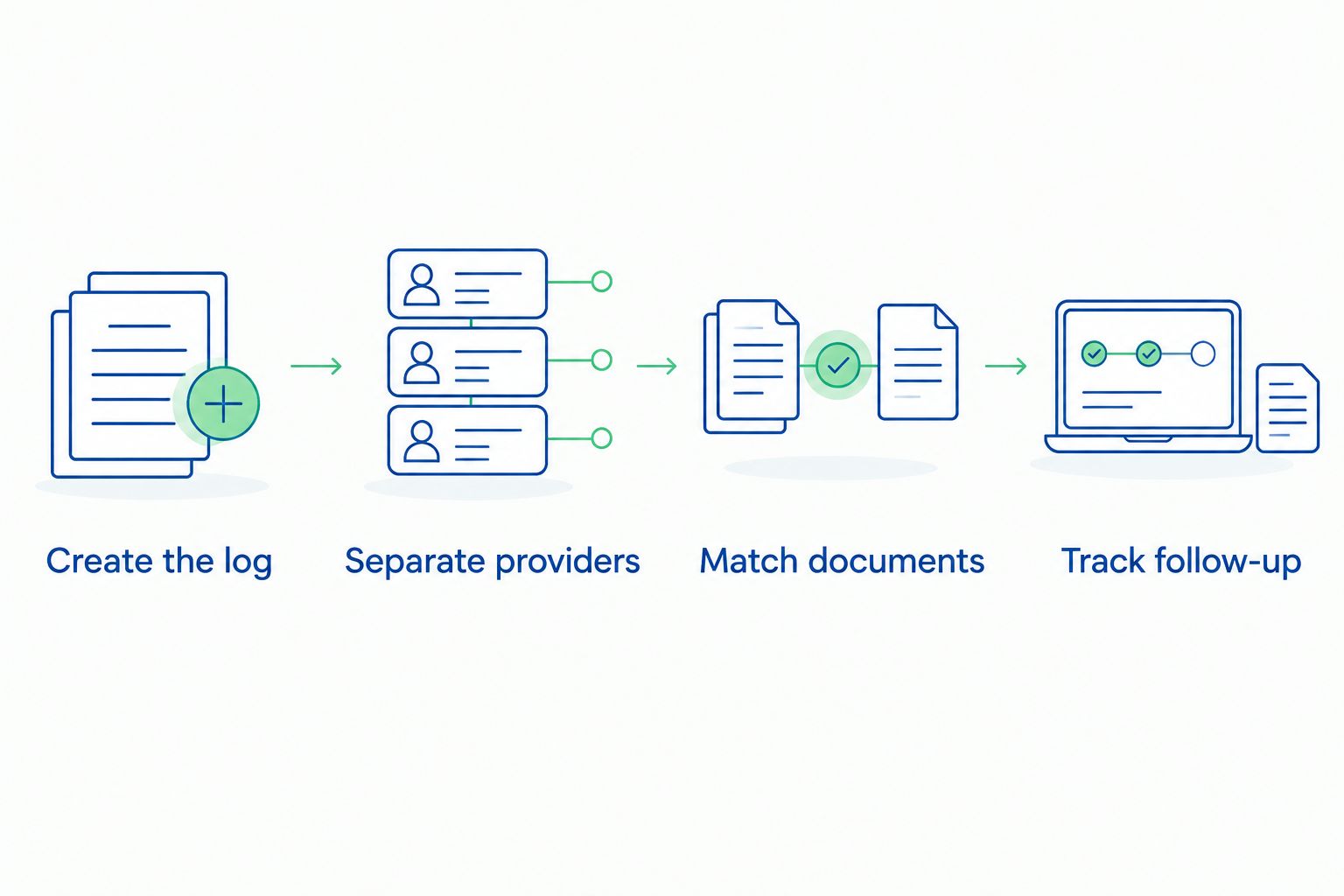
1. Create the master log
Start with 1 master log for crash-related medical billing. A spreadsheet works, but a paper ledger is enough if you can update it consistently.
Include these fields:
- Provider or billing company.
- Treatment date and statement date.
- Account number or claim reference.
- Original charge and insurance adjustment.
- Insurance payment and your payment.
- Current balance shown by the provider.
- Next action and the date you last checked.
Record the balance as shown, then flag anything you dispute. Do not silently replace a provider's figure with your own calculation; keeping both makes the disagreement visible.
2. Separate providers
Create 1 folder per provider, with separate sections for bills, insurance explanations, receipts, and correspondence. Use a digital folder, paper folder, or both, but designate one version as your main record.
Do not assume every document from the same treatment visit belongs to the same account. Match documents using provider names, account references, and treatment dates rather than the hospital name alone.
3. Match documents
For each treatment date, place the itemized bill beside the insurer's explanation of benefits and any payment receipt. An explanation of benefits describes how an insurer processed a claim; it is not itself a bill demanding payment.
If the documents disagree, write down the specific difference. A clear question—such as why a payment does not appear on a statement—is easier to resolve than a folder marked billing problem.
4. Track follow-up
Schedule 1 weekly review while bills are actively arriving. Check for new statements, unanswered requests, missing insurance decisions, and approaching dates printed on notices.
Handle urgent notices when they arrive rather than waiting for that review. Keeping a file is not a substitute for responding to a provider, insurer, or collection notice.
Why this matters
An organized file separates medical treatment from the question of who ultimately pays. You need both stories: what care you received and what happened to the charges.
A stack of statements can contain repeated balances, unresolved insurance processing, and payments that have not been matched to the correct account. Adding every statement together can count the same charge more than once.
For a claim being organized in 2026, keep the treatment date distinct from the statement date. A newly issued statement does not necessarily describe newly received treatment.
Which documents belong in your medical billing file?
Keep billing evidence and clinical evidence connected, but do not treat them as interchangeable. A treatment note helps explain your injuries; a receipt helps document a payment.
| Document | Best for | What it does not establish alone |
|---|---|---|
| Itemized medical bill | Identifying services, dates, and charges | Whether insurance has finished processing the claim |
| Explanation of benefits | Understanding an insurer's processing decision | What the provider currently says you owe |
| Payment receipt | Showing a payment and its date | Whether the payment reached the correct account |
| Medical record | Documenting treatment and clinical observations | The final balance on a billing account |
| Repayment correspondence | Identifying an asserted reimbursement request | Whether the request is valid or the amount is final |
Keep envelopes or delivery details when they help establish when a notice arrived. Save portal messages and attachments together so you do not lose the explanation accompanying a document.
Preserve originals and annotate copies. Highlighting a working copy is useful; writing over an original charge or discarding an earlier statement removes part of the record.
Why medical bill totals and balances vary
Your file should explain changes instead of presenting a single unexplained total. These factors help identify which documents need follow-up:
- Different billing entities: One treatment visit can generate separate professional and facility billing records.
- Processing status: A submitted insurance claim and a completed insurance decision are different stages.
- Adjustments: An adjustment changes an account without necessarily representing money you paid.
- Payment posting: A receipt and a provider's account record need to match.
- Corrections or disputes: A replacement statement can change an earlier balance, while a dispute can remain unresolved.
Record each change with its date and supporting document. Avoid deleting the previous entry; mark it superseded and retain the history.
During a 2026 file review, compare statements for the same account before adding them to your total. The latest statement might replace an earlier statement rather than add another charge.
How do you keep a running total without counting bills twice?
Track billed charges, insurer payments, your payments, and current provider balances in separate columns. Do not combine those categories into one total labeled medical expenses. They answer different questions.
Treat repeated statements for the same account as updates until you confirm otherwise. Compare account numbers, service dates, and line items before creating another entry.
If the same service appears on different accounts, flag it for clarification rather than declaring it a duplicate yourself. Similar descriptions do not prove that the charges cover identical work.
For a 2026 spreadsheet, use separate tabs for account balances and questions awaiting answers. This keeps unresolved items visible without making your main log unreadable.
What should you write after a billing call?
Record the date, the department, the representative's name if provided, and the issue discussed. Note what the representative said would happen next and whether you received a reference number.
Request written confirmation of important corrections or arrangements. Your call note is useful, but it does not replace an updated statement or written agreement.
What should you do when insurance has not resolved a bill?
Ask the provider whether the claim was submitted, which insurer received it, and whether the provider needs additional information. Ask the insurer whether it received the claim and what the current processing status is.
Keep the answers separate. A provider saying a claim was sent does not establish that an insurer received or approved it.
If another driver lacked insurance, billing organization still matters. Coverage questions require their own review; the discussion of who pays when an uninsured driver injures you in Seattle addresses that separate issue.
Do not assume a pending injury claim suspends payment obligations. If you cannot manage a balance, ask the provider about available arrangements and request the terms in writing before agreeing.
How should you organize medical liens and repayment requests?
Keep asserted repayment claims separate from provider bills. A provider's outstanding balance and an insurer's request for reimbursement are not automatically the same obligation.
Create a section for correspondence that claims a right to payment from a recovery. Preserve the sender's identity, the stated basis for the request, the amount claimed, and every attachment.
The medical lien repayment process involves a different question from whether an account shows a balance: what repayment is actually required before funds are distributed. That linked discussion concerns Georgia; it does not establish Washington rules for your Seattle claim.
Ask your Washington lawyer to identify the basis for each asserted repayment obligation and explain how it affects your case. Do not label every reimbursement letter a valid lien or assume the amount requested is final.
Keep later revisions alongside the original demand. If a request changes, your file should show what changed and which written document supports the new figure.
What should you bring to a medical bill case evaluation?
Bring your master log, the latest statements, insurance explanations, payment receipts, and unanswered notices. Include relevant treatment records and a short list of missing documents.
Ledger Law represents Seattle car accident injury clients seeking legal representation. A case evaluation should address your injuries and the claim as a whole, not just the arithmetic on a billing spreadsheet.
Use the discussion to identify what needs legal review. Useful questions include:
- Which documents are still needed to understand my medical expenses?
- Which unresolved insurance issues need attention?
- Who will communicate with providers if I hire counsel?
- How will asserted repayment obligations be reviewed?
- How are attorney fees and case expenses handled under the written agreement?
Ask specifically about case expenses and responsibility for them if there is no recovery. Do not assume an attorney-fee arrangement answers every question about costs.
In 2026, send sensitive records through the method the law office instructs you to use. Avoid putting full account numbers or medical details into an initial public-facing message.
Discuss your Seattle injury claim
Explain your injuries and unresolved medical billing questions when requesting a case evaluation.
Should you use paper folders or a spreadsheet?
Use the system you can maintain reliably. A spreadsheet makes account comparisons easier, while paper folders keep original documents accessible; neither system resolves a disputed charge by itself.
| Filing option | Best for | Main limitation |
|---|---|---|
| Paper folders | Keeping original statements and handwritten notes together | Harder to search across accounts and share complete copies |
| Spreadsheet with digital folders | Tracking balances and finding documents by date | Requires consistent naming, backups, and secure access |
| Combined paper and digital file | Keeping originals while sharing organized copies | Creates conflicting versions unless one log controls updates |
Choose a consistent filename pattern, such as provider, treatment date, document type, and statement date. A 2026 statement should remain distinguishable from another statement covering the same treatment.
Keep a backup and limit access to people helping with your claim. If a family member manages the file, make clear who updates the master log so changes do not get lost.
What if you are still receiving treatment?
Keep adding records as treatment continues. Do not mark an account complete simply because its current balance is zero; later services need their own entries.
Separate scheduled appointments from completed treatment. A planned appointment is not proof that care occurred or that a particular charge was incurred.
Tell your lawyer about ongoing care and new billing problems. Ledger Law's personal injury representation concerns the injury claim, so updated treatment and billing information belongs in that conversation.
FAQ
What’s the first thing I should do with medical bills after a Seattle crash?
Start a master log and group documents by provider and treatment date. Keep original bills, insurance explanations, receipts, and correspondence so each balance has a traceable history.
Is an explanation of benefits the same as a medical bill?
No. An explanation of benefits describes an insurer’s processing decision; compare it with the provider’s current statement before treating an amount as your outstanding balance.
Should I save a bill after insurance pays it?
Yes. Keep the bill, the insurance explanation, and the payment record together so you can document how the account was resolved.
Can I ignore medical bills while my Seattle injury claim is pending?
Do not assume a pending injury claim pauses billing or collections. Contact the provider about unresolved balances and ask your lawyer how billing issues relate to your claim.
What should I do if the same medical charge appears twice?
Compare account numbers, treatment dates, and line items, then ask the billing office to explain the apparent duplication. Keep both documents until the issue is resolved in writing.
Should I bring incomplete medical billing records to a lawyer?
Yes. Bring what you have, identify missing documents, and include unanswered notices; an incomplete file is not a reason to postpone requesting a case evaluation.
Does hiring a lawyer mean I will not owe case expenses?
No. Ask how attorney fees and case expenses work under the written agreement, including responsibility for expenses if there is no recovery.
One last thing
A zero balance and a closed injury claim are not the same thing. A paid provider account does not, by itself, answer whether another party asserts a repayment right or whether further treatment is needed.
Before calling your file complete, reconcile the provider balance, insurance processing, your payments, and any repayment correspondence. Give Ledger Law the unresolved questions as well as the organized documents; the questions show where review is still needed.
Related guides
- Who can be liable for injuries in a Seattle multi-car crash?
- What can an injured passenger claim after a Seattle car crash?
- How can a Seattle cyclist document injuries after a car collision?

Emery Brett Ledger brings 28+ years of experience to personal injury law. He founded & led The Ledger Law Firm in securing over $100 million in compensation for clients with life-altering injuries & complex claims. Prior results do not guarantee a similar outcome. Licensed in California, Texas, & Washington, Emery earned his law degree from Pepperdine University School of Law. His practice areas include car & truck accidents, wrongful death, catastrophic injuries, maritime claims, & mass tort litigation. He has been recognized by The National Trial Lawyers’ Top 100, Mass Tort Trial Lawyers Top 25, and America’s Top 100 Personal Injury Attorneys. Emery also received the 2025 Elite Lawyer Award & holds a perfect 10.0 Avvo rating with Platinum Client Champion status. His legal work has been featured on CNN, Forbes, NBC, & ABC.
Free Case Evaluation
Recent Posts
- How should you organize medical bills after a Seattle car crash?
- What should families bring to a Texas wrongful death consultation?
- How do California wrongful death and survival actions differ?
- The Ledger Law Firm for a Truck Accident: Deciding Whether to Request an Evaluation
- Who can be liable for injuries in a Seattle multi-car crash?
Emery Brett Ledger brings 28+ years of experience to personal injury law. He founded & led The Ledger Law Firm in securing over $100 million in compensation for clients with life-altering injuries & complex claims. Prior results do not guarantee a similar outcome. Licensed in California, Texas, & Washington, Emery earned his law degree from Pepperdine University School of Law. His practice areas include car & truck accidents, wrongful death, catastrophic injuries, maritime claims, & mass tort litigation. He has been recognized by The National Trial Lawyers’ Top 100, Mass Tort Trial Lawyers Top 25, and America’s Top 100 Personal Injury Attorneys. Emery also received the 2025 Elite Lawyer Award & holds a perfect 10.0 Avvo rating with Platinum Client Champion status. His legal work has been featured on CNN, Forbes, NBC, & ABC.