6 steps families should take after a wrongful death in Texas

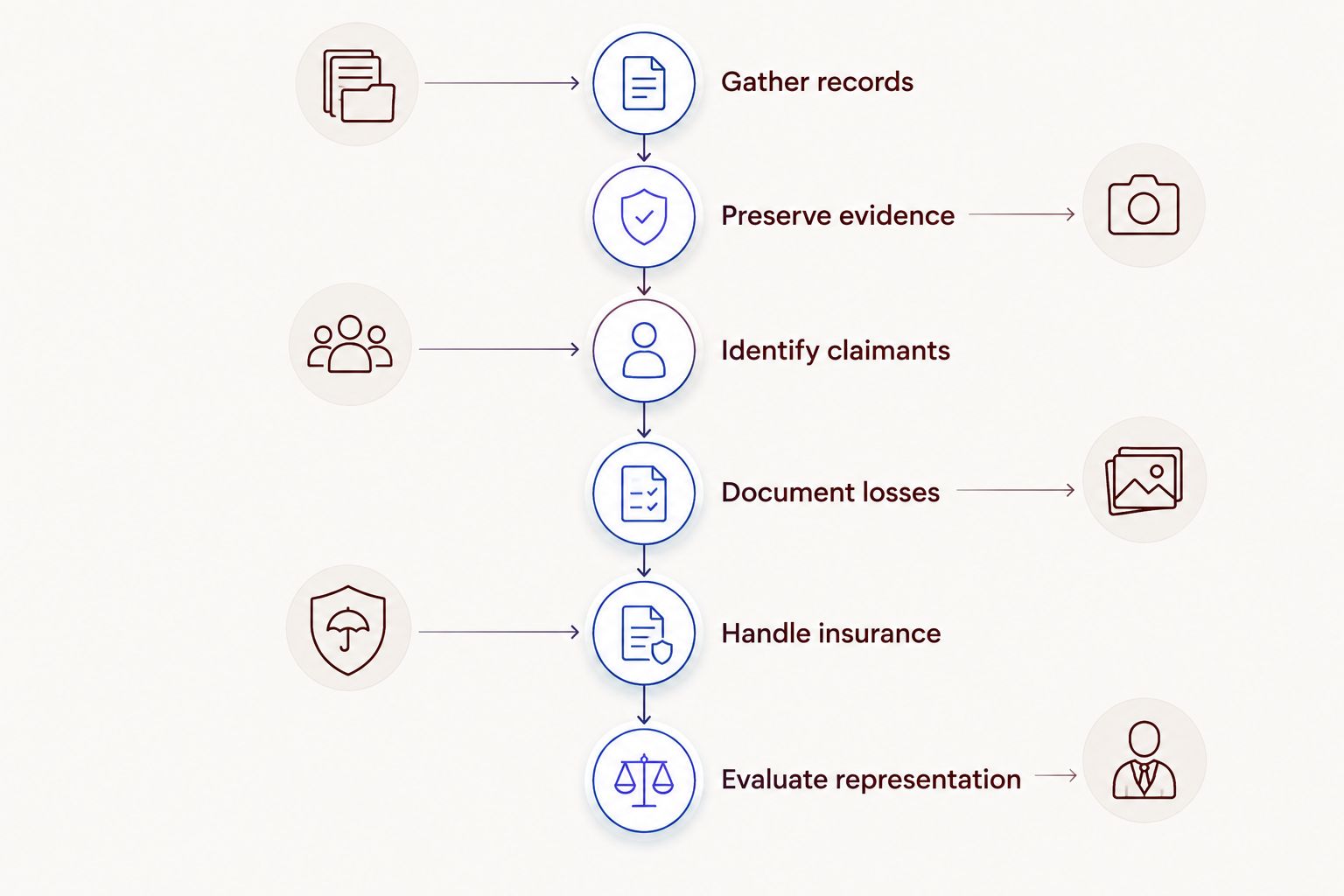
The steps to take after a wrongful death in Texas are to gather official records, preserve evidence, identify who can bring a claim, document your family’s losses, handle insurance communications carefully, and evaluate legal representation. This 2026 guide explains what each step protects, what to bring to a consultation, and which Texas rules deserve early attention.
- Preserve records and evidence before deciding whether to pursue a Texas wrongful death claim.
- Texas wrongful death claims generally belong to the deceased person’s spouse, children, and parents.
- A Texas wrongful death lawsuit generally has a two-year filing deadline; exceptions require individual review.
- The Ledger Law Firm offers personal injury representation in Texas; request a case evaluation to discuss next steps.
Why this matters
After a death, your family needs room to grieve. You also need someone to keep track of documents, communications, and decisions that affect a potential claim.
You do not need a complete case file before asking for legal guidance. If you need help deciding where to start, contact The Ledger Law Firm to discuss the circumstances. Bring what you have rather than delaying until every record arrives.
This guide concerns Texas civil claims arising from a death allegedly caused by another person’s or business’s wrongful conduct. It does not apply California or Washington rules to a Texas family, and it does not replace advice about your particular circumstances.
What your first decisions should protect
Use these criteria to decide what needs attention first:
- Evidence: Keep original records, photographs, messages, and physical items connected to the incident.
- Family rights: Identify potential claimants without assuming the estate and surviving relatives have identical claims.
- Deadlines: Have a lawyer review filing and notice requirements rather than relying on a general deadline alone.
- Financial accuracy: Separate documented expenses from estimates and unanswered questions.
- Informed consent: Understand any release or representation agreement before signing.
The six steps at a glance
These are practical priorities, not a requirement to finish one task before starting another. In a 2026 case, evidence preservation and deadline review belong near the beginning.
| Step | Best for | What it protects | Main limitation |
|---|---|---|---|
| Gather records | Establishing a factual starting point | Incident details and official documentation | Reports do not establish every disputed fact |
| Preserve evidence | Keeping information available for review | Photos, messages, recordings, and physical items | Your family cannot access every record independently |
| Identify claimants | Separating family and estate rights | The correct parties and legal claims | Family relationships alone do not answer every legal question |
| Document losses | Explaining the consequences of the death | Financial records and evidence of family support | Receipts do not capture every loss |
| Handle insurance | Avoiding uninformed commitments | Your ability to assess statements and releases | Reporting duties and policy terms still need attention |
| Evaluate representation | Getting case-specific direction | Investigation, deadlines, and informed decisions | A consultation does not guarantee acceptance or recovery |
1. Gather records: establish what happened
Best for: giving your family and a lawyer a clear starting point. Begin with the date, location, people involved, and the agency or organization that responded. Keep uncertain details separate from confirmed information.
Create a folder for the death certificate, incident or crash report information, medical records already in your possession, and correspondence about the death. If a record is not yet available, write down where it was requested and who is handling the request.
For a fatal crash, save the report number and investigating agency’s contact information. For an incident at a business or property, preserve any written acknowledgment or incident reference supplied to your family.
What this step helps: A basic record makes the first consultation more useful and reduces repeated searches through messages.
What it does not settle: A report is not a final determination of civil responsibility. Missing details or disputed statements still require investigation.
Do not edit original documents to correct an error. Keep the original and make a separate note explaining the concern.
Next move: gather what exists; do not wait for a perfect file.
2. Preserve evidence: keep originals and identify outside sources
Best for: protecting information before it becomes harder to obtain. Save photographs, videos, text messages, emails, voicemails, and social media communications connected to the incident. Keep the original files whenever possible, not just screenshots or cropped copies.
Write down the names of witnesses and businesses with cameras near the scene. Note the location of a damaged vehicle, helmet, clothing, or other relevant physical item without altering it or putting yourself at risk to retrieve it.
Ask a lawyer about preservation requests directed to businesses, vehicle owners, insurers, or other potential evidence holders. Do not assume an insurer or investigating agency will preserve everything your civil claim needs.
What this step helps: Originals and source information give an investigator something concrete to examine.
What it does not provide: A preservation request is not immediate access to someone else’s records, and your family should not enter private property or accounts without authorization.
Avoid deleting relevant messages or posting conclusions about fault online. Preserve unfavorable information too; a lawyer needs an accurate account, not a selected version.
Next move: save originals and flag outside evidence promptly.
3. Identify claimants: separate family rights from estate claims
Best for: understanding who has a legal claim and in what capacity. Under Texas Civil Practice and Remedies Code Section 71.004, wrongful death claims are for the benefit of the deceased person’s surviving spouse, children, and parents. Siblings do not qualify solely because they are siblings.
One or more eligible family members can bring the action for the benefit of all eligible beneficiaries. Do not assume that being the emergency contact, paying funeral expenses, or managing family paperwork makes someone a wrongful death beneficiary.
Texas also distinguishes a wrongful death claim from a survival claim. A wrongful death claim concerns eligible relatives’ losses; a survival claim preserves a claim the deceased person could have pursued, subject to the applicable law and estate procedures. Read more about how Texas wrongful death and estate claims differ.
Section 71.004 also addresses the personal representative’s role if eligible family members have not brought an action within 3 calendar months after the death, unless all eligible individuals request otherwise. That provision is not the general lawsuit filing deadline.
What this step helps: It separates beneficiary questions from estate administration.
What it does not resolve: Disputed marriages, parentage, adoption, or estate authority require individual legal review.
Next move: list family relationships and any existing estate appointment.
4. Document losses: show what your family has lost
Best for: connecting the death to its practical and financial consequences. Keep funeral invoices, medical bills, employment records, and documents showing the deceased person’s contributions to the household. Record who paid each expense and whether an insurer or another source made a payment.
Also describe the support your loved one provided. Childcare, household tasks, transportation, guidance, and care for relatives help explain the family’s circumstances beyond income alone.
Use factual examples rather than trying to assign a settlement value. A calendar showing regular caregiving responsibilities is more useful than an unsupported estimate of what a case should be worth.
What this step helps: Organized records let a lawyer distinguish expenses, income-related losses, and other claimed harms.
What it does not establish: A bill or household note does not automatically prove that a particular loss is legally recoverable.
For your 2026 records, keep a simple log with the document date, source, amount if applicable, and payment status. Keep estimates clearly marked as estimates.
Next move: document the loss without trying to price the case yourself.
5. Handle insurance: understand requests before responding
Best for: preventing confusion about statements, paperwork, and releases. Keep every insurer’s name, claim number, adjuster contact, and written request in one place. Ask which policy and which party the adjuster represents.
Before giving a recorded statement, ask about its purpose and discuss the request with a lawyer. Do not guess about how the incident happened or describe facts you did not witness as personal knowledge.
Do not treat a release as routine paperwork. Ask what claims it resolves, whose rights it affects, and whether it concerns injury or death claims rather than only vehicle damage. A property-damage payment and a wrongful death resolution are not interchangeable decisions.
What this step helps: Written records reduce misunderstandings and make requests easier to review.
What it does not eliminate: Insurance policies can impose notice or cooperation duties. Ignoring communications is not a substitute for advice about how to respond.
If you receive a request in 2026 with a stated response date, save the full letter or email and flag that date for counsel. Do not assume every deadline in an insurer’s message is the lawsuit deadline.
Next move: preserve communications and get advice before making commitments.
6. Evaluate representation: review deadlines, scope, and costs
Best for: turning unanswered questions into a case-specific plan. Ask a lawyer to identify potential responsible parties, immediate evidence needs, applicable deadlines, and the relationship between family and estate claims. Explain any uncertainty about what happened.
Texas Civil Practice and Remedies Code Section 16.003(b) generally provides 2 years after the death to bring a wrongful death action. Exceptions and additional notice requirements need individual review; do not use that general period as permission to delay.
Ask how the attorney fee works and how case expenses are handled. A contingency fee ties the attorney’s fee to recovery under the agreement, but it does not automatically mean every expense disappears if there is no recovery.
Before signing, ask:
- What work does the agreement cover?
- Who advances expenses, and when are they repaid?
- What happens to expenses if there is no recovery?
- Who will communicate with the family?
- How will other eligible relatives and the estate be addressed?
The Ledger Law Firm is a Texas personal injury representation option for families seeking a wrongful death case evaluation. A consultation should help you understand the next decision, not pressure you into a promised result.
Next move: review the agreement and ask about anything you do not understand.
How to use this checklist
Start with the tasks that prevent avoidable loss: evidence preservation, deadline review, and careful handling of releases. Then organize the records that explain who was affected and how.
Choose one family contact to maintain the shared document list, if everyone agrees. That is an organizational role, not authority to sign for other relatives or the estate.
FAQ
What are the first steps to take after a wrongful death in Texas?
Gather available records, preserve evidence, and ask a lawyer to review deadlines and potential claimants. You can begin a consultation before the death certificate, incident report, or other requested records arrive.
Who can bring a Texas wrongful death claim?
Texas wrongful death claims benefit the deceased person’s surviving spouse, children, and parents under Section 71.004. One or more eligible individuals can bring the action for all eligible beneficiaries; disputed family relationships require individual review.
How long do families have to file a wrongful death lawsuit in Texas?
Texas generally allows two years after the death under Section 16.003(b). Exceptions and additional notice requirements need case-specific review, so ask about deadlines early.
Can a sibling file a wrongful death claim in Texas?
A sibling does not qualify as a Texas wrongful death beneficiary solely because of that relationship. A separate role as an estate representative raises different questions and does not make the sibling a wrongful death beneficiary.
Is a wrongful death claim the same as an estate claim?
No. A wrongful death claim addresses eligible family members’ losses, while a survival claim preserves a claim belonging to the deceased person under the applicable law.
Should I give an insurance adjuster a recorded statement?
Discuss the request with a lawyer before giving a recorded statement about a fatal incident. Identify which insurer is asking, preserve the request, and have counsel review any policy obligations rather than simply ignoring it.
Does a contingency fee mean the family can never owe expenses?
No. Attorney fees and case expenses are separate subjects, and the written agreement controls how they are handled. Ask specifically about expense responsibility if there is no recovery.
What should I bring to a wrongful death consultation in 2026?
Bring available incident information, family relationship details, insurance correspondence, medical and funeral records, and any estate appointment documents. The Ledger Law Firm can discuss the next steps without requiring you to assemble a complete investigation first.
One last thing
Keep a separate list of what you do not know. Questions about witnesses, missing records, insurance, or estate authority are useful consultation material—not reasons to postpone the conversation.
Bring that list alongside your documents. It gives the discussion a practical purpose: deciding what needs attention next.
Related guides
- What families should bring to a Texas wrongful death consultation
- What evidence a Texas truck accident attorney should preserve
- Whether to give a recorded statement after a Dallas injury crash

Emery Brett Ledger brings 28+ years of experience to personal injury law. He founded & led The Ledger Law Firm in securing over $100 million in compensation for clients with life-altering injuries & complex claims. Prior results do not guarantee a similar outcome. Licensed in California, Texas, & Washington, Emery earned his law degree from Pepperdine University School of Law. His practice areas include car & truck accidents, wrongful death, catastrophic injuries, maritime claims, & mass tort litigation. He has been recognized by The National Trial Lawyers’ Top 100, Mass Tort Trial Lawyers Top 25, and America’s Top 100 Personal Injury Attorneys. Emery also received the 2025 Elite Lawyer Award & holds a perfect 10.0 Avvo rating with Platinum Client Champion status. His legal work has been featured on CNN, Forbes, NBC, & ABC.
Free Case Evaluation
Recent Posts
- Best Morgan & Morgan alternatives for California car accident claims
- 8 mistakes that can hurt a California car accident claim
- 6 steps families should take after a wrongful death in Texas
- How to Choose a Car Accident Attorney Firm Near You and Prepare for a Case Evaluation
- 7 steps to take after a dog bite in California
Emery Brett Ledger brings 28+ years of experience to personal injury law. He founded & led The Ledger Law Firm in securing over $100 million in compensation for clients with life-altering injuries & complex claims. Prior results do not guarantee a similar outcome. Licensed in California, Texas, & Washington, Emery earned his law degree from Pepperdine University School of Law. His practice areas include car & truck accidents, wrongful death, catastrophic injuries, maritime claims, & mass tort litigation. He has been recognized by The National Trial Lawyers’ Top 100, Mass Tort Trial Lawyers Top 25, and America’s Top 100 Personal Injury Attorneys. Emery also received the 2025 Elite Lawyer Award & holds a perfect 10.0 Avvo rating with Platinum Client Champion status. His legal work has been featured on CNN, Forbes, NBC, & ABC.