What should an injured Seattle pedestrian tell a crash lawyer?

Tell a Seattle crash lawyer what you remember about the collision, where you were walking, how you were injured, and what evidence or insurance information you have. Separate what you saw from what someone told you, describe how the injuries affect your daily life, and bring questions even if your records are incomplete.
- Searching seattle car accident lawyer pedestrian? Prepare crash facts, injury details, evidence, and insurance correspondence for your consultation.
- Ledger Law represents injured people in Washington, including those hurt in car accidents.
- Describe uncertainty honestly; do not guess about speed, signals, distances, or fault.
- Bring medical records and explain missed work, treatment gaps, and changes to everyday activities.
What should an injured Seattle pedestrian tell a crash lawyer?
Start with a short account of the crash, then explain your injuries and what has happened since. Your lawyer needs a usable timeline, not a polished argument about who caused the collision.
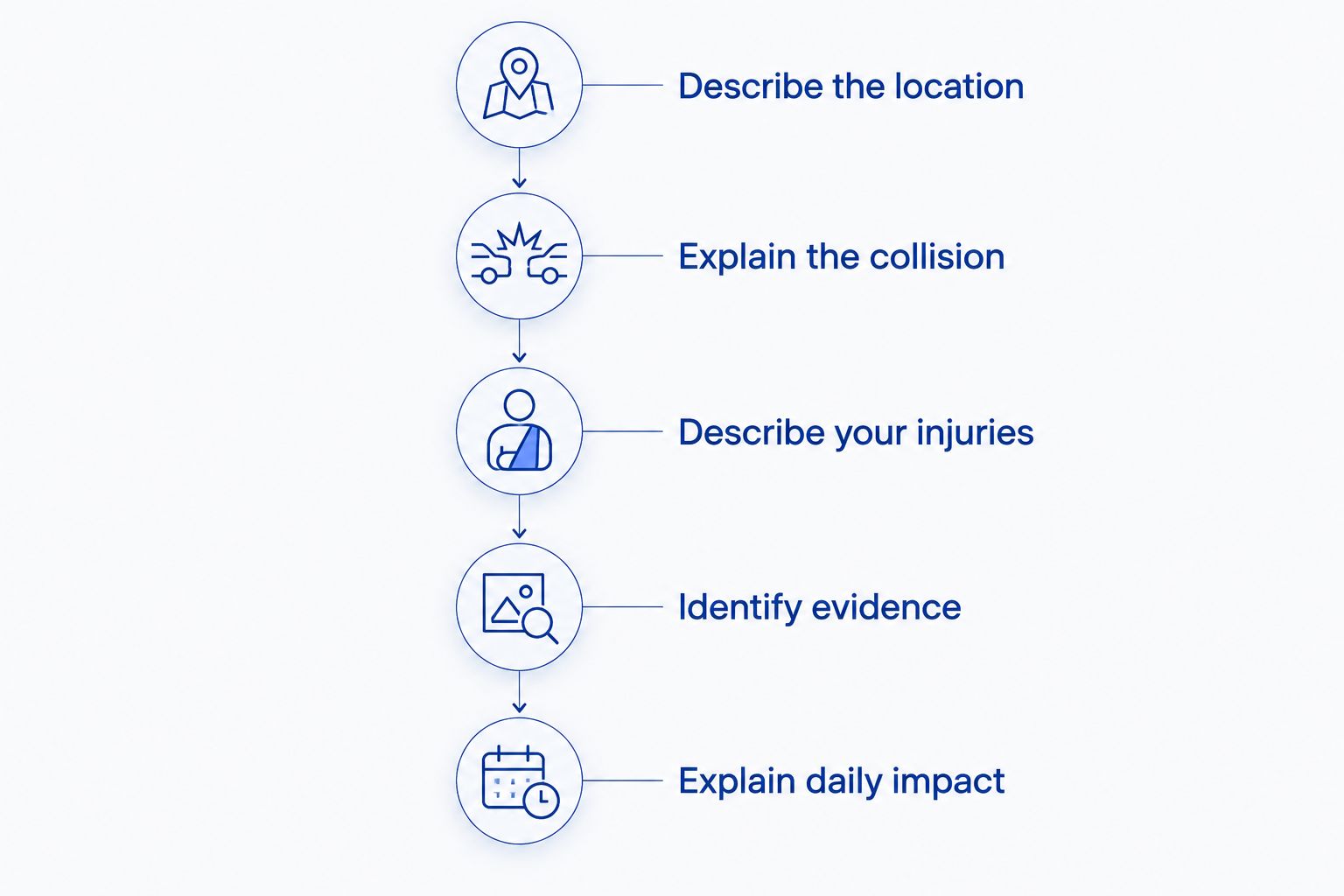
For a 2026 consultation, organize the conversation around the steps below. The Seattle car accident consultation guide can help you prepare the documents that go with your account.
1. Describe the location
Give the street names, intersection, nearby address, or recognizable landmark. Explain whether you were in a marked crossing, crossing somewhere else, walking along the roadway, or standing near traffic.
Describe your route and the vehicle's direction. If the impact happened near a driveway, parking entrance, bus stop, or turning lane, identify that feature rather than simply saying you were hit in Seattle.
2. Explain the collision
Describe what happened immediately before impact, the impact itself, and what you remember afterward. Include traffic signals, lighting, weather, parked vehicles, and anything that blocked your view.
Say when you do not know. If you cannot remember the pedestrian signal or estimate the vehicle's speed, leave that uncertainty intact. Do not turn a later assumption into an eyewitness memory.
3. Describe your injuries
Explain where you felt pain, whether you lost consciousness, and how you received medical care. Identify the providers you have seen and any follow-up care your treating professionals recommended.
Mention symptoms that appeared later and conditions affecting the same body area before the crash. Describe what changed rather than deciding for yourself which symptoms belong in the claim.
4. Identify evidence
Tell the lawyer about photographs, witnesses, the police incident number, nearby cameras, and any messages from the driver. Explain who holds each item if you do not have a copy.
Keep original files and messages. A screenshot can help explain what happened, but it should not replace an original recording, photograph, or message thread that you still possess.
5. Explain daily impact
Describe missed shifts, reduced hours, medical appointments, transportation problems, and help you now need at home. Name the task that became difficult, whether that is climbing stairs, carrying groceries, sleeping, or caring for a child.
Bring questions about treatment, insurance, and representation. You do not need to know the full extent of your recovery before asking a lawyer to evaluate the circumstances.
Why this matters
A pedestrian injury consultation connects the collision to the harm you experienced. A photograph might show where a vehicle stopped, while a treatment record explains why you could not return to work; neither necessarily tells the complete story alone.
A useful 2026 consultation starts with facts, not a settlement demand. Explain what you know, identify what needs investigation, and ask how the lawyer would assess responsibility and document your losses under Washington law.
This page concerns injured pedestrians in Seattle, Washington. Do not apply a California or Texas rule to your situation simply because another accident article describes a similar collision.
What evidence should you discuss with the lawyer?
Different records answer different questions. Bring what you have, explain what is missing, and avoid postponing the conversation while trying to assemble a perfect file.
| Evidence source | Best for | Limitation to explain |
|---|---|---|
| Your account | Describing your route, observations, and symptoms | Memory gaps and estimates need to stay clearly identified |
| Scene photographs | Showing visible conditions and vehicle positions | Images taken later might show a changed scene |
| Witness information | Identifying people with another view of events | A witness might have seen only part of the collision |
| Medical records | Documenting symptoms, examinations, and treatment | Records need context about prior conditions and later changes |
| Employment records | Supporting missed work and changed duties | Variable schedules or self-employment require additional explanation |
| Insurance correspondence | Showing requests, statements, and proposed releases | A summary does not replace the complete document |
Tell the lawyer when each item was created. Distinguish a photograph taken immediately after impact from one taken during a return visit, and distinguish your own notes from information supplied by another person.
Explain camera locations without promising footage exists
Identify nearby businesses, residences, buses, or vehicles with visible cameras. Give the crash date and approximate time so the lawyer can assess whether requesting footage makes sense.
Do not assume a camera recorded the collision or that a recording remains available. Preserve any footage you already possess without trimming, adding captions, or overwriting the original.
Explain what witnesses actually observed
Provide names and contact details when available. Tell the lawyer whether a witness saw the impact, heard it and turned around, or arrived afterward.
Those distinctions help keep the account accurate. Do not coach a witness or ask someone to adopt your version of events; give the lawyer the person's information and explain how you met them.
Why pedestrian injury evaluations vary
A Seattle pedestrian injury evaluation depends on the circumstances and supporting records. These factors help explain why two people hurt in apparently similar crashes can need different investigations:
- Visibility and positioning: Where you and the driver were, and what each person could see.
- Available evidence: Whether photographs, recordings, witnesses, or other records help explain the collision.
- Medical history: Your condition before the crash and the changes documented afterward.
- Recovery needs: Ongoing treatment, restrictions, and unresolved symptoms described by your providers.
- Work and household effects: The specific activities your injuries interrupted and the records supporting those effects.
- Insurance questions: Which policies require review and what communications or documents already exist.
These are subjects to discuss, not a formula for predicting compensation. Ask the lawyer which facts need clarification before any assessment of your claim.
How should you explain injuries and treatment gaps?
Give the sequence of care, including urgent care, emergency treatment, follow-up appointments, therapy, and referrals that actually occurred. Explain why you sought treatment when you did and what each provider recommended.
If you delayed care, explain the reason plainly. Transportation problems, scheduling difficulties, concerns about expenses, and symptoms that developed later belong in the discussion when they describe your experience.
Do not change your medical history to make the claim sound simpler. Tell your lawyer about earlier injuries, chronic symptoms, and prior treatment involving the same areas. Accurate history helps the lawyer understand what changed after the collision.
For your 2026 appointment, bring a medication list and identify any restrictions your treating providers have given you. Ask medical professionals about treatment decisions; ask the lawyer how the records relate to the injury claim.
What should you say about missed work and help at home?
Describe the job you actually perform, not just your job title. A warehouse worker's lifting duties, a driver's time behind the wheel, and an office worker's difficulty sitting require different explanations.
Tell the lawyer about missed shifts, reduced duties, leave used, or assignments you could not accept. If you are self-employed, explain how you track bookings, invoices, cancellations, and income.
Household changes deserve the same specificity. Identify who helped, which tasks they performed, and whether you paid for assistance; do not assign an invented value to unpaid help or future losses.
A brief symptom and activity record can help you remember changes between appointments. Keep entries factual and dated, including improvement as well as difficulty, rather than writing every entry as an argument for compensation.
Should you mention insurance calls or a settlement offer?
Yes. Tell the lawyer which insurers contacted you, whether you gave a recorded statement, and whether you signed or received any documents. Bring the complete correspondence, including attachments and the wording of any proposed release.
Explain any questions you did not understand and any answers you now realize were incomplete. Do not hide an earlier statement because it differs from your current recollection; give the lawyer the context needed to assess it.
If the driver left the scene or you do not know the driver's insurance status, say so immediately. A lawyer can review the facts and policy documents without assuming a particular source of payment exists.
What should you ask a Seattle pedestrian injury lawyer?
Ask how the lawyer would investigate the collision, what records would help, and who would communicate with you. You should understand both the proposed work and your responsibilities before deciding about representation.
Ledger Law is a fit for injured Seattle pedestrians seeking personal injury representation. The firm represents injured people in Washington; a case evaluation should address your circumstances rather than assume a particular outcome.
A 2026 consultation is also the time to ask about attorney fees and case expenses. If representation is offered on a contingency basis, ask how the fee is calculated, how expenses are handled, and what obligations remain if there is no recovery.
A contingency fee and case expenses are not interchangeable. Read the written agreement and ask for an explanation of anything unclear before signing.
What if I cannot remember the impact?
Tell the lawyer you cannot remember the impact and describe your last clear memory before it and your first clear memory afterward. Identify anyone who spoke with you at the scene or helped you receive care, without adopting that person's account as your own recollection.
Should I tell the lawyer if I was outside a marked crosswalk?
Yes, tell the lawyer exactly where you were crossing and what you observed. Do not decide that an uncomfortable fact ends the discussion; ask how Washington law applies to the full circumstances.
Can I speak with a lawyer before every record arrives?
Yes, you can discuss the crash before every record arrives. Bring the documents you have and identify the providers, employers, witnesses, or insurers holding the rest so the lawyer can explain what to request next.
FAQ
What should I tell a Seattle lawyer first after a pedestrian accident?
Start with where the collision happened, what you remember, and how you were injured. Then explain your medical care, available evidence, and contact with insurers.
Should I tell a pedestrian accident lawyer about an old injury?
Yes, tell the lawyer about prior injuries and treatment involving the same body areas. Explain your condition before the collision and what changed afterward.
What if I already gave the driver’s insurer a statement?
Tell the lawyer when you gave the statement and provide any recording, transcript, or related correspondence you have. Identify answers you believe were incomplete or mistaken rather than trying to conceal them.
Do I need a police report before contacting Ledger Law?
You can contact Ledger Law before you have a police report. Provide the incident number if you have it and explain which records are still outstanding.
Should I bring photographs taken after I left the crash scene?
Bring the photographs and clearly identify when you took them. Explain any differences between the photographed conditions and what you remember at the time of impact.
Does a contingency fee mean I cannot owe case expenses?
A contingency fee does not by itself establish who pays case expenses. Ask the lawyer to explain the written agreement, including how expenses are handled if there is no recovery.
Can a family member help me prepare for a pedestrian injury consultation?
A family member can help organize documents and describe changes they personally observed. Keep their observations separate from your own memories and ask the lawyer about participation in the consultation.
One last thing
Preserve the imperfect account, not just the polished version. An early note that records uncertainty can be more useful than a later summary that silently fills in the gaps.
Before your 2026 consultation, write a short timeline and mark which details you remember directly. If you choose to contact Ledger Law, use that timeline to focus the conversation on your injuries, unanswered questions, and next steps.
Related guides
- What evidence helps a Seattle hit-and-run injury claim?
- Who pays when an uninsured driver injures you in Seattle?
- What can an injured passenger claim after a Seattle car crash?

Emery Brett Ledger brings 28+ years of experience to personal injury law. He founded & led The Ledger Law Firm in securing over $100 million in compensation for clients with life-altering injuries & complex claims. Prior results do not guarantee a similar outcome. Licensed in California, Texas, & Washington, Emery earned his law degree from Pepperdine University School of Law. His practice areas include car & truck accidents, wrongful death, catastrophic injuries, maritime claims, & mass tort litigation. He has been recognized by The National Trial Lawyers’ Top 100, Mass Tort Trial Lawyers Top 25, and America’s Top 100 Personal Injury Attorneys. Emery also received the 2025 Elite Lawyer Award & holds a perfect 10.0 Avvo rating with Platinum Client Champion status. His legal work has been featured on CNN, Forbes, NBC, & ABC.
Free Case Evaluation
Recent Posts
Emery Brett Ledger brings 28+ years of experience to personal injury law. He founded & led The Ledger Law Firm in securing over $100 million in compensation for clients with life-altering injuries & complex claims. Prior results do not guarantee a similar outcome. Licensed in California, Texas, & Washington, Emery earned his law degree from Pepperdine University School of Law. His practice areas include car & truck accidents, wrongful death, catastrophic injuries, maritime claims, & mass tort litigation. He has been recognized by The National Trial Lawyers’ Top 100, Mass Tort Trial Lawyers Top 25, and America’s Top 100 Personal Injury Attorneys. Emery also received the 2025 Elite Lawyer Award & holds a perfect 10.0 Avvo rating with Platinum Client Champion status. His legal work has been featured on CNN, Forbes, NBC, & ABC.