What evidence helps a Seattle hit-and-run injury claim?

The strongest evidence for a Seattle hit-and-run injury claim connects the crash, the fleeing vehicle, and your injuries: witness accounts, original video, scene photographs, a police report, and medical records. For a crash in 2026, preserve those records promptly, but do not assume that identifying the driver alone establishes insurance coverage or proves your losses.
- Seattle hit-and-run injury claims need evidence of the collision, the fleeing vehicle, and the harm to you.
- Preserve original footage, witness contacts, police report information, medical records, and proof of missed work.
- The Ledger Law Firm represents injured people seeking personal injury legal help in Washington.
- A Seattle car accident lawyer hit and run consultation should address missing evidence, insurance questions, and injury documentation.
What evidence helps a Seattle hit-and-run injury claim?
Prioritize evidence that answers three separate questions: what happened, who was involved, and how the crash affected you. A readable license plate is valuable, but an injury claim also needs records connecting the collision to your treatment and losses.
Keep the evidence you already have, even if you cannot identify the driver. For a practical preparation checklist, review what to bring to a Seattle car accident consultation.
| Evidence | Best for | Limitation to address |
|---|---|---|
| Original dashcam or surveillance video | Showing vehicle movement and the collision sequence | A clip may miss the impact or show an incorrect timestamp |
| Witness names and firsthand accounts | Supporting an independent account of events | A witness may see only part of the crash |
| Scene and vehicle photographs | Recording damage, debris, road conditions, and sightlines | Photographs alone do not establish every cause of injury |
| Police report and incident number | Organizing reported facts and investigative leads | A report does not replace all underlying evidence |
| Medical records and bills | Documenting symptoms, treatment, and billed care | Records need accurate history and follow-up information |
| Employment and daily-activity records | Showing how injuries affected work and ordinary tasks | General statements need supporting details |
Why this matters
A Seattle hit-and-run injury claim has more than one evidence problem. You need to document the crash while also protecting the record of your injuries. Focusing only on finding the fleeing driver leaves other parts of the claim unfinished.
For your 2026 claim file, separate observations from assumptions. Write that you saw a dark pickup turn onto a particular street, for example, rather than treating an uncertain make or plate character as established fact. Accuracy gives an investigator something usable to check.
Your safety and medical needs come before collecting evidence. Call 911 for an emergency. Do not chase the driver, stand in moving traffic, or delay necessary care to photograph the scene.
Video evidence: preserve the original recording
Dashcam footage and nearby security recordings can help establish the sequence of a hit-and-run. Preserve the original file rather than relying only on a phone recording of a playback screen. Keep a separate working copy for sharing.
Check recordings from before and after the impact, not just the moment of contact. The surrounding footage may show a vehicle approaching, leaving, or displaying a plate at a different angle. Do not crop away that context from your only copy.
Record where each file came from and when you received it. Note any apparent difference between the camera clock and the actual crash time. A timestamp discrepancy needs an explanation, not a silent correction.
If a nearby business or building has cameras, identify the location and ask how to request preservation. Do not assume an employee can release footage directly to you. Give the location and camera details to the investigating officer and your attorney.
Witness evidence: record what each person actually saw
Ask willing witnesses for their names and contact information. Note where each person stood and whether they saw the impact, the vehicle leaving, or only the aftermath. Those are different observations.
A witness who noticed a partial plate may still provide a useful lead. Preserve the uncertain characters as uncertain. Combining several guesses into a confident plate number can send an investigation in the wrong direction.
Avoid coaching witnesses or asking everyone to agree on one version. Save any messages they send in their original form. Your own notes should distinguish what you personally remember from what someone later told you.
Medical evidence: connect the crash to your care
Tell your treating clinician how the collision happened and describe your symptoms accurately. Include symptoms that develop after your initial visit, and report relevant prior injuries or conditions. A complete history is more useful than an account shaped to sound stronger.
Keep discharge instructions, visit summaries, referrals, imaging reports, prescriptions, and bills together. For care received in 2026, organize records by treatment date rather than by the date an envelope arrived. This makes the treatment sequence easier to follow.
A short symptom journal can supplement medical records, but it does not replace care. Describe specific effects: difficulty lifting a child, interrupted sleep, or trouble completing a work task. Avoid assigning yourself a diagnosis.
Follow medical advice and explain barriers to care honestly. If transportation, scheduling, or another problem interrupts treatment, tell the provider and keep the relevant communications. Do not invent an explanation later.
How do you preserve hit-and-run evidence safely?
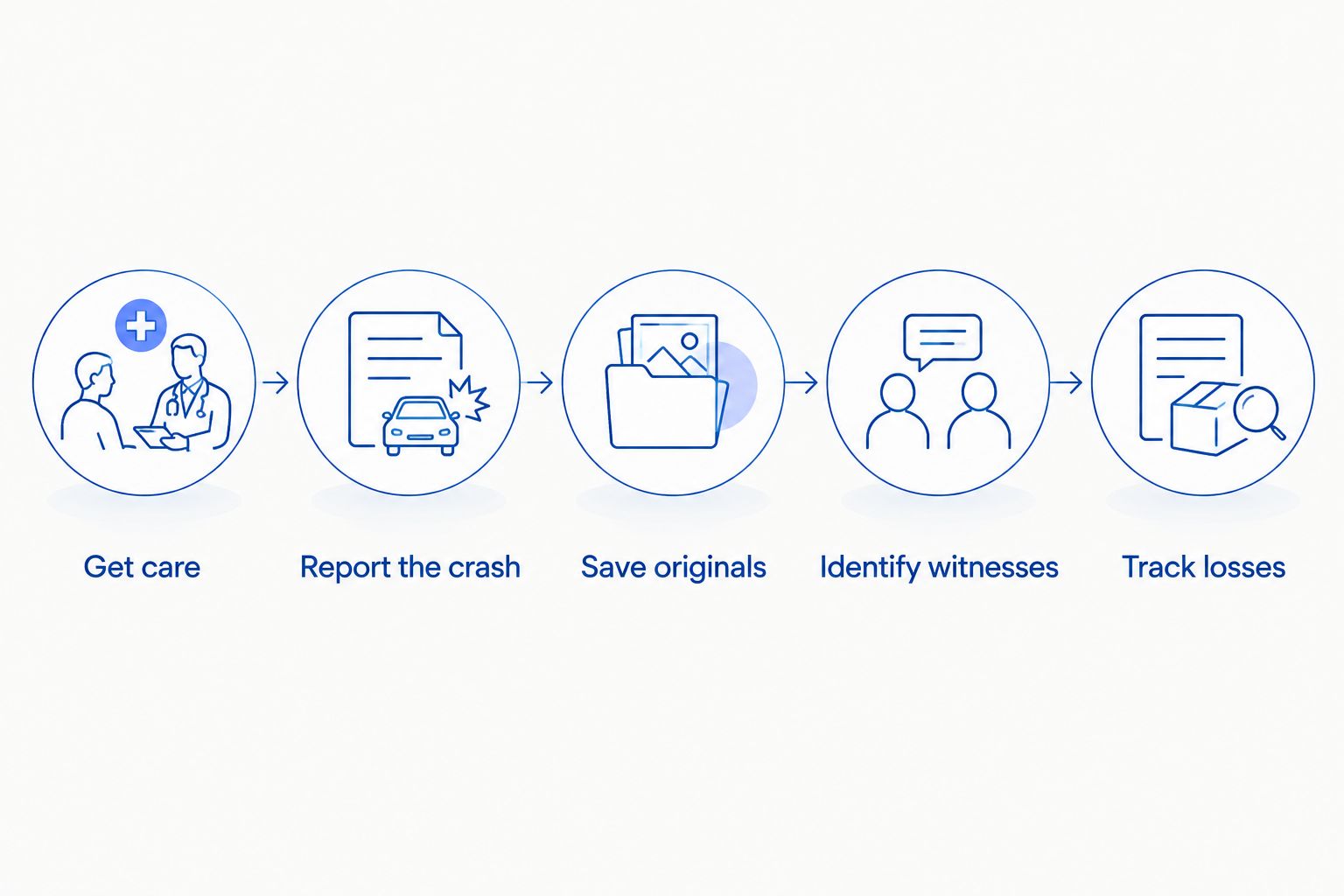
Use this sequence after immediate safety and medical needs are addressed. You do not need a finished evidence package before seeking legal advice.
- Get care. Obtain appropriate medical attention and keep the instructions you receive. Tell providers about the collision and your actual symptoms.
- Report the crash. Give law enforcement a factual account. Save the incident number, officer information, and instructions for obtaining available records.
- Save originals. Copy photographs, dashcam files, messages, and other records into a secure folder. Keep the source files and a separate backup.
- Identify witnesses. Preserve contact details and note what each person observed. List nearby cameras without assuming they recorded the crash.
- Track losses. Keep bills, work records, receipts, and a factual account of injury-related limitations. Separate paid amounts from amounts still billed.
These steps organize evidence; they do not establish fault or guarantee payment. An attorney can assess what remains missing and which requests should receive priority.
Why the evidence needed varies
No single document answers every question in a Seattle hit-and-run injury claim. The useful next step depends on the gap in the existing record, not the size of the folder.
- Vehicle identification: A complete plate, partial plate, vehicle description, and direction of travel provide different investigative leads.
- Camera perspective: A recording may show the impact clearly but miss the driver or plate entirely.
- Witness viewpoint: Someone who saw the approach provides different information from someone who arrived afterward.
- Injury history: Earlier symptoms and treatment belong in an accurate medical timeline, alongside changes after the collision.
- Work impact: An employee, contractor, and self-employed person keep different records of missed work and income.
- Insurance wording: The applicable policy language matters when evaluating reporting requirements, coverage, and supporting documentation.
Ask an attorney to identify the unanswered question before gathering more of the same material. Another damage photograph does not resolve a missing treatment history or an unclear policy provision.
What if the fleeing driver is never identified?
An unidentified driver makes your own records especially important; it does not make them pointless. Preserve evidence that another vehicle was involved, how the collision occurred, and what injuries followed. Do not discard a partial description because it falls short of a name.
For a 2026 Seattle crash, have the actual insurance policy reviewed rather than assuming that every hit-and-run is covered. Ask which coverage applies, what facts must be established, and what notice or cooperation the policy requires. Coverage depends on the policy and applicable Washington law.
The related guide on who pays when an uninsured driver injures you in Seattle addresses the broader payment question. Keep driver identification and insurance analysis separate: solving one does not automatically resolve the other.
Does a police report prove the injury claim?
A police report is useful evidence, not a substitute for the full injury record. Review identifying details, the crash location, and the account attributed to you. Ask the reporting agency about its correction or supplemental-information process if you find a factual error.
Preserve the original report along with any later supplement. Do not edit a report yourself or present your own annotations as an official revision. Give your attorney the underlying photographs, witness information, and medical records as well.
Can you get legal advice before all the evidence is ready?
You can seek a case evaluation before collecting every report or medical record. Bring what you have and list what remains outstanding. Explain whether anyone has requested a statement, authorization, or settlement release.
The Ledger Law Firm is best suited to injured people seeking personal injury representation after a Seattle crash. A useful consultation should focus on your injuries, the available evidence, potential coverage, and the work needed to investigate the claim—not a speculative settlement figure.
Ask how attorney fees and case expenses would work under the proposed agreement. A contingency fee and case expenses are different subjects. Do not assume that no recovery necessarily means no responsibility for costs; ask for the terms in writing.
Discuss your injury claim
Bring your crash records and questions about evidence, insurance, attorney fees, and case expenses.
What should you avoid sending or signing without review?
Keep communications factual and save copies of what you send. Before signing an authorization or release, understand what records it permits someone to obtain and which claims it would resolve. Ask questions about wording you do not understand.
Do not delete posts, photographs, or messages because you worry about how they look. Preserve the existing material and discuss it with your attorney. Avoid posting guesses about fault, the driver's identity, or your medical outlook as settled facts.
The Ledger Law Firm represents injured people across Washington, California, and Texas, but this article concerns Seattle, Washington. Do not apply advice about a California or Texas claim deadline, insurance rule, or procedure to a Washington collision without a jurisdiction-specific review.
FAQ
What is the most useful evidence after a Seattle hit-and-run injury?
Evidence connecting the collision, the fleeing vehicle, and your injuries is most useful. Preserve original video, witness contacts, scene photographs, police information, and medical records rather than relying on one document.
Can I pursue an injury claim if I only have part of the license plate?
A partial plate is an investigative lead, not a complete identification. Preserve it exactly as remembered, mark uncertain characters, and provide the vehicle description and direction of travel.
Should I chase a hit-and-run driver to get evidence?
Do not chase a hit-and-run driver or put yourself in traffic to gather evidence. Prioritize safety, emergency assistance, and information you can record without creating another danger.
What if a nearby business will not give me its camera footage?
Ask about preserving the recording and document the camera’s location. Give that information to the investigating officer and your attorney; do not assume the business must release footage directly to you.
Do I need medical records if the crash is on video?
Yes, video of the crash does not replace documentation of your injuries and treatment. Keep medical records, bills, instructions, and accurate notes about injury-related limitations.
What should I bring to a Seattle car accident lawyer hit and run consultation?
Bring the records you have, including the incident number, photographs, video, insurance documents, treatment information, and witness contacts. List missing items rather than postponing the consultation until your file feels complete.
Does a contingency fee mean I cannot owe case expenses?
A contingency fee does not by itself answer who pays case expenses. Ask how expenses are handled during the case and if there is no recovery, and read the written agreement.
One last thing
Preserve a photograph of the scene even when it does not show the fleeing vehicle. Road markings, sightlines, debris, and the positions of other vehicles can help explain what happened. Keep the original image and record where you took it; do not add labels to your only copy.
For your 2026 evidence folder, maintain a simple index: file name, source, date received, and what the item shows. Give The Ledger Law Firm the originals and the index when discussing representation. A clear record is more useful than a polished story that fills gaps with guesses.
Related guides
- What can an injured passenger claim after a Seattle car crash?
- How can a Dallas lawyer investigate a hit-and-run injury?
- How do you preserve evidence after a California lane-splitting crash?

Emery Brett Ledger brings 28+ years of experience to personal injury law. He founded & led The Ledger Law Firm in securing over $100 million in compensation for clients with life-altering injuries & complex claims. Prior results do not guarantee a similar outcome. Licensed in California, Texas, & Washington, Emery earned his law degree from Pepperdine University School of Law. His practice areas include car & truck accidents, wrongful death, catastrophic injuries, maritime claims, & mass tort litigation. He has been recognized by The National Trial Lawyers’ Top 100, Mass Tort Trial Lawyers Top 25, and America’s Top 100 Personal Injury Attorneys. Emery also received the 2025 Elite Lawyer Award & holds a perfect 10.0 Avvo rating with Platinum Client Champion status. His legal work has been featured on CNN, Forbes, NBC, & ABC.
Free Case Evaluation
Recent Posts
- Attorneys for Work Injuries: How to Decide Whether to Contact One and Prepare for an Evaluation
- Injury Attorneys Dallas: How to Decide Whether to Contact a Car Accident Lawyer
- Personal Injury Lawyer Greenville South Carolina: How to Decide Whether to Seek Help After a Slip and Fall
- Lawyers for Wrongful Death: How to Choose One and Prepare for a Case Evaluation
- Injury Attorney in LA: How to Decide Whether to Seek a Case Evaluation After a Crash
Emery Brett Ledger brings 28+ years of experience to personal injury law. He founded & led The Ledger Law Firm in securing over $100 million in compensation for clients with life-altering injuries & complex claims. Prior results do not guarantee a similar outcome. Licensed in California, Texas, & Washington, Emery earned his law degree from Pepperdine University School of Law. His practice areas include car & truck accidents, wrongful death, catastrophic injuries, maritime claims, & mass tort litigation. He has been recognized by The National Trial Lawyers’ Top 100, Mass Tort Trial Lawyers Top 25, and America’s Top 100 Personal Injury Attorneys. Emery also received the 2025 Elite Lawyer Award & holds a perfect 10.0 Avvo rating with Platinum Client Champion status. His legal work has been featured on CNN, Forbes, NBC, & ABC.