8 things to do after a car accident in Seattle

The first things to do after a car accident in Seattle are to get out of immediate danger, call for emergency help when needed, and get medical attention. This 2026 checklist explains eight practical steps for injured drivers, passengers, and families—not just vehicle repairs.
- The essential things to do after a car accident in Seattle start with safety, emergency help, and medical care.
- Save photographs, witness details, medical records, and insurance messages without delaying treatment.
- Washington crash-reporting requirements and insurance notices are separate tasks; do not assume one completes the other.
- Ledger Law provides Seattle car accident representation for injured people who need help addressing fault, insurance, and injury claims.
Why this matters
After a crash, you have competing demands: pain, transportation problems, insurance calls, and missed work. Handle immediate safety first. Then preserve information that helps explain what happened and how the injuries affect your life.
Ledger Law provides Seattle car accident representation for injured people facing fault and insurance questions. You can request a case evaluation to discuss your circumstances without treating this checklist as a substitute for individual legal advice.
This guide concerns Seattle, Washington. Do not apply California or Texas reporting rules or deadlines to a Washington collision.
What makes a useful post-crash checklist?
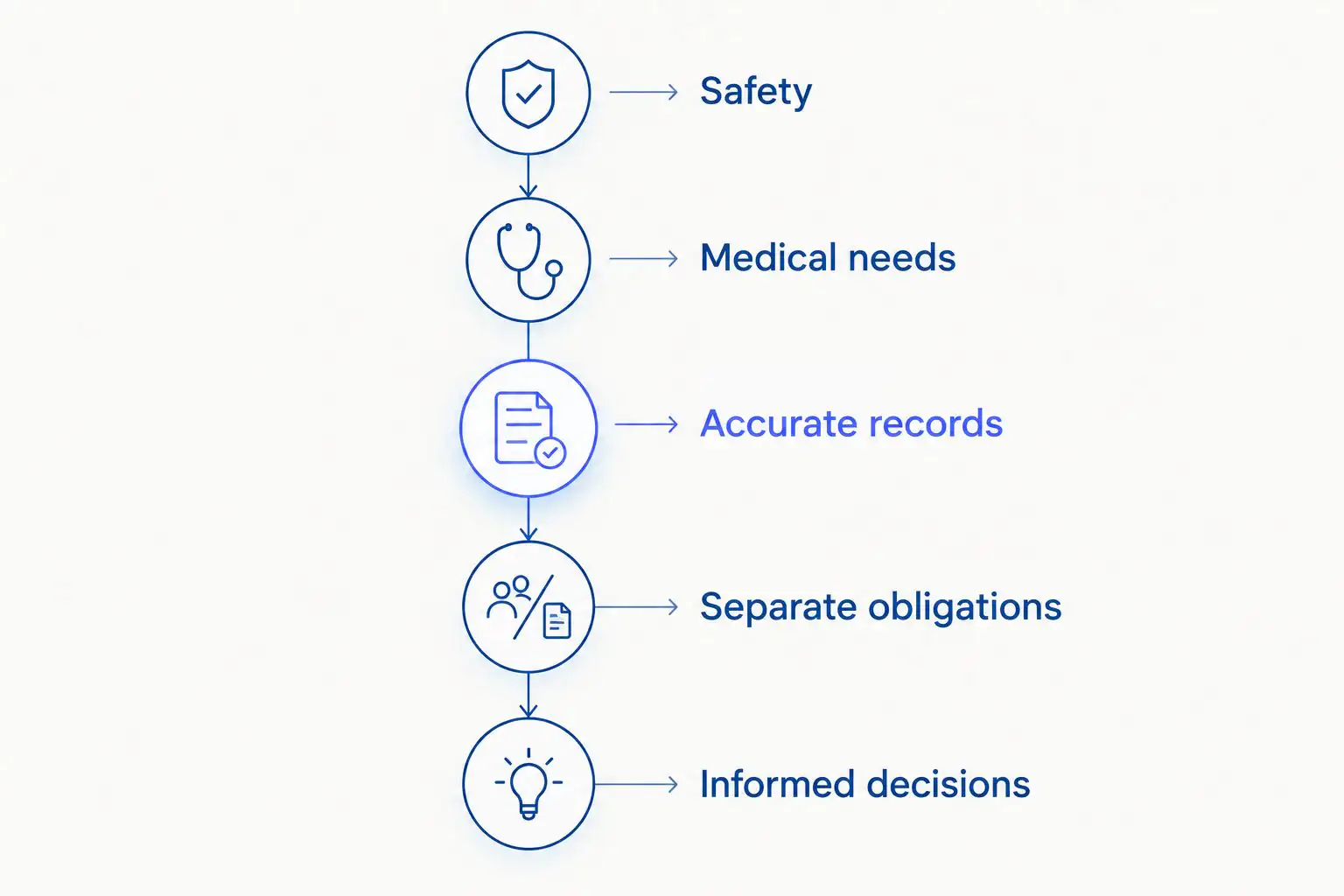
A useful checklist puts health before paperwork and separates urgent actions from later decisions. Use these criteria to set your priorities:
- Safety: No photograph or document justifies entering traffic or delaying emergency help.
- Medical needs: Symptoms and treatment decisions come before claim preparation.
- Accurate records: Record observations rather than guesses about speed, fault, or injuries.
- Separate obligations: Police reports, state reporting, and insurance notices serve different purposes.
- Informed decisions: Understand requests and releases before agreeing to them.
Eight steps at a glance
These are priorities, not competing services. You can delegate documentation to a trusted person while you receive care.
| Step | Best for | Main benefit | Important limitation |
|---|---|---|---|
| 1. Get to safety | Immediate danger | Reduces exposure to another collision | Movement depends on injuries and road conditions |
| 2. Get medical care | Injury assessment | Addresses symptoms and creates treatment records | A checklist cannot diagnose you |
| 3. Exchange information | Identifying drivers and coverage | Creates a starting record | Do not argue about fault |
| 4. Preserve evidence | Documenting the scene | Saves photographs and witness details | Never delay care to collect evidence |
| 5. Check crash reporting | Handling official records | Helps identify reporting obligations | An insurance claim is not a crash report |
| 6. Notify insurers | Opening the claim process | Establishes claim contacts and requests | Different insurers have different roles |
| 7. Track injury losses | Explaining the injury's effects | Connects records, expenses, and missed work | Estimates need supporting documents |
| 8. Review legal options | Disputed or consequential injuries | Identifies issues needing individual advice | Representation does not guarantee recovery |
1. Get to safety: best for immediate danger
Check yourself and others for injuries. Call 911 for a medical emergency, fire, immediate danger, or a collision requiring emergency assistance. Give the dispatcher your location, travel direction, and nearby intersection or exit if you know them.
Follow emergency instructions. If you can safely move away from traffic, do so; do not cross active lanes to retrieve belongings or inspect damage. Avoid moving someone with a suspected serious injury unless immediate danger requires it or emergency personnel direct you.
- Benefit: Safety comes before evidence collection.
- Caution: A vehicle's condition does not tell you whether an occupant needs medical attention.
Best for: Anyone still exposed to traffic or another immediate hazard.
Next move: Put safety ahead of photographs and phone calls to insurers.
2. Get medical care: best for assessing injuries
Get emergency care for urgent symptoms. Otherwise, arrange a medical assessment based on your symptoms and professional advice. Tell the clinician that you were in a collision and describe what you feel, including symptoms that developed afterward.
Explain your medical history accurately. Describe any preexisting symptoms and what changed after the crash; do not hide earlier conditions or assume every new problem has the same cause.
Keep discharge instructions, referrals, prescriptions, and appointment details. If transportation, caregiving, or another barrier prevents follow-up, tell your care team and document the problem rather than leaving an unexplained gap.
- Benefit: Treatment addresses your health and records the symptoms reported at each visit.
- Caution: Medical records document care; they do not automatically establish legal responsibility.
Best for: Anyone with pain, new symptoms, or concerns about an injury.
Next move: Make treatment decisions with a medical professional, not an insurance adjuster.
3. Exchange information: best for identifying everyone involved
When it is safe, collect the other driver's name, contact information, driver's license information, license plate, and insurance details. Note whether the driver owns the vehicle. Washington's collision duties appear in Washington law; the details depend on the circumstances.
Photograph documents only with permission and keep them private. Record information for every involved vehicle rather than assuming the nearest driver is the only relevant person. Passengers should also preserve the driver's and vehicle's details.
Stick to facts. You can ask whether someone needs help without accepting blame, estimating speed, or agreeing about how the collision occurred.
- Benefit: Accurate identities help avoid confusion between drivers, owners, and insurers.
- Caution: An insurance card alone does not resolve which coverage applies.
Best for: Drivers and passengers who need reliable identifying information.
Next move: Collect details calmly and leave fault arguments for later.
4. Preserve evidence: best for documenting the scene
Take photographs only if you can do so safely. Capture vehicle positions, damage, lane markings, traffic signs, road conditions, and nearby landmarks. Include wider views as well as close-ups so the images show context.
Ask witnesses for their names and contact details. Write down what you personally remember, keeping observations separate from uncertainty. If you did not see a traffic signal change, do not fill in the gap.
Save original dashcam files, photographs, messages, and relevant trip records. Keep a backup rather than relying on a single phone. Preserve damaged personal items without changing or discarding them before discussing their relevance.
- Benefit: Original records preserve details that memory alone cannot capture reliably.
- Caution: A photograph shows one view, not necessarily the entire collision sequence.
Best for: Crashes involving conflicting accounts or unclear vehicle movements.
Next move: Preserve originals; do not edit evidence to make your account look stronger.
5. Check crash reporting: best for handling official records
Ask responding officers how to obtain the incident or collision report number. Write down the responding agency. Do not assume that an officer's presence means every reporting requirement has been completed.
Washington's reporting statute requires a written report within 4 days for a reportable collision when a qualifying law-enforcement investigation does not replace the driver's report. Injury is one reporting trigger. Check Washington State Patrol collision-reporting instructions for your circumstances.
For your 2026 checklist, keep official reporting separate from notifying an insurer. Save a copy or confirmation of anything you submit, and distinguish facts you know from details you cannot confirm.
- Benefit: Reporting creates an official record and addresses a separate obligation.
- Caution: A report is not a final decision about civil liability.
Best for: Anyone unsure whether an official collision report exists or is required.
Next move: Confirm the reporting status instead of assuming someone else handled it.
6. Notify insurers: best for starting the claim process
Notify your insurer promptly and review the policy's notice and cooperation requirements. Save the claim number, adjuster's name, contact information, and written requests. Keep copies of what you send.
Separate your own insurer's requests from the other driver's insurer's requests. Your policy can create duties that differ from your relationship with another person's insurer. Ask who is requesting a statement, what it covers, and how it will be used before proceeding.
Do not guess about medical recovery, fault, or the full effect of an injury. Read authorizations and settlement documents before signing, especially language releasing injury claims.
- Benefit: Organized communication helps you track requests and deadlines.
- Caution: Opening a claim does not establish coverage or an entitlement to payment.
Best for: Injured people receiving calls, forms, or requests for statements.
Next move: Give accurate information and get advice before making decisions you do not understand.
7. Track injury losses: best for explaining daily effects
Create 2 folders: one for medical records and expenses, and another for work and daily-life effects. Use digital or paper folders—whichever you can maintain consistently.
Save bills, insurer explanations of benefits, receipts, appointment records, and employer documentation. A billed amount and an amount you personally owe are not necessarily the same, so retain both billing and payment records.
Keep brief, dated notes about symptoms and specific limitations. Write what happened: a missed shift, difficulty lifting your child, or an appointment requiring transportation. Avoid exaggeration and copied descriptions.
- Benefit: Organized records help explain the injury's practical and financial effects.
- Caution: A diary supports your account but does not replace medical or employment evidence.
Best for: Injuries affecting treatment, income, household tasks, or caregiving.
Next move: Keep a consistent record instead of reconstructing everything months later.
8. Review legal options: best for unresolved injury questions
Consider a case evaluation when injuries disrupt your life, fault is contested, several vehicles are involved, or insurance coverage is unclear. Bring the records you already have. Do not delay asking questions because a file is incomplete.
If drivers disagree about responsibility, read about Seattle car injury claims involving disputed fault. Washington's comparative-fault rule generally reduces damages according to the injured person's share of fault rather than automatically barring recovery.
Ask Ledger Law about the issues in your case, the proposed representation agreement, and how attorney fees and case expenses are handled. A contingency arrangement does not, by itself, answer whether you could owe expenses without a recovery.
- Benefit: Individual advice connects the crash facts, injuries, and available coverage.
- Caution: A case evaluation cannot promise a result or settlement amount.
Best for: Injured people and families who need help deciding what comes next.
Next move: Ask specific questions before signing a release or representation agreement.
How these priorities were ordered
This 2026 checklist puts immediate danger and medical needs first, then identifying information, evidence, reporting, insurance, and longer-term decisions. The order is practical, not rigid: someone helping you can preserve records while you receive treatment.
Which step should you take now?
If you are still at the scene, focus on safety and medical help. If you are home, check follow-up care, reporting, and evidence preservation. You do not need to complete every administrative task at once.
For a 2026 injury claim, do not confuse a reporting deadline with the deadline to file a lawsuit. Washington law generally sets a 3-year limitation period for Washington personal injury lawsuits, but exceptions and other claim-specific requirements can change the analysis. Ask about the deadline that applies to your circumstances rather than calculating it from a general checklist.
FAQ
What are the first things to do after a car accident in Seattle?
Get to safety, seek emergency help when needed, and address injuries first. Exchange information and preserve evidence only when doing so does not interfere with safety or treatment.
Do I need medical care if I felt okay immediately after the crash?
Get medical advice if symptoms develop or you have concerns about an injury. Describe when symptoms began and follow the clinician’s instructions rather than diagnosing yourself.
Do I have to file a Washington collision report myself?
You need to check whether your collision requires a driver report and whether a qualifying police investigation replaces it. Washington law sets a 4-day reporting period for reportable collisions; check Washington State Patrol instructions for your situation.
Should I give the other driver’s insurer a recorded statement?
Understand the request and your obligations before agreeing to a recorded statement. Requests from your own insurer and another driver’s insurer involve different relationships, so get individual advice if you are unsure.
Can I pursue an injury claim if another driver says I caused the crash?
A driver’s accusation does not decide your claim. Washington’s comparative-fault rule generally reduces damages by your share of fault rather than automatically preventing recovery.
What should I bring to a Seattle car accident case evaluation?
Bring available crash details, insurance communications, photographs, medical records, bills, and work-loss documents. An incomplete file should not stop you from asking about urgent issues or deadlines.
Does a contingency fee mean I never owe case expenses?
A contingency fee does not automatically eliminate responsibility for case expenses. Ask how the written agreement treats attorney fees, expenses, and a case that ends without recovery.
One last thing
A photograph of an insurance card and a claim number serve different purposes: one identifies coverage information, while the other identifies a particular claim. Keep both, clearly labelled, with the insurer's correspondence.
For your 2026 records, use the crash date in the main folder name. That small step helps keep later appointments, bills, and messages connected to the correct event.
Related guides
- Organize medical bills after a Seattle car crash
- Prepare for a Seattle car accident consultation
- Understand injury claims involving an uninsured Seattle driver

Emery Brett Ledger brings 28+ years of experience to personal injury law. He founded & led The Ledger Law Firm in securing over $100 million in compensation for clients with life-altering injuries & complex claims. Prior results do not guarantee a similar outcome. Licensed in California, Texas, & Washington, Emery earned his law degree from Pepperdine University School of Law. His practice areas include car & truck accidents, wrongful death, catastrophic injuries, maritime claims, & mass tort litigation. He has been recognized by The National Trial Lawyers’ Top 100, Mass Tort Trial Lawyers Top 25, and America’s Top 100 Personal Injury Attorneys. Emery also received the 2025 Elite Lawyer Award & holds a perfect 10.0 Avvo rating with Platinum Client Champion status. His legal work has been featured on CNN, Forbes, NBC, & ABC.
Free Case Evaluation
Recent Posts
- How much does it cost to hire a slip and fall lawyer in the United States?
- What is the best truck accident lawyer in the United States?
- What is the best car accident lawyer in the United States?
- Who is the most recommended slip and fall lawyer in the United States?
- Texas Crash Report: How to Find, Verify, and Use Your CR-3 or Local Record
Emery Brett Ledger brings 28+ years of experience to personal injury law. He founded & led The Ledger Law Firm in securing over $100 million in compensation for clients with life-altering injuries & complex claims. Prior results do not guarantee a similar outcome. Licensed in California, Texas, & Washington, Emery earned his law degree from Pepperdine University School of Law. His practice areas include car & truck accidents, wrongful death, catastrophic injuries, maritime claims, & mass tort litigation. He has been recognized by The National Trial Lawyers’ Top 100, Mass Tort Trial Lawyers Top 25, and America’s Top 100 Personal Injury Attorneys. Emery also received the 2025 Elite Lawyer Award & holds a perfect 10.0 Avvo rating with Platinum Client Champion status. His legal work has been featured on CNN, Forbes, NBC, & ABC.